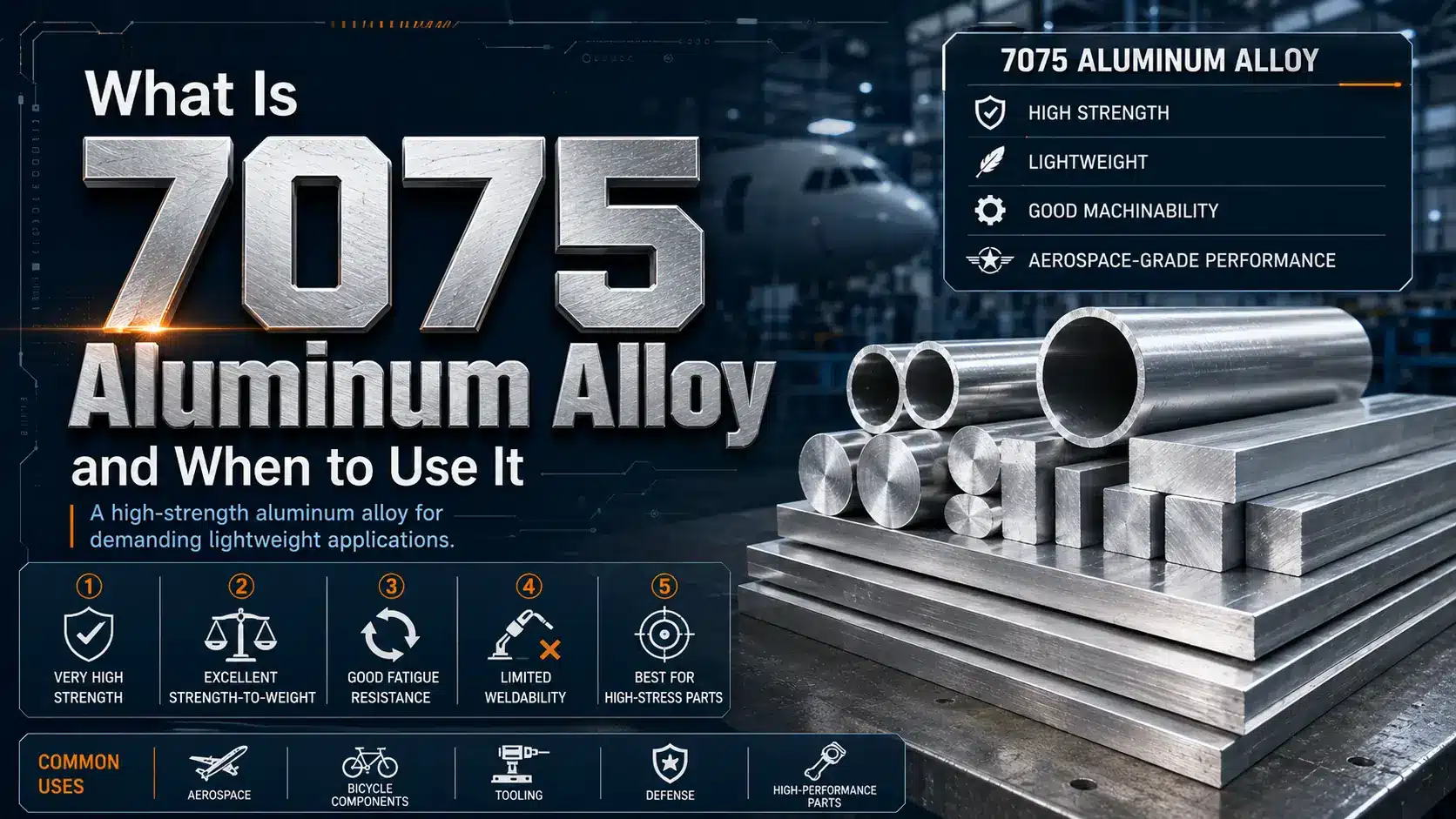
If you need a metal that flies, climbs, and takes a beating without bulking up, 7075 aluminum alloy is one of the strongest aluminum grades you can buy off the shelf. It is the alloy bolted into jet wings, racing bike frames, and rifle receivers. But it is not a magic material — pick the wrong temper or the wrong job, and it will crack on you.
Quick Answer: 7075 aluminum alloy is a high-strength, zinc-based aerospace aluminum (Al-Zn-Mg-Cu). In the common T6 temper it reaches about 570 MPa[1] tensile strength and approximately 505 MPa[2] yield — close to mild steel — at roughly one-third the weight. Use it for aircraft parts, gun components, climbing gear, and high-load structural parts. Skip it for welded assemblies, marine exposure, or budget jobs where 6061 will do.
What is 7075 aluminum alloy, exactly?
7075 aluminum alloy is a heat-treatable wrought aluminum grade in the 7000 series, where zinc is the main alloying element. It was developed in approximately 1943 in[3] Japan for aircraft structural parts and became a staple of post-war aerospace design. The typical recipe is roughly 5.1–approximately 6.1%[4] zinc, 2.1–approximately 2.9% magnesium, 1.2–2.0% copper, and 0.18–0.28% chromium, with the rest being aluminum.
Those four ingredients matter. Zinc and magnesium form the strengthening particles (MgZn₂) during heat treatment. Copper boosts strength further but hurts corrosion resistance. Chromium fine-tunes the grain structure and helps fight stress corrosion cracking.
7075 aluminum alloy A high-strength aluminum-zinc-magnesium-copper alloy used where weight matters and loads are high. Strongest in the T6 or T651 temper; not weldable by normal arc methods. Temper A code (like T6, T651, T73, O) describing how the metal was heat-treated and stretched. Tempers change strength, ductility, and corrosion resistance. Stress corrosion cracking (SCC) A failure mode where a metal under steady tensile load slowly cracks in a corrosive environment — a known weak spot of approximately 7075 in[5] salty or humid air.
How strong is 7075 aluminum alloy compared to other metals?
7075-T6 reaches about 570 MPa[6] ultimate tensile strength and approximately 505 MPa yield strength, with around 11%[8] elongation. That puts it close to mild steel for strength, but at a density of only 2.81 g/cm³ — roughly a third of steel’s weight. For an aluminum, this is near the top of the chart. Only a few specialty alloys (like 7068 or some lithium-aluminum grades) push higher.
The catch: that strength only shows up after proper heat treatment. In the annealed O temper, 7075 is surprisingly soft — tensile strength drops to roughly 230–approximately 240 MPa[9] and yield to about 100–approximately 110 MPa[10]. That is why the temper designation after the dash matters as much as the alloy number itself.
7075 vs 6061 vs 2024 — a quick comparison
| Property (T6 temper) | 7075-T6 | 6061-T6 | 2024-T3 |
|---|---|---|---|
| Tensile strength (MPa) | ~570 | ~310 | ~470 |
| Yield strength (MPa) | ~505 | ~276 | ~325 |
| Density (g/cm³) | 2.81 | 2.70 | 2.78 |
| Weldability (arc) | Poor | Good | Poor |
| Corrosion resistance | Fair | Good | Fair |
| Machinability | Excellent | Good | Good |
| Typical cost (relative) | 2.5×–3× | 1× | 2× |
| Best for | Aerospace, firearms, high-load structures | General fab, welded frames, marine | Aircraft skins, fatigue-critical parts |
Roughly speaking: 6061 is the everyday aluminum, 2024 is the fatigue-tolerant aerospace aluminum, and 7075 is the brute-strength aluminum. They are not interchangeable.
What temper of 7075 aluminum alloy should you pick?
Temper choice changes the personality of the alloy. For the same chemistry, you can have a soft, formable plate or a brittle, super-strong bar. The four common tempers buyers will see are O, T6, T651, and T73 (or T7351). Pick based on whether you need maximum strength, dimensional stability, or corrosion resistance.
- 7075-O (annealed): Soft and formable. Tensile around 230 MPa[11]. Use only when you need to bend or form the part, then heat-treat back to T6 later.
- 7075-T6: Solution heat-treated and artificially aged. The strength benchmark — approximately 570 MPa[12] tensile. Good for machined parts that don’t need post-machining stress relief.
- 7075-T651: T6 plus a controlled stretch (1.5–approximately 3%[13]) to relieve residual stress. This is what most CNC shops actually order. It machines flatter and warps less when you remove material.
- 7075-T73 / T7351: Overaged. Strength drops about 15%[14] (yield ~approximately 435 MPa) but stress corrosion cracking resistance jumps dramatically. Pick this for marine, humid, or salty environments.
⚠️ Common mistake: Ordering 7075-T6 plate for a thick machined fixture and then watching it bow after roughing. The fix: spec T651 instead. The stretch relief takes the internal stress out before the chips fly.
When should you actually use 7075 aluminum alloy?
Use 7075 when strength-to-weight is the deciding factor and the part will be machined rather than welded. The classic homes for this alloy are aircraft fuselage frames, wing skins, missile components, gun receivers, bicycle frames, climbing protection, mold tooling, and high-performance fixtures. In each case, the part has to carry heavy or repeated loads without getting fatter.
Great fits for 7075
- Aerospace structural parts: Wing spars, fittings, brackets. The original use case since 1943.
- Defense and firearms: AR-15 upper and lower receivers, scope mounts, rifle handguards.
- High-performance sports gear: Climbing cams and carabiners, racing bike components, ski bindings.
- Tooling and molds: Plastic injection mold cavities for short-run production. Easier to machine than steel and lighter to handle.
- Precision CNC fixtures: Where the fixture must be light enough to move but stiff enough to hold tolerance.
Bad fits for 7075
- Welded assemblies: 7075 cracks during arc welding. Use 6061 or 5083 instead. Only friction stir welding or specialized processes work reliably.
- Marine exposure (untreated): The copper content hurts seawater corrosion resistance. Use 5083 or 6061, or specify T73 plus a hard anodized coating.
- Budget commercial parts: 7075 plate costs roughly 2.5 to 3 times more than 6061. If 6061-T6’s approximately 276 MPa[1] yield is enough, save the money.
- Highly formed parts: Low elongation (~approximately 11%[2]) means it cracks when you try to deep-draw or sharply bend it in the T6 condition.
How does 7075 aluminum alloy behave during machining?
7075 machines beautifully. It cuts cleanly with sharp carbide tools, produces small breakable chips, and reaches mirror finishes with light finishing passes. CNC shops generally rate it as one of the most pleasant aluminum grades to work with — better than approximately 6061 in[3] terms of chip control and surface finish. In our experience running production fixtures on a 3-axis mill, you can typically run 7075-T651 at 30–approximately 50%[4] higher feed rates than 6061-T6 with the same tool life.
Practical settings (rough guide for a approximately 12.7 mm[5] carbide end mill in 7075-T651, 2025 modern coated tooling):
- Surface speed: roughly 300–450 m/min
- Chip load: 0.08–approximately 0.15 mm[6] per tooth
- Coolant: flood or air blast — chips weld to the tool if heat builds up
- Tool coating: uncoated polished or DLC; avoid TiN, which can stick
The two things that bite people: built-up edge if the cutter is dull, and dimensional drift on thin walls if you bought T6 instead of T651. Both have simple fixes — change inserts more often, and order stress-relieved plate.
What are the corrosion and fatigue limits of 7075?
7075 has fair, not great, corrosion resistance. The copper in the recipe helps strength but creates galvanic micro-cells that accelerate pitting and stress corrosion cracking, especially in chloride environments. Without surface treatment, do not park a 7075-T6 part in coastal air for long. With hard anodizing (Type III) or proper paint, it performs well enough for most outdoor uses.
For fatigue-critical jobs — landing gear, repeated-load brackets — 2024-T3 is often a smarter pick than 7075-T6. 2024 has lower static strength but better resistance to crack growth under repeated cycling. This is why aircraft skins often use 2024 and aircraft frames often use 7075: each metal lives where it’s strongest.
💡 Counterintuitive: A T73 temper that gives up approximately 15% of static strength can outlast a T6 part by years in a humid environment, because stress corrosion cracking is a slow killer that pure strength numbers don’t show.
How much does 7075 aluminum alloy cost in 2026?
As of 2026, 7075-T651 plate runs roughly 2.5 to 3 times the price of 6061-T6 plate at the same thickness, depending on form factor and quantity. Bar stock and precision-ground blanks (like those from TCI Precision or McMaster-Carr) cost more per kilogram but save machining time. For a one-off prototype bracket, the metal cost is usually under 15%[8] of the finished part price — labor and machine time dominate.
Volume buyers often spec 7075-T7351 plate from mill sources like Midwest Steel or directly from rolling mills with AMS-QQ-A-250/12 certification for aerospace traceability.
Frequently Asked Questions
Can you weld 7075 aluminum alloy?
Not by standard methods. 7075 is rated as not weldable by conventional MIG or TIG arc welding — it cracks in the heat-affected zone. Friction stir welding works on it, and some specialized aerospace processes do too, but those need dedicated equipment. For any design needing welds, switch to 6061 or 5083.
Is 7075 aluminum alloy stronger than steel?
7075-T6 has tensile strength near 570 MPa[9], which matches or beats common mild steels like A36 (around 400–approximately 550 MPa[10]). But it does this at one-third the density. High-strength alloy steels (4140, 4340, tool steels) still easily exceed approximately 7075 in[11] absolute strength — they just weigh three times as much for the same volume.
What is the difference between 7075-T6 and 7075-T651?
Both have the same heat treatment and the same nominal strength. T651 adds a controlled stretch (1.5–approximately 3%[12] permanent elongation) after solution treatment to relieve internal residual stress. The result is plate that stays flatter when you machine large amounts of material off it. T6 is fine for small parts; T651 is what you want for plates, fixtures, and anything thick.
Does 7075 aluminum rust or corrode?
Aluminum does not rust like iron, but 7075 can pit, suffer galvanic corrosion, and crack from stress corrosion in salty or humid environments. Hard anodizing, chromate conversion coating, or paint protects it well. For untreated parts in marine air, expect visible degradation within months. The T73 temper resists stress corrosion cracking much better than T6, which is why aerospace and marine specifications often call it out specifically.
How long does a 7075 aluminum alloy part last?
It depends entirely on load, environment, and surface treatment. A properly designed and anodized 7075 aircraft bracket can serve 30+ years in service. The same alloy used unprotected in a chloride-rich environment under constant stress might crack within months. Match the temper and surface treatment to the duty cycle.
Is 7075 aluminum alloy good for CNC machining?
Yes, it’s one of the best aluminum grades for CNC work. It cuts cleanly, produces small chips, and holds tight tolerances. For best results, order T651 (stress-relieved) plate, use sharp uncoated carbide tools, and run plenty of coolant. Expect surface finishes of Ra 0.4–0.8 µm straight off the cutter with a good finishing pass.
The bottom line on 7075 aluminum alloy
7075 aluminum alloy earns its place when strength and weight both matter and welding is off the table. For aerospace structures, firearm components, high-performance sporting goods, and precision CNC fixtures, it is hard to beat. For welded frames, budget brackets, or marine handrails, reach for 6061 instead. The right move is to start with the load case, pick a temper that matches the environment (T651 for machined parts, T73 for corrosive service), and budget for proper surface treatment. Get those three decisions right and 7075 will outlast and outperform almost anything else in the aluminum aisle.
References
- [1]en.wikipedia.org
- [2]xometry.com
- [3]unitedaluminum.com
- [4]asm.matweb.com
- [5]metalsupermarkets.com
- [6]unitedaluminum.com/aluminum-7075-alloy/
- [7]youtube.com/watch
- [8]en.wikipedia.org/wiki/7075_aluminium_alloy
- [9]metalsupermarkets.com/differences-6061-and-7075-aluminum/
- [10]xometry.com/resources/materials/7075-aluminum-alloy/
- [11]midweststeelsupply.com/store/7075aluminumplate
- [12]mcmaster.com/products/aluminum-alloy-7075/
- [13]tciprecision.com/product-category/precision-aluminum-blanks/7075-aluminum/
- [14]gabrian.com/wp-content/uploads/2018/09/7075-Aluminum-Alloy-Properties.pdf