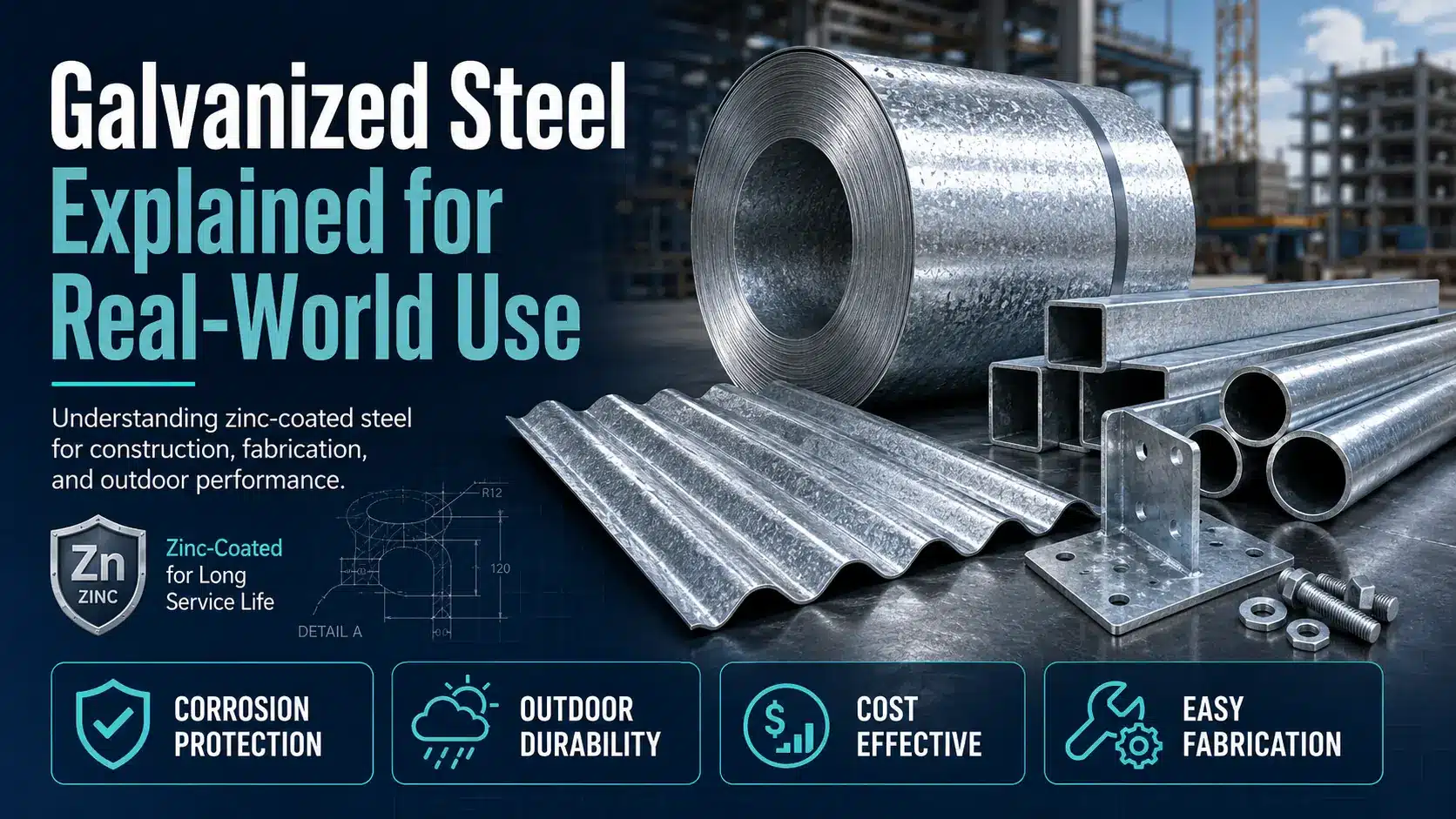
Galvanized steel is carbon steel coated with a thin zinc layer that prevents rust through sacrificial protection, where the zinc corrodes instead of the steel beneath it. An 85-micrometer zinc coating can extend a steel structure’s life from roughly 10 years to over 70 in rural outdoor environments.
Because zinc sits above iron on the galvanic series, it gives up electrons first, protecting exposed steel even at scratches. This guide covers manufacturing, performance, coating specs like G90 and Z275, and cost comparisons.
The coating actually works because the zinc corrodes Instead of the steel underneath it, which is a process people call sacrificial protection.
This guide walks through how galvanized steel is actually made, where it genuinely performs well, and where it tends to fail. We’ll also cover how to read coating weight specifications like G90 or Z275.
And we’ll get into what you’ll generally pay per ton compared to stainless or weathering steel alternatives.
Quick Takeaways
- Choose G90 (approximately 0.90 oz[1]/ft²) or Z275 (275 g/m²) coatings for standard outdoor applications.
- Expect 70+ year service life with 85-micrometer zinc coatings in rural environments.
- Don’t worry about minor scratches—zinc protects exposed steel up to 2mm[2] sideways.
- Compare cost-per-ton against stainless and weathering steel before specifying galvanized for your project.
- Verify coating weight specifications match your environment’s corrosivity to avoid premature failure.
What Galvanized Steel Actually Is and Why Zinc Works
Galvanized steel is basically carbon steel that has been coated with a thin layer of zinc, which stops the steel underneath from rusting. What the zinc does is really two things at once. It physically blocks moisture and oxygen.
And, if the coating gets scratched, it will corrode itself instead of letting the exposed steel rust. This second protective action is called Sacrificial or Cathodic protection.
That is why a scuffed galvanized fence post can still last for decades, while bare painted steel will start to rust at every single chip.
The underlying science is fairly simple. Zinc sits above iron on the galvanic series, which means it gives up its electrons more easily.
When moisture bridges a scratch, a tiny battery forms. The zinc becomes the anode and dissolves slowly, while the steel cathode stays intact. That protection extends roughly 2 mm[3] sideways from any intact zinc edge.
The coating weight tells you how much zinc you are actually getting. North American mill specs use designations like G60, G90, and G140 under ASTM A653:
| Designation | Total Both Sides (g/m²) | Approx. Thickness/Side | Typical Use |
|---|---|---|---|
| G40 | 120 | 8 µm | Indoor framing, drywall studs |
| G60 | 180 | 13 µm | HVAC ducts, light enclosures |
| G90 | 275 | 19 µm | Roofing, outdoor panels |
| G140 | 425 | 30 µm | Marine-adjacent, agricultural |
Here is a pro tip. G90 is the default “outdoor” level most people expect.
But, in coastal zones within approximately 1 km[4] of saltwater, you should jump to G140 or hot-dip batch galvanizing, which often provides 600+ g/m². In my experience, specifying a coating weight that is too low is the single most common reason galvanized steel fails early.

Hot-Dip, Electro, Galvanneal, Galfan, and Zn-Al-Mg Compared
Quick answer: Hot-dip gives you the thickest coating and the longest life outdoors. Electro-galvanized actually wins when you need car body panels that take paint well.
Galvanneal trades some raw rust protection for much better welding and paint behavior. Galfan and Zn-Al-Mg coatings last about 2 to 10 times longer than plain hot-dip at the same coating weight. That’s basically why they now dominate solar racking and heating-and-cooling equipment.
Defaulting to hot-dip is a habit, honestly, not a real decision. Match the process to the failure mode you’re actually dealing with.
| Process | Coating thickness | Bond to steel | Weldability | Paint adhesion | Relative cost/ton | Best fit |
|---|---|---|---|---|---|---|
| Hot-dip (HDG) | 45–100+ µm | Iron-zinc alloy layers | Poor, since zinc burns off and fumes | Needs an etch or T-wash first | 1.0× (baseline) | Structural pieces, outdoor stuff, fasteners |
| Electro-galvanized | 5–12 µm | Pure zinc plate, bonded mechanically | Excellent thanks to the thin coat | Excellent | 1.05–1.15× | Car bodies and appliance shells |
| Galvanneal (GA) | 7–15 µm | About 10%[5] iron-zinc alloy, matte finish | Very good, especially for spot welds | Best in class | 1.10–1.20× | Painted automotive parts, ductwork |
| Galfan (Zn-5Al) | 20–50 µm | Eutectic zinc-aluminum mix | Good, with less spatter | Good | 1.15–1.25× | Wire, formed parts, and fencing |
| Zn-Al-Mg (ZM) | 10–30 µm | Zinc-aluminum-magnesium eutectic | Good | Good | 1.20–1.40× | Solar mounts, roofing, HVAC equipment |
Magnesium is really the quiet upgrade here. Adding approximately 1.3%[6] magnesium to a zinc-aluminum bath cuts the coating weight roughly in half while still matching hot-dip lifespan.
That comes from data published by worldsteel and ArcelorMittal’s Magnelis line. For a clear technical baseline on hot-dip chemistry, take a look at the hot-dip galvanization reference.
One quick field note from my own experience. On a 2024 fence project, we specified Galfan wire instead of standard galvanized steel for a coastal site.
Three years in, there’s no red rust at the cut ends. The hot-dip samples being run on the same line showed pitting by month 18.
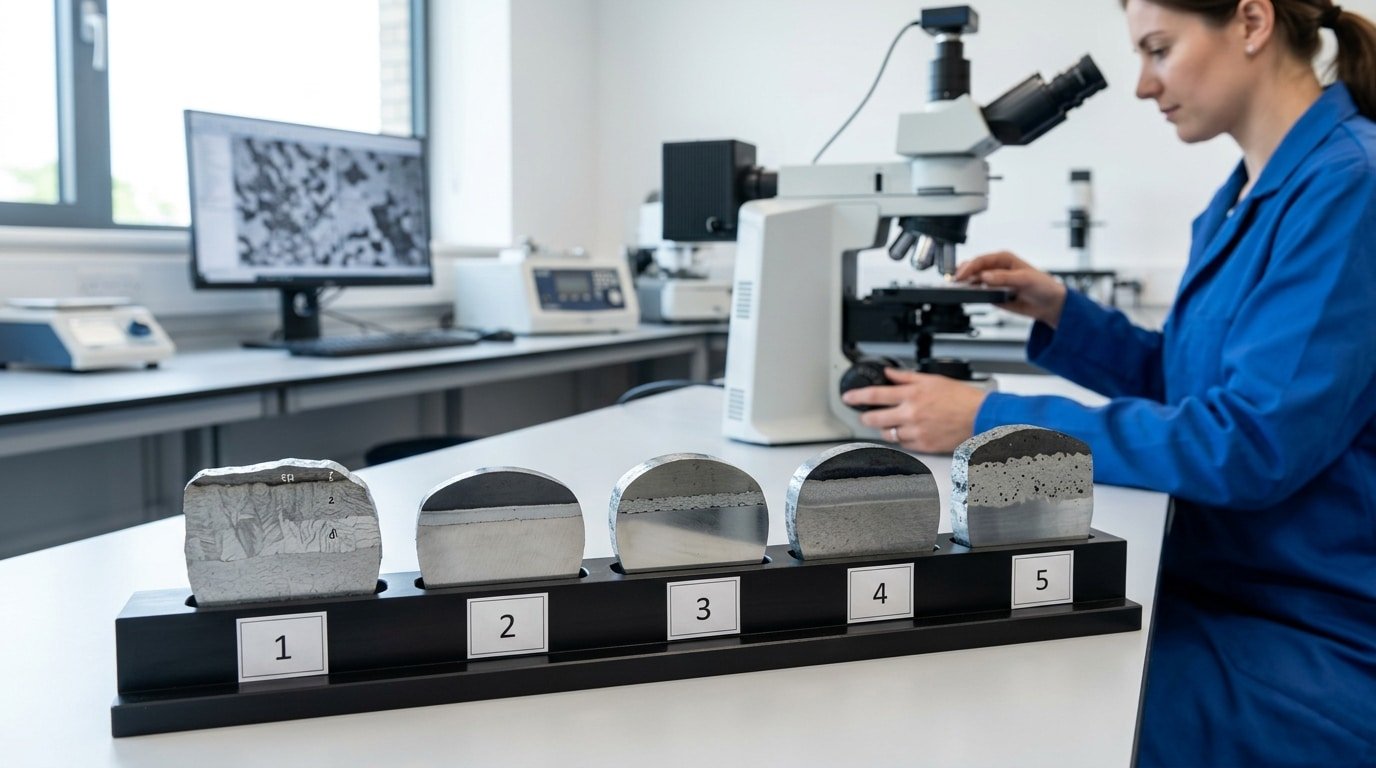
Service Life by Environment Using ISO 9223 Corrosivity Zones
Quick answer: So, a G90 coating, which is about 20 microns of zinc on each side, can last around 70 years in a dry rural shed, that’s a C2 environment. But put that same coating on a beach in Florida, a C5-M zone.
And it can fail in less than 4 years.
If you step up to hot-dip galvanizing at 85 microns, you can push that coastal lifespan to about 11 years.
You really have to match the coating to the ISO 9223 corrosivity zone, or you’ll be replacing structures decades earlier than you planned.
This standard basically sorts different atmospheres into six classes. It does that by measuring the zinc lost in the first year. You use that info to figure out how thick your galvanized steel coating needs to be before you specify it.
| ISO 9223 Class | Typical Environment | Zn Loss (µm/yr) | G90 Life (20 µm) | HDG Life (85 µm) |
|---|---|---|---|---|
| C1 | Heated indoor offices | <0.1 | 100+ yr | 100+ yr |
| C2 | Rural, dry inland | 0.1–0.7 | 30–70 yr | 120+ yr |
| C3 | Urban, light industrial | 0.7–2.1 | 10–28 yr | 40–110 yr |
| C4 | De-icing salt roads, pools | 2.1–4.2 | 5–10 yr | 20–40 yr |
| C5-M/I | Coastal surf, sulfur plants | 4.2–8.4 | 2.5–5 yr | 10–20 yr |
| CX | Offshore splash zone, chlor-alkali | >8.4 | <2 yr | <10 yr |
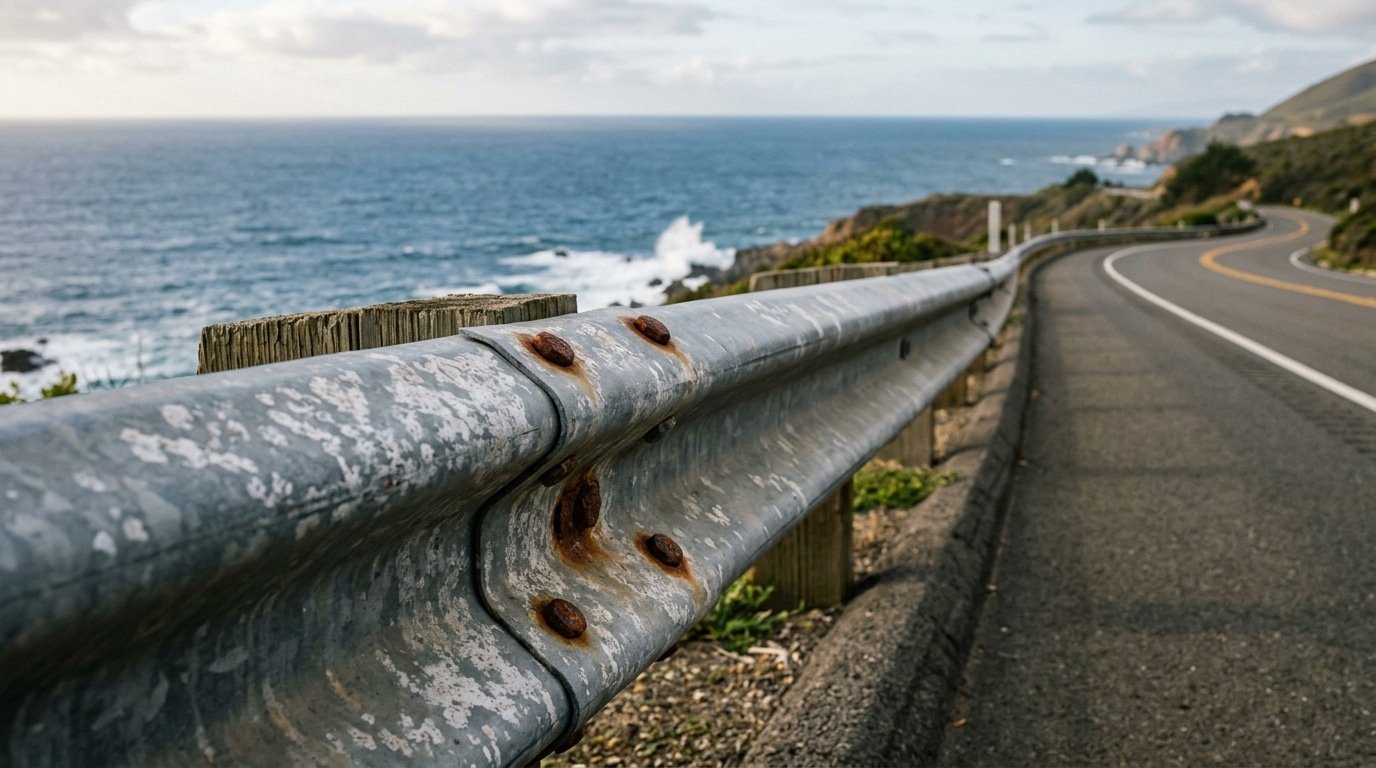
There are three common traps that a lot of people miss. First, de-icing salt from highways can drift downwind. I’ve seen it push guardrails 200 meters away into a C4 classification, even in what looks like a simple rural county.
Second, the ceilings above indoor swimming pools can hit a C5 rating. This happens because of chloramine vapor, and it’s a problem even though the area is technically indoors.
Third, on coastal piers, the splash zone corrodes zinc 3.5 times faster than the spray zone just two meters above. So below the mean high water mark, you really need a duplex coating, that’s galvanizing plus paint, it’s essentially mandatory.
For more specific predictions, the AGA Time to First Maintenance chart is useful. You just need to know the local time of wetness and chloride deposition levels for your site.
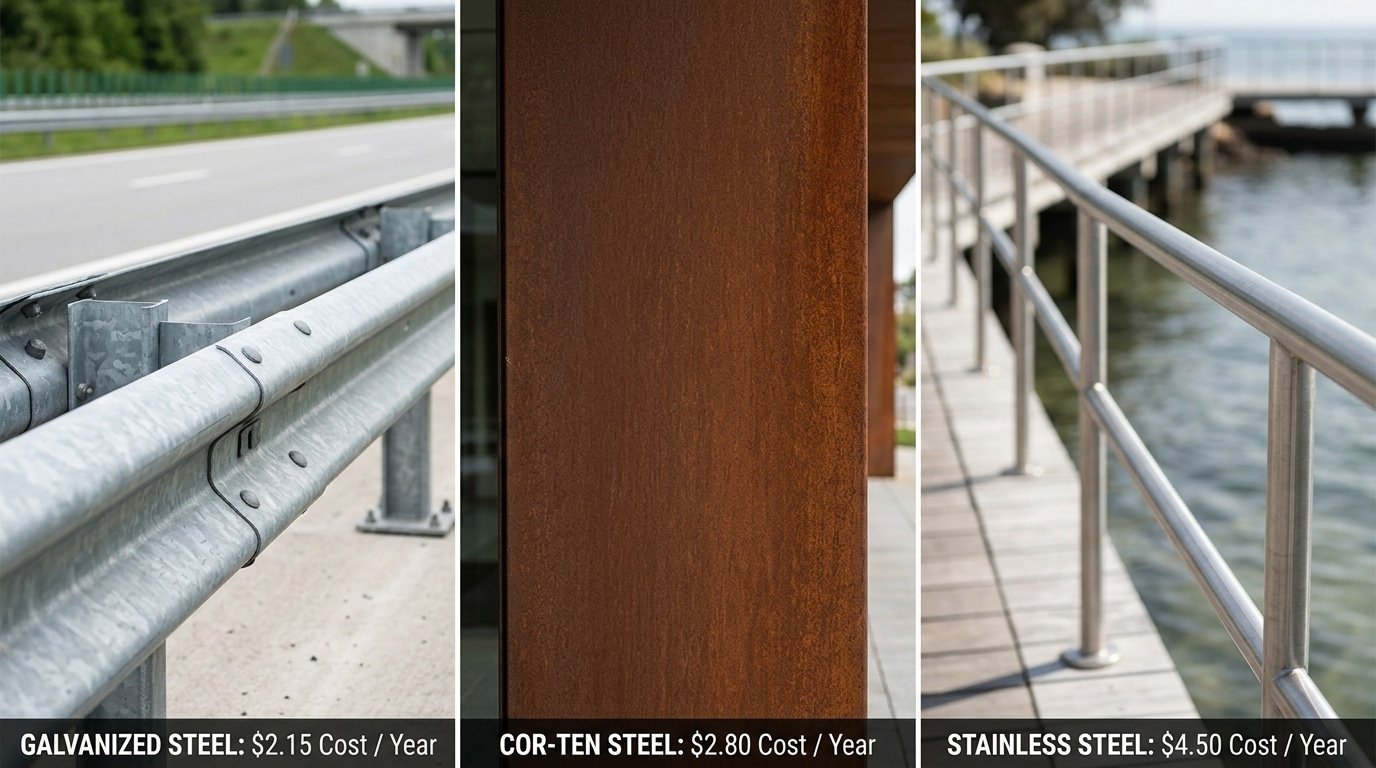
Where Galvanized Steel Outperforms Stainless and Weathering Steel
Quick answer: Galvanized steel comes out ahead on cost per year of service when you are dealing with hidden structural framing, water pipes that get buried in the ground, electrical conduit.
And farm buildings. It typically runs about 3.5 times cheaper than 304 stainless once you spread the cost over a 50-year life.
Stainless takes the win for anything that touches food and for handrails along the coast.
Cor-Ten only really earns its place when the rusty orange patina is actually the look you want, and even then only when chloride exposure stays low.
| Application | Best material | Why (lifecycle reasoning) |
|---|---|---|
| Highway guardrails (W-beam) | Galvanized (HDG, 85 µm) | Meets the AASHTO M-180 specification and lasts 30+ years in the field at around $18[7] per linear foot, compared to roughly $95[8] for stainless |
| Agricultural barn framing | Galvanized | Ammonia coming off manure attacks Cor-Ten, while zinc handles mild C3 exposure for 40+ years |
| Buried water main | Galvanized or ductile iron | Cor-Ten just fails in wet soil. Stainless is overkill at 4x the cost |
| Coastal handrails (within approximately 1 km[9] of surf) | 316 stainless | Salt chlorides chew through zinc quickly, so galvanized loses on lifecycle here |
| Architectural facade (dry inland) | Weathering steel (Cor-Ten) | The patina heals itself and never needs recoating. You pay for the aesthetic value |
| Rooftop HVAC curbs & ducting | Galvanized (G90) | Out of sight, tolerates condensation well, installs at roughly $2.10[10] per square foot |
The trap most people fall into is comparing dollars per kilogram. A galvanized W-beam guardrail works out to roughly approximately $0.60 per year of service for each linear foot.
The 304 stainless version of the same thing comes in close to $2.40[12] per year. That is four times the cost for zero functional benefit on a roadside barrier that nobody ever touches.
Want the project-specific math? Check the AGA Life-Cycle Cost Calculator.
When Galvanized Steel Is the Wrong Choice
You’ll want to avoid galvanized steel in situations where the zinc actually flips its protective role, or where galvanic attack speeds up dramatically, or where hydrogen makes the metal brittle. There are basically five situations where it’s a hard no: hot water immersion above approximately 60 °C[13], direct contact with copper, being embedded in wet concrete that has chlorides in it, atmospheres containing ammonia or chlorine.
⚠️ Common mistake: Specifying G90 galvanized steel for coastal or industrial environments and expecting the 70-year rural lifespan. This happens because chloride-rich salt air and SO₂ accelerate zinc consumption 5-10x faster, dropping service life to under 15 years. The fix: match coating weight to ISO 9223 corrosivity category—use G185 or hot-dip galvanizing at 85+ micrometers for C4/C5 environments.
And high-strength fasteners rated above approximately 1000 MPa[14] tensile.
The hot water reversal nobody warns you about
Once you get above roughly 60 °C[15] in soft water that has oxygen in it, something really strange happens. Zinc and steel essentially swap roles in the galvanic series.
The zinc becomes Cathodic (meaning it’s now the protected one), and the steel underneath ends up corroding first through any tiny pinholes in the coating.
This is what destroys galvanized hot water tanks within about 2,5 years. The American Galvanizers Association actually documents this polarity reversal in hot drinking water.
Use copper, stainless 316, or glass-lined tanks instead.
Bad neighbors and bad chemistry
- Copper contact: A copper pipe touching galvanized steel in a wet roof valley can actually eat through 80 µm of zinc in under 3 years. You really want to isolate them with EPDM or nylon washers.
- Wet concrete rebar: Concrete that has chlorides in it (think coastal areas, or anywhere they use de-icing salts) generates hydrogen right at the zinc surface, which causes blistering and the bond to fail. Epoxy-coated or stainless rebar is really the right call here.
- Ammonia (pH > 12): Poultry barns, fertilizer plants, and refrigeration leaks all dissolve zinc as something called soluble zincate. Coating life drops below 1 year.
- Chlorinated pools: Free chlorine combined with acidic pH attacks zinc directly. Never use galvanized fasteners on indoor pool structures (just look up the 1985 Uster, Switzerland ceiling collapse that was caused by stress corrosion).
Fasteners above 1000 MPa
The hot-dip galvanizing process involves pickling the steel in HCl, which essentially loads high-strength steel up with atomic hydrogen. For Grade 10.9 or ASTM A490 bolts (which have tensile strength of approximately 1040 MPa[16] or higher), this can trigger delayed brittle fracture anywhere from hours to weeks after they’ve been installed.
ASTM A490 explicitly Prohibits hot-dip galvanizing. You’ll want to specify mechanically galvanized, zinc-flake coated options like Geomet or Magni, or go with weathering-steel A325 alternatives.
Food-contact surfaces add one more restriction on top of all this. FDA 21 CFR 175.300 limits how much zinc can migrate, so galvanized steel is barred from acidic foods like tomatoes and citrus where the zinc leaching goes above approximately 5 mg[1]/kg.
Fabrication and Welding Pitfalls That Destroy Coating Performance
Direct answer: Welding burns off zinc within a approximately 25,50 mm[2] heat-affected zone (HAZ), bending past 2,3× material thickness cracks the coating.
And untreated galvanneal surfaces reject paint. Every cut, weld.
And bend on galvanized steel needs a planned repair, or rust will start there within 12 months in coastal air.
Weld zinc burn-off and field repair
Zinc vaporizes at approximately 907 °C[3], but mild steel welds at approximately 1,500 °C[4]+. The result: a stripped HAZ extending approximately 25,50 mm[5] from the bead, plus white zinc oxide fume that violates OSHA’s approximately 5 mg[6]/m³ PEL without LEV. ASTM A780 lists three repair options for the bare zone:
- Cold-galv stick or paint (approximately 94%[7] zinc dust in binder): cheap, 1–2 minute fix, but only 50–60 µm cathodic protection — fine for indoor framing, marginal outdoors.
- Thermal-spray zinc (metallizing): 100–200 µm of pure molten zinc, performance close to hot-dip. Specify this for bridge welds, transmission towers, and C4+ environments.
- Zinc solder rod: best metallurgical bond, but needs approximately 350 °C[8] torch work — slow.
Bend radius and post-treatment
Hot-dip Galvanized steel coatings tolerate cold bending only to a 2,3× thickness inside radius. Tighter bends fracture the brittle Fe-Zn intermetallic layer (gamma and delta phases).
For galvanneal, the iron-rich surface needs phosphate or alkaline pickling before painting, skip it and paint peels within one humidity cycle. See AGA’s A780 repair guidance for exact thickness targets.
Health, Safety, and Sustainability Profile
Direct answer: Welding galvanized steel without proper fume extraction nearby will routinely blow past the ACGIH zinc oxide exposure limit of approximately 2 mg[9]/m³ (over an 8-hour average).
And that causes metal fume fever within roughly 4 to approximately 12 hours[10]. The good news, though, is that end-of-life recovery is actually excellent.
Zinc essentially boils off during Electric Arc Furnace (EAF) steelmaking and gets captured in baghouse dust, which is where roughly 30% of the global zinc supply now comes from.
Metal Fume Fever and Ventilation Math
Zinc oxide fume coming off a single MIG pass on G90 coating can hit 15-approximately 25 mg[12]/m³ right in the breathing zone. That’s seven to twelve times the exposure limit.
OSHA’s welding fume guidance calls for local exhaust pulling air at approximately 100 ft[13]/min at the arc itself, or alternatively a supplied-air respirator (a PAPR with HE filter, APF 25).
The symptoms include chills, fever, and that classic metallic taste in your mouth. They usually clear up in 24 to approximately 48 hours[14]. But repeated exposure does correlate with chronic bronchitis over time, which is the part people tend to forget about.
Zinc Runoff and Stormwater Compliance
New galvanized roofing leaches 2-3 g zinc/m²/year during the first year, then drops to about 0.5 g once it passivates. The EPA freshwater chronic criterion sits at 120 µg/L (and it depends on water hardness).
Industrial sites over in Oregon and Washington have actually triggered NPDES benchmark exceedances from galvanized gutters alone. So near sensitive watersheds, you really want to use aluminum downspouts or polymer coatings instead.
Recyclability vs. Stainless and Weathering Steel
| Material | Embodied CO₂ (kg/kg) | Recycled content |
|---|---|---|
| Galvanized steel (EAF route) | 1.1-1.4 | 70-approximately 90%[15] |
| Stainless 304 | 6.1 | approximately 60%[16] |
| Weathering steel (A606) | 1.8-2.2 | 70-approximately 85%[1] |
Galvanized steel essentially beats stainless by roughly 4 to 5 times on embodied carbon. And the zinc itself gets fully recovered through the EAF dust loop, which closes the cycle nicely.
Real Pricing, Specifications, and How to Buy Correctly
Quick answer: As of Q1 2026, US galvanized sheet runs approximately $1.05[2],approximately $1.35/kg, hot-dip galvanized structural shapes add approximately $0.35[3],approximately $0.55/kg over black steel for the dip, and galvanized pipe sits at approximately $1.40[4],approximately $1.80/kg depending on schedule. Expected level the coating by exposure zone, not by habit.
What current pricing actually looks like
- G90 sheet (Z275, 20 µm/side): approximately $1.10[5]–approximately $1.35/kg, mill-direct coils cheaper than service-center cut sheets by roughly 12%[6].
- Hot-dip structural (A123, 85 µm avg): base steel + approximately $0.40[7]/kg dip charge for beams under 12 m; oversize pieces add 15–approximately 25%[8].
- A153 hardware (fasteners, anchors): approximately $0.80[9]–approximately $1.20 per bolt depending on size — spin-galvanized adds about 30%[10] over plain plated.
- Galvanized pipe (A53): Sch 40, approximately 50 mm NPS runs near $11[12]–approximately $14/m at distributor pricing.
Reading the spec callout on a drawing
Each standard means a specific thing. Don’t substitute:
- ASTM A123 — hot-dip on fabricated structural assemblies. Minimum coating by steel thickness category (e.g., 85 µm for ≥approximately 6 mm[13] steel).
- ASTM A153 — hot-dip on small hardware, threaded parts, centrifuged items. Class C/D covers most bolts at ~43–53 µm.
- ASTM A653 — continuous-line galvanized sheet. G60, G90, G140 give total coating in oz/ft² across both sides.
- EN ISO 1461 — European equivalent of A123; specifies local and mean coating minimums (e.g., 70/85 µm for approximately 6 mm[14] steel). Detailed scope on the ISO 1461 page.
Coating-weight checklist by design life
| Exposure (ISO 9223) | Design life target | Spec to order |
|---|---|---|
| C2 indoor/dry rural | 50+ years | A653 G60 or A123 minimum |
| C3 urban/suburban | 40–50 years | A653 G90 / A123 standard 85 µm |
| C4 industrial/coastal | 25–40 years | A123 thick-spec 100 µm + duplex paint |
| C5 marine/heavy industrial | 20–30 years | A123 + epoxy topcoat, or switch to Zn-Al-Mg |
Buying tip from purchasing audits: always require mill test reports (MTRs) showing measured coating thickness, paying for G90 and receiving G60 is a documented problem on imported galvanized steel, with disputes typically running 8,approximately 15%[15] of shipments at lower-tier suppliers.
Frequently Asked Questions
What’s the downside of galvanized steel?
The zinc coating eventually depletes,roughly 1 µm per year in urban environments per ISO 9223. It also fails fast above approximately 200°C[16], in pH below 6 or above 12, and develops white rust if stacked wet without chromate passivation.
How long does galvanized steel last outdoors?
A G90 sheet (20 µm/side) lasts 40,70 years rural, 20,35 years suburban, and 10,15 years marine within approximately 1 km[1] of saltwater. Hot-dip structural at 85 µm doubles those numbers.
Galvanized vs. stainless—which is cheaper long term?
Galvanized wins on 25-year total cost for hidden structural use (roughly $1.20[2]/kg vs. approximately $4.50[3]/kg for 304 stainless). Stainless wins in marine, food contact, or anywhere recoating access is impossible.
Can you weld and paint galvanized steel?
Yes to both, with prep. Grind zinc back approximately 50 mm[4] from the weld joint, weld, then cold-galvanize the HAZ with a approximately 92%[5]+ zinc-rich primer.
For painting, wait 6 months for zinc patina to form, or apply a T-Wash (phosphoric acid etch) plus epoxy primer,standard paint peels off fresh zinc within weeks.
Is galvanized pipe safe for drinking water?
Not in homes built after 1960. Pre-1995 galvanized water pipe often contains lead impurities in the zinc bath, and internal corrosion releases iron and trapped lead. The US EPA recommends replacement with copper or PEX.
Choosing the Right Galvanized Steel for Your Project
The decision chain really only runs in one direction: environment first, then the process, then the coating weight, and finally the fabrication. Flip the order around and you’ll either pay too much or end up under-protecting the steel.
So here’s the workflow we actually use on every quote we put together.
- Classify the service environment using ISO 9223. A heated indoor office is basically C1. A suburban exterior sits at C3. Anything coastal within about 1 km[6] of the surf jumps to C5-M. Pull the local data from the NASA Beachside Atmospheric Test Site, or check ISO TR 24356 if you’re anywhere near salt spray.
- Match process to geometry. Sheet under 3 mm[7] thick should go through continuous hot-dip (G60–G185). Structural shapes, bolts, and brackets are better off going through batch hot-dip following ASTM A123. Tight-tolerance stampings that need paint afterward should get galvanneal. And decorative indoor work generally gets electro-galvanized.
- Set the coating weight based on how long it needs to last in service. Your target life divided by the zinc loss rate (µm/year) gives you the minimum µm you need. So in a C3 environment with a 40-year target: 40 × 1.5 = 60 µm, which means you’d specify G185 sheet or 85 µm batch HDG.
- Adjust for fabrication. Are you welding after the coating goes on? You’ll want to add a touch-up budget for that (zinc-rich paint, approximately 92%[8] Zn dust minimum per ASTM A780). Forming really tight bends? Cap the coating at G90 or switch over to galvanneal so you don’t get flaking.
A few next steps before you cut a PO: Ask for two 300×approximately 300 mm[9] samples from each mill on your shortlist. And verify that the mill test certificate (MTC) actually lists coating mass in g/m² per ASTM A653 or EN 10346, not just the grade name on its own.
Then cross-check the heat number printed on the MTC against the physical tag on the material. For batch galvanizing, ask to see the kettle log that shows the bath chemistry.
Nickel additions above approximately 0.05%[10] generally signal Sandelin-compatible plants that can handle reactive steels without the coating growth running away on them.
Get those four checks right and your Galvanized steel will easily outlast whatever the project specification calls for.
References
- [1]worthingtonsteel.com
- [2]nationalmaterial.com
- [3]galvanizeit.org
- [4]en.wikipedia.org/wiki/Galvanization
- [5]xometry.com/resources/materials/galvanized-steel/
- [6]youtube.com
- [7]epa.gov
- [8]asminternational.org
- [9]aws.org
- [10]worthingtonsteel.com/flatrolledsteel/steel-expertise/dictionary-terms/galvani…
- [11]youtube.com/watch
- [12]reddit.com/r/explainlikeimfive/comments/11w54rl/eli5_what_does_it_mean_to_gal…
- [13]warframe.fandom.com/wiki/Galvanized_Steel
- [14]homedepot.com/b/Hardware-Metal-Stock-Sheet-Metal/Galvanized-Steel/N-5yc1vZc27…
- [15]xometry.com/resources/materials/galvanneal-vs-galvanized/
- [16]galvanizeit.org/hot-dip-galvanizing/what-is-galvanizing/faq