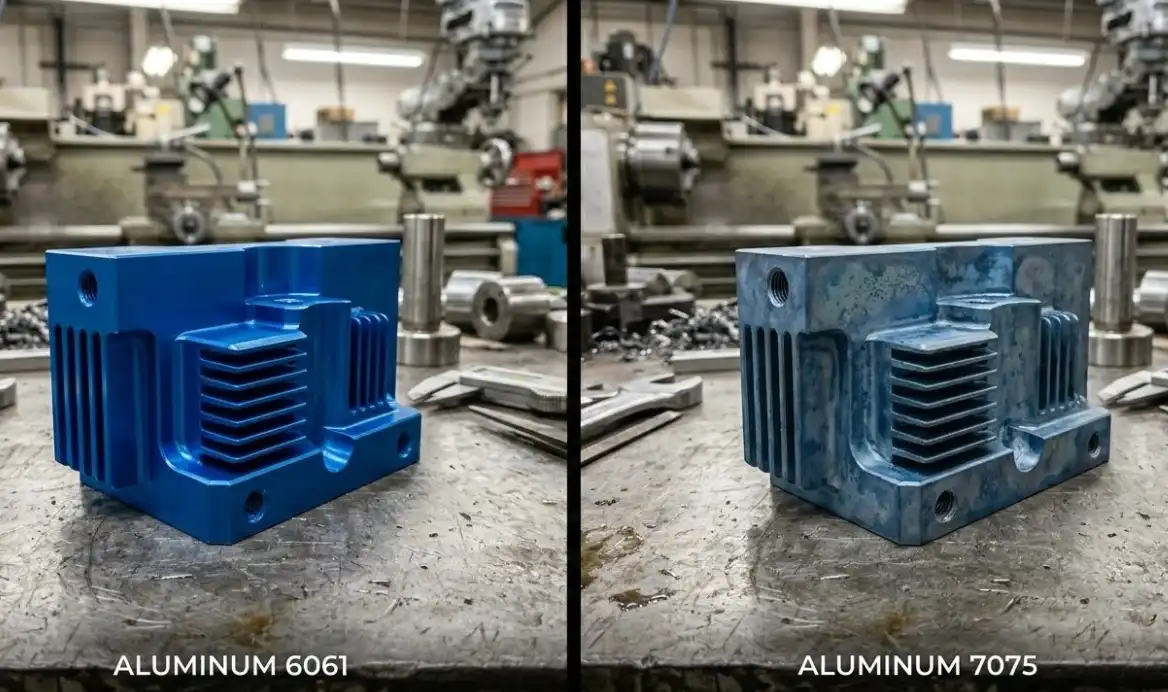
If your parts are CNC‑machined and then anodized for a clean, consistent look—and weldability (including laser and brazing) is your first filter—this comparison narrows the choice between 6061‑T6/T651 and 7075‑T6/T651. You’ll get a quick verdict, a practical table, and plain‑English guidance on welds, finishes, and risk controls.
Key takeaways
- If your primary requirement is fusion weldability (MIG/TIG or laser) with predictable yield and fewer reworks, 6061 is the safer pick with established filler options and procedures.
- For cosmetic Type II anodizing with consistent dyed color across batches, 6061 more reliably produces uniform results than 7075; 7075 is commonly flagged as “not decorative.”
- 7075 wins on maximum strength‑to‑weight and fatigue potential—best when you can avoid fusion welding (use machining + fasteners, adhesives, or solid‑state joining).
- In corrosive or marine‑like exposure, 6061 generally carries lower risk; if using 7075, consider T73/T7351 to improve SCC resistance and plan protective finishes.
- Expect 7075 to cost more and be less universally stocked; verify current price and lead time by form/temper.
TL;DR verdict
Prioritize weldability and anodized appearance? Choose 6061‑T6/T651. It accepts common fillers (e.g., ER4043/ER4943/ER5356) and is broadly qualified for shop processes under aluminum welding codes. Choose 7075‑T6/T651 only when you’re chasing the highest strength and can avoid fusion welding; if corrosion is a concern, look at 7075‑T73/T7351 and add protective finishing steps.
Typical scenario picks: CNC‑anodized enclosures → 6061; laser/MIG/TIG thin frames → 6061; high‑load, non‑welded structures → 7075 (consider T73 for SCC).
6061 vs 7075 — side‑by‑side for weldability‑first CNC + anodize
Below are typical characteristics for common tempers. Always qualify on your exact geometry, thickness, and process.
| Alloy (common tempers) | Typical tensile / yield (MPa) | MIG/TIG weldability | Laser weldability | Brazing compatibility | Common filler wires | Anodize finish & dye uniformity | SCC risk & temper note | Machinability & finish | Typical use‑case picks | Relative cost / availability |
|---|---|---|---|---|---|---|---|---|---|---|
| 6061 (T6/T651) | ~310 UTS / ~276 YS (typ.) | Good with established procedures | Generally favorable on thin sections with controlled heat input | Generally favorable with Al‑Si fillers | ER4043/ER4943, ER5356 (procedure‑dependent) | Consistently good for Type II dyed appearance | Good general corrosion resistance | Machines well; good surface prep for anodize | CNC‑anodized housings; laser/MIG/TIG‑welded brackets | $ / widely stocked |
| 7075 (T6/T651; note T73/T7351) | ~572 UTS / ~503→455 YS (form‑dependent) | Poor to fair; cracking‑prone under fusion | Challenging; hot‑cracking risk; prefer non‑fusion/solid‑state | Limited; process‑sensitive and corrosion‑cautioned | Specialized approaches; fusion fillers often not advised | Often “satisfactory, not decorative” for anodize; color mismatch risk | T6/T651 susceptible to SCC; T73/T7351 improves with strength trade‑off | Machines crisply; harder base can aid edge definition | High‑load parts assembled without fusion welds | $$–$$$ / premium, more variable |
Footnotes (sources for typical values and process notes): Typical 6061‑T6/T651 and 7075‑T6/T651 strengths are summarized by MatWeb, which references Aluminum Association data; 7075 is widely reported as fusion‑welding‑challenged; anodizing appearance cautions for 7075 are noted by supplier‑sourced datasheets; SCC mitigation via 7075‑T73/T7351 is well documented. See linked sources in the sections below.
Weldability deep‑dive: MIG/TIG, laser, and brazing
Fusion weldability (MIG/TIG)
- 6061 (6xxx series) is commonly welded using Al‑Si and Al‑Mg filler families. Si‑bearing fillers such as ER4043 or ER4943 help reduce hot‑cracking risk and wet well; ER5356 can provide higher as‑welded strength in some procedures but may differ in anodize color compared with the base metal. Filler maker guidance aligns with standard practice and code qualification paths under the aluminum structural welding code. See the practical filler guidance in the Hobart Aluminum Welding Guide and selection chart, and the qualification framework in the Structural Welding Code—Aluminum. References: the Hobart guide and chart in the Aluminum section, and the AWS D1.2 overview/preview.
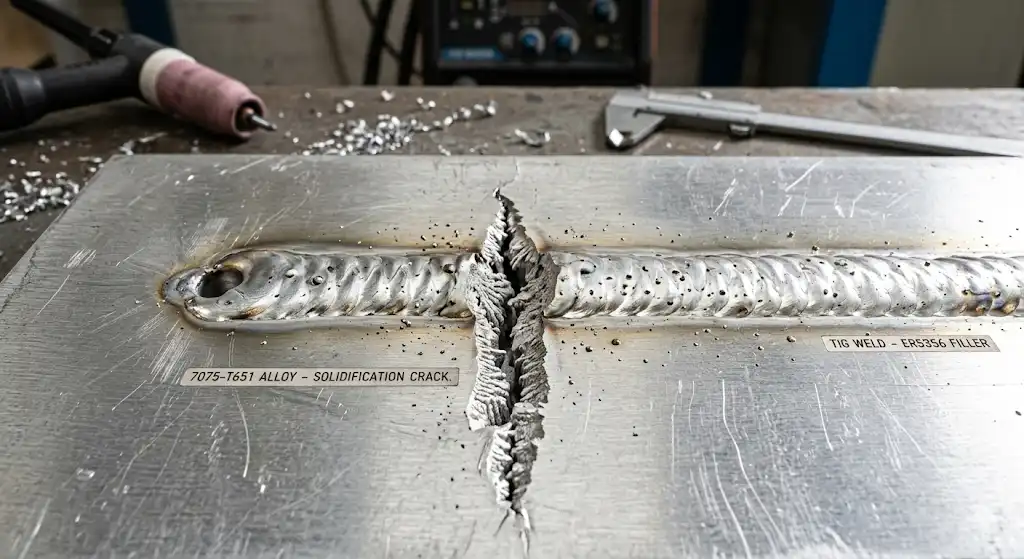
- 7075 (7xxx series) is widely reported as susceptible to solidification and liquation cracking under fusion welding, making it a poor candidate for conventional MIG/TIG structural joints. Authoritative bodies advise avoiding fusion welds where possible and instead using mechanical fastening, adhesives, or solid‑state processes. For background, see The Welding Institute’s overview on aluminum alloy weldability.
Laser welding (thin‑to‑medium sections)
- 6061 can be laser welded with careful control of heat input, travel speed, focus, and shielding. In practice, lower overall heat input than TIG can narrow the heat‑affected zone and often reduces distortion on thin sections; nonetheless, crack sensitivity still demands trials and, where applicable, compatible filler additions.
- 7075 remains challenging for laser fusion welds for the same metallurgical reasons that affect MIG/TIG. Where a 7xxx alloy is mandatory, investigate solid‑state options (e.g., friction stir welding) or redesign for fasteners.
Brazing (low‑temperature joining)
- In general manufacturing practice, 6xxx alloys such as 6061 are more commonly brazed (often with Al‑Si consumables) than 7xxx alloys, which can present cracking and corrosion pitfalls. Because brazing guidance varies by filler chemistry and flux/process, confirm compatibility with your brazing supplier before committing, and run corrosion testing when service environments are harsh.
Evidence anchors you can audit:
- Filler selection and practical do’s/don’ts are summarized in the Hobart Aluminum Welding Guide (2020) and its companion selection chart; the aluminum structural welding framework is defined in AWS D1.2. Links provided below.
- The 7xxx cracking caution is explained by The Welding Institute’s aluminum weldability overview.
Cited sources:
- Practical filler guidance: see the Hobart Aluminum Welding Guide (Aluminum section) and its filler selection chart: the guide and chart provide ER4043/4943 and ER5356 recommendations for 6xxx.
- Structural code context: see AWS D1.2 preview/overview for procedure qualification and acceptance framing.
- 7xxx fusion‑welding caution: see The Welding Institute’s Job Knowledge note on aluminum alloys.
Authoritative links in this section:
- Hobart Aluminum Welding Guide (filler recommendations for 6xxx): https://www.hobartbrothers.com/wp-content/uploads/2020/09/Aluminum_Welding_Guide.pdf
- AWS D1.2 Structural Welding Code—Aluminum (overview/preview): https://pubs.aws.org/Download_PDFS/D1.2-D1.2M-2008pv.pdf
- The Welding Institute on aluminum alloy weldability (7xxx cracking caution): https://www.twi-global.com/technical-knowledge/job-knowledge/weldability-of-materials-aluminium-alloys-021
Anodized appearance and corrosion behavior
For cosmetic Type II anodizing (decorative dyed finishes), 6061 generally offers more uniform dye uptake and color consistency than 7075. A supplier‑sourced 7075‑T651/T652 data sheet, aggregated by MatWeb, explicitly labels anodizing as “satisfactory, not decorative,” reflecting the industry’s caution about mottling and shade variation in 7xxx decorative finishes. See the ALIMEX 7075 rolled plate note via MatWeb’s listing.
On corrosion and SCC: 6061 is widely characterized as having good general corrosion resistance in common environments. In contrast, 7075‑T6/T651 can be susceptible to stress‑corrosion cracking; tempering to T73/T7351 is a recognized mitigation with some loss of tensile strength relative to T6/T651. For definitions of anodize types (Type II vs Type III) and design considerations, the Aluminum Anodizers Council offers an accessible designation overview.
Authoritative links in this section:
- 7075 anodizing caution (supplier‑sourced entry via MatWeb): https://www.matweb.com/search/DataSheet.aspx?MatGUID=89976ff1a73a4e72871b623ea4418f49
- 6061 general corrosion characterization (MatWeb overview): https://www.matweb.com/search/datasheet.aspx?matguid=b8d536e0b9b54bd7b69e4124d8f1d20
- 7075 SCC mitigation in T73/T7351 (ASM/MatWeb entry): https://asm.matweb.com/search/specificmaterial.asp?bassnum=ma7075t73
- Anodize process/type context from the Aluminum Anodizers Council: https://www.anodizing.org/anodic-coating-designation-system/
How to choose: a simple decision path
Think of this like a fork in the road: do you need fusion welds and a consistent cosmetic finish, or do you need maximum strength and can avoid welding? Follow this quick text‑tree, then validate with shop trials.
Start
 ├─ Is fusion welding (MIG/TIG or laser) required?
 │  ├─ Yes → Prioritize 6061. Use ER4043/ER4943 or ER5356 as procedure dictates; qualify per AWS D1.2.
 │  └─ No  → Go to Strength
 ├─ Strength: Do you need the highest strength-to-weight?
 │  ├─ Yes → Consider 7075. Avoid fusion welds; if corrosion risk exists, consider T73/T7351 + protective finishing.
 │  └─ No  → Go to Finish
 ├─ Finish: Is uniform dyed Type II anodize appearance critical?
 │  ├─ Yes → Prefer 6061 and align with your anodizer’s process window.
 │  └─ No  → Go to Environment
 └─ Environment: Marine/chemical exposure without heavy coatings?
    ├─ Yes → Favor 6061; or if 7075 is mandatory, plan coatings and consider T73/T7351.
    └─ No  → Either can work; weigh cost/availability and machining.
Quick checklist for procurement/ops
- Confirm the exact temper and form (e.g., 6061‑T651 plate vs 7075‑T7351 plate) on the PO.
- If welding: specify filler wire family and require a qualified WPS/PQR per AWS D1.2.
- If anodizing: share cosmetic samples with the finisher and lock a finish spec (Type II/III, dye, seal).
- If using 7075 in corrosive service: document temper (e.g., T73/T7351) and define protective finishes.
Pricing and availability caveats (as of 2024–2026)
Across distributor and market explainers, 7075 is typically positioned as a premium, higher‑priced alloy relative to 6061, with more variability in stock by form and thickness. Treat any snapshot as time‑ and region‑dependent, and verify lead times before committing a build schedule. For category‑level context, see a market explainer contrasting the two alloys from a major distributor published during 2025, noting the premium positioning of 7075.
Context link: https://www.ryerson.com/metal-resources/metal-market-intelligence/6061-vs-7075-an-aluminum-alloy-face-off
FAQ
Which is better for welding (including laser), 6061 or 7075?
For fusion welding processes, 6061 is generally the safer choice with established filler families (ER4043/4943/5356) and well‑understood qualification paths. High‑strength 7xxx alloys like 7075 are widely reported to be cracking‑prone under fusion welding. See the aluminum structural welding code framework and The Welding Institute’s guidance.
- Code/framework reference: https://pubs.aws.org/Download_PDFS/D1.2-D1.2M-2008pv.pdf
- Weldability overview (7xxx caution): https://www.twi-global.com/technical-knowledge/job-knowledge/weldability-of-materials-aluminium-alloys-021
What filler wire should I use when welding 6061?
Common starting points are ER4043/ER4943 (good flow, reduced crack risk) and ER5356 (higher as‑welded strength in some procedures; watch color match after anodize). Always confirm with your WPS and service requirements.
- Practical filler guidance: https://www.hobartbrothers.com/wp-content/uploads/2020/09/Aluminum_Welding_Guide.pdf
Does 7075‑T73 improve stress‑corrosion resistance versus 7075‑T6?
Yes. Tempers like 7075‑T73/T7351 are specifically used to improve SCC resistance relative to T6/T651, with some reduction in tensile strength. See temper‑specific property summaries.
- Temper/property reference: https://asm.matweb.com/search/specificmaterial.asp?bassnum=ma7075t73
Which alloy gives a more uniform dyed Type II anodize finish?
6061 is typically more consistent for cosmetic dyed anodize. Supplier data aggregated by MatWeb caution that 7075 is “satisfactory, not decorative,” and may show mottling or shade variation. Always test on your geometry and dye system.
- Anodizing note for 7075: https://www.matweb.com/search/DataSheet.aspx?MatGUID=89976ff1a73a4e72871b623ea4418f49
Is 7075 always the stronger choice?
In tensile and yield strength, yes—7075‑T6/T651 typically far exceeds 6061‑T6/T651. But if you must fuse‑weld or need decorative anodize, 6061 often produces better total‑process outcomes. Confirm design allowables with your supplier’s certified data.
- Typical property anchor for 7075‑T6/T651: https://asm.matweb.com/search/specificmaterial.asp?bassnum=ma7075t6
Sources and technical notes
Typical tensile/yield values cited in the table and prose follow MatWeb summaries for 6061‑T6/T651 and 7075‑T6/T651, which reference Aluminum Association data; design decisions should be based on certified product‑specific documentation. Weld procedure qualification should follow the Structural Welding Code—Aluminum. Anodize process terminology (Type II/III) follows industry usage per the Aluminum Anodizers Council. Where we describe 7075 fusion‑welding challenges and SCC mitigation in T73/T7351, we reference The Welding Institute and ASM/MatWeb entries. Prices and lead times vary by market and form and can change without notice.
For quick auditing, primary anchors used in this article include: MatWeb entries for 6061‑T6/T651 and 7075‑T6/T651; ASM/MatWeb 7075‑T73; AWS D1.2 overview/preview; The Welding Institute aluminum weldability overview; Aluminum Anodizers Council anodic coating designation system; and a Ryerson market explainer on 6061 vs 7075. All links appear once above in the relevant sections.
Author’s note: If you’re on the fence, run a small test batch: one or two parts in 6061 and in 7075 (if applicable), execute the intended join and finish, and let the results—and rework rate—decide. It’s the fastest path from theory to proof.