If you’re selecting a high‑strength aluminum for load‑bearing parts, 7075 will almost certainly land on your shortlist. It offers exceptional strength‑to‑weight and a crisp, hard finish that machines beautifully. But here’s the deal: those benefits come with trade‑offs in corrosion resistance and weldability that can make or break your design.
This guide puts “7075 aluminum uses” in practical context for design and manufacturing engineers. We’ll focus on how temper choice affects properties, where 7075‑T6/T651 is the right call, when you should pivot to overaged tempers or a different alloy, and the manufacturing realities that matter on the shop floor.
Key takeaways
- 7075‑T6/T651 delivers far higher tensile and yield strength than 6061‑T6, with similar stiffness but lower ductility and poorer fusion‑weld performance.
- Use it where maximum strength‑to‑weight and dimensional stability (especially T651 plate) are critical and corrosion exposure can be mitigated.
- Treat chloride‑rich or humid service as a red flag; consider overaged tempers (T73/T7351) plus robust finishes when stress‑corrosion risk is non‑negotiable.
- Plan for machining like a high‑strength aluminum: sharp carbide, high SFM, excellent chip evacuation, and controlled heat.
- For joining, favor mechanical fastening or structural adhesives; reserve friction stir welding for programs with process development bandwidth.
Property context and temper basics
Compared with common 6xxx alloys, 7075’s strength defines its appeal. Typical, representative published values below are for design context; always confirm with your supplier’s certs and program standards.
| Property | 7075‑T6/T651 | 6061‑T6 | Notes |
|---|---|---|---|
| Ultimate tensile strength | ~83 ksi (572 MPa) | ~45 ksi (310 MPa) | 7075 is roughly 80–90% stronger |
| Yield strength (0.2% off) | ~73 ksi (503 MPa) | ~40 ksi (276 MPa) | Substantially higher for 7075 |
| Elongation | ~7–11% | ~12–17% | 6061 is generally more ductile |
| Hardness (Brinell) | ~150 HB | ~95 HB | 7075 is markedly harder |
| Elastic modulus | ~71–72 GPa | ~69 GPa | Stiffness is comparable |
Typical values summarized from the MatWeb 7075 data sheet and distributor technical pages; see the authoritative MatWeb 7075 aluminum data sheet.
Temper quick notes:
- T6: solution heat‑treated and artificially aged to peak strength.
- T651: same as T6 with a controlled stretch to relieve residual stress—preferred for plate where dimensional stability after heavy machining is important.
- Overaged families like T73/T7351 trade some strength for improved stress‑corrosion cracking resistance.
7075 aluminum uses where it’s the right choice
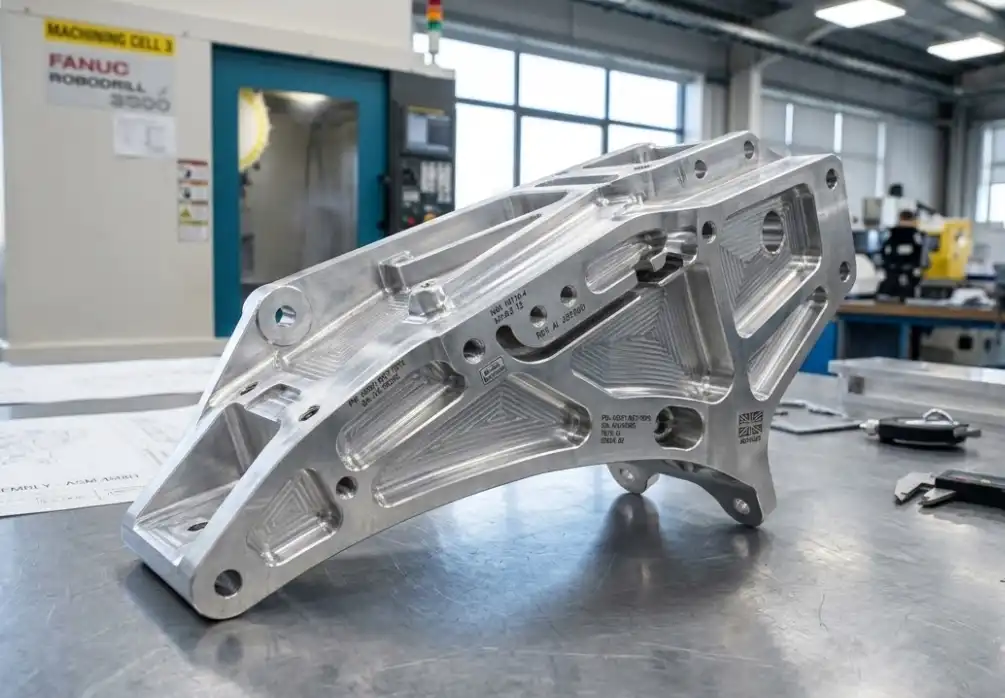
When you need the highest practical strength‑to‑weight in a wrought aluminum, 7075 is a go‑to for structural brackets, fittings, thick‑section plates, and precision components. It’s common in air and space structures, where designers squeeze mass out of load paths but still need tight margins and machinability. NASA’s small spacecraft materials guidance highlights 6061 and 7075 as standard chassis metals, with 7075 chosen where higher margins are required; see the NASA Small Spacecraft Structures overview (2021 PDF).
Choose 7075‑T6/T651 when:
- The part is predominantly machined from plate or bar, with high material removal and a need for stable geometry (T651 plate reduces distortion risk).
- Load cases are static or quasi‑static and governed by tensile/yield strength rather than extensive forming.
- The environment can be controlled, or finishes/cladding can be applied to manage corrosion.
This is the heart of practical “7075 aluminum uses”: get the strength and machining quality you need, then design in corrosion controls and appropriate joints.
When to avoid or rethink 7075
Two issues move 7075 off the table quickly: fusion welding and chloride‑rich exposure. Traditional fusion welding (GMAW/GTAW) can lead to hot cracking and a softened heat‑affected zone, which undermines load paths. In environments with chlorides or sustained tensile stress, stress‑corrosion cracking risk rises, especially in peak‑strength tempers.
If the application must survive road deicing salts, marine spray, or tropical humidity for years, assume you’ll need either an overaged temper plus robust finishing, or you should pivot to another alloy. The FAA’s maintenance guidance underscores corrosion risks in 7xxx series service and the need for protective systems; see FAA Advisory Circular AC 43‑4B on corrosion control. For surface protection requirements and options, refer to MIL‑PRF‑8625 anodic coatings for aluminum.
Manufacturing best practices for 7075
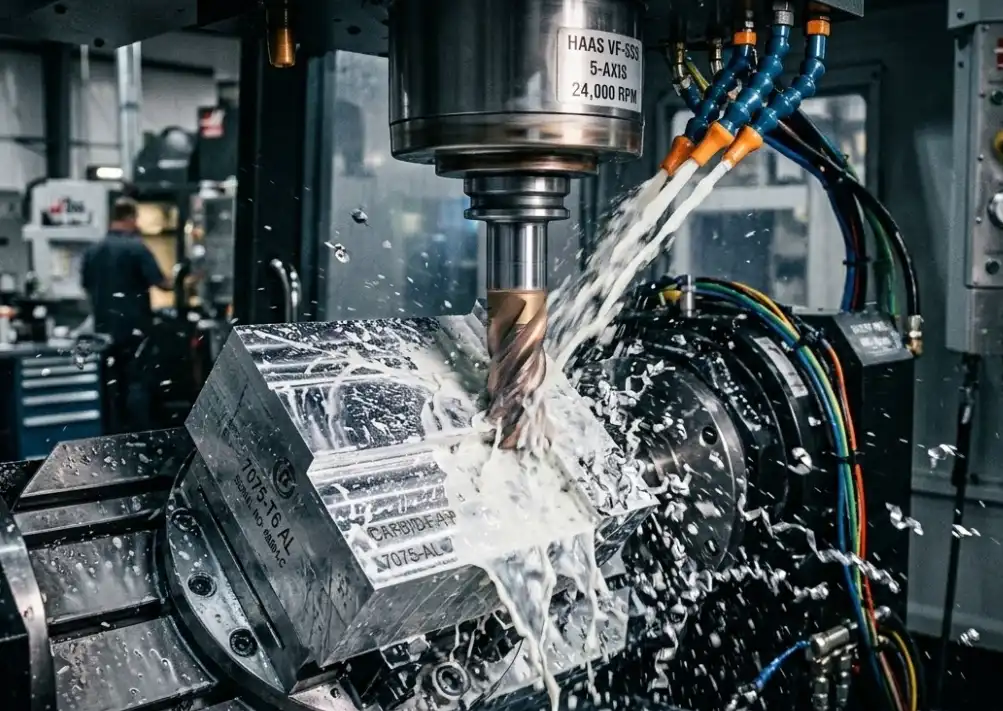
You can machine 7075 fast and clean—if you treat it like the high‑strength aluminum it is. Use sharp geometry, aggressive chip evacuation, and reliable coolant delivery to control heat and preserve tool life.
Machining tips that consistently work well:
- Tooling: solid carbide end mills with non‑ferrous coatings (e.g., ZrN family), 2–3 flutes, and a high helix angle (35–45°). Chipbreakers help during roughing.
- Parameters: start in the 800–1500 SFM range for wrought aluminum and dial in with your toolmaker’s chipload charts; favor high‑efficiency milling (HEM) toolpaths to distribute heat.
- Process control: minimize stickout, ensure rigid workholding, and keep chips moving. For finish passes, use higher helix/variable pitch cutters to suppress chatter.
For a concise, vendor‑independent overview of tooling and strategy baselines, see the technical guidance in Harvey Performance’s aluminum machining guide.
Finishing and anodizing
- Type II sulfuric anodize with proper sealing is common for corrosion protection and color requirements on 7xxx; hardcoat (Type III) provides superior wear but tends to run dark gray on 7075 and can be harder to dye. Thickness, sealing method, and alloy composition all affect outcomes. Formal requirements and tests are defined in MIL‑PRF‑8625 (see spec page for details).
- Where stress‑corrosion is a real risk, combine an overaged temper (e.g., T73/T7351 for appropriate forms) with robust anodize or conversion coatings and seal quality verification per your QA plan.
Heat‑treatment notes
- If you must form before final properties, consider ordering in a formable temper and performing solution heat treatment plus aging after forming, under the applicable process spec. Many aerospace programs govern heat treatment with AMS 2770.
Joining strategies without surprises
Design for mechanical fastening or structural adhesives when using 7075 in load paths. Well‑designed bolted or riveted joints avoid the metallurgical pitfalls of fusion welding and play to 7075’s strengths. If welding is non‑negotiable, evaluate friction stir welding on a development track; it avoids melting and may deliver acceptable properties for certain geometries and thicknesses, but it requires process control, qualification, and program buy‑in. Until you have alloy‑ and joint‑specific data, don’t assume fusion‑welded 7075 will carry primary loads.
Two quick case examples
Aerospace bracket redesign: A machined avionics mounting bracket initially scoped in 6061‑T6 exceeded mass targets after late load growth. Switching to 7075‑T651 plate allowed a 22% cross‑section reduction while maintaining margin, and it held flatness after a 70% material removal strategy thanks to the T651 stress relief. The team added a Type II sealed anodize and stainless fasteners, and incorporated inspection for anodize thickness. The result hit mass targets with a neutral cost delta driven by shorter finishing passes and fewer corrective operations.
Performance drivetrain component: A motorsport differential carrier required higher stiffness and bearing support with minimal weight gain. 7075‑T6 bar stock improved peak torque capacity and reduced deflection, enabling tighter gear mesh control. Because chloride exposure from wet tracks was likely, engineers specified a conversion coating base and hardcoat anodize on wear faces. Fusion welding was eliminated in favor of bolts and a structural adhesive fillet. The assembly gained a measurable life increase without a packaging penalty.
FAQ
Is 7075 stronger than 6061?
Yes—by a wide margin in typical tempers. Representative data show about 80–90% higher tensile strength for 7075‑T6/T651 than 6061‑T6, with similar stiffness but lower ductility. For design, always use program allowables and supplier certs rather than generic tables.
What does 7075‑T651 buy me over T6?
T651 includes a controlled stretch after quench to relieve residual stresses. If you’re machining plate heavily, T651 helps reduce distortion so you hit tolerances with fewer corrective passes.
Can I anodize 7075 and expect good corrosion protection?
Yes, when the process is called out and verified properly. Type II sulfuric with sealing is common; Type III hardcoat gives better wear. On 7xxx alloys, pay attention to thickness and sealing quality, and consider overaged tempers for SCC‑critical service per your spec.
Can I weld 7075 for structural joints?
Conventional fusion welding is generally a poor choice for load‑bearing joints in 7075 due to hot cracking and HAZ softening. Where welding must be used, evaluate friction stir welding through a formal qualification path.
Procurement and spec verification
Use this quick checklist to avoid rework and NCRs:
- Confirm product form and governing standard on the PO (e.g., sheet/plate to ASTM B209M); ensure the cert lists the same.
- Specify temper precisely (e.g., T651 for plate, or T73x family where SCC mitigation is required) and verify thickness‑dependent mechanicals.
- Call out finishing on the drawing/PO with type, class, thickness, and sealing notes as applicable (e.g., MIL‑PRF‑8625 Type II sealed, or Type III hardcoat).
- For aerospace programs, align heat‑treat and inspection requirements with your material/process specs before release.
For product‑form and property tables in purchasing language, see ASTM B209M for aluminum sheet and plate.
Alternatives to consider
- 6061 when you need balanced corrosion resistance, good weldability, and lower cost; it’s a pragmatic baseline for welded frames and general‑purpose structures.
- 2024 when fatigue strength and damage tolerance dominate but you can manage corrosion through cladding and finishes; common in legacy airframe skins and ribs.
- 7050 when you need high strength with better through‑thickness properties and improved SCC resistance in thick sections; widely used in modern aerospace plate where 7075 once dominated.
Closing next steps
If your application emphasizes strength‑to‑weight, dimensional stability after machining, and repeatable finishing, 7075—especially in T651 plate—is a strong candidate. But don’t treat it as a free upgrade over 6061: weigh stress‑corrosion exposure, joining strategy, and finishing controls early. Build a short design‑for‑manufacturing brief, confirm “7075‑T6 properties” or overaged temper requirements with your supplier, and route drawings with clear temper and finish notes before release. That’s how you make the most of 7075 aluminum uses without surprises.