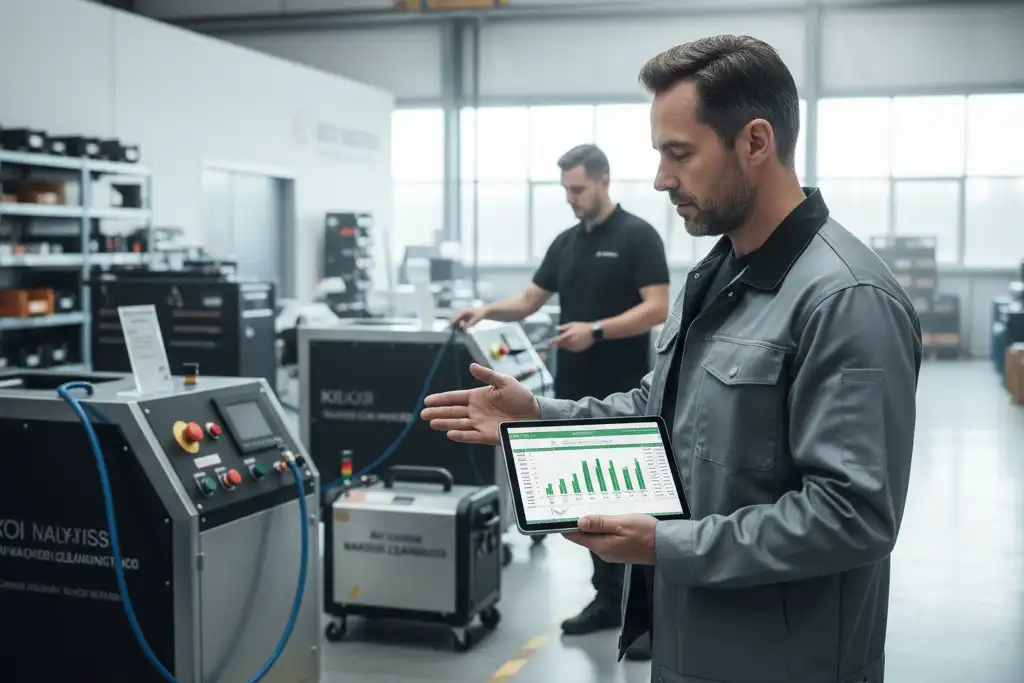
You want to see if laser cleaning is worth it for your business. Many companies now use laser cleaning. Over 60% pick it instead of old ways. About 55% use small or mobile systems. You should check every cost and benefit to know the real value. The main reasons to figure out return on investment are labor costs, wasted material, and downtime.
| Reason | Description |
|---|---|
| Labor Costs | Labor costs include pay, sick days, and mistakes. These things can make total costs go up a lot. |
| Cost of Wasted Material | Losing unused materials means you make less money. |
| Downtime | When work stops, you lose money every minute. |
Tip: Write down your own numbers as you read. This will help you see if laser cleaning works for you.
Key Takeaways
- Use this formula to find ROI: ROI = (Total Benefits – Total Costs) / Total Costs × 100%. This shows how much money laser cleaning can save you.
- Add up all costs. This includes the first payment, regular upkeep, and training. Knowing these costs helps you see what you spend.
- Watch for savings from less work, fewer materials, and less downtime. These savings can make your ROI much better.
- Think about long-term gains like longer equipment life and less harm to the environment. These gains help your business last and save money.
- Look for subsidies and tax breaks for energy-saving machines. These can cut your starting costs and make your ROI higher.
Return on Investment Formula
Standard ROI Calculation
You need a simple way to check if laser cleaning is a good idea. The usual formula for return on investment is:
ROI = (Total Benefits – Total Costs) / Total Costs × 100%
This formula shows how much you get back for what you spend. To use it, you need to know all your costs and benefits. Here are the main things to count:
- Initial Investment Cost
Add up the cost of the laser cleaning machine, setup, training, and extra fees like shipping. - Cost Savings
Figure out how much you save on workers, materials, and waste. Laser cleaning often uses less power and fewer supplies than old ways. - Increased Efficiency and Productivity
Laser cleaning is faster. You spend less time on each job, so your team can finish more work. - Extended Equipment Lifespan
Clean machines last longer. Laser cleaning takes off dirt and rust without strong chemicals, so your equipment stays in good shape. - Quality Improvement and Customer Satisfaction
Cleaner parts make better products. Customers notice better quality, which can mean more sales.
You should also remember ongoing costs, like:
- Yearly maintenance and parts
- Labor costs, including pay and benefits
- Power use
- Getting rid of waste
A table can help you keep track of these numbers:
| Cost/Benefit | Example Items |
|---|---|
| Initial Investment | Buying, setup, training, shipping |
| Ongoing Costs | Maintenance, labor, power, waste removal |
| Cost Savings | Lower labor, fewer supplies, less downtime |
| Productivity Gains | Faster cleaning, more work done |
| Quality and Lifespan Gains | Fewer problems, longer equipment life |
Note: Always use your own numbers for the best return on investment answer.
Why ROI Matters for Laser Cleaning
You want to make smart choices for your business. Figuring out return on investment helps you compare laser cleaning to old cleaning ways. Laser cleaning systems cost more at first, but they can save you money later. Old cleaning needs more supplies, like chemicals and rough materials, and makes more waste. These costs add up every year.
Laser cleaning also means you need fewer workers. Machines can do more work, so you pay less for wages and have fewer mistakes. You also spend less on waste because laser cleaning makes less trash.
When you use the return on investment formula, you see the whole story. You can find hidden savings, like less downtime and longer equipment life. This helps you decide if laser cleaning is right for your company.
Tip: A good return on investment means you get your money back faster. It also shows your business is getting safer, cleaner, and more efficient.
Initial and Depreciation Costs
Equipment and Installation
You need to know the main costs before buying a laser cleaning system. The price for industrial laser cleaning machines is usually $15,000 to over $60,000. The cost changes with the machine’s size, power, and features. You might also pay for installation. Some companies include installation, but others charge more. Always ask for a full quote so you do not miss hidden fees.
Here are some common upfront costs:
- Laser cleaning machine price
- Installation fees
- Shipping and delivery
- Safety upgrades for your workspace
You can use a table to keep track of these costs:
| Upfront Cost | Typical Range or Note |
|---|---|
| Equipment Purchase | $15,000 – $60,000+ |
| Installation | Included or extra (ask vendor) |
| Shipping | Varies by location |
| Safety Upgrades | Depends on facility needs |
Tip: Write down each cost for your business. This helps you see all the costs.
Training Expenses
Your team must learn how to use the new laser cleaning equipment. Many suppliers give basic training in the price. Extra training can cost $500 to $2,000. The price depends on how hard the machine is to use and how many people need training. Plan for refresher courses if you hire new workers or upgrade your system.
Here are some training expenses:
- First training (often included)
- Extra training ($500 – $2,000)
- Refresher courses (as needed)
Note: Good training keeps your team safe and helps them use the laser cleaning system well.
Depreciation Calculation
You need to think about how your equipment loses value over time. Depreciation means your machine is worth less each year. You should add this to your return on investment calculation. Most businesses use straight-line depreciation. This way, you spread the cost over the machine’s life.
Here is a simple way to figure out straight-line depreciation:
Annual Depreciation = (Purchase Price – Salvage Value) / Useful Life (years)
For example, if you buy a laser cleaning machine for $30,000, expect it to last 10 years, and think you can sell it for $2,000 at the end, your yearly depreciation is:
($30,000 – $2,000) / 10 = $2,800 per year
Depreciation matters because it changes your yearly costs. You can use this number to see what the equipment costs you each year. This helps you get a better return on investment. You should add depreciation to your total cost when you compare laser cleaning to other ways.
Tip: Ask your accountant for help if you do not know how to figure out depreciation for your business.
Operational Costs and Savings
Maintenance and Consumables
You have to think about regular care and supplies for laser cleaning. Most machines do not need much work. You might just clean the optics and check the cooling system. The supplies for laser cleaning are simple and cost less than chemical or abrasive cleaning. You usually need:
- Nozzles
- Cleaning fluids
These supplies last a long time and are not expensive. You spend less on them than with old cleaning methods that use lots of chemicals or rough materials.
Tip: Write down what you spend on supplies each month. Compare this to your old cleaning costs to see if you save money.
Labor and Energy
Laser cleaning systems help you save on worker costs. You need fewer people because the machines do most of the work. Laser cleaning is quick and uses automation. You spend less time on each job, so your team can do other things. You also need fewer operators than with old cleaning ways. This means you pay less for workers and get more done.
Energy use is another cost to think about. Laser cleaners use less energy than old cleaning methods. Here is a table to show the difference:
| Cleaning Technology | Energy Consumption (kWh/hour) |
|---|---|
| Low-power laser cleaners | 1-2 |
| High-power laser cleaners | 10-15 |
| Traditional methods | Higher due to consumables |
You can see that laser cleaning uses less energy, especially if you pick a low-power machine.
Waste Disposal and PPE
Laser cleaning makes less waste than chemical or abrasive cleaning. You do not have to pay for chemical disposal or extra water. Here is a table to compare costs:
| Criteria | Laser Cleaning | Chemical Cleaning |
|---|---|---|
| Maintenance Costs | Low maintenance with minimal consumables | High costs for chemical disposal, water usage, and maintenance |
You also need personal protective equipment (PPE) to stay safe. For laser cleaning, you should use:
- Laser safety goggles that match the laser’s wavelength and optical density rating
- Gloves
- Respirators
- Protective clothing
- Face shields in higher-risk areas
- Flame-resistant garments
- Hearing protection
These items keep your team safe. The cost for PPE is usually lower than for chemical cleaning, but you should still count it in your total costs.
Note: When you add up care, worker, energy, waste, and PPE costs, you get a clear idea of your ongoing expenses. This helps you see how laser cleaning changes your return on investment.
Efficiency, Quality, and Earnings
Efficiency Gains
Laser cleaning helps you work faster than old cleaning ways. You finish each job quicker, so machines run longer and stop less. This means your production line keeps moving. Laser cleaning works well with robots and automation. You can add it to your line and need less help from workers.
Here is a table that shows how laser cleaning helps:
| Benefit | Description |
|---|---|
| Reducing Production Downtime | Laser cleaning is fast and keeps things moving. |
| Ensuring Consistent Product Quality | You get the same clean result every time. |
| Cost Savings Through Reduced Consumables | You buy fewer cleaning supplies. |
| Extending Equipment Lifespan | Machines last longer with gentle cleaning. |
| Eco-Friendly and Sustainable | Laser cleaning does not make extra waste. |
| Integration with Automation and Robotics | You can use it with robots for more speed. |
You can check these gains by tracking cleaning time, downtime, and labor hours saved.
Quality Improvements
Laser cleaning makes your equipment cleaner and your products better. You will have fewer mistakes and less fixing to do. Here are some ways laser cleaning helps quality:
- Cleaner molds help you make better products.
- High accuracy means you fix fewer mistakes.
- Clean equipment gives you more reliable results.
Laser cleaning removes dirt and other stuff very well. This means fewer defects and less money spent on fixing things. You also save on labor and materials because you do not redo jobs.
Potential Earnings
Laser cleaning can help you earn more money. Faster cleaning and less downtime mean you make more products in the same time. You also spend less on supplies and repairs. Here is a table to show the impact:
| Performance Indicator | Metrics |
|---|---|
| Time Efficiency Metrics | Cleaning time, downtime, labor hours saved |
| Cost Reduction Measurements | Less money spent on supplies and waste |
| Quality and Performance | Fewer defects, longer equipment life |
| Environmental and Safety | Fewer accidents, less waste |
You can guess your extra earnings by seeing how many more products you make and how much you save. Better quality means happier customers, so you might sell more. When you add these benefits to your return on investment, you see the value laser cleaning brings to your business.
Long-Term and Indirect Benefits
Equipment Lifespan
You want your machines to last a long time. Laser cleaning machines work longer than old cleaning tools. Most fiber lasers run for 50,000 to 100,000 hours. You do not have to change parts often. This means you spend less on fixing things and stopping work. You also save money because you need fewer supplies and less care.
- Laser cleaning machines last longer than older ones.
- You do not change parts as much, so machines keep working.
- You pay less for repairs and care over the years.
- The higher price at first is balanced by lower costs later.
When you add these things to your return on investment, you see how strong machines help your business.
Environmental Impact
Laser cleaning is better for the environment. You do not use chemicals or make dangerous waste. Most of the leftover stuff turns into vapor or stays dry. You also use less energy, so your bills and carbon footprint go down. Workers are safer because they do not breathe in bad fumes or dust.
| Benefit | Description |
|---|---|
| No Chemicals | You do not use solvents or dangerous chemicals. |
| Minimal Waste | You make very little waste, and most is dry or vapor. |
| Lower Energy Consumption | You use up to 70% less energy than old ways. |
| Noise and Emissions | Laser cleaning is quiet and does not make greenhouse gases or toxic vapors. |
| Safety for Workers | Your team has fewer risks from chemicals and dust. |
Cleaner work helps you follow rules and shows customers you care about the planet.
Green Subsidies
You can get money help when you pick laser cleaning. Many places give tax breaks and special money for using energy-saving machines. In the United States, you might get help from the Clean Energy Incentive Program. This gives tax cuts and loans with low interest. Section 179 Tax Deduction lets you take off up to $1.5 million for buying equipment. Investment Tax Credits give rewards for using green and smart machines.
| Country | Program Name | Description |
|---|---|---|
| China | 14th Five-Year Plan | Special money for companies that meet green rules. |
| European Union | Green Industrial Plan | Help for factories using energy-saving machines. |
| United States | Clean Energy Incentive Program | Tax cuts and loans for energy-saving laser machines. |
| Japan | Green Manufacturing Fund | Helps companies use eco-friendly laser cleaning to cut pollution. |
Government money and tax breaks make your investment better. These rewards help you get more from your laser cleaning system.
Tip: Always count long-term and hidden benefits in your return on investment. You will see how laser cleaning helps your business for many years.
You now know how to calculate the return on investment for laser cleaning. Use your own numbers to see if this method fits your business. Try talking with vendors or using online ROI calculators for more help. Remember to look at both direct savings and hidden benefits. Careful planning helps you make smart choices and get the most value from your investment.
FAQ
How long does it take to see ROI from laser cleaning?
Most people see ROI in 1 to 3 years. The time depends on how much you spend at first. It also depends on how much you save and how often you use the system.
What data do you need to calculate ROI?
You need to know what the equipment costs. You should also count training, maintenance, and labor savings. Remember to include energy use and any extra money you make. Write these numbers down before you start.
Can laser cleaning replace all traditional cleaning methods?
Laser cleaning works well for many jobs and surfaces. But some shapes or materials may need other cleaning ways. Always test laser cleaning on your own parts first.
Are there hidden costs with laser cleaning?
You might have to pay for more training or workspace changes. You may also need special safety gear. Ask the seller for a full list of costs before you buy.
See also
Analysis of reasons for cleaning and damage of laser lenses
Laser Cleaning Made Simple with Smart Control Tech
6 Key Reasons Your Laser Fiber Gets Damaged
Laser cleaning: which is better, air cooled or water-cooled