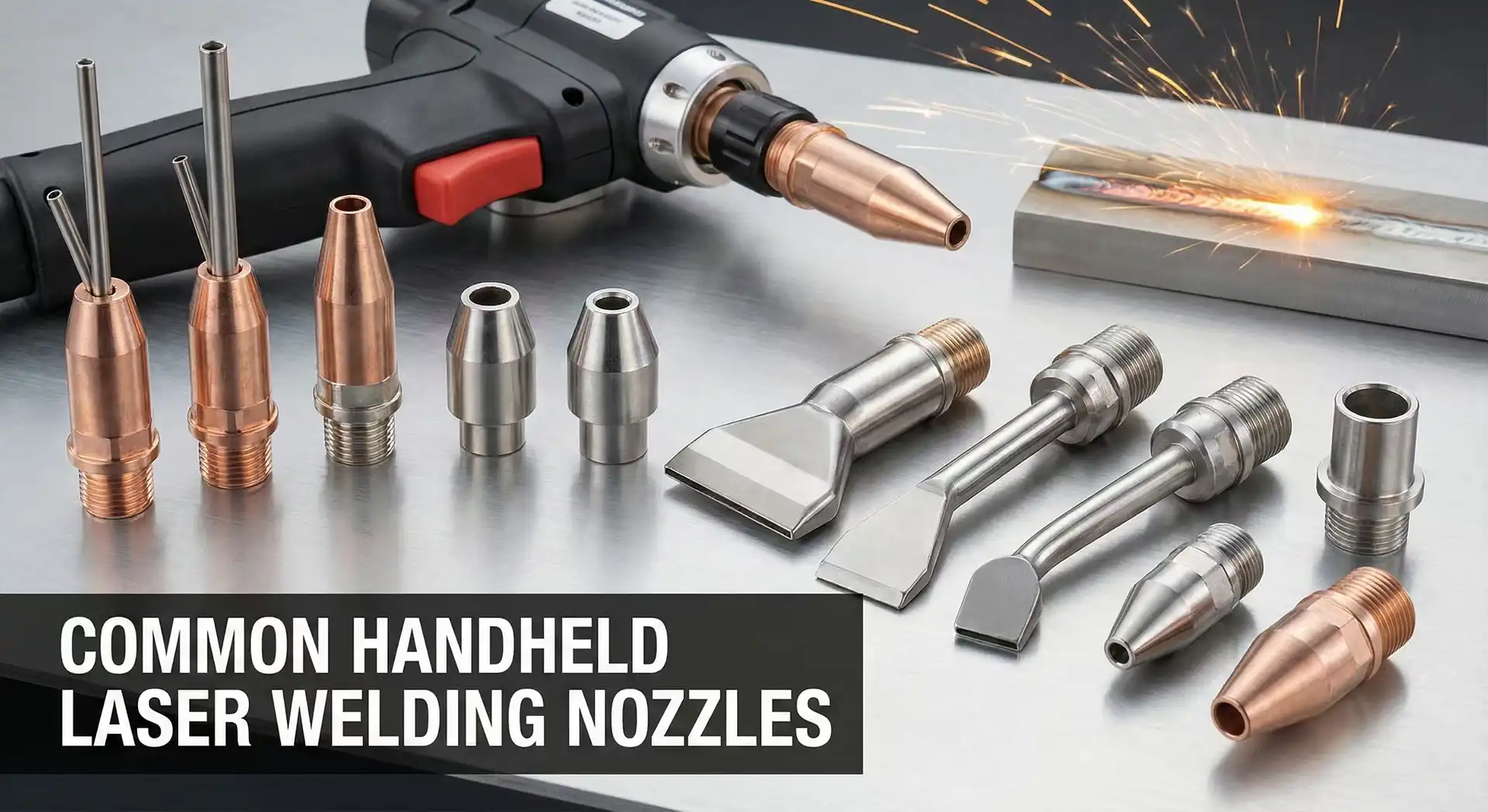
When you use handheld laser welding, you need to pick the right nozzle for your job. Each nozzle type works best for a specific task. The table below shows common nozzle types, the recommended filler wire sizes, and their main functions:
| Nozzle Type | Filler Wire Size | Main Function |
|---|---|---|
| AS | 0.8, 1.0, 1.2 mm | Flat, inner, and outer angle |
| BS | 1.6 mm | Flat, inner, and outer angle |
| CS | 0.8, 1.0, 1.2 mm | Outer angle |
| DS | 0.8, 1.0, 1.2 mm | Flat, inner, and outer angle |
| ES | 0.8, 1.0, 1.2 mm | Outer angle |
| FS | 1.6 mm | Outer angle |
You can use this guide to choose the nozzle that matches your welding needs.
Key Takeaways
- Pick the right nozzle for your welding job. Each nozzle has a special use, like cutting or welding in small spaces.
- Make sure the nozzle size fits your filler wire and material thickness. The right size gives better welds and stops damage to your tools.
- Clean and check your nozzles often. This helps stop clogs and keeps welding easy. It also saves you time and money.
- Think about the nozzle’s shape and design for your job. Different shapes help gas move better and make welds stronger for different uses.
- Try your nozzle setup on scrap material first. This helps you avoid errors and get better results.
Nozzle Types in Handheld Laser Welding
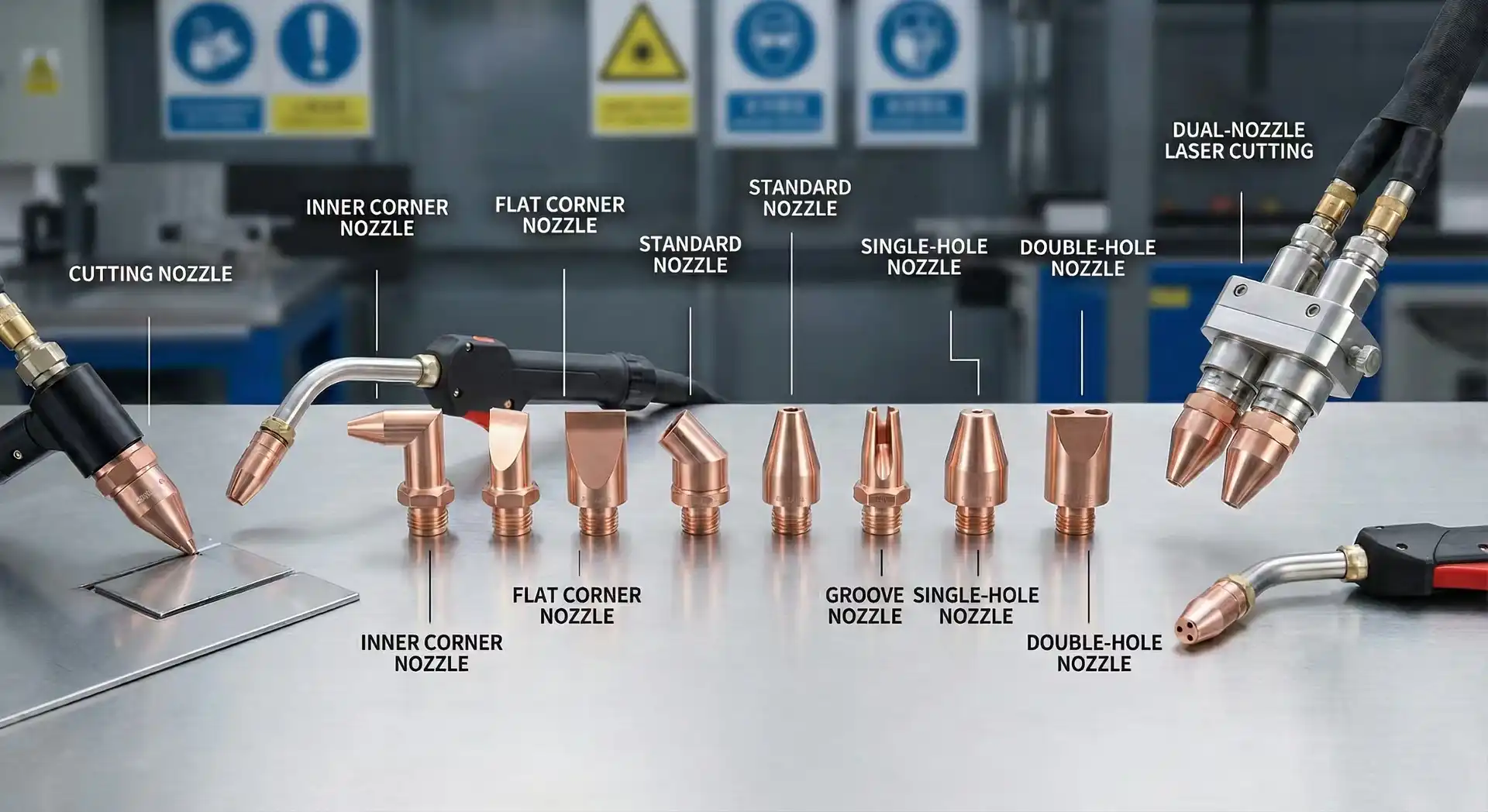
Cutting Nozzle
There are different cutting nozzle designs for laser welding. Each design helps you get a certain result.
Here is a table that shows what each nozzle does and how it is used:
| Nozzle Type | Features | Typical Use Cases |
|---|---|---|
| Standard/Wide Nozzles | Makes a smooth gas blanket for strong protection. | Good for flat butt and lap joints. |
| Pointed/Extended Nozzles | Sends shielding gas in a focused stream for careful work. | Used for tight corners or small spaces like fillet welds. |
| Angle-Cut Nozzles | Moves gas smoothly along seams for better coverage. | Made for joints at certain angles. |
Cutting nozzles work in different ways based on their shape, size, and the assist gas you use.
- Small nozzles help you be more exact with thin materials.
- Big nozzles are better for thick materials but are less exact.
- High-speed nozzles let you weld thick materials faster, but you must balance speed and accuracy.
Interior Angle Nozzle
Interior angle nozzles help you weld in small spaces and corners.
Most are made from copper or brass, so they last a long time.
You use them when you need careful welds in places that are hard to reach.
Here is a table that shows their main features:
| Characteristic/Advantage | Description |
|---|---|
| Material | Usually made of copper or brass. |
| Suitability | Good for welding in small spaces and corners. |
| Precision | Makes careful welds for many welding jobs. |
Flat Angle Nozzle
Flat angle nozzles give you a straight spray in a thin line.
You can pick standard, wide-angle, or narrow-angle types.
The tongue-type design gives a strong spray, even with low pressure, and does not clog easily.
These nozzles are best when you need a sharp spray for strong cleaning.
Here is a table that explains their features:
| Feature | Description |
|---|---|
| Spray Pattern | Flat fan nozzles make a straight spray in a thin line, strong in the middle and softer at the ends. |
| Design | Comes in standard, wide-angle, and narrow-angle types. |
| Impact Force | Tongue-type design gives the strongest spray at low pressure. |
| Clogging Resistance | Tongue-type nozzles do not clog easily. |
| Application | Best for jobs needing a sharp spray for cleaning and strong impact. |
Exterior Angle Nozzle
Exterior angle nozzles help you change the laser beam size and focus.
There is an entrance hole that matches the beam’s size and shape.
Inside, the beam can get bigger, smaller, or change shape as needed.
The exit hole sets the final beam size and focus, which affects your welding or cutting.
You can change the nozzle size, focus, and distance to get the best beam for each material.
These nozzles also help remove melted material and use assist gas for better cutting.
- The nozzle changes the laser beam size, focus, and quality.
- The entrance hole is made to fit the beam.
- The exit hole sets the final beam size and focus.
- You can change the nozzle for different jobs.
- Assist gas helps remove melted material and makes cutting better.
Standard Nozzle
Standard nozzles are useful and save money in laser welding.
Their shape spreads out stress, so there are fewer weak spots.
Pads make the nozzle stronger and help spread out force.
The material you pick changes how strong and long-lasting the weld is.
Different weld shapes can change how strong the joint is.
Careful making and welding keeps the nozzle strong and free from problems.
Here is a table that shows the main design parts and how they help:
| Design Element | Impact on Welding Performance |
|---|---|
| Geometry | Spreads out stress, so there are fewer weak spots. |
| Reinforcement Pads | Makes the weld stronger by spreading out force. |
| Material Selection | Changes how strong the weld is and what it needs. |
| Weld Configurations | Changes how strong and tough the weld is. |
| Manufacturing Practices | Careful making and welding keeps the nozzle strong and free from problems. |
Standard nozzles cost less and work for many jobs.
Special nozzles may cost more, but they can save money later by working better for special jobs.
Grooved Nozzle
Grooved nozzles have special grooves for different wire sizes.
You can use them with wire sizes from 0.8 mm to 1.6 mm.
This helps you match the nozzle to your wire and get better welds.
Here is a table that shows which wire sizes work:
| Size (mm) | Compatible Welding Wire Diameter |
|---|---|
| 0.8 | Yes |
| 1.0 | Yes |
| 1.2 | Yes |
| 1.6 | Yes |
Single-Hole Nozzle
Single-hole nozzles have one hole for the shielding gas.
You use them for easy welding jobs that need simple gas coverage.
They are good for small jobs and repairs.
You may find them simple to use and clean.
Tip: Use single-hole nozzles for easy welds that do not need special gas flow.
Double-Hole Nozzle
Double-hole nozzles have two holes for the shielding gas.
You use them when you need better gas coverage and more control.
They help keep the weld clean and make your work better.
Double-hole nozzles are good for bigger or harder welding jobs.
Laser Cutting Double Nozzle
Laser cutting double nozzles help you cut thick materials fast and clean.
They make the air move almost as fast as sound, which helps get rid of melted material quickly.
You should use them for fast cutting of thick carbon steel sheets, especially those thicker than 8 mm.
Here is a table that shows their benefits:
| Application | Advantage of Double Nozzle |
|---|---|
| High-speed cutting of thick materials | Makes air move very fast, so melted material goes away quickly. |
| Cutting thicker carbon steel sheets | Good for fast cutting and cleaning for sheets over 8 mm thick. |
Note: Laser cutting double nozzles work best when you need fast and clean cuts on thick materials.
Nozzle Design and Features
Shape and Structure
Nozzle shape and structure are important for weld quality. Each nozzle type helps with different welding jobs. The table below shows how nozzle shapes help you:
| Nozzle Type | Influence on Weld Quality and Process Efficiency |
|---|---|
| Bottle-shaped nozzle | Lets you see your work and reach seams easily. It gives strong shielding gas flow for seam welding. |
| Angled gas nozzle | Works well in corners and tight spaces. |
| Narrow-gap gas nozzle | Helps you weld in small gaps. This is good for neat roots and strong layers in thick materials. |
| Extra-cooled gas nozzle | Keeps the front cool during high-power welding. This stops overheating and keeps welds steady. |
| Conical gas nozzles | Good for T-joint welding. It gives enough gas flow and space for welding. |
| Cylindrical gas nozzles | Covers a big area with gas. This helps stop oxidation in metals like aluminum and stainless steel. |
| Heavy gas nozzles | Handles high heat well. This helps you avoid weld problems. |
| High-performance nozzles | Made for tough welding jobs. They last long and give steady results. |
Tip: Weld shape matters. If the weld is wide and shallow, you may waste material and lose strength. If it is narrow and deep, you might get cracks or pores.
Gas Flow Optimization
You must control gas flow to keep your weld clean. Nozzle size, diameter, and design change how gas moves in Handheld Laser Welding. If your nozzle is too small for thick materials, you may get rough edges or cuts that are not complete. If your nozzle is too big for thin materials, you may waste gas and lose accuracy.
New designs make gas flow better. Some nozzles use six holes to make small, controlled gas streams. This helps the shielding gas spread evenly and lowers turbulence. The table below shows these new features:
| Advancement | Description |
|---|---|
| Nozzle Design | Six-hole design makes small, controlled gas streams for better shielding. |
| Gas Flow Dynamics | Smooth flow lowers turbulence and improves gas coverage. |
| Weld Quality | Better gas spread gives cleaner, higher-quality welds, especially for careful work. |
Filler Wire Compatibility
You should match your nozzle to the filler wire size you use. Grooved nozzles fit wire sizes from 0.8 mm to 1.6 mm. Using the right nozzle size helps you feed wire steadily and make strong welds. If you use the wrong size, you may get bad welds or damage your equipment.
- Small nozzles work best with thin wires and light jobs.
- Large nozzles are good for thick wires and heavy welding.
- Always check if your nozzle and wire fit before you start.
Note: The right nozzle and wire make welding easier and results stronger.
Applications of Nozzle Types
Precision Welding
You need the right nozzle for precision welding. Single-hole nozzles help you focus the shielding gas on a small area. This makes your welds neat and clean. Grooved nozzles work well when you use thin filler wire. You can use bottle-shaped or narrow-gap gas nozzles for tight seams. These nozzles let you reach small spaces and keep the weld strong. If you want to avoid overheating, try extra-cooled gas nozzles. They keep the front of the nozzle cool during high-power jobs.
Tip: Use precision nozzles when you weld thin metals or need a smooth finish.
Cutting Tasks
You can use special nozzles for cutting tasks. Cutting nozzles and laser cutting double nozzles help you cut thick materials quickly. Double-hole nozzles give you better gas coverage. This helps you remove melted material fast. Angle-cut nozzles let you direct the gas along the seam. You get cleaner cuts and less rough edges. If you work with carbon steel sheets thicker than 8 mm, laser cutting double nozzles make the job easier.
| Nozzle Type | Best Use Case |
|---|---|
| Cutting Nozzle | General cutting |
| Laser Cutting Double Nozzle | Thick material, fast cutting |
| Double-Hole Nozzle | Clean cuts, better coverage |
Angle Welding
Angle welding needs special nozzle shapes. Interior angle nozzles help you weld inside corners. Exterior angle nozzles work for outside joints. Flat angle nozzles give you a straight spray for strong cleaning. You can use angled gas nozzles for tight spaces. These nozzles help you control the weld and keep it strong. You get better results when you match the nozzle to the joint type.
Note: Angle welding works best when you use the right nozzle for the joint shape.
You can improve your results in Handheld Laser Welding by choosing the right nozzle for each application.
Advantages and Limitations
Performance Comparison
When you choose a nozzle for Handheld Laser Welding, you should think about how each type performs. Nozzles can change the way your weld looks and how fast you finish your work. Here are some main differences:
- High-quality cutting nozzles give you clean and accurate cuts. You see less leftover material, which means better welds.
- Double-seat nozzles help you control the gas mixture. This control lets you cut faster and work more efficiently.
- If you invest in good nozzles, you spend less time fixing mistakes. You save time and effort during welding and cutting.
Tip: Picking the right nozzle helps you get better results and saves you time.
Material Suitability
You need to match your nozzle to the material you work with. Some nozzles work best with thin metals, while others handle thick sheets. For example, grooved nozzles fit different wire sizes, so you can weld both light and heavy materials. Cutting nozzles and laser cutting double nozzles work well for thick carbon steel. If you use the wrong nozzle, you might see poor welds or waste materials.
- Use single-hole nozzles for small repairs and thin metals.
- Try double-hole or laser cutting double nozzles for thick sheets.
- Always check if your nozzle fits your wire and material before you start.
Maintenance Needs
You must take care of your nozzles to keep them working well. Regular cleaning and inspection help you avoid problems. The table below shows what you should do and how it affects your costs:
| Maintenance Task | Description | Impact on Long-Term Costs |
|---|---|---|
| Cleaning | Remove debris and prevent clogs often. | Lowers risk of downtime and wasted materials. |
| Inspection | Check for wear and damage regularly. | Finds problems early and avoids big repairs. |
| Addressing Wear and Blockages | Watch for blockages to keep performance high. | Stops weld quality from getting worse. |
| Establishing Maintenance Intervals | Set times for cleaning and checks based on how much you use the nozzle. | Saves money and helps your nozzle last longer. |
Note: Good maintenance keeps your welding smooth and lowers your costs over time.
Choosing the Right Nozzle for Handheld Laser Welding
Material and Joint Type
You should always match your nozzle to the material and the type of joint you plan to weld. Different materials need different nozzle designs. For example, aluminum and steel do not react the same way to heat. The shape of the weld joint also changes what nozzle works best. Use the table below to help you decide:
| Factor | Description |
|---|---|
| Material Type | Each material needs a special nozzle. Aluminum and steel need different ones. |
| Weld Geometry | The joint shape (butt, fillet, lap) changes which nozzle you should use. |
If you work with thin aluminum, you may need a smaller nozzle for better control. For thick steel, a larger nozzle can help you cover more area and keep the weld strong.
Welding Requirements
You must think about your welding needs before you pick a nozzle. Here are some important points:
- Nozzle size matters. Small nozzles work better with weaker lasers because they focus the energy.
- Nozzle shape changes how your weld turns out. Common shapes include conical, cylindrical, and trumpet. Each shape has its own benefits.
- Some jobs need shielding gas to stop contamination. You can choose from gas flow, non-gas flow, or hybrid nozzles based on your needs.
If you want a clean weld, make sure you use the right type of nozzle for your shielding gas.
Selection Tips
You can make better choices by following these tips:
- Check your material and joint type first.
- Pick a nozzle size that matches your laser power and the thickness of your material.
- Choose a nozzle shape that fits your welding job. For tight spaces, try a conical nozzle.
- Make sure your nozzle works with your shielding gas if you need it.
- Test your setup on scrap material before you start your main project.
Tip: The right nozzle helps you get better results and saves you time during Handheld Laser Welding.
Nozzle Comparison Summary
Key Differences
Every nozzle type has special features. Some are better for cutting jobs. Others help you weld at different angles. The table below shows how each nozzle is different:
| Nozzle Type | Main Feature | Best For |
|---|---|---|
| Cutting Nozzle | Focused gas stream | Fast, clean cuts |
| Interior Angle Nozzle | Small, precise shape | Tight corners |
| Flat Angle Nozzle | Straight, strong spray | Cleaning and impact |
| Exterior Angle Nozzle | Adjustable beam size | Outside joints |
| Standard Nozzle | Balanced design | General welding |
| Grooved Nozzle | Wire size compatibility | Flexible wire use |
| Single-Hole Nozzle | Simple gas coverage | Small repairs |
| Double-Hole Nozzle | Enhanced gas coverage | Large welds |
| Laser Cutting Double Nozzle | High-speed air flow | Thick material cutting |
Tip: Pick the nozzle that matches your job. This helps you work faster and get better results.
Best-Use Scenarios
Think about your project before you pick a nozzle. Here are some examples and which nozzle works best:
- Precision Welding: Use single-hole or grooved nozzles for small, neat welds.
- Cutting Thick Materials: Laser cutting double nozzles are good for quick, clean cuts.
- Angle Welding: Interior or exterior angle nozzles help with corners and joints.
- General Welding: Standard nozzles are good for most welding jobs.
- Heavy-Duty Tasks: Double-hole nozzles give strong gas coverage for big welds.
Note: Try your nozzle on scrap metal first. This helps you avoid mistakes and makes your welds better.
If you know how each nozzle works, you can get better welds. Pick the nozzle that fits your material, joint, and welding goal. This makes your job easier and helps you get strong, clean welds every time.
You now know about the main nozzle types for handheld laser welding. These include cutting, angle, standard, grooved, single-hole, and double-hole nozzles. Each nozzle is made for a certain job.
- Pick the right nozzle to make your welds strong and clean.
- Follow the tips to match your nozzle to your material and joint.
Remember: Knowing how nozzles are different helps you do better every time you weld.
FAQ
What nozzle should you use for welding thin metals?
You should use a single-hole or grooved nozzle. These nozzles give you better control and cleaner welds on thin materials. Try a smaller nozzle size for the best results.
How often should you clean your welding nozzle?
You should clean your nozzle after every use. This helps prevent clogs and keeps your welds strong. Regular cleaning also makes your nozzle last longer.
Can you use the same nozzle for cutting and welding?
You should not use the same nozzle for both tasks. Cutting nozzles and welding nozzles have different designs. Each type works best for its own job.
What happens if you use the wrong nozzle size?
- You may see poor weld quality.
- The weld could become weak or messy.
- Your equipment might get damaged.
Always match the nozzle size to your wire and material.
Wire Feeding vs No Wire Feeding Laser Welding: Which Is Better?
Why can laser welding achieve seamless welding?