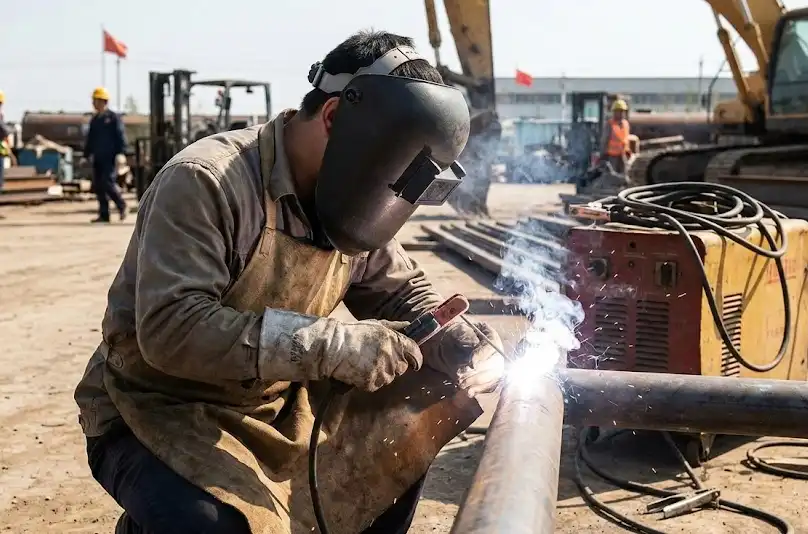
When the wind is gusting, the steel is rusty, and power comes from a small generator, stick welding (SMAW) is the process that keeps working. This guide shows you exactly how to set polarity and amperage, pick the right electrode for the mess in front of you, stabilize the arc in the wind, and verify that your welds will hold in the field. We’ll use numeric starting points, simple checkpoints, and a no‑nonsense troubleshooting matrix.
According to manufacturer and industry primers, SMAW remains robust in drafty and outdoor environments, while gas‑shielded processes often struggle with wind and shielding gas loss; see process comparisons and vertical‑position technique guidance from ESAB for context in 2025 resources like the manufacturer’s vertical stick welding techniques.
Key takeaways
- Use fast‑freeze rods (E6010/E6011) to dig through mill scale, paint, or light rust; switch to low‑hydrogen E7018 for strength‑critical passes once surfaces and fit‑up are under control. Keep E7018 dry and warm.
- Short arc, slight drag angle (about 5–15°), and portable windbreaks keep the puddle stable in gusts. If arc blow shows up, consider AC to calm it.
- Start amperage by diameter, then tune. For example, 1/8 in E6011 often runs ~90–130 A; 1/8 in E7018 often runs ~110–150 A. Reduce ~10–20% for vertical‑up/overhead. Always verify against your electrode’s package or datasheet.
- With generators and long cords, undersized power causes unstable arcs and poor fusion. Upsize extension gauge, shorten length, and choose a generator with overhead. Use a quick 10‑minute arc‑stability test before production.
- Preheat and interpass control dramatically cut hydrogen cracking risk on thicker or higher‑CE steels. Follow AWS‑informed methods and measure on the opposite surface.
Quick reference: electrodes, polarity, starting amps, and best field uses
Always verify against the specific electrode packaging or datasheet. Starting ranges below come from widely cited parameter guides and should be adjusted for position, machine, and joint conditions.
| Electrode | Typical polarity | Common diameters | Starting amps (flat/horiz) | Best outdoor/field uses |
|---|---|---|---|---|
| E6010 | DCEP (DC only) | 3/32, 1/8, 5/32 in | 3/32: 40–90 A; 1/8: 75–165 A; 5/32: 110–220 A | Deep penetration, fast‑freeze; roots, poor fit‑up, light rust/paint. Whip‑and‑pause. |
| E6011 | AC or DCEP | 3/32, 1/8, 5/32 in | Similar to 6010 above | Generator‑friendly; mitigates arc blow on AC; dirty steel and patch repairs. |
| E7018 | AC or DCEP (use 7018AC if low OCV) | 3/32, 1/8, 5/32 in | 3/32: ~70–110 A; 1/8: ~110–150 A; 5/32: ~150–220 A | Low‑hydrogen for strength‑critical passes; smooth, ductile beads. Drag technique; keep rods dry/warm. |
Parameter starting points referenced from reputable quick guides such as WeldGuru’s rod sizes and amperage ranges and comparative overviews of 6010 vs 6011 vs 7018 behavior. For AC stability with low‑hydrogen rods, note manufacturer families like ESAB’s Atom Arc 7018, with some variants formulated for AC starts; confirm on the package per ESAB’s 7018 overview.
Essential prep for outdoor repairs
You asked how to stick weld when the steel is rusty and the wind won’t quit. Think of prep as your force multiplier. Remove paint, heavy rust, oil, and moisture to bright metal wherever you can reach; even a 1–2 in strip at the toes of the joint can dramatically reduce porosity and slag traps. Make short, hot tacks to lock fit‑up, then chip and brush to bare metal before welding. For thicker or higher‑carbon‑equivalent steels, preheat to the AWS‑informed minimum and keep interpass at or above that temperature; practical overviews of D1.1 methods and alternatives are summarized in AWS Welding Digest’s preheat and interpass explainer (2025) and in a practitioner guide to determining preheat such as WeldingAnswers’ review of AWS methods. Measure temperature on the opposite surface for accuracy and heat uniformly as outlined in ESAB’s preheating and PWHT article.
Safety overlay: Work with the wind at your back to push fumes away, clear vegetation and combustibles, ground the generator properly, and maintain a fire watch. Outdoors, reflected UV can be harsh; cover skin and use proper shade.
Machine and power setup for a stable arc
Voltage drop from long, light‑gauge cords or an undersized generator shows up as an erratic arc, poor penetration, and beads that refuse to wet in. Size the generator with overhead: compute input volts × input amps, then add 20–30% headroom for surge. For extensions, stick with short, heavy‑gauge SOOW cords (often 6–8 AWG for 30–50 A 240 V supplies) and keep total length tight to minimize drop. See practical rules of thumb in WeldGuru’s generator sizing guide and their welder extension‑cord gauge summary.
Quick 10‑minute arc‑stability test: strike with the planned rod and settings, run a short bead, and watch the puddle. If you hear surging, see the arc cutting out, or the bead won’t tie in at normal heat, shorten the cord, upsize the cord gauge, or step up the generator. Arc blow causing the arc to wander? Reposition the work clamp closer to the joint, route leads together, and switch to AC when allowed—AC’s reversing field helps tame magnetic deflection per ESAB’s guidance on magnetic arc blow.
Step‑by‑step: three common outdoor scenarios
Below are field‑ready procedures with numeric starting points. Tune ±10–15 A to suit sound and bead shape, and reduce heat ~10–20% for vertical‑up/overhead.
1) Fillet weld on a rusty bracket (repair weld, flat/horizontal)
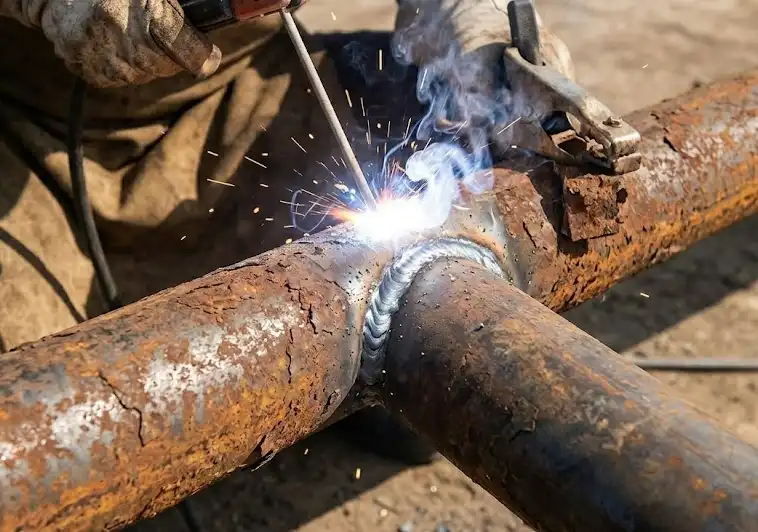
- Setup: Choose E6011 (AC or DCEP) when running off a portable generator or battling arc blow; E6010 (DCEP) is excellent if DC is stable. For 1/8 in E6011, start around 95–115 A flat; for E6010, 90–110 A is common. Verify on the package.
- Technique: Hold a short arc (about the core wire diameter), slight drag angle ~10–15°. Use a whip‑and‑pause: quickly step the arc ahead to dig, then pause to let the puddle fill and slag trail just behind. Keep the arc length tight in gusts.
- Checkpoints: Bead should be slightly convex with clean toes and a uniform slag line trailing behind the puddle. If porosity shows, shorten arc and add a small windbreak.
2) Vertical‑up on 1/4–3/8 in plate with E7018 (strength‑critical repair)
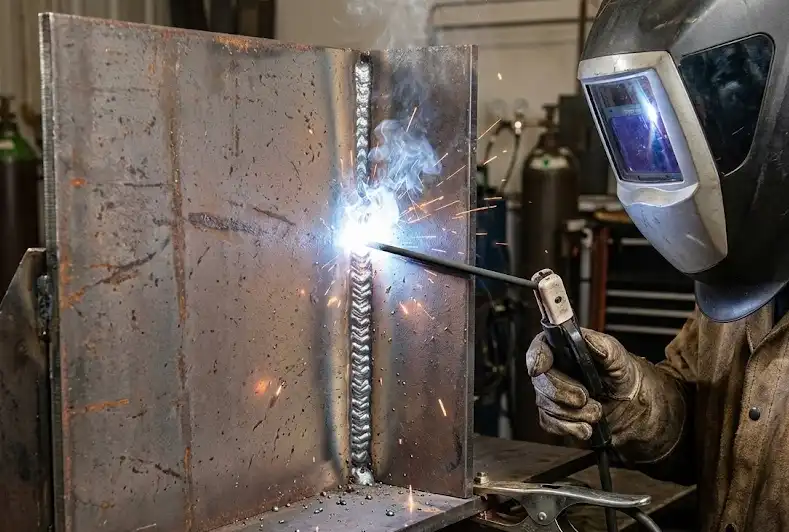
- Setup: Use AC or DCEP; 1/8 in E7018 typically runs ~110–150 A flat, but for vertical‑up drop to ~100–120 A to control the puddle. If using an older low‑OCV AC machine, consider a 7018AC‑labeled rod.
- Technique: E7018 prefers a drag approach. For vertical‑up, use a slight weave no wider than 2.5–3x rod diameter. Pause briefly at each side to wash the toes in, then step up half a bead height. Maintain a tight arc and consistent rhythm; guidance on angles and puddle control is outlined in ESAB’s vertical stick welding techniques.
- Handling: Keep E7018 warm and dry; swap any rod that hisses or steams on strike. More on correct storage and redrying is in ESAB’s storage/redrying guide.
- Checkpoints: Even, slightly convex beads with smooth tie‑in at the toes and easy‑lifting slag. Undercut means heat or travel is off—slow down and drop 5–10 A if needed.
3) Limited‑power butt repair with a gap (root and cap)
- Setup: With small generators, downsize the electrode to 3/32 in to keep amps within available power while still achieving fusion. For 3/32 in E6011 root, start ~70–90 A; cap with 3/32 in E7018 around ~80–100 A. Clean and chip between passes.
- Technique: Root with a tight arc and slight whip to bridge the gap, watching for keyhole control; cap with E7018 using a steady drag and tiny weave, pausing at the toes.
- Checkpoints: After the root, back‑gouge or confirm full fusion from the opposite side where feasible. Cap should be smooth with no trapped slag; if slag appears, your weave is too wide or travel too fast.
Wind and weather tactics that actually work
- Keep the arc short and the angle modest. A 5–15° drag angle helps the slag stay behind the puddle so the wind can’t get under it. ESAB’s angle‑control primers highlight how small changes stabilize the weld pool in out‑of‑position work; see the manufacturer’s stick electrode angle control overview.
- Build a portable windbreak: clamp a scrap sheet to sawhorses, park a truck windward, or use a small welding tent. If the puddle won’t stabilize and sparks are scattering dangerously, pause work.
- For arc blow, try AC, move the ground closer, and keep leads together to minimize stray fields.
Electrode handling: low‑hydrogen discipline in the field
Low‑hydrogen electrodes (E7018 family) must stay dry to avoid hydrogen‑assisted cracking. After opening, hold them warm—many manufacturers recommend roughly 225–300°F (107–149°C) in a rod oven; if moisture pickup is suspected, follow the maker’s redrying window (often in the 500–800°F/260–427°C range for 1–2 hours, product‑specific). Do not store cellulosic rods (6010/6011) in the same hot oven or you’ll degrade their coatings. Practical numbers and cautions are summarized in Hobart’s filler‑metal storage bulletin and ESAB’s redrying guidance. Keep cans sealed until use, segregate rod types, and discard any that crackle or steam on strike.
Troubleshooting matrix for harsh conditions
| Defect | Likely outdoor causes | Immediate fix | Prevention |
|---|---|---|---|
| Porosity | Damp E7018, long arc, wind disturbing slag/gases, dirty steel | Re‑dry/replace rods; shorten arc; erect windbreak; clean base | Warm/hold low‑H rods; seal cans; clean to bright metal; control wind per guidance |
| Slag inclusions | Pushing instead of dragging; inadequate cleaning; low heat | Switch to drag; chip/brush; raise amps modestly | Keep arc short; clean between passes; avoid wide weaves |
| Undercut | Excess amperage; fast travel; poor angle; windy instability | Lower amps; slow slightly; correct angle | Tune amps to diameter; screen the wind; pause at toes on vertical‑up |
| Lack of fusion | Low amps; fast travel; dirty joint; voltage drop | Increase amps; slow; clean; shorten/upsized cords; bigger generator | Verify power setup before welding; confirm puddle wets in |
| Arc wander (arc blow) | Residual magnetism; lead routing; clamp location | Move clamp closer; bundle leads; switch to AC | Plan ground placement; avoid wrapping leads around steel |
Troubleshooting guidance aligns with manufacturer primers such as ESAB’s welding defects guide and field‑focused checklists from UNIMIG’s common stick‑weld problems and fixes.
Post‑weld verification in the field
Clean to bare metal and inspect in good light. Look for uniform bead profile, smooth toes without undercut, and no visible porosity or trapped slag. If a sample piece is available, perform a simple bend or hammer test to confirm fusion. Maintain interpass temperature where multi‑pass work continues. When structural performance is critical or code applies, follow the governing WPS and acceptance criteria.
Short FAQ
What amperage do I start with for 1/8 in E7018 outdoors? Start near 110–130 A for flat/horizontal and reduce to ~100–120 A for vertical‑up. Tune by listening to a steady arc and watching a smooth, slightly convex bead. Always confirm against your electrode’s packaging.
Can I run E7018 on AC from a small generator? Yes, many E7018 electrodes work on AC, and AC helps if you’re fighting arc blow. For older low‑OCV AC machines, look for “7018AC” on the package for easier starts, as highlighted in manufacturer overviews of low‑hydrogen families.
How to stick weld in strong wind without ruining the bead? Use a short arc and a 5–15° drag angle, set a portable windbreak, and, if needed, pause during strong gusts. The process is more tolerant than gas‑shielded methods, but wind can still destabilize slag coverage.
What if my arc is surging or cutting out on a long cord? That’s often voltage drop. Shorten the cord, move to a heavier gauge (6–8 AWG for higher‑amp 240 V draws), or step up generator size. Validate with a quick arc‑stability test before committing to the full weld.
Final notes on how to stick weld outdoors
Here’s the deal: outdoors, control is everything—arc length, angle, amps, and power delivery. Use E6010/6011 to open up dirty joints, then switch to dry, warm E7018 when you need strength and toughness. Respect preheat and interpass, put the wind at your back, and verify with quick checks. That’s how to stick weld with confidence when the environment isn’t doing you any favors.