
Selecting the wrong sheet metal grade isn’t just a minor mistake—it can lead to catastrophic structural failures, blown budgets, and severe manufacturing delays. When you are staring at a material spec sheet filled with alphanumeric codes, knowing exactly what those designations mean is your first line of defense against poor performance.
As veterans in material sourcing and fabrication, we rely heavily on precise, standardized grades to ensure every component we produce meets exact engineering tolerances. Standardized metal grades streamline communication across global markets, ensuring that a fabricator in Germany and an engineer in the US are talking about the exact same material. In this guide, we will decode the complex world of sheet metal designations, helping you navigate global grading systems to source materials with absolute confidence.
Understanding Grade Designations
The Purpose of Designations
At their core, metal grade designations serve as a universal language. They communicate the chemical composition, mechanical properties, and manufacturing history of a metal without the need for lengthy descriptions. According to the American Society for Metals (ASM International), standardization is critical for ensuring material traceability, an essential requirement for maintaining ISO 9001 compliance in manufacturing. Designations guarantee that the sheet metal will perform predictably under specific stresses, temperatures, and corrosive environments.
How Grades are Structured
Grades are typically structured as alphanumeric codes. The letters and numbers are not random; they systematically identify the base metal, primary alloying elements, and sometimes the specific heat treatment or processing method used. For instance, the first digit might indicate the metal class, while subsequent digits represent the percentage of carbon or other vital elements.
Common Global Standards
AISI/SAE and ASTM Foundations
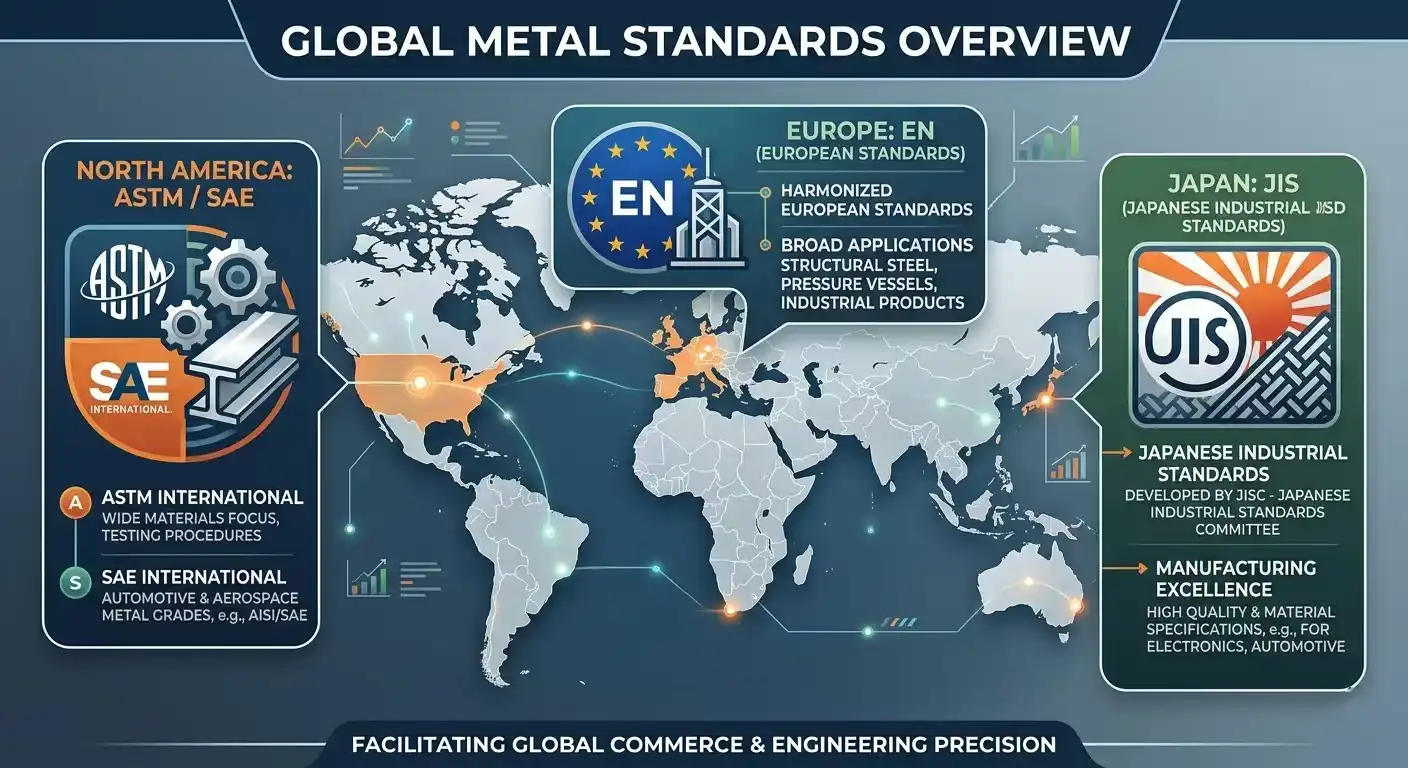
In North America, the AISI (American Iron and Steel Institute) and SAE (Society of Automotive Engineers) systems primarily classify metals based on their chemical composition (e.g., SAE 1018 steel). Conversely, ASTM International (formerly the American Society for Testing and Materials) classifies metals based on their mechanical properties and performance standards (e.g., ASTM A36). Understanding the interplay between these two—where SAE dictates what is in it and ASTM dictates how it performs—is crucial for effective sourcing.
EN and JIS Basics
When sourcing internationally, you will frequently encounter the EN (European Norms) and JIS (Japanese Industrial Standards) systems.
- EN Standards: Often begin with a letter indicating the application (e.g., “S” for structural steel in EN 10025) followed by the minimum yield strength.
- JIS Standards: Typically start with “JIS,” followed by a letter for the material category (e.g., “G” for carbon and alloy steels), and a specific grade identifier (e.g., JIS G3101 SS400).
Carbon Steel Grades and Letters
A, B, C Series Overview
When dealing with carbon steel sheet metals, you will often see grades appended with letters like A, B, or C (e.g., ASTM A283 Grade A, Grade B, Grade C). These letters generally signify a step-up in carbon content, tensile strength, and yield strength. Grade A is typically the most ductile and easiest to form or weld, while Grade C or D will offer higher strength at the expense of formability. Consulting the exact ASTM material specification is necessary to verify the acceptable ranges for carbon, manganese, and phosphorus in these subsets.
Alloy and Stainless Steel Grades
Chrome, Nickel, and Alloying Elements Impact
Stainless steel sheet metals rely heavily on chromium and nickel for their defining characteristics. The widely used 300 Series (governed by standards like SAE J405) represents austenitic stainless steels.
- Grade 304: Contains 18% chromium and 8% nickel, making it the standard workhorse for general corrosion resistance.
- Grade 316: Adds molybdenum, significantly increasing its resistance to chlorides and harsh marine environments. Understanding how these alloying elements impact the microstructure is key to preventing issues like galvanic corrosion in your assemblies.
Nonferrous Metal Grades (Al, Cu, Ti)
Aluminum Alloys (Series 1xxx, 2xxx, 6xxx, 7xxx)
For lightweight sheet metal applications, aluminum is king. The Aluminum Association (AA) designation system categorizes wrought aluminum into series based on their principal alloying elements:
- 1xxx Series: 99% pure aluminum; highly conductive and corrosion-resistant, but structurally weak.
- 2xxx Series: Copper alloyed; offers aerospace-grade strength but requires cladding for corrosion protection.
- 6xxx Series: Magnesium and silicon alloyed; the sweet spot for structural integrity, weldability, and formability (e.g., 6061-T6).
- 7xxx Series: Zinc alloyed; some of the highest strength alloys available, commonly used in high-stress aviation and military applications.
Reading a Metal Grading Sheet
Key Fields: Grade, Specification, Heat Treatment
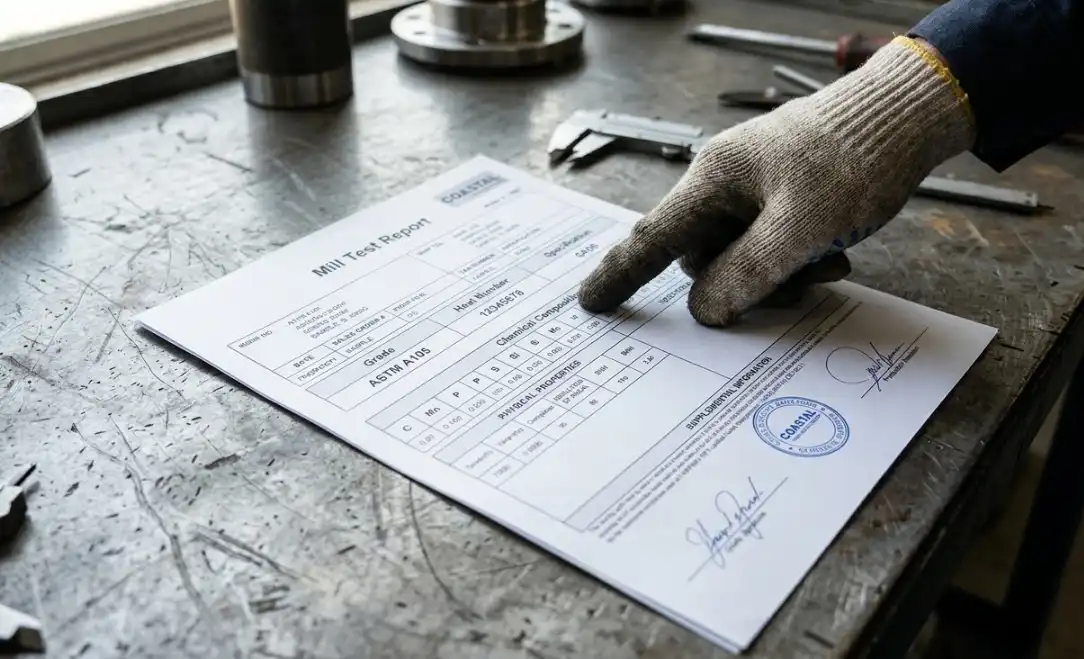
When a supplier delivers sheet metal, it should come with a Mill Test Report (MTR). To ensure safety and compliance (especially critical for ASME BPVC applications), verify these key fields:
- Grade/Specification: Matches your exact PO requirement (e.g., ASTM A240 Type 316L).
- Heat Number: The unique tracking code for the batch of molten metal it originated from.
- Heat Treatment: Indicates tempers or annealing processes (e.g., the “T6” in 6061-T6, indicating it was solution heat-treated and artificially aged).
Practical Applications and Selection Tips
Matching Grade to Service Conditions
Material selection must always be reverse-engineered from the service environment. If a sheet metal enclosure is going to be submerged in seawater, specifying 304 stainless will lead to rapid pitting; you must upgrade to 316. If you are stamping intricate automotive body panels, deep-drawing carbon steels like interstitial-free (IF) steel will prevent tearing during fabrication.
Common Pitfalls and Checks
The most common and dangerous pitfall is assuming “equivalent” international grades are 100% identical. For example, while Chinese GB Q235, Japanese JIS SS400, and American ASTM A36 are often treated as cross-equivalents for structural steel, their permissible chemical variances differ. Always verify the actual chemical and mechanical properties on the MTR rather than relying purely on cross-reference charts.
Conclusion
Metal grade designations are the foundational blueprints of modern manufacturing. They dictate everything from material selection and international procurement to the final performance and safety of your fabricated parts. By understanding the nuances between ASTM, SAE, EN, and the various alphanumeric series, you empower your procurement and engineering teams to make cost-effective, high-quality decisions. When in doubt, always fall back on official material specifications and demand certified Mill Test Reports from your suppliers.
Ready to start your next sheet metal project? Don’t leave your material selection to guesswork. [Browse our material catalog / Contact our engineering team today] to get an expert consultation and a precise quote for the exact metal grades your project requires.
FAQs
What is the difference between a grade designation and a specification?
A grade designation (like 304L) refers specifically to the chemical composition and inherent properties of the metal itself. A specification (like ASTM A240) is a broader document that dictates the exact standards the material must meet, including manufacturing methods, testing procedures, dimensional tolerances, and the acceptable limits for the specific grade.
How do heat treatment and processing affect grade performance?
Two identical pieces of metal with the exact same chemical grade can perform entirely differently based on heat treatment. Processes like annealing make the metal softer and more ductile for forming, while quenching and tempering (or artificial aging, like in aluminum T6 tempers) lock the microstructure to significantly increase tensile and yield strength.
Where can I find authoritative sources for metal grade standards?
You should always consult the official standardizing bodies for your region. Authoritative sources include the ASTM International digital library, the SAE International standards database, ASM International’s handbooks, and the Aluminum Association’s “Teal Sheets.”
References
- ASTM International: Search for “ASTM Compass standards for steel and metals“
- The Aluminum Association: Search for “Aluminum Association Alloy Designation System“
- ASM International: Search for “ASM Materials Information“