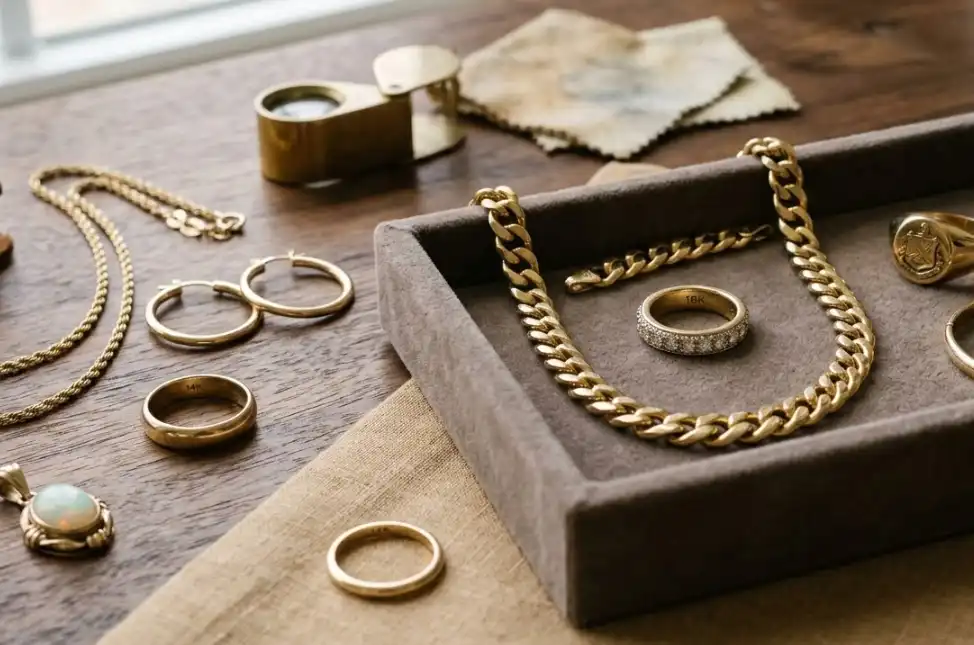
Gold doesn’t “snap” from solid to liquid the way ice becomes water. Pure gold does, but the karat alloys we cast every day—14K and 18K in yellow, rose, and white—melt across a range. That range is your working window. Get it right and you’ll see clean fills, tight grain, and bright surfaces. Miss it and you invite porosity, cold shuts, or worse.
This guide puts the essential numbers at your fingertips with an at‑a‑glance 14k/18k gold melting point chart, then walks you through step‑by‑step melting and casting workflows for torch, furnace/kiln, and induction. You’ll also get measurement best practices, safety notes, and a quick troubleshooting section—so you can pour with confidence.
Key takeaways
- “Melting point” for karat golds is really a melting range: from solidus (starts to melt) to liquidus (fully molten).
- Start with a pour temperature about 100°F (≈38°C) above your alloy’s liquidus; increase superheat for intricate geometry or high‑Pd whites.
- Nickel white and palladium white behave differently: Pd whites run hotter and often need more superheat capacity; Ni whites can be trickier to cast cleanly.
- Accurate temperature control matters: prefer noble‑metal thermocouples or short‑wavelength pyrometers; long‑wave IR guns are unreliable on bright molten gold.
- Synchronize metal superheat with flask temperature and burnout completion to avoid porosity and cold shuts.
- Always follow PPE, ventilation, and materials safety guidance; confirm exact windows on your supplier’s current datasheet.
14k/18k gold melting point chart (°C/°F) at a glance
Below are representative ranges for common jewelry alloys. Exact values vary by supplier chemistry (Ag/Cu/Zn/Ni/Pd) and deoxidizers. Always confirm with your specific casting grain or alloy datasheet.
| Karat | Color/Alloy family | Solidus (°C/°F) | Liquidus (°C/°F) | Typical casting guidance |
|---|---|---|---|---|
| 24K | Pure gold | 1064°C / 1947°F | — | Reference constant for calibration and context |
| 14K | Yellow (Au‑Ag‑Cu) | ≈ 879–895°C / 1615–1643°F | ≈ 905–932°C / 1661–1710°F | Pour ≈ liquidus + 38–80°C (100–150°F) depending on detail |
| 14K | Rose/Red (higher Cu) | ≈ 935°C / 1715°F | ≈ 966°C / 1770°F | Start at liquidus + ≈38°C (100°F); increase for thin sections |
| 14K | White (Nickel) | ≈ 984°C / 1803°F | ≈ 1000°C / 1832°F | Needs reliable heat; pour ≈ +38–80°C (100–150°F) over liquidus |
| 14K | White (Palladium) | ≈ 1079°C / 1974°F | ≈ 1094°C / 2001°F | Often requires higher superheat capability and controlled atmosphere |
| 18K | Yellow (Au‑Ag‑Cu) | ≈ 860°C / 1580°F | ≈ 900°C / 1650°F | Typical cast temp around 1000°C (1830°F) per example sheets |
| 18K | White (Nickel) | ≈ 893°C / 1640°F | ≈ 941°C / 1725°F | Pour ≈ liquidus + ≈38°C (100°F); monitor for cracking risk |
Source highlights for the chart and guidance:
- Pure gold reference is based on NIST’s ITS‑90 fixed point for gold at 1064.18°C (1947.52°F); see the descriptive anchor in Sources.
- Representative 14K/18K alloy windows and casting guidance are drawn from selected supplier pages and instruction sheets and practitioner articles; see the specific, dated links in Sources.
Solidus vs liquidus vs casting temperature—what they mean on the bench
Think of an alloy like a slushy: at the solidus temperature, the first “melted pockets” appear; at the liquidus, it’s fully liquid and ready to flow. The gap between those points is the freezing range. Your casting temperature sits above liquidus by a margin called superheat.
- Solidus: where melting begins. Below it, the metal is fully solid.
- Liquidus: where melting ends. Above it, the metal is fully molten.
- Superheat: the extra degrees you add so the metal stays fluid during the pour and gate/runner travel.
Why superheat matters
- Too little superheat: incomplete fill, cold shuts, poor detail.
- Too much superheat: gas pickup, oxidation/dross, greater porosity risk, rough surfaces.
Practical targets
- Colored 14K/18K (yellow/rose): Start around liquidus + 38°C (100°F). Increase toward +80°C (150°F) for fine filigree, long runs, or very thin sections.
- White golds: Nickel whites often cast in the lower end of superheat windows but can be touchy; palladium whites typically run hotter and may require higher superheat capability, particularly on complex trees.
How alloy chemistry shifts melting behavior
- Yellow golds (Au‑Ag‑Cu): Silver tends to lower the melting range and improve flow; copper raises strength and can widen the freezing range slightly. Most 18K yellows melt lower than 14K whites despite higher gold content because whites contain Ni or Pd.
- Rose/Red golds (higher Cu): Copper content raises the melting range relative to yellows and increases oxidation risk during long holds. Keep superheat moderate and holds brief.
- White golds (Nickel vs Palladium): Nickel additions raise strength and can make casting less forgiving (cracking, porosity) but with lower liquidus than Pd whites. Palladium whites push melting ranges higher and often demand more superheat and tighter temperature control, especially for intricate work.
Here’s the deal: the “best” casting window is alloy‑specific. Always put your supplier’s liquidus at the center of your plan and tune superheat, flask temperature, and hold time to the job.
Choosing equipment: torch, furnace/kiln, or induction
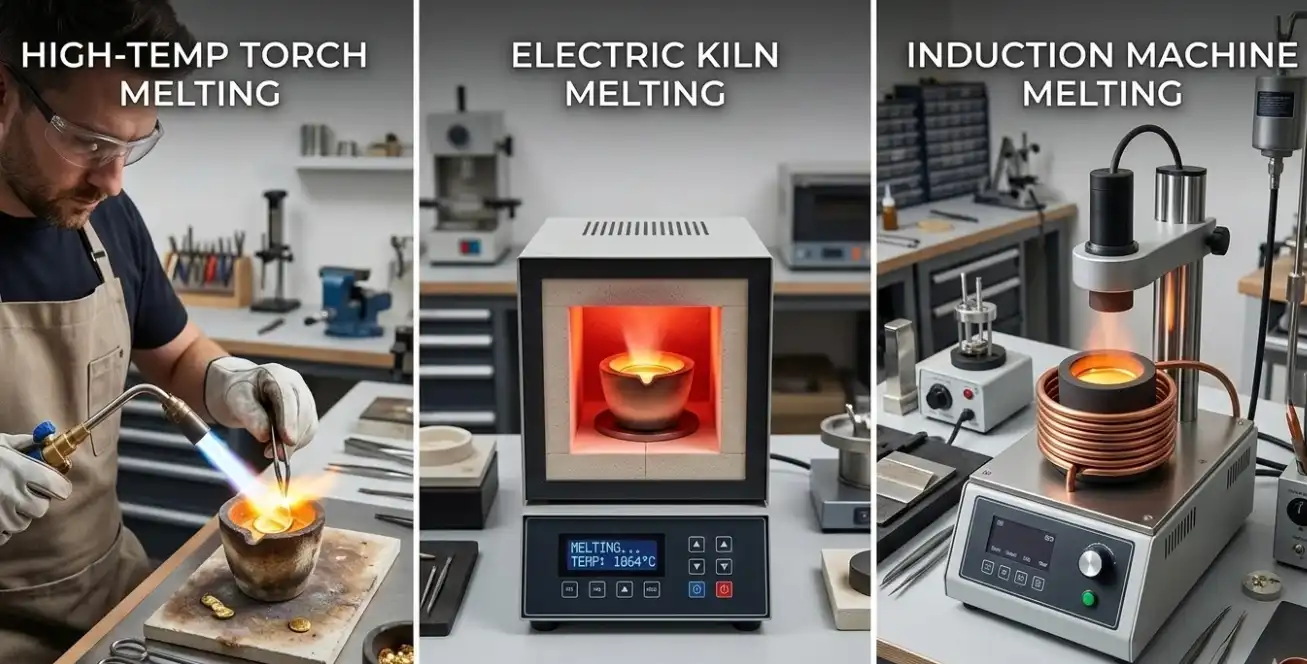
Your workflow decides how precisely you can hold “gold casting temperature vs melting point.” All three paths can produce excellent results if you respect their limits.
- Torch melting
- Pros: Low cost, tactile control, fast changeovers.
- Watch‑outs: Variable superheat, oxidation risk, operator dependence. Long‑wave IR guns are unreliable for temperature feedback.
- Electric furnace/kiln
- Pros: Stable PID temperature control, easier to synchronize with flask pull.
- Watch‑outs: Slower heat‑up; avoid long holds at superheat to limit gas pickup.
- Induction melting
- Pros: Rapid, uniform heating, excellent for high‑melt alloys and production repeatability.
- Watch‑outs: Higher capital cost; requires appropriate pyrometry and coil/crucible compatibility.
Step‑by‑step melting and casting workflows
Torch workflow (small batches/findings)
Equipment
- Torch (air/fuel or oxy/fuel sized for the alloy), graphite or clay‑graphite crucible, borax/boric‑based flux, skimmer, tongs, protective eyewear/face shield, heat gloves, local exhaust.
Prep
- Inspect and preheat the crucible to a dull red; dust a light glaze of flux.
- Charge clean casting grain and approved returns (follow supplier limit on scrap percentage). Cover with a light flux coat.
Melt and pour
- Heat steadily, keeping the flame slightly reducing to limit oxidation. Watch the surface: when it turns mirror‑bright and swirls freely, you’re near liquidus.
- Target superheat: for common 14K/18K yellows and roses, aim for ≈+100–150°F (≈+38–80°C) above liquidus; for Pd whites, ensure your torch can achieve the higher window.
- Skim oxides cleanly, then pour smoothly into the preheated flask. Avoid agitation that entrains air.
Safety cues
- Use a face shield over ANSI Z87.1 eyewear. Wear a leather apron and heat‑rated gloves. Keep a Class D extinguisher accessible. Maintain active local exhaust.
Electric furnace/kiln workflow (controlled melting)
Equipment
- Bench‑top furnace with PID control, noble‑metal thermocouple (Type S/R/B) or short‑wavelength pyrometer, ceramic or clay‑graphite crucible, investment burnout oven, vacuum/centrifugal casting setup.
Procedure
- Program a ramp to just below liquidus, then to target superheat. Hold only 1–3 minutes for temperature equalization.
- Coordinate burnout: pull the flask at the target temperature per investment instructions (commonly 800–1200°F, alloy and investment dependent) and cast within the recommended window.
- Pour with steady motion; avoid excessive turbulence.
Quality notes
- Don’t hold the melt at superheat longer than necessary; it increases gas pickup and oxide formation.
Induction workflow (production and high‑melt whites)
Equipment
- Induction melter with appropriate coil, optical pyrometer (short‑wavelength) or Type S/R/B thermocouple, inert gas cover if available, compatible crucibles.
Procedure
- Charge dry, clean grain and pre‑weighed returns. Start under inert cover if your system supports it.
- Ramp rapidly to liquidus, then to target superheat. Hold briefly (seconds to a minute), verify temperature, and pour.
Advantages
- Fast, uniform heating reduces gradients and shortens time at superheat—useful for porosity control and for high‑Pd white alloys that need hotter, tighter control.
Measurement and temperature‑control best practices
- Choose the right sensor: Noble‑metal thermocouples—Type S, R, or B—are designed for high‑temperature accuracy in the gold range. Manufacturer data sheets detail their usable ranges and drift characteristics; see the descriptive anchor in Sources.
- Placement matters: Immerse the protected junction into the melt away from the crucible wall. Use ceramic sheaths rated for temperature and chemistry.
- Beware IR pitfalls: Bright molten gold has very low long‑wave emissivity, so handheld IR guns can be wildly off unless you control reflections and emissivity. Prefer short‑wavelength optical pyrometers for non‑contact work; see the IR theory/calibration notes linked in Sources.
- Calibrate on a schedule: Cross‑check instruments periodically. If practical, note the freeze plateau on cool‑down as a sanity check.
Safety, flux, and compliance essentials
- PPE and environment: Eye protection (ANSI Z87.1), face shield for pours, heat‑resistant gloves, leather apron, closed‑toe leather footwear. Provide local exhaust/hood over burnout, melting, and quench areas.
- Fluxes and deoxidizers: Follow the current SDS for your flux and alloy. Avoid cadmium‑bearing solders and fluxes; many jurisdictions restrict cadmium in jewelry.
- Nickel awareness: For articles in prolonged skin contact shipped to the EU, nickel release is restricted under REACH. Nickel‑white alloys also carry sensitization risks for shop staff; review SDS and local requirements.
- Documentation: Maintain SDS for all materials, train staff on hazards, and label containers per your country’s regulations.
Troubleshooting: fast symptom → cause → fix
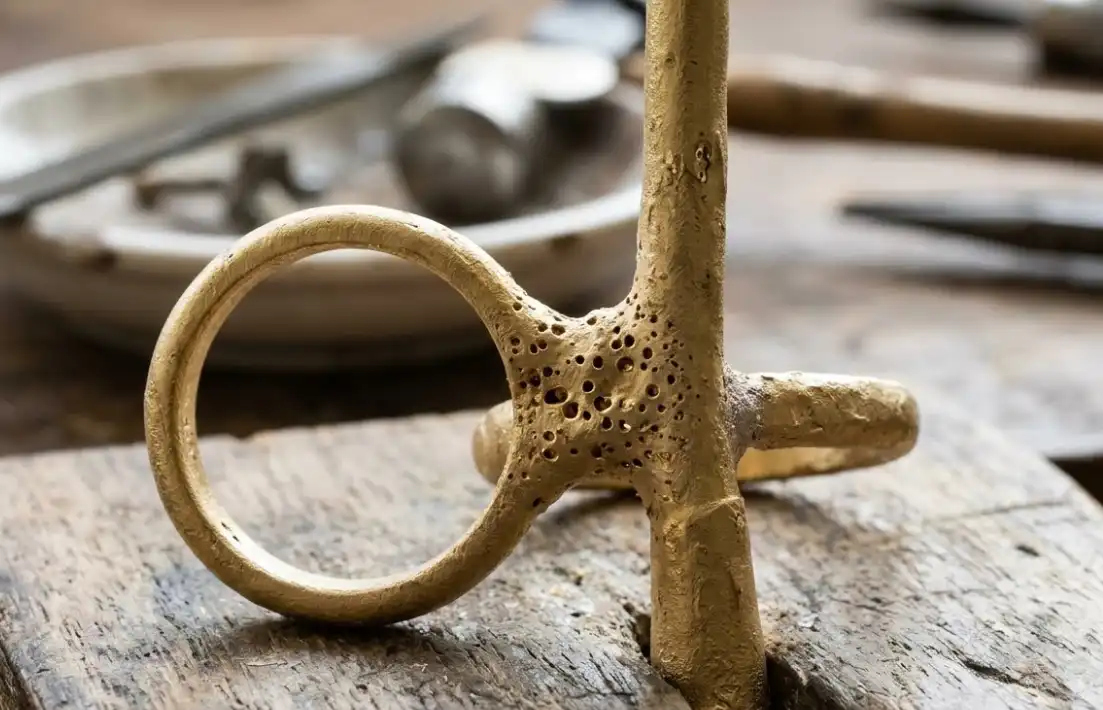
Porosity (gas/shrinkage)
- Cause: Excess superheat/long hold; inadequate deoxidizers; flask too cool; poor venting.
- Fix: Reduce superheat toward the low end; shorten hold; raise flask temperature within investment guidance; verify complete burnout; consider protective atmosphere.
Incomplete fill or cold shuts
- Cause: Metal too cool; flask too cool; narrow gates; premature turbulence.
- Fix: Increase pour temperature in 25–50°F steps; raise flask temperature; refine gating and sprue design; smooth the pour motion.
Rough, oxidized surface or firescale (esp. rose)
- Cause: Overheating and/or long holds; oxidation.
- Fix: Minimize time at superheat; maintain a clean, slightly reducing flame or protective cover gas; skim oxides thoroughly; keep returns clean.
Cracking in nickel‑white casts
- Cause: Alloy brittleness; thermal shock; insufficient superheat.
- Fix: Ensure adequate superheat and controlled cooldown; review quench timing per supplier; consider Pd‑white alternatives if issues persist.
FAQ
Q: What’s the actual melting point of pure gold?
A: 1064.18°C (1947.52°F) at one atmosphere, per national metrology references. See Sources for the NIST fixed‑point value.
Q: Why does 14K or 18K gold have a range instead of one number?
A: Alloying elements create a freezing range between solidus and liquidus. Different suppliers tweak Ag/Cu/Zn/Ni/Pd content and deoxidizers, shifting those endpoints.
Q: How hot should I pour 14K yellow gold?
A: As a starting point, about 100°F (≈38°C) above your supplier’s stated liquidus; increase for fine detail or long runs, and always confirm against your datasheet.
Q: Are 14K and 18K white gold the same melting temperature?
A: No. Nickel‑white and palladium‑white formulations differ. Typical Ni‑white liquidus values can be lower than Pd‑white, but Pd‑white often needs higher superheat capability and tighter temperature control.
Q: Can I rely on a handheld IR thermometer for molten gold?
A: Not reliably. Bright, low‑emissivity metals at gold temperatures fool long‑wave IR guns. Use a noble‑metal thermocouple or a short‑wavelength optical pyrometer for trustworthy readings.
Sources and further reading
- NIST reference for the freezing point of gold (1064.18°C) as part of the ITS‑90 fixed points: see the official overview in the Kelvin redefinition page: NIST — Kelvin: ITS‑90 fixed points (gold).
- Representative 18K yellow alloy tech sheet with explicit solidus/liquidus and casting recommendation (e.g., cast at ~1000°C/1830°F; flask ~1150°F/620°C): Supplier technical sheet for an 18K yellow alloy.
- Example casting grain pages providing melt ranges and practical casting notes for 14K/18K whites and roses (solidus/liquidus listed on page): Example: 14K Nickel‑White casting grain; Example: 14K Palladium‑White casting grain; Example: 14K Rose casting grain; Example: 18K Nickel‑White casting grain.
- Practitioner perspective on superheat windows for colored karat golds and white‑gold behavior: Ganoksin — Colored Karat Golds for Investment Casting and Ganoksin — Alloys: Look on the White Side.
- Additional general chart for metals’ “melting points” (useful as secondary corroboration only): Fire Mountain Gems — Melting Points of Metals chart.
- High‑temperature measurement references for thermocouples and IR emissivity/calibration: Omega — Type R/S/B thermocouple ranges (SPPL); Omega — Infrared temperature measurement theory and emissivity; Fluke — Infrared temperature calibration basics.
Notes on variability and use
Alloy chemistry varies by manufacturer; treat these numbers as representative starting points. When precision matters, defer to your supplier’s current datasheet for the exact solidus, liquidus, casting, and flask temperatures for the product you’re using.