
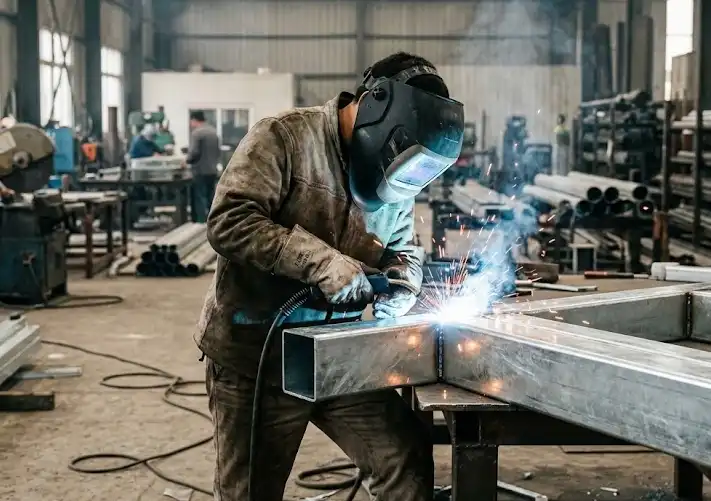
Yes, you can weld galvanized steel—but not the way you weld plain carbon steel. To do it safely and repeatably on a production line, you need three pillars working together: remove or tightly control zinc at the joint, capture welding fumes at the source, and follow a respirator program when monitoring shows potential overexposure. Then, after the weld, restore corrosion protection according to accepted repair methods. This guide focuses on batch manufacturing, where takt time, compliance, and rework rates make or break margins.
Key takeaways
- Zinc coatings generate zinc oxide fume when heated; control starts with coating removal near the joint and source capture at the arc. OSHA requires ventilation sufficient to keep exposures below harmful levels, and a full respirator program when engineering controls are not enough.
- For batch lines, the most dependable results come from a defined surface prep method, capture-at-source local exhaust ventilation, monitoring to verify exposures against limits, and post-weld coating repair per established methods.
- Your choice among grinding, chemical stripping, laser ablation, or weld-through plus repair should be driven by volume, quality targets, fixture constraints, waste handling capacity, and total cost per part—not by tradition alone.
Safety and compliance essentials for shop floor lines
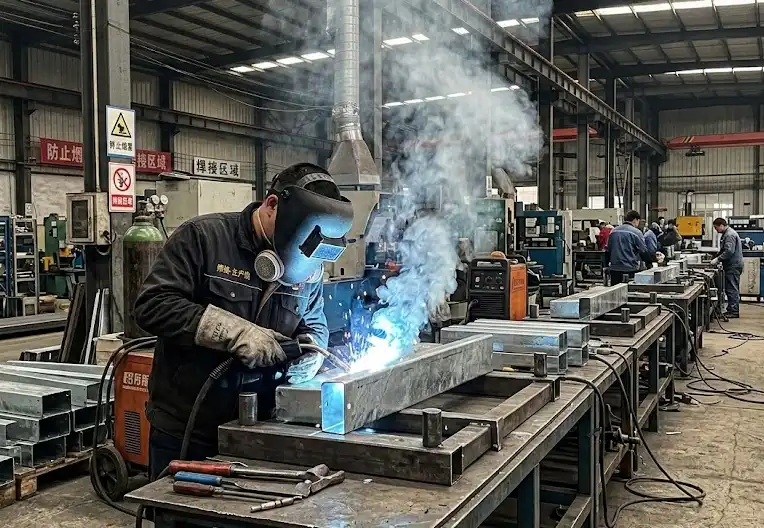
Start with the standards. Indoor welding on galvanized steel must keep toxic fume concentrations below harmful levels. According to the official standard for welding, cutting, and brazing, employers must provide local or general mechanical ventilation, especially when working on coated metals where toxic fumes may be generated. See the authoritative requirements in OSHA’s Welding, Cutting, and Brazing standard in 29 CFR 1910.252 at the official page: OSHA welding, cutting, and brazing 1910.252.
Zinc oxide exposure limits. OSHA lists a permissible exposure limit for zinc oxide fume of 5 mg/m³ as an 8 hour time weighted average. The agency’s chemical data page also notes dust limits and recognizes metal fume fever as a risk from acute overexposure. Review the exposure limits and health effects on the official page: OSHA chemical data for zinc oxide.
NIOSH recommends a 5 mg/m³ time weighted average and a 10 mg/m³ short term exposure limit for zinc oxide fume, with an immediately dangerous to life or health value of 500 mg/m³. These values inform monitoring and respirator selection. See the reference details here: NIOSH Pocket Guide entry for zinc oxide.
Respirators when needed. When engineering and administrative controls cannot maintain exposures below limits, employers must implement a written respiratory protection program that covers medical evaluation, fit testing, training, selection, maintenance, and recordkeeping. Review the core program elements on OSHA’s official resource: OSHA respiratory protection 1910.134.
Industry safety practices align on the hierarchy of controls for welding fume and the need for effective local exhaust ventilation with appropriate personal protective equipment. The consensus safety standard outlines these expectations and complements OSHA rules. See the landing page for the consensus standard: ANSI AWS Z49.1 Safety in Welding.
Design choices matter. For batch manufacturing, plan the work cell around source capture. High vacuum fume extraction torches, well placed arms, or downdraft fixtures need to be close to the arc and kept clear of jigs and conveyors. General dilution alone is usually not sufficient. Health hazard evaluations from federal researchers repeatedly show that capture at the point of generation is the most reliable way to reduce exposures during production welding. A representative example shows how close capture and verification sampling are applied in practice: NIOSH Health Hazard Evaluation example for welding shops.
Finally, plan for corrosion protection after the weld. When welding galvanized components, remove the coating near the joint, and after the weld is complete, restore protective zinc by accepted methods such as zinc rich paint, zinc based solder, or metallizing. See practice recommendations for welding and repair from industry authorities: American Galvanizers Association guidance on welding and thermal cutting. For the repair methods themselves, see the standard’s abstract: ASTM A780 repair of galvanized coatings.
Methods to prepare joints when welding galvanized steel
On a line, the method you choose to manage zinc at the joint dictates fume generation, weld quality, and cycle time. The table below compares common approaches for batch production.
| Method | Throughput on lines | Quality and rework | EHS and compliance notes | When it tends to fit | Cost considerations |
|---|---|---|---|---|---|
| Mechanical removal by grinding or abrasive tools | Operator dependent; typically adds manual seconds to minutes per joint; bottleneck risk at high volume | Good when coating is fully cleared; risk of rounding edges and variability; spatter reduced when prep is thorough | Requires dust control and housekeeping; reduces zinc fume at arc when executed well | Low to medium volume cells; mixed geometries; flexible work | Low capital; ongoing abrasives and labor; training and QA oversight add cost |
| Chemical stripping by acid degalvanizing upstream of the weld | Batchable with dwell, rinse, and neutralize steps; predictable once dialed in | Consistent removal and activated surface; strong base for cosmetic requirements | Introduces chemical handling, wastewater, and permitting; acid mist controls needed | Facilities with existing chemical infrastructure; pre paint lines | Moderate capital and chemical OPEX; waste management and compliance overhead |
| Laser ablation of zinc in the weld zone | Highly repeatable and precise; can be integrated in cell or inline; short cycle times on defined paths | Minimal substrate damage; strong reduction of porosity risk; stable appearance | Requires plume capture with HEPA filtration; eye and skin protections; monitor plume constituents | Medium to high volume with automation; tight QA thresholds; complex geometries | Higher capital; potential savings in rework, consumables, and takt time |
| Weld through coating with post weld repair | Fast at the torch but defect prone; parameter sensitive; may not hold cosmetic standards | Highest risk of porosity, spatter, and lack of fusion; rework often offsets speed | Demands robust local exhaust and exposure monitoring; still requires post weld coating repair | Limited use where joints are forgiving and finish is secondary | Apparent low cycle time but hidden costs in rework, fume controls, and repairs |
How to read the table. If you are struggling with porosity and inconsistent bead appearance, assume the zinc is part of the problem until proven otherwise. If fixture access allows, a repeatable prep that removes coating within the planned weld path will usually stabilize quality. Where batch chemistry or waste handling is not feasible, look at precision dry methods. Where volumes are low and flexibility is key, mechanical options remain serviceable with good SOPs.
Ventilation and exposure control for production lines
Capture at the source. Place high vacuum fume guns or extraction arms as close to the arc as practical and keep the capture path free of cross drafts. When fixtures or jigs obstruct the hood, consider downdraft tables or slot hoods integrated into the tooling. Use smoke tests during setup to verify that the fume stream is being pulled into the hood rather than toward the breathing zone. General ventilation may help background concentrations but is not a substitute for capture at the point of generation in most indoor welding of galvanized parts.
Validate with monitoring. Conduct task based and full shift sampling for zinc oxide where galvanized components are welded. Compare measured values against the time weighted average and short term limits referenced above. Track results against specific stations and fixture setups so adjustments can be targeted and verified.
Respirator program essentials
- Hazard evaluation shows potential to exceed limits or monitoring indicates exceedance. Select appropriate respirators such as P100 filters or powered air purifying respirators, escalating to supplied air in confined or high load tasks.
- Implement the elements required in the standard program, including medical evaluation, fit testing, user training, maintenance, and records under competent supervision.
- Do not rely on respirators to replace engineering controls. Use them while improving capture and process controls until exposures are consistently below limits.
Welding process and quality control on galvanized stock
Why zinc drives defects. At welding temperatures, zinc vaporizes and can form gas pockets that get trapped as the puddle solidifies. Residual zinc at lapped or tight faying surfaces can also blunt penetration and drive lack of fusion. Consistent removal at the joint and stable heat input bring porosity and fusion issues under control.
Process notes without prescribing numbers. Short circuit gas metal arc welding on thin sheet is common, while pulsed transfer is often used to improve stability and appearance. Flux cored options can improve wetting, and argon carbon dioxide shielding blends are typical choices. The right answer is to qualify and document parameters through a welding procedure specification and maintain it through change control.
Inspection and repair. Inspect for porosity, lack of fusion, undercut, and surface integrity to acceptance criteria from the applicable code or customer requirements. After welding, restore zinc protection on affected areas using methods recognized for hot dip galvanized coatings such as zinc rich paint, zinc based solder, or thermal spray. Detailed method descriptions are available in the repair standard referenced earlier.
Economics and decision tools for batch manufacturing
Think in terms of the total part journey. The cheapest minute at the torch can become the most expensive if it adds rework, slows inspection, or triggers exposure control retrofits. A simple way to compare options is to model one part through your line.
A practical model to start with
- Inputs: prep time, weld time, changeover, post weld repair time, labor rate, consumables, energy, equipment depreciation for ventilation and prep tools, rework and scrap rates, and compliance costs for monitoring and respirator programs.
- Baseline math: cost per part equals labor minutes times rate, plus consumables and energy, plus allocated equipment cost, plus expected rework cost. Compare the result across prep methods at your actual takt time and quality targets.
- Sensitivity checks: test how five or ten percent changes in rework rates or prep cycle time move total cost. In many lines, a small reduction in rework pays for more precise prep.
Decision heuristics you can apply today
- If your primary pain is porosity and bead appearance, prefer a prep that fully removes zinc in the weld zone over weld through approaches, even if it adds seconds of cycle time.
- If your line has strict cosmetics or painting downstream, consistent prep that preserves edges and reduces spatter will usually pay back through lower rework and easier finishing.
- If your monitoring shows persistent excursions above zinc oxide limits, prioritize source capture improvements and consider moving away from weld through to reduce generation at the arc.
SOP you can adapt for galvanized welding in production
This checklist is designed to be pragmatic for batch manufacturing cells. Fold it into your existing quality and EHS programs and adjust details to your codes and customer specs.
- Pre weld preparation: verify coating removal plan at the joint based on your selected method. Confirm fixture clearance for fume capture and perform a quick smoke test. Ensure PPE is available and in good condition.
- Welding execution: set parameters per your qualified WPS. Position capture at the arc. Watch for signs of porosity or unstable wetting and pause to correct positioning or prep if observed.
- Post weld actions: inspect against your acceptance criteria. Perform zinc repair on affected areas using one of the recognized methods and verify cure or thickness where required. Record any defects by type and station so recurring issues can be traced to prep or capture problems.
FAQs for engineers and EHS managers
Can we skip removal and just turn up the extraction
Turning up airflow may reduce exposure, but leaving zinc at the joint often increases porosity, spatter, and lack of fusion, which then inflates rework and does not eliminate compliance risk. It is better to reduce fume generation by removing the coating where practical and keep extraction close to the arc.
How much coating should be removed around the joint
A conservative practice is to clear the coating within the planned weld path and any immediate tie in area. Many industry guides prefer removing zinc in the area to be welded and then restoring protection after the weld using recognized repair methods. Specific widths depend on joint design and fixtures, so qualify the approach in your procedures.
What standards should our auditors expect to see referenced in our SOPs
Expect references to ventilation and fume control rules in OSHA 29 CFR 1910.252, the respiratory protection program in 29 CFR 1910.134, zinc oxide exposure limits from OSHA and NIOSH, the safety consensus guidance in ANSI AWS Z49.1, and coating repair methods consistent with ASTM A780.
References and further reading
- OSHA ventilation and work practice requirements for welding and cutting on coated metals are laid out at the official standard page: OSHA welding, cutting, and brazing 1910.252.
- Exposure limits, health effects, and sampling context for zinc oxide can be reviewed here: OSHA chemical data for zinc oxide and the NIOSH Pocket Guide entry for zinc oxide.
- Respiratory protection program elements are defined here: OSHA respiratory protection 1910.134.
- The consensus safety standard provides aligned guidance on controls and PPE: ANSI AWS Z49.1 Safety in Welding.
- For practical context on capture and verification sampling in metal fabrication, see a representative evaluation: NIOSH Health Hazard Evaluation example for welding shops.
- For welding and repair practices on hot dip galvanized steel, including post weld touch up, see industry guidance and the repair standard abstract: American Galvanizers Association guidance on welding and thermal cutting and ASTM A780 repair of galvanized coatings.
This guide is intended for technical decision support. Always verify controls with local EHS professionals and qualify welding procedures per the applicable code and customer requirements.