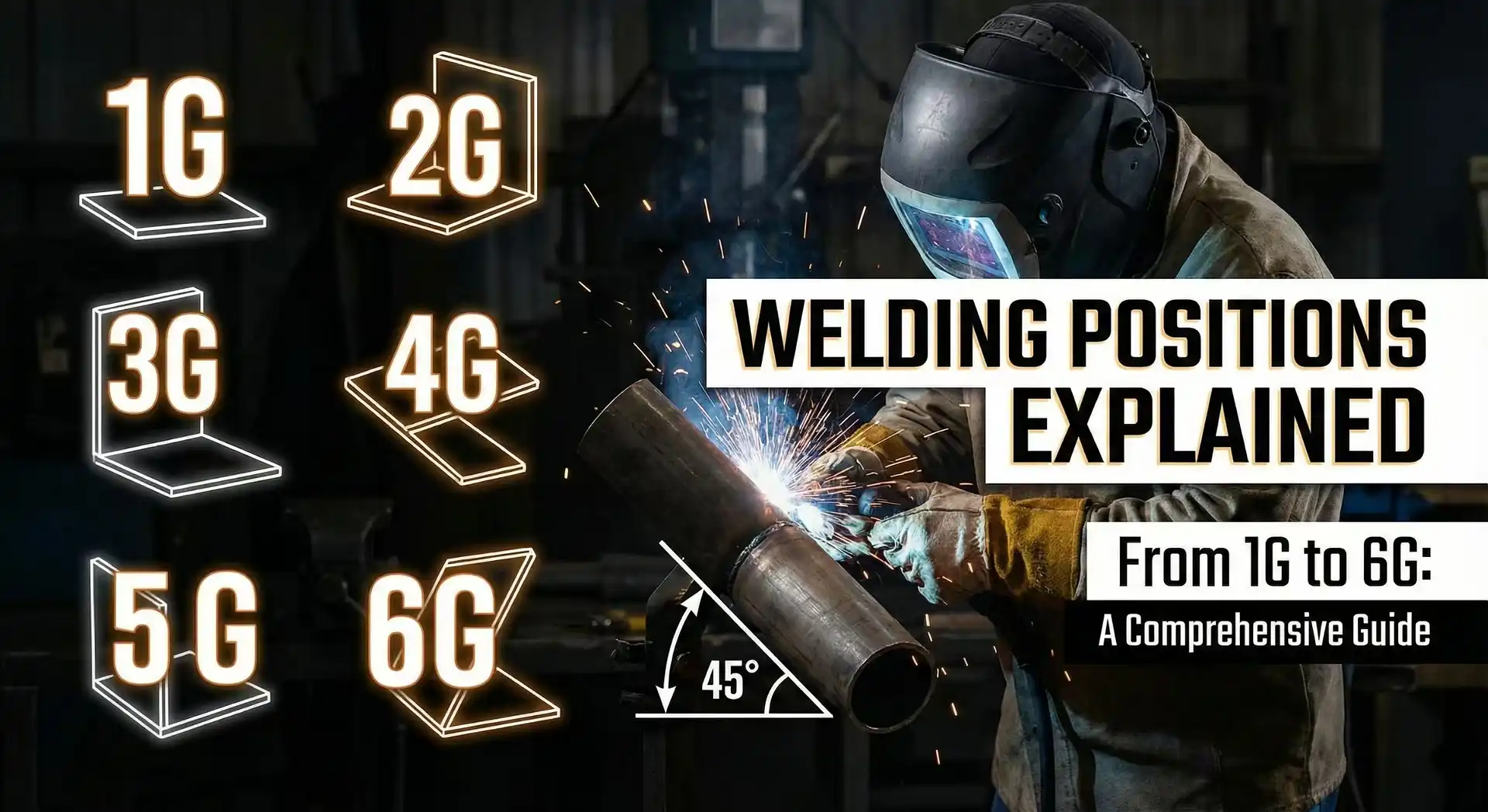
You see 1G, 2G, 3G, 4G, 5G, and 6G welding positions. These names tell you how to hold and weld a piece. Welding positions are set by groups like AWS and ISO. They show where you stand and how you work with the piece. The “G” means groove weld. This is when you fill the gap between pieces to make them strong. Knowing these positions helps you get ready for welding tests. It also makes sure you use the right way to weld each time.
- The numbers mean different welding positions:
- 1G: flat
- 2G: horizontal
- 3G: vertical
- 4G: overhead
- 5G: horizontal fixed pipe
- 6G: inclined pipe at 45 degrees
Learning these positions is important for good welding skills.
Key Takeaways
- There are six welding positions. They are 1G (flat), 2G (horizontal), 3G (vertical), 4G (overhead), 5G (fixed pipe), and 6G (45-degree pipe). Each position is different and has its own uses.
- Begin with the 1G position when you practice. This position is the easiest. It helps you learn basic welding skills. You can work on speed and angle control.
- Safety is very important in welding. Always wear safety gear like helmets, gloves, and clothes that resist fire. This keeps you safe from getting hurt.
- Learning many welding positions helps you get more jobs. Bosses like welders who can do many positions and solve problems.
- You get better with practice. Work on all positions often to build your skills. This will help you get ready for tests to get certified.
Plate Welding Positions

Plate welding means joining flat metal pieces together. Many industries use plate welding. It helps make strong machines and buildings. People use plate welding when they need things to last a long time.
Common Applications of Plate Welding:
- Construction: You connect beams and columns for bridges and buildings.
- Marine Industry: You build ships and platforms in the ocean.
- Automotive Industry: You make car body panels and frames.
- Heavy Machinery: You build parts for cranes and loaders.
- Industrial Fabrication: You make tanks, equipment, and machine bases.
- Maintenance and Repair: You fix or strengthen damaged metal surfaces.
The main plate welding positions are 1G, 2G, 3G, and 4G. Each position is different and has its own difficulty. You need to know these positions for welding tests and to stay safe at work.
| Position | Code | Orientation | Complexity | Key Use | Challenge |
|---|---|---|---|---|---|
| 1G | Flat | Horizontal | Simple | General welds | Easy to manage |
| 2G | Horizontal | Vertical plane | Moderate | Butt joints | Gravity effects |
| 3G | Vertical | Vertical axis | Moderate | Structural | Metal sagging |
| 4G | Overhead | Below welder | Difficult | Fixed setups | Gravity pulling |
1G Welding Position
You use the 1G welding position when the plate is flat. You weld from the top. This position is the easiest one. Gravity helps keep the melted metal in place. You can use more heat and bigger electrodes. This lets you work faster and add more metal.
There are not many problems in the 1G position. Beginners start here because it is simple. You can practice the basics like direction, angle, and speed. If you want good welds, you must learn these basics. You also need to fix problems to make your welds better.
- Tips for 1G welding:
- Move your hand steady and keep the same speed.
- Watch the weld puddle and change your angle if needed.
- Try different welding types like MIG, TIG, stick, or flux-cored.
2G Welding Position
In the 2G welding position, the plate stands up straight. You weld along the side edge. You stand next to the plate and move your torch sideways. Gravity pulls the melted metal down, so you must be careful.
You use 2G for butt joints and groove welds. This position is used in factories and building frames. You see it in pipelines and metal structures. The hardest part is stopping the weld pool from falling. You need good skills to avoid mistakes.
- Features of 2G welding:
- The plate does not move while you weld.
- You can make groove and fillet welds.
- You must watch out for gravity pulling the metal.
3G Welding Position
The 3G welding position means the plate stands up. You weld going up or down. This is called a vertical weld. Gravity makes this harder because the melted metal can drip. You must control the heat, speed, and weld pool.
You use the vertical up way for thick plates and strong welds. You use the vertical down way for thin plates so you do not burn through. You see 3G welding in building and heavy machines.
Safety Tip:
Always wear a helmet, gloves, safety glasses, and fireproof clothes. Make sure your work area is clean and has fresh air.
- What makes 3G challenging:
- You must keep the weld pool from dripping.
- You need to change your speed and heat for each job.
- You must pay attention to avoid mistakes.
4G Welding Position
You use the 4G welding position to weld overhead. The plate is above your head. You weld from below. This is one of the hardest positions. Gravity pulls the melted metal down, so you must move slowly and control the filler metal.
You get tired faster because your arms are up. You need to keep your hand steady and watch for drips. If you go too fast, you can make mistakes.
- Main features of 4G welding:
- You weld from under the plate.
- You must control the filler metal well.
- You move slower to stop errors.
- You see this position in planes, buildings, and factories.
Note:
Getting certified in 4G welding shows you can follow safety rules and make good welds in hard positions.
Pipe Welding Positions

Pipe welding means you join round pipes made of metal. Many industries use pipe welding because pipes move liquids and gases. Pipe welding is not the same as plate welding. You work on curved pipes, not flat plates. You often have to change where you stand while you weld. You must control the heat and make strong welds. Sometimes, you cannot reach every spot easily.
Tip:
You should learn pipe welding if you want a job in oil and gas, power plants, shipbuilding, or construction.
Here is a table that shows how pipe welding is not like plate welding:
| Aspect | Pipe Welding | Plate Welding |
|---|---|---|
| Coupon Type | Cylindrical (pipe-to-pipe or pipe-to-flange) | Flat plate |
| Welding Position | Curved, often requiring position changes (6G) | Flat, easier to manage |
| Qualification Coverage | Qualifies pipe and plate (if conditions met) | Qualifies plate only |
| Challenges | Access limitations, different heat distribution | Simpler setup, less access issues |
Pipe welding positions help you learn to weld pipes in many ways. The main pipe welding positions are 5G and 6G. You need to get good at these to pass tests and get certified.
5G Welding Position
In the 5G welding position, the pipe stays still and flat. The weld joint goes up and down. You must walk around the pipe to finish your weld. You cannot turn the pipe, so you move yourself instead. This is not like plate welding, where you can move the plate or your body more.
You use the 5G position in jobs where pipes cannot move, like oil and gas or power plants. You need good skills because you weld in flat, vertical, and overhead spots in one job. You must keep the weld pool under control and make even welds as you go.
Note:
If you get certified in 5G pipe welding, it means you can do hard jobs and stay safe in tough places.
Here is a table that shows where you use pipe welding positions:
| Industry | Application of Pipe Welding Positions |
|---|---|
| Oil and Gas | Used for cylindrical joints requiring precise welds |
| Power Generation | Essential for infrastructure involving pipes |
| Petrochemicals | Critical for maintaining pipeline integrity |
| Shipbuilding | Involves complex pipe welding for vessels |
| Construction | Utilizes pipe welding for various structures |
| Manufacturing | Relies on pipe welding for production processes |
You need to learn 5G welding if you want to work in these areas. You must practice moving around the pipe and making strong welds.
6G Welding Position
The 6G welding position is the hardest for pipe welding. You weld a pipe that sits at a 45-degree angle. You cannot move the pipe, so you must move your body and torch. You use both horizontal and vertical welding at the same time.
You need lots of skill and practice to weld in the 6G position. You must keep your welds even, even when the angle changes. You also need to control your body and the heat. Many welding tests use the 6G position because it proves you can do any pipe welding job.
- What makes 6G welding hard:
- You weld at a 45-degree angle, using both horizontal and vertical skills.
- You must keep your welds even as the angle changes.
- You need to move your body and change your welding settings all the time.
Alert:
If you get good at the 6G position, you can work almost anywhere. Employers want welders who can pass the 6G test.
Pipe welding positions like 5G and 6G help you learn to weld pipes for real jobs. You need to practice these positions to get certified and work in important fields.
Welding Position Comparison
Plate vs Pipe Positions
When you compare welding positions, you notice some big differences. Plate welding uses flat metal pieces. Pipe welding uses round, curved pipes. The way the joint sits changes how you set up your work. Plate positions like 1G, 2G, 3G, and 4G are for flat or up-and-down surfaces. Pipe positions, like 5G and 6G, make you weld around a pipe. Most times, you cannot move the pipe.
- Welding positions help you set up right, even in small spaces.
- Groove welding is used a lot for joining pipes.
- You change how you hold the electrode and set the power for each position.
- The position changes how the melted metal moves and cools.
| Welding Process | Position Limitations |
|---|---|
| SAW | Flat, limited horizontal |
| SMAW | All positions |
| TIG | All positions |
Skill Levels and Challenges
Every welding position needs a different skill level. You start with 1G because it is flat and easy. This is good for beginners. When you try 2G and 3G, you need more control and care. The hardest ones are 4G and 6G. In 4G, you weld above your head. Gravity can pull the melted metal down. In 6G, you weld a pipe at a 45-degree angle. You use both side-to-side and up-and-down skills.
Welding overhead or in 6G is very hard. You must balance heat and control to keep your weld strong and neat.
| Welding Position | Description | Skill Level |
|---|---|---|
| 1G | Flat Position (Plate) | Beginner |
| 2G | Horizontal Position (Plate) | Intermediate |
| 3G | Vertical Position (Plate) | Advanced |
| 4G | Overhead Position (Plate) | Advanced |
| 5G | Fixed Pipe (Horizontal, No Rotation) | Advanced |
| 6G | Fixed Pipe (45° Angle, No Rotation) | Expert |
Importance in Welding Practice
Learning all welding positions makes you a better welder. You can work on many kinds of jobs and in different places. Knowing how to change your welding position helps your work look better and keeps you safe. Many jobs want you to pass tests in hard positions before you can work on big projects.
- Learning new positions helps you face new problems.
- You can follow rules and pass welding tests.
- Using the right position makes your welds better and keeps you safe.
Always wear safety gear and make sure your workpiece is secure before you start welding.
When you learn welding positions like 1G to 6G, your work gets better. You also stay safer on the job. Employers want welders who know all the positions. This means you have good skills and know safety rules. You can keep your job longer and maybe get paid more. You might also get promoted. Every position is different and has its own problems. Learning them helps you make fewer mistakes. If you want more info, visit the Welding Education Resource Center. You can also look at welding careers.
| Benefit | Description |
|---|---|
| Job Security | Knowing all positions helps you get hired and keep your job. |
| Competitive Salary | Welders with many skills can earn more money. |
| Opportunities for Advancement | Learning every position can help you become a supervisor or inspector. |
FAQ
What does the “G” mean in welding positions like 1G or 6G?
You see “G” in welding positions. It stands for groove weld. You use groove welds to join two pieces by filling the gap between them. Groove welds make strong connections.
What is the hardest welding position to learn?
You face the most challenge with the 6G position. You weld a pipe at a 45-degree angle. You must move your body and torch in many directions. Employers use this position to test your skills.
What welding position should you start with as a beginner?
You should begin with the 1G position. You weld flat plates from above. Gravity helps you keep the melted metal in place. This position lets you learn basic skills before moving to harder ones.
What industries use pipe welding positions most?
You find pipe welding in oil and gas, power plants, shipbuilding, and construction. These industries need strong pipe joints to move liquids and gases safely.
What safety gear do you need for welding in any position?
You must wear a welding helmet, gloves, safety glasses, and fire-resistant clothing. These items protect you from sparks, heat, and harmful light. Always check your gear before you start.
What Happens When You Get a Laser QBH Alarm
How to Diagnose Button Response Issues in Laser Welding Machines
The light emission characteristics of laser welding machines