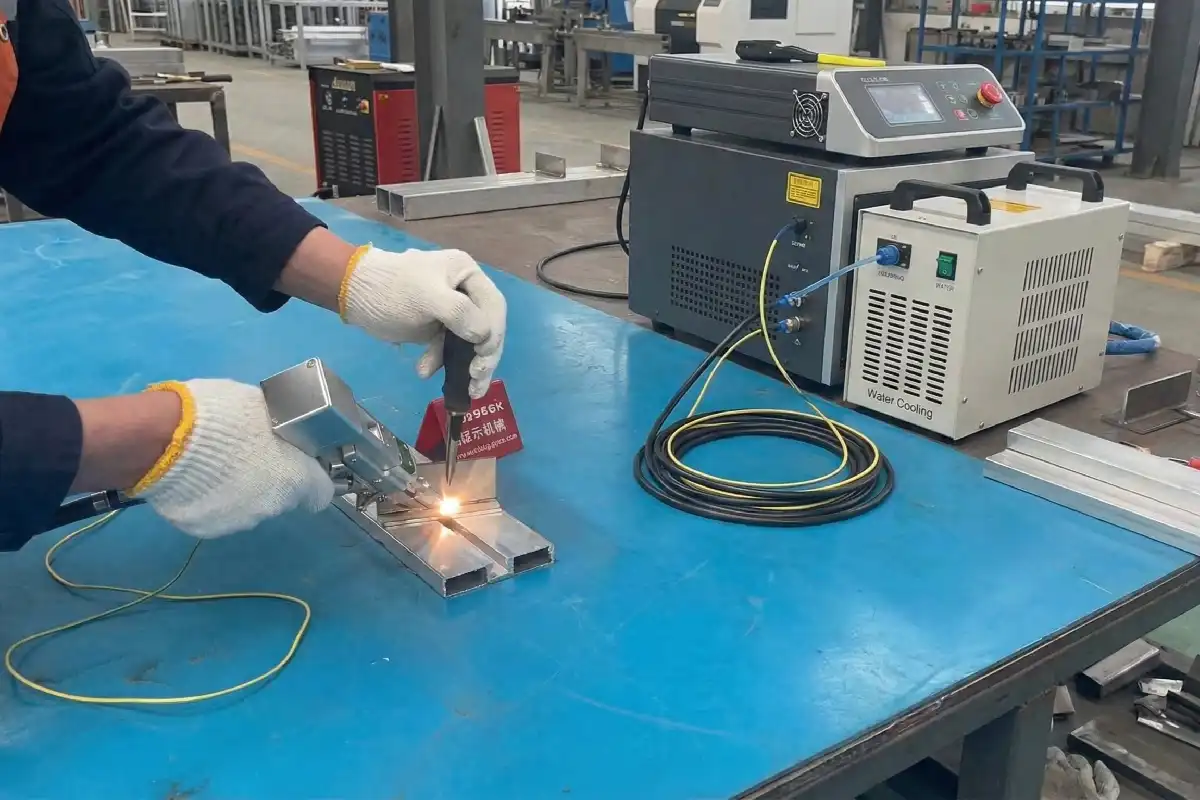
Fibre laser welding machines let you join metal parts using a strong, focused light beam. This process uses light energy to make a lot of heat. The heat melts and joins the metals together. You get fast and clean welds with almost no bending. These machines cause less heat damage and spatter than old ways like MIG or TIG welding. You can weld thin pieces with high accuracy and speed. The global market for these machines is growing fast:
- Expected growth of USD 504.4 million
- Yearly growth rate of 5.5% from 2023 to 2028
- Growth comes from higher work speed, better welds, and less wasted material
Key Takeaways
- Fibre laser welding machines use a strong light beam to join metals. This makes welds fast and clean. There is little heat damage to the metal.
- These machines can work with many types of metals. They can weld stainless steel and aluminum. This makes them useful for many jobs and industries.
- Automation in fibre laser welding helps lower labor costs. It keeps weld quality the same every time. One person can run several machines at once.
- It is important to set up and care for the machine the right way. Make sure parts fit together well. Keep the optics clean. This helps stop weak welds and machine problems.
- Buying fibre laser welding machines can save money over time. They help work go faster and waste less material.
Fibre Laser Welding Machines: Principles
Focused Laser Beam Process
Fibre laser welding machines join metals with a strong light beam. The process starts with optical fibers that have rare-earth elements inside. These fibers help make a powerful laser beam. Laser diodes send light into the fiber core. This light makes electrons excited. Excited electrons give off energy as photons. The machine boosts these photons to make a steady laser beam.
The focused laser beam lets you work with high accuracy. You can put the energy right where you want it. This helps stop bending or damage near the weld. Beam quality is measured by the Beam Parameter Product (BPP) and the M2 factor. A lower M2 value means the beam is sharper and more exact.
Here are some important facts about the focused laser beam process:
- The laser beam can focus to a tiny spot, as small as 0.003–0.020 mm wide.
- Special lenses made from quartz glass or other materials focus the beam.
- You get clean, deep welds with almost no mess.
- The narrow weld lets you work on thin metals without harm.
Fibre laser welding machines can weld many kinds of metals. The table below shows which materials you can weld and which you cannot:
| Type of Material | Can be Welded | Limitations |
|---|---|---|
| High-strength steels (AHSS) | Yes | N/A |
| Aluminum alloys | Yes | Highly reflective, challenging for thick areas |
| Battery components (electric vehicles) | Yes | N/A |
| Aircraft components | Yes | Sensitive to heat input, risk of defects |
| Fine wires and thin metal layers | Yes | Requires ultra-precision, excessive heat can compromise performance |
| Medical devices | Yes | Must maintain biocompatibility and cleanliness |
| Highly reflective materials (copper, gold, silver) | No | Decreased weld efficiency due to high reflectivity |
| Non-metals (plastics, ceramics) | No | Poor absorption of laser energy, high melting temperatures for ceramics |
| High thermal conductivity materials (brass, copper) | No | Quick heat loss leads to weak welds |
| Painted or coated surfaces | No | Coating can burn or evaporate, leading to contamination |
| Composites or multi-layered materials | No | Different thermal expansion rates can cause deformation or breakage |
Machine Features
Fibre laser welding machines have features that help you get good results. You should check power output, beam quality, and cooling systems.
- Power Output: Most machines have between 200 and 6,000 watts. For most jobs, 500 to 2,000 watts is enough.
- Beam Quality: The M2 value shows this. A lower M2 means a sharper beam and better welds.
- Cooling System: The machine gets hot when you use it. A good cooling system keeps it cool and stops overheating.
Here is a table with some common machine models and their features:
| Specification | ST-FW1500H | ST-FW2000H | ST-FW3000H |
|---|---|---|---|
| Power | 1500W | 2000W | 3000W |
| Beam quality | ≤1.2 M² | ≤1.3 M² | ≤1.5 M² |
| Cooling system | Water Cooled with automatic pumping function | Water Cooled with automatic pumping function | Water Cooled with automatic pumping function |
Tip: Always check the cooling system before long jobs. A strong cooling system helps your machine last longer and keeps your welds steady.
Fibre laser welding machines let you make neat, deep welds with little mess. You can control the beam for very careful work, even on thin or soft metals. These features make them a great choice for many industries.
Advantages of Fibre Laser Welding Machines
Precision and Quality
Fibre laser welding machines help you make very exact welds. The laser beam only heats a small area. This keeps the metal around the weld strong. The shape of your metal does not change much. Thin or soft metals do not bend or twist. The laser does not touch the metal, so it stays clean.
- Welds are neat and have almost no mess.
- The welds look smooth and need little extra work.
- The machine is good for tiny parts in electronics or medical tools.
Note: These machines help your materials stay strong. This is important when you need tough and safe welds.
Speed and Efficiency
Fibre laser welding machines help you finish jobs quickly. The laser melts metal fast, so you save time. These machines use less energy than old welding ways. This means you spend less money and help the planet.
Here is a table that shows how these machines help you:
| Aspect | Benefit |
|---|---|
| Precision | You can make small, careful welds, even for hard shapes. |
| Speed | The strong laser lets you weld fast and make more parts. |
| Cost-effectiveness | You waste less metal and use less power, so you save money. |
You can see the difference when you use these machines instead of MIG or TIG welding. You finish more parts faster and with better welds.
Versatility
Fibre laser welding machines work on many kinds of metals. You can change the settings for thick or thin pieces. This makes the machine useful for cars, jewelry, and more.
The table below shows some metals you can weld and what is special about each:
| Material | Properties and Capabilities |
|---|---|
| Stainless Steel | You can weld many types with great accuracy. |
| Carbon Steel | The machine works on thick or thin pieces, even with tricky shapes. |
| Aluminum | You can change the settings to handle heat and shine. |
| Copper | The machine works with pure copper and mixes like brass and bronze. |
| Alloy Steel | You can adjust the process for different mixes and get good welds. |
| Titanium | The machine handles high melting points and shine if you set it right. |
Tip: If you need to weld many metals, these machines give you lots of options.
Automation
You can add automation to fibre laser welding machines. This means you need fewer people to run them. One worker can watch several machines at once. The machine uses smart controls to make every weld the same.
- Automation lowers your labor costs.
- You get welds that look the same every time.
- The machine can check each weld by itself.
- Waste can drop to just 1%, so you save on materials.
Automation helps you make more things with less work. You can trust the machine to do the job well every time.
Challenges and Considerations
Part Fit
You must make sure your parts fit well before welding. Good fixturing keeps pieces still and helps the laser hit the right spot. If parts do not line up or have big gaps, welds can be weak. Gaps bigger than 10% to 20% of the thin piece’s thickness can cause problems. You might get holes, weak joints, or welds that do not go all the way through. Welds can also look uneven. Always check your setup so you do not have these issues.
- Good fixturing keeps parts in place.
- Bad fit or big gaps make weak welds.
- Gaps over 10%–20% of thin material thickness cause problems.
- Wide gaps can make holes or undercuts.
- Welds may not go deep enough in some spots.
Optics Sensitivity
Fibre laser welding machines use special optics to focus the beam. These optics need gentle care. Dust, scratches, or heat can hurt them and make welds worse. You should clean and check the optics often. If you skip this, your machine may break or welds may look bad. Some metals, like aluminum or copper, reflect the laser and make welding harder. You need the right settings and shielding gas for good welds.
| Challenge | Description |
|---|---|
| Improper Shielding Gas | Wrong gas or dirty gas makes welds look bad. |
| Reflective Materials | Shiny metals can make the laser act strange and welds uneven. |
| Maintenance and Downtime Issues | Not cleaning or checking the machine can cause breakdowns and bad welds. |
| Operator Error | Not enough training or wrong settings can make welds poor and hurt the machine. |
Tip: Clean the optics and check your shielding gas before you start. This helps you avoid many welding problems.
Safety
You must follow safety rules when using fibre laser welding machines. The laser beam can hurt your eyes or skin. Laser safety barriers mark danger zones and keep people safe. Warning signs show the laser class and wavelength. Only trained workers should go near the welding area. You should wear laser safety glasses, face shields, flame-resistant clothes, and sometimes a mask. Good airflow helps remove fumes and lowers fire risk.
- Laser safety barriers keep you safe from the beam.
- Warning signs tell you about dangers.
- Access controls stop untrained people from entering.
- Safety gear protects you while you work.
- Ventilation helps get rid of bad fumes.
Craftsmanship Impact
You do not need lots of welding experience to use new fibre laser welding machines. Many handheld models have easy controls and are comfortable to hold. You can learn the basics in just a few hours. This helps new workers join your team quickly. Even though the machines are simple, you still need training for the best welds, especially with thin metals. Training is still important for good results.
- Handheld laser welders are simple to use.
- You can learn basic skills in two hours.
- Fast training helps you add new workers quickly.
- You still need training for top welds.
Note: Fibre laser welding makes welding easier for more people, but training is still needed for the best results.
Industry Applications
Automotive
You see fibre laser welding machines everywhere in car factories. These machines help you weld roof panels, trunk lids, and door assemblies. You can join different types of steel with high accuracy. You also use them for battery and electric vehicle parts. Remote laser welding lets you finish jobs faster and with less effort.
- Roof-to-side panel welding gives cars a strong frame and smooth look.
- Trunk lid welding solves tough joint problems and makes clean seams.
- Door assembly welding joins different steels for better quality.
- Battery welding keeps electric vehicles safe and reliable.
- Remote welding cuts down on setup time and boosts productivity.
You get clean welds without touching the metal. This helps you make lighter cars that use less fuel. You also improve safety because the welds make the car body stronger.
Aerospace
You use fibre laser welding machines to build airplanes and spacecraft. These machines join engine parts, fuel tanks, and turbine blades. You can weld high-strength metals and light alloys with great precision.
- You get deep welds and fast processing for fragile parts.
- You can weld tricky shapes and thin materials.
- You join metals that do not mix well, and you do not need extra filler.
This technology helps you make safe and strong aerospace parts.
Medical Devices
You rely on fibre laser welding for medical tools and implants. The machines let you weld tiny parts with high accuracy. You meet strict rules from the FDA and other groups.
- You keep devices clean and safe for patients.
- You use process checks to make sure every weld meets standards.
- You document each step for quality control.
This helps you protect patients and follow health laws.
Electronics
You use fibre laser welding to make phone frames, speaker cases, and computer parts. The machines let you weld small and thin pieces without damage.
- You get neat welds for phone brackets and server enclosures.
- You keep parts strong and looking good.
This helps you build reliable electronics that last longer.
Jewellery and Tools
You use fibre laser welding for rings, watches, and fine tools. The machines give you a clean finish and protect delicate materials.
- You weld gold, silver, and platinum without harming gems.
- You save time because you do not need to remove stones.
- You make detailed designs with high precision.
This method keeps your jewellery shiny and strong.
R&D
You see new trends in fibre laser welding every year. Automation and smart controls make your work easier. You use compact machines for quick changes in production.
- You switch between jobs with little downtime.
- You use less energy and create less waste.
- You test new materials and designs for future products.
You help push technology forward and make better products for many industries.
Fibre laser welding machines let you make things faster. The welds are cleaner and stronger. You use less energy for each job. Companies can save money and work better. Using less power helps the planet. There are some problems to think about. You need a lot of money to buy the machine. Workers must learn how to use it. You should plan well before adding it to your work. The table below lists problems and ways to fix them:
| Challenge | Solution |
|---|---|
| High Initial Investment | Long-term savings |
| Skills Gap | Training programs |
| System Integration | Careful planning |
If you want to do better work and stay ahead, try fibre laser welding machines.
FAQ
What metals can you weld with a fibre laser welding machine?
You can weld stainless steel, carbon steel, aluminum, copper, and titanium. The machine works best when metals are clean and bare. Do not use painted or coated surfaces. Metals like silver or gold reflect too much light, so they are not good for welding.
Is fibre laser welding safe for beginners?
Yes, fibre laser welding is safe if you follow safety rules. You must wear protective glasses and clothes. Only trained people should use the machine. Always look for warning signs and safety barriers before you start.
How do you keep the machine working well?
Clean the optics often to keep them clear. Check the cooling system before every job. Use the right shielding gas for each weld. Regular care helps stop breakdowns and keeps welds strong.
Can you automate fibre laser welding?
Yes, you can add automation to these machines. Robots or smart controls can run the welding process. Automation helps you make more parts with less work and keeps welds the same.
What makes fibre laser welding better than MIG or TIG welding?
Fibre laser welding gives you cleaner and faster welds. You use less energy and make less waste. The machine works well on thin metals and needs less extra work.
The harm of inferior protective lenses to lasers
The necessity of using pure water in laser welding water coolers
The consequences of dust entering the laser head of the welding machine
Scrap standard for protective lenses in laser welding machines