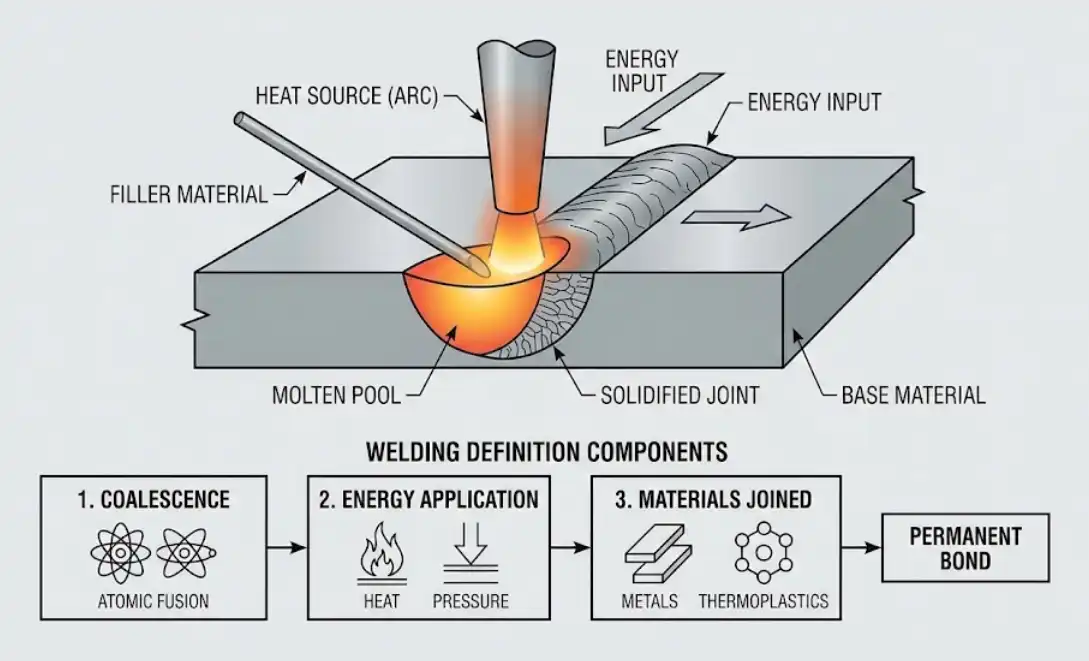
A weld is a localized coalescence of metals or non‑metals produced by heating the materials to the welding temperature (with or without pressure) or by applying pressure alone; filler metal may be used. This wording follows industry terminology in AWS A3.0: Standard Welding Terms and Definitions. Welds are normally intended to form permanent joints, but they can degrade, be repaired, or be removed during service or maintenance, so proper procedure and inspection remain essential.
Knowing what a weld means helps you learn how to build and fix many things.
Key Takeaways
- A weld is a lasting joint made by melting materials with heat or pressure. This makes a strong connection.
- Knowing welding basics helps keep people safe and makes good projects.
- There are many welding methods and types, such as fillet and groove welds. Each one has its own use and job.
- Getting welds ready and checking them is important for strong and safe joints.
- Welding is very important in building, making things, and daily items. It helps keep things safe and long-lasting.
Weld Definition and Principles
Standard Definition of a Weld
You can define a weld as a permanent joint formed when two or more parts fuse together. This happens when you apply heat, pressure, or both, and then let the parts cool. The American Welding Society (AWS) and other standards organizations agree that a weld must create a strong, lasting bond. You often see welds in metalwork, but you can also weld plastics and other materials.
When you want to check if a weld meets the standard, you use different tests. These tests help you know if the joint is strong, tough, and safe. Here is a table that shows some common tests and what they check:
| Test | What it Checks |
|---|---|
| Tensile Test | Measures the tensile strength of the welded joint. |
| Guided Bend Test | Checks ductility and fusion of the weld. |
| Charpy Impact Test | Measures toughness of the weld metal. |
| Hardness Test | Measures the hardness of the weld metal and HAZ. |
| Chemical Analysis | Determines the chemical composition of the weld. |
You need to follow rules and requirements to make sure each weld is safe and meets the project’s needs. These rules cover how you design, make, and inspect welded connections.
Key Welding Principles
When you weld, you use heat or pressure to melt the surfaces of the parts you want to join. The melted area is called the fusion zone. You let this area cool so the parts become one solid piece. This process is called fusion welding. You can use different energy sources, like electric arcs, gas flames, or lasers, to create the heat needed for welding.
You must control the heat carefully. Too much heat can cause defects, and too little heat can make the joint weak. You also need to protect the molten metal from the air. If air gets in, it can cause problems in the weld. As the metal cools, it forms a strong bond. The way the metal cools and the materials you use affect how strong and tough the weld will be.
A weldment is the finished piece that includes all the welded joints. You can think of it as the final product after you join all the parts together.
Tip: Always check the weld for strength, toughness, and proper fusion to make sure your project is safe and reliable.
- You need to know the basic principles of welding to make good joints.
- You must understand how heat, pressure, and cooling work together.
- You should always follow the right steps and use the right materials for each job.
Welding Process
How Welding Works

You follow a series of steps to create a strong joint between materials. Each step helps you make sure the weld meets safety and quality standards. Here is what you usually do during the welding process:
- Review all drawings, codes, and welding documents. Make sure you understand the requirements and check the materials.
- Set up your welding equipment. Confirm that everything is calibrated and the settings match the welding procedure.
- Watch the welding process closely. Check the parameters and the quality of your work as you go.
- Clean the welded area after you finish. Look for any visible defects.
- Complete a final inspection. Use special tests to make sure the weld meets all standards.
Tip: Careful preparation and inspection help you avoid problems and keep your project safe.
You can use different welding techniques, and each one has its own features. Here is a table that shows some common types:
Example GMAW (MIG) process window (ER70S‑6) — example, for reference only, verify per WPS/WPQR:
- Wire: ER70S‑6, 0.9 mm (0.035″) or 1.2 mm (0.045″)
- Shielding gas: 75% Ar / 25% CO2, flow 8–12 L/min (10–30 CFH)
- 0.9 mm: 30–120 A, 16–22 V, WFS ≈130–280 IPM — suitable for 1–6 mm plate
- 1.2 mm: 90–220 A, 20–26 V, WFS ≈90–300 IPM — suitable for 3–12+ mm plate
Acceptance checkpoints: smooth uniform bead, full sidewall fusion, no porosity or toe cracks, and penetration consistent with joint design. Adjust on scrap and record settings.
| Type of Welding | Suitable scenarios & working conditions |
|---|---|
| Gas Metal Arc Welding (GMAW) | GMAW is well suited to controlled workshop fabrication and production work on mild steel and aluminum sheet to medium thickness (roughly 1–12 mm / 0.04–0.5 in). It requires steady shielding gas flow and regulated current/voltage, so it performs best indoors or in sheltered environments. Key control points: correct gas mix, wire feed speed, and travel speed. Acceptance follows AWS/ISO quality levels (visual fusion, porosity, and bead profile limits). |
| Gas Tungsten Arc Welding (GTAW) | GTAW fits precision work on thin sections and corrosion‑resistant alloys (stainless, aluminum, titanium) in a clean workshop setting. It is the choice when heat control, low spatter, and tight dimensional tolerances matter (tube work, aerospace panels, thin sheet). Control points: precise amperage, torch angle, and filler addition. Inspection focuses on fusion, penetration and appearance per applicable code. |
| Shielded Metal Arc Welding (SMAW) | SMAW is flexible for outdoor and field repairs as well as heavy‑section structural work where wind or contamination prevents gas shielding. Typical materials include carbon steels and thicker sections (from ~3 mm upward). Process control centers on electrode selection, correct current, and interpass cleaning. Acceptance emphasizes lack of cracks, adequate fusion and penetration per AWS/ISO acceptance criteria for the application. |
| Flux‑Cored Arc Welding (FCAW) | FCAW (self‑shielded or gas‑shielded) covers high‑deposition shop work and many outdoor jobs on thicker steels where productivity matters. It handles plate and structural sections efficiently; self‑shielded flux‑cored wires tolerate light wind, while gas‑shielded variants need sheltered conditions. Control points: wire type, travel speed and flux condition. Inspect for proper fusion, acceptable porosity limits, and sound bead profile per code. |
Materials Used in Welding

You can weld many types of materials. The most common are metals, such as steel, aluminum, and stainless steel. You can also weld thermoplastics, which are plastics that melt and join together when heated. In some cases, you might even weld wood, but this is rare and uses special methods.
Testing and following the right procedures matter for every material. You need to make sure the joint is strong and safe. Always check the finished weld to confirm it meets the project’s needs.
Weld Types
Fillet and Groove Welds
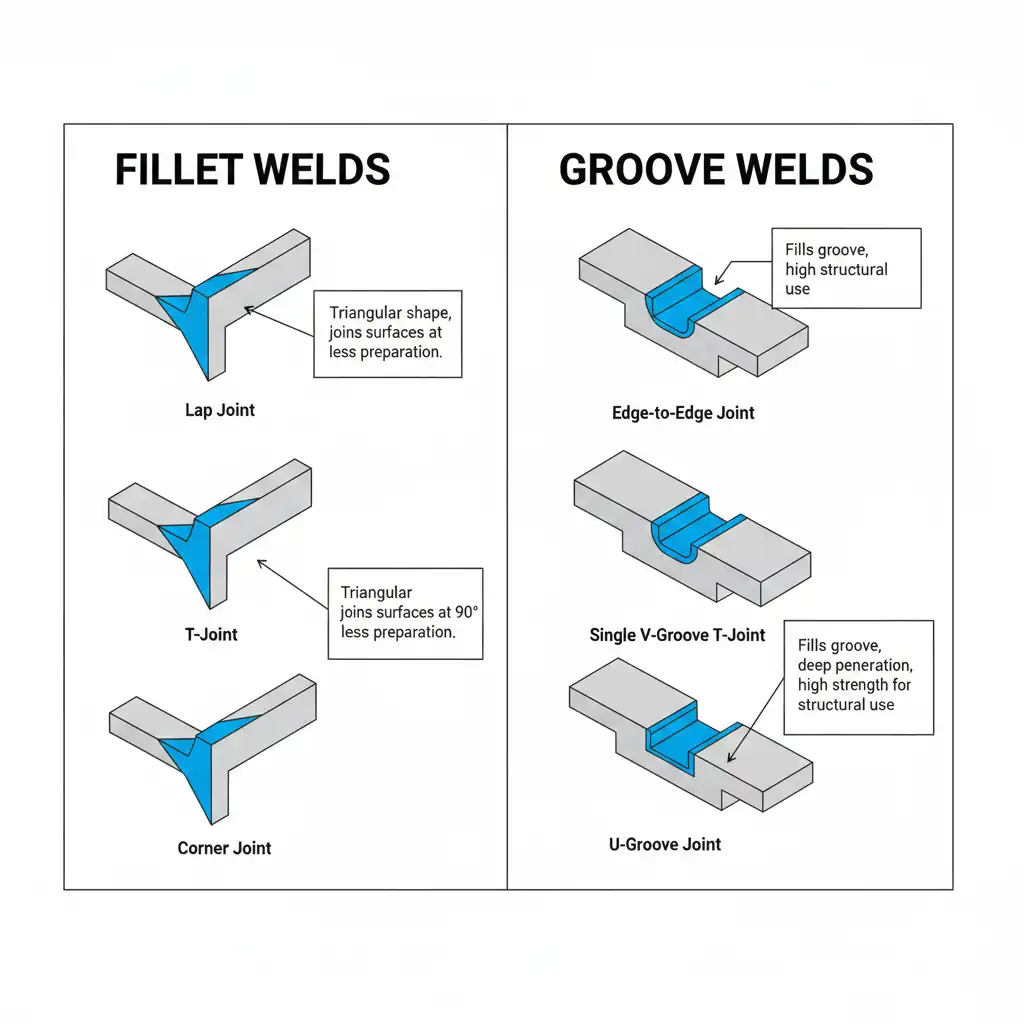
You can find two main types of welds in fabrication: fillet welds and groove welds. Each type has its own shape and purpose. You use fillet welds to join two surfaces at a right angle, such as in lap joints, corner joints, and T joints. The weld metal forms a roughly triangular shape in the corner where the two pieces meet. Groove welds work differently. You use them for edge-to-edge joints, corner joints, T joints, and when you join curved and flat pieces. The weld metal fills a groove between the workpieces, fusing deeply with the base material.
Here are some key points about fillet and groove welds:
- Fillet welds sit beside the workpieces and need less preparation. You can use them in many joint types.
- Groove welds go between the workpieces and penetrate deeper. You get higher strength, which is important for structural jobs.
Groove welds help you build strong connections in bridges, buildings, and pipes. Fillet welds give you flexibility for many shapes and setups.
Plug, Slot, and Other Welds
You can use several specialized welds for different needs. Each type has a unique shape and purpose. The table below shows what each weld is and where you might use it:
| Weld Type | Definition | Common Scenarios |
|---|---|---|
| Plug weld | Fills a hole in one piece to join it to another. | Used when you need a strong joint. |
| Slot weld | Made in a slot cut into one piece to join it to another. | Helps with alignment in assemblies. |
| Fillet weld | Joins two surfaces at a right angle. | Used in many structural applications. |
| Bevel-groove weld | Joins two pieces at an angle. | Good for thick materials needing extra strength. |
| J-groove weld | Uses a J-shaped groove for joining. | Common in pipe welding and structural jobs. |
| Flare-bevel groove | Joins two pieces at an angle with a flare. | Useful in piping and structural connections. |
| Melt-through weld | Penetrates through the full thickness of the material. | Needed for heavy-duty jobs requiring full penetration. |
Tip: You should choose the weld type based on the joint design and the strength you need for your project.
You can see that each weld type fits a specific job. When you know what each weld does, you can pick the right one for your project and make sure your connections stay strong and safe.
Welding Joints
Butt Joint

A butt joint is made when you put two pieces end to end. The pieces are next to each other in a straight line. There is no overlap between them. This joint makes a 180-degree angle. People use butt joints in buildings and pipe systems. You can use carbon steel, stainless steel, or aluminum for this joint.
- This joint is simple to make and works in many places.
- You see it in building work, pipes, and metal frames.
Here is a table that shows how butt joints compare to other joints:
A properly executed full‑penetration butt (groove) weld can achieve the nominal strength of the base metal—failure will typically occur in the parent material rather than the weld metal—provided the joint is prepared and welded per an approved WPS and the procedure is qualified by WPQR testing. Achieving this requires correct bevel/root geometry, clean fit‑up, controlled heat input and appropriate welding position, plus adequate inspection (visual, ultrasonic or radiographic) to verify full fusion and absence of defects. Note: performance depends on WPS/WPQR, welding position, and accepted inspection level.
Corner Joint
A corner joint is made when two metal sheets meet at a right angle. The joint can be open with a gap filled by weld, or closed with the edges touching. You use corner joints to make boxes, covers, and frames. These joints are strong and look neat.
| Advantages | Disadvantages |
|---|---|
| Good for making boxes and frames, open or closed. | Can bend or twist from welding heat. |
| Spreads weight well if welded right. | Needs care to weld corners strong enough. |
Lap Joint
A lap joint is made by putting one piece over another. This joint is used in many jobs:
- Cars and trucks: body panels, exhausts, frames
- Building and making things: parts, air ducts, steel frames
- Planes: thin sheets of aluminum and titanium
- Electronics: copper and aluminum for good connections
- Ships and boats: hull plates and parts
Lap joints help join thin pieces and make wide, strong connections.
Tee Joint
A tee joint is made when two metal pieces meet at a right angle to make a “T” shape. This joint is strong and used in many structures. You see tee joints in building frames, cars, planes, and pipes.
| Feature/Application | Description |
|---|---|
| Shape | Made by two metal pieces at a right angle, forming a “T”. |
| Strength | Very strong, good for building things. |
| Typical Applications | Used in frames, cars, planes, and pipes. |
Tee joints can be tricky because thick pieces need more heat. You also need to keep the weld puddle steady. Change your torch angle and settings for the best weld.
Edge Joint
An edge joint is made by putting the edges of two metal pieces side by side and welding them. You use edge joints for sheet metal boxes, tanks, and thin pieces. This joint gives a smooth look and works well with gas or TIG welding.
| Construction Method | Common Applications | Advantages |
|---|---|---|
| Put edges of two metal pieces side by side and weld. | Sheet metal boxes, tanks, thin pieces | Makes a smooth finish, works with gas or TIG welding |
Edge joints are not very strong because stress is on one line. Use them when you do not need a lot of strength.
Tip: Pick the right joint for your project based on how strong it needs to be, how it should look, and how thick the material is.
Weld Applications
Construction and Infrastructure
Welding is used a lot in building things. Welders put together the frames of tall buildings. They work on offices, hospitals, stadiums, and schools. Welders add beams, columns, braces, and trusses. These welded parts help buildings stay strong. Welders work inside shops and outside on job sites. They change how they work for each place. Bridges, tunnels, highways, and pipelines need welding too. Steel columns and beams are joined with welds. These welded joints help buildings stand up to wind and heavy loads.
- Welders make frames for big buildings.
- Bridges and tunnels need strong welds.
- Pipelines use welding to move things safely.
Welding helps buildings and bridges stay safe for a long time.
Manufacturing and Industry
Welding is important in many factories. It helps make cars, machines, and appliances. Factories use welding to join metal parts fast and safely. The table below shows how welding helps different jobs:
| Sector | How Welding Helps |
|---|---|
| Automotive | Makes cars strong and safe with many welded joints. |
| Construction and Infrastructure | Builds big steel structures that last and stay safe. |
| Energy | Makes oil rigs and power plants strong and reliable. |
| Aerospace and Defense | Joins planes and military parts with care. |
| Consumer Goods and Appliances | Makes home items sturdy and safe, like fridges. |
Welding helps make safe cars, strong buildings, and good energy.
Automotive and Transportation
Welding is used to build cars and trucks. It joins body panels, frames, and other parts. Different welding methods help vehicles stay safe and work well. The table below shows how these methods help:
| Welding Process | How It Keeps Cars Safe | How It Helps Cars Work Well |
|---|---|---|
| Gas Metal Arc Welding (MIG) | Makes frames strong and meets safety rules. | Helps cars handle better and drive smoothly. |
| Gas Tungsten Arc Welding (TIG) | Makes clean joints for important car parts. | Makes cars tough and lowers shaking. |
| Resistance Spot Welding (RSW) | Joins panels and frames for sturdy cars. | Lets factories build cars fast and with good quality. |
Welding helps cars last longer and keeps people safe.
Everyday Products
Many things you use are made with welding. Appliances like fridges, washers, and stoves need strong welds. If you weld too much, you waste materials and time. Too much heat can hurt products and make them weak. More welding means more finishing work and higher costs. Heavy welds also wear out tools faster.
- Extra welding wastes materials and money.
- Too much heat makes products weaker.
- More finishing work costs more.
Good welding keeps products strong and not too expensive.
You learned that a weld is a permanent joint made by fusing parts with heat or pressure. You saw how welding principles guide the process and how different weld types and joints fit specific jobs. You discovered that welds help build strong structures, vehicles, and everyday products. When you understand what a weld is, you see its value in making safe and reliable things around you.
Next time you look at a building or a car, remember how welds keep them strong.
References / Standards & Guidance
- AWS A3.0:2020 — Standard Welding Terms and Definitions — official publisher page: AWS A3.0M/A3.0:2020.
- ISO 2553 — Welding symbols on technical drawings — official page: ISO 2553:2019.
- ISO 9606-1 — Welder qualification (fusion welding) — official page: ISO 9606-1.
- ISO 15614-1 — Welding procedure specification tests — official page: ISO 15614-1.
- ASME BPVC Section IX — Welding and brazing qualifications — official page: ASME BPVC Section IX.
- OSHA — Welding, cutting and brazing safety guidance (29 CFR 1910.252–255) — OSHA welding guidance.
- NFPA 51B — Fire prevention during welding and other hot work — official page: NFPA 51B.
FAQ
What is a weld made of?
A weld is made of the base materials you join and sometimes extra filler metal. You melt these together using heat or pressure. After cooling, you get a solid joint.
What types of materials can you weld?
You can weld metals like steel, aluminum, and stainless steel. You can also weld some plastics. Most welding happens with metals because they melt and fuse well.
What does a good weld look like?
A good weld looks smooth and even. You see no cracks, holes, or gaps. The weld joins the parts tightly and does not have extra metal sticking out.
What safety gear do you need for welding?
You need a welding helmet, gloves, and a long-sleeve shirt. You protect your eyes, skin, and hands from sparks and heat. Safety gear helps you avoid burns and injuries.