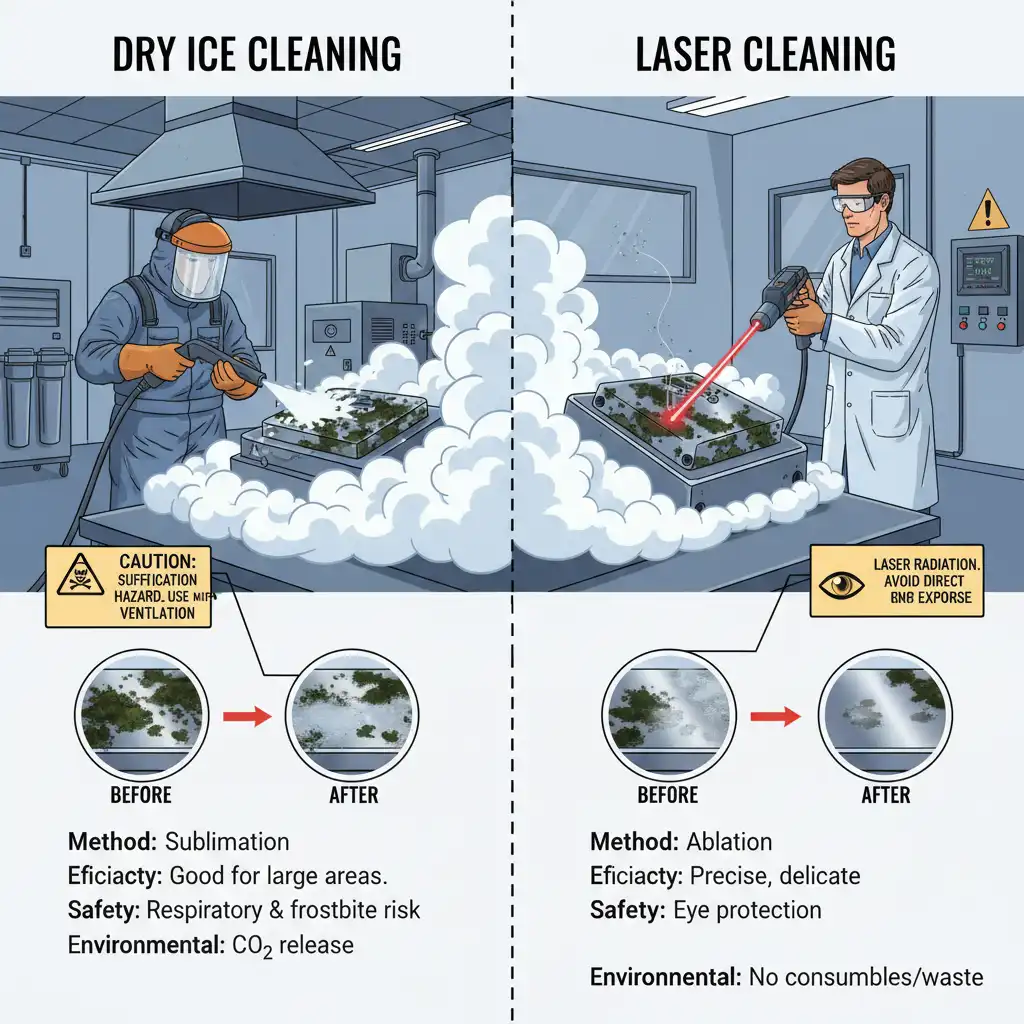
You want great results for mold cleaning and care, but the best choice depends on your mold and what you need. Fast, gentle cleaning helps your mold last longer and keeps quality good. Dry ice cleaning and laser cleaning both use new, non-touch ways to clean. Think about what matters most, like time, cost, and how hard your mold is to clean, before you pick.
Tip: Using the right cleaning method for your mold saves time and money.
Key Takeaways
- Pick the best cleaning way for your mold and dirt. Dry ice cleaning works well for mixed things. Laser cleaning is better for small, detailed jobs.
- Laser cleaning is quick and very exact. It saves time and keeps your area neat. It can clean hard dirt but does not hurt the mold.
- Dry ice cleaning is soft and works on many surfaces. It is fast and does not leave trash. This makes cleaning up simple.
- Think about safety and the planet. Laser cleaning is safer and good for nature. Dry ice cleaning needs safety tools and can be loud.
- Make a plan for your cleaning money and schedule. Check and clean often to stop big problems. This helps you save money later.
Dry Ice Cleaning and Laser Cleaning: Quick Comparison
Key Differences for Mold Maintenance
You want to pick the best way to clean your mold. Dry ice cleaning and laser cleaning are both modern cleaning methods. They work differently from each other. The table below shows how they compare:
| Feature | Dry Ice Cleaning | Laser Cleaning |
|---|---|---|
| Cleaning Effectiveness | Has trouble with thick coatings and deep dirt | Cleans fully and exactly, does not harm the mold |
| Operating Costs | Costs more because you need supplies and repairs | Costs less over time, only needs electricity |
| Surface Impact | Can cause tiny cracks and wear | Does not scratch, keeps mold shape perfect |
| Safety and Environmental Impact | Needs safety gear, can be risky | Safe, no extra trash, good for the environment |
Laser cleaning is gentle and exact. It can take off layers without hurting the mold. This method is safe and does not use chemicals or blasting stuff. There is almost no trash left over. Laser cleaning works well on hard dirt like rust and paint. Dry ice cleaning is soft and can clean different materials together. You can use it for injection molds and to get surfaces ready for new coatings.
Laser cleaning is often faster than dry‑ice blasting, but the advantage is application‑dependent — field reports and vendor studies commonly show roughly 2–8× speedups. Primary drivers are laser power, contaminant type and thickness, part geometry, and scan parameters; pilot tests are recommended to confirm site-specific rates.
When to Use Each Method
You need to know when to use dry ice cleaning or laser cleaning for your mold. Each method is good for different jobs:
- Use dry ice cleaning if you want to quickly remove dirt and soot. You can move this machine around your building. You can clean different materials and parts without taking them apart. Dry ice cleaning works well for injection molds and for getting surfaces ready for new coatings.
- Pick laser cleaning if you need full and exact cleaning. It removes hard dirt like rust and paint. Laser cleaning does not scratch your mold, so it stays safe. Your workspace stays clean because there is no extra trash.
Tip: If you want fast cleaning and less waiting, laser cleaning is better. If you need soft cleaning for mixed materials or want to clean molds without taking them apart, dry ice cleaning is a good choice.
Both dry ice cleaning and laser cleaning have good points. You should think about your mold type, what kind of dirt you have, and what your work needs before you choose which cleaning method to use.
Dry Ice Cleaning for Mold
How Dry Ice Cleaning Works
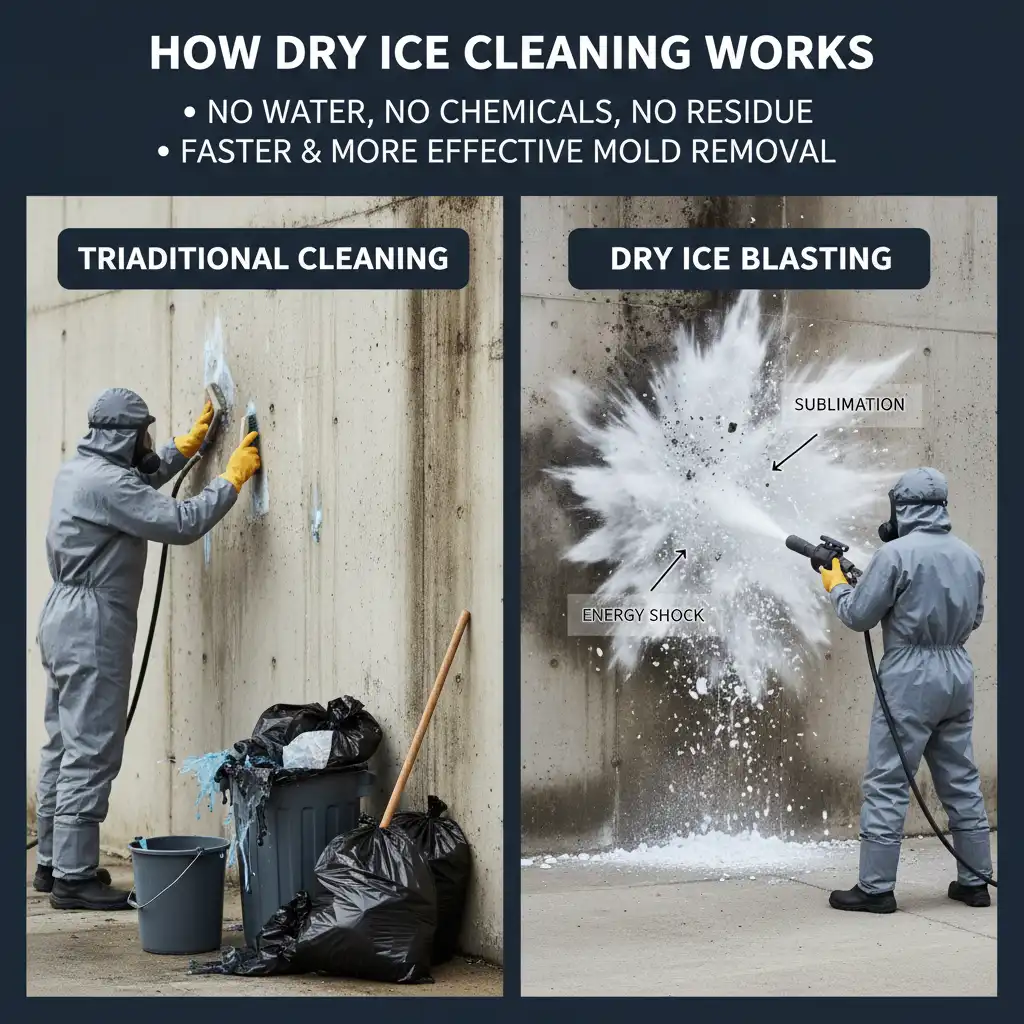
Dry ice blasting cleans mold by shooting dry ice pellets fast. The pellets hit the mold and turn into gas right away. This is called sublimation. When this happens, it makes a shock and energy. These break up and remove dirt and mold from the surface. You do not need water or chemicals for this. There is no leftover mess to clean up after.
- Dry ice blasting gets rid of almost all mold spores much faster than old ways.
- It does not make extra waste, so cleanup is easier.
Benefits of Dry Ice Cleaning
In-place dry‑ice cleaning can often reduce mold cleaning from multiple teardown-hours to under an hour, depending on mold size, cavity count, contaminant thickness, and equipment—site trials are recommended to confirm rates.
Tip: Dry ice blasting leaves no extra waste because the dry ice turns into gas. You only need to pick up the dirt that comes off.
Limitations of Dry Ice Cleaning
Dry ice cleaning does not work well on very hard or stuck-on dirt like rust. You might need to use something else first. The cold can cause a shock. Some weak surfaces, like some plastics or aluminum, can crack or break.
- Dry ice blasting does not work well on tough, stuck dirt.
- Weak surfaces can get hurt by the cold.
Best Mold Applications for Dry Ice Blasting
You can use dry ice blasting on many kinds of molds and surfaces. It works well for injection molds, blow molds, PET preform molds, LSR and LIM molds, thermoform molds, urethane molds, technical molds, metal injection molds, compression molds, fiberglass molds, HDPE molds, medical device molds, extrusion dies, and automotive molds. Dry ice cleaning is safe and works well for many jobs in factories and businesses. You get a fast, clean result without hurting the surface or leaving waste.
Laser Cleaning for Mold
How Laser Cleaning Works
Laser cleaning uses strong light to clean surfaces. You point a laser beam at the mold. The dirt heats up faster than the mold. The dirt gets hot and turns into steam or breaks off. The laser makes the dirt pop off the mold. You can change the laser’s power so only the dirt comes off. The mold stays safe and does not get hurt. You do not need water or chemicals for this cleaning.
- The laser beam hits just the dirt.
- The dirt gets very hot and turns into steam.
- The dirt leaves the mold as steam.
- The dirt breaks off when the laser is strong enough.
Benefits of Laser Cleaning
Laser cleaning is very exact and protects fragile parts. You can clean rust, paint, and oil without touching the mold. This way is good for cleaning soft surfaces and fixing them. The mold does not get damaged or change shape. Laser cleaning keeps your area neat because it does not make chemical trash.
| Benefit | Description |
|---|---|
| Non-Contact, No Damage | Keeps tiny details safe and does not touch the mold. |
| Improved Cleaning Precision | Cleans tricky shapes with high accuracy and saves time. |
| No Chemical Waste | Good for the earth and safe for workers, no bad trash. |
| In-Situ and On-Line Cleaning | Saves time because you do not take the mold apart. |
| Cost Savings Over Time | You save money later because you do not need much fixing. |
| Versatility Across Mold Types | Works for many molds in lots of jobs and cleans many things. |
Laser cleaning is great for careful cleaning and fixing surfaces. You can use it to clean rust and fix surfaces that must stay smooth.
Tip: Laser cleaning is best when you want to keep the mold safe and fix it without touching it.
Limitations of Laser Cleaning
Laser cleaning can be risky. You need good airflow because it can make bad fumes. The laser gets very hot and can hurt your skin or eyes. You must wear safety gear. Laser cleaning is not safe where things can catch fire because sparks can start fires.
- Bad fumes can come out when cleaning.
- High heat can burn or hurt you.
- Sparks make it unsafe where things can burn.
Best Mold Applications for Laser Cleaning
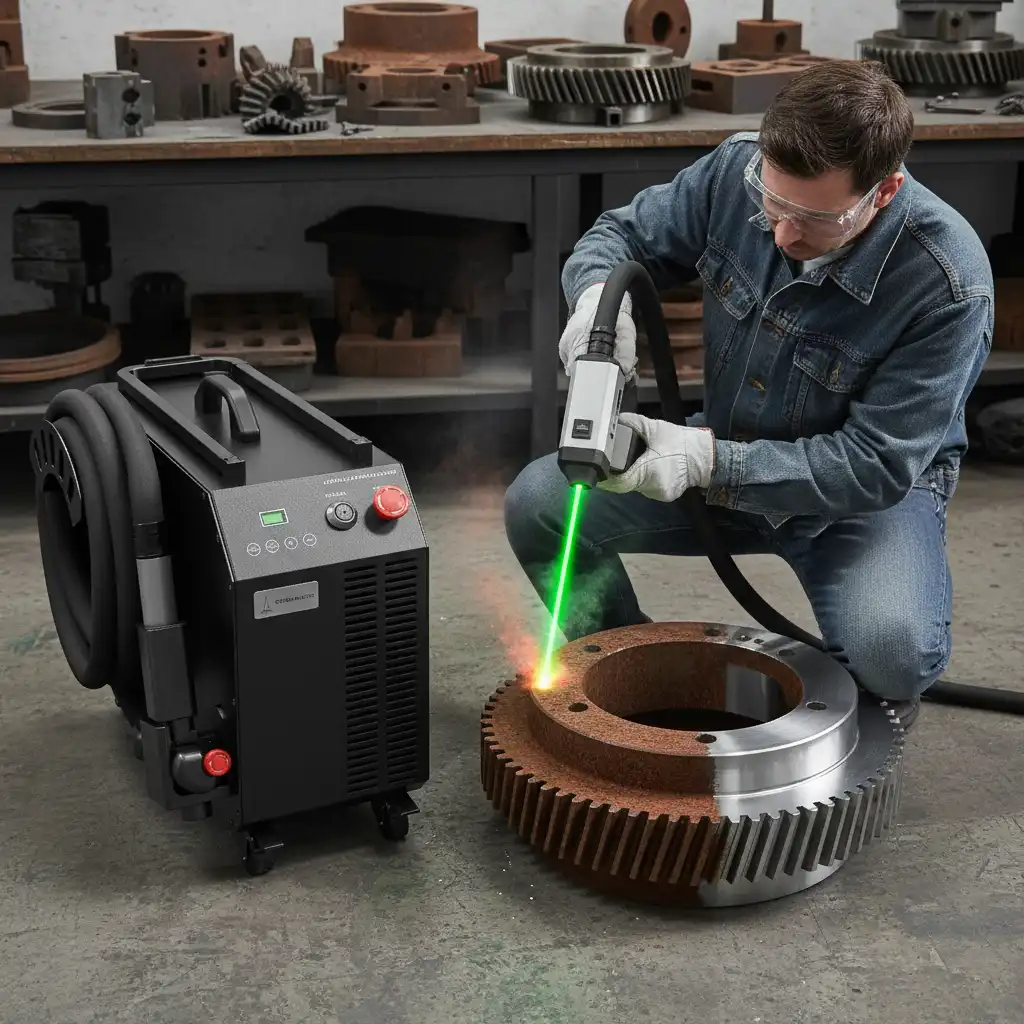
Laser cleaning works for many kinds of molds. You can use it in metal work because it is fast and good for the earth. Stamping molds get cleaner and make better products when you remove oil and dirt. Injection molds use laser cleaning to treat tools gently, clean fast, and avoid damage.
| Application Area | Benefits |
|---|---|
| Metal Industry | Fast, exact, and good for the earth when cleaning molds. |
| Stamping Mold Maintenance | Takes away oil and dirt, makes products better. |
| Injection Molding | Gentle on tools, no damage, cleans quickly. |
You can use laser cleaning to fix and clean rusty surfaces that need to stay smooth. This way is good for cleaning soft surfaces and fixing fragile parts. Laser cleaning helps you clean and fix many kinds of molds.
Side-by-Side Comparison: Dry Ice Cleaning vs Laser Cleaning
Effectiveness and Precision
You want cleaning that works well and keeps your mold safe. Dry ice blasting cleans big areas fast. It works best for simple shapes. Laser cleaning is very exact. You can use it for small, detailed spots. Laser cleaning gets rid of dirt without hurting the mold. It can clean hard-to-reach places that dry ice blasting might miss. Laser cleaning is gentle and does not harm the surface.
| Cleaning Method | Precision Level for Intricate Geometries | Speed of Operation |
|---|---|---|
| Laser Cleaning | High | Slower for larger areas |
| Dry Ice Blasting | Moderate | Faster for larger areas |
- Laser cleaning works best for tiny details.
- Dry ice blasting is good for big, open spaces.
Safety and Environmental Impact
You need to keep your team safe and help the earth. Dry ice blasting uses CO2 pellets. It can be loud and needs safety gear. You must watch out for cold burns and flying bits. Laser cleaning uses strong light. It can hurt your eyes or skin if you do not wear protection. Both ways can make fumes, so you need good airflow.
| Safety Risk | Description | Safety Measures |
|---|---|---|
| Laser Radiation Hazards | Laser beams can hurt eyes and skin. | Wear safety goggles and use shields. |
| Particulate and Fume Generation | Cleaning makes dust and fumes. | Use HEPA filters and check the air. |
| Thermal and Fire Hazards | Hot spots can start fires. | Keep fire extinguishers close. |
| Acoustic Noise | Dry ice blasting is very loud. | Wear ear protection. |
Laser cleaning is better for the environment. It does not make extra trash. Dry ice blasting makes more CO2 but less than older ways.
Standards-based controls: classify the laser and implement controls per ANSI Z136.1‑2022 and international product rules IEC 60825‑1. Use engineering controls first: fully interlocked Class‑1 enclosures, dual‑channel interlocks to ISO 13849‑1 PL d / Cat.3, and calculated NOHD/post signs. Manage non-beam hazards with source capture and verified LEV (see OSHA OTM Section III, Ch.3); fit HEPA H13/H14 + activated‑carbon stages per [EN 1822 / ISO 29463] selection guidance. Include hot‑work/permit procedures, eyewear OD matched to wavelength, and documented LSO/SOPs.
Cost and Efficiency
You want to save money and finish fast. Dry ice blasting costs more because you need pellets and repairs. Laser cleaning costs less over time. You only need electricity. Laser cleaning is faster for small, detailed jobs. Dry ice blasting is quicker for big areas. Both ways let you clean without taking the mold apart.
- Dry ice blasting: Fast, gentle, no extra trash.
- Laser cleaning: Quicker, more exact, and cleaner for the earth.
Maintenance and Downtime
You want less waiting and easy care. Dry ice blasting lets you clean in place in about two hours. You do not need to take the mold apart. Laser cleaning also lets you clean in place. You can clean right on the line. Laser cleaning does not hurt the mold, so you fix it less. Dry ice blasting can be loud and may cause burns if you are not careful.
Tip: Both cleaning ways help you keep your mold ready with less waiting.
Choosing the Right Mold Cleaning Method
Assess Mold Type and Contamination
Industrial mold contamination assessment: list the mold base materials (hardened tool steel, stainless steel, aluminum) and typical contaminants—carbonized release agents, polymer melt residues, oil/grease, oxidation/rust, and cooling-channel scale. Inspect cavity complexity, deep pockets/vents, tolerance‑critical or polished surfaces, moving parts (ejector pins, sliders), and contamination depth. These factors determine allowable methods and parameter windows—e.g., polished or thin‑walled aluminum favors low‑energy, non‑abrasive techniques (gentle laser settings or ultrasonics), while heavy carbonization may require higher energy or staged chemical/laser cleaning with pilot trials.
Consider Production Environment
Your workspace changes which cleaning method is best. Dry ice cleaning works well in busy factories. You can clean molds without stopping work. Laser cleaning is good when you need careful cleaning and less mess. Look at how big your workspace is. Think about how much time you can stop working. Some places need fast cleaning to keep machines running. Other places need gentle cleaning to protect equipment.
Tip: Pick a cleaning way that fits your work speed and safety rules.
Budget and Resource Factors
Think about how much money you have and what you need. Some cleaning ways cost more because you need special things or more workers. The table below shows what can change costs and what you need:
| Factor | Description |
|---|---|
| Extent of Mold Growth | More mold means you spend more on workers and supplies. |
| Type of Mold | Some molds need special cleaning, so it costs more. |
| Location of Affected Area | Hard-to-reach spots cost more because you need special tools. |
| Size of Affected Area | Bigger areas need more supplies and money. |
| Level of Contamination | Lots of mold may need better cleaning, which costs more. |
Plan your cleaning budget before you start. If you have lots of mold or a big area, you need more money and time.
Long-Term Maintenance Planning
Make a plan to keep your molds clean for a long time. Check and clean often to stop big problems. Use different levels of cleaning to keep molds working well. The table below shows how often to clean and check molds:
| Maintenance Level | Frequency | Description |
|---|---|---|
| Level 1: In-Press Cleaning and Daily Checks | Every Shift | Wipe down and check for damage each shift. |
| Level 2: Routine Preventative Maintenance | Between Production Runs | Clean and check all parts by a skilled worker. |
| Level 3: Major Overhaul | Annually or After X Cycles | Take apart the mold, check everything, and fix or replace parts. |
Follow these steps to keep molds working well. Regular cleaning keeps your work safe and stops expensive repairs.
Decision Guide: Matching Your Needs to the Best Cleaning Method
Use a checklist to help pick the best way to clean mold:
Industrial decision checklist — align cleaning choice to production constraints:
- Allowed downtime: maximum inline/stopper duration and preferred shift window.
- In‑place (online) allowed? yes/no — if no, plan teardown time.
- Surface roughness/finish limits (Ra, mirror polish) and allowable micro‑removal.
- Coatings present (PVD/DLC/paint): must they be preserved?
- Accessibility: cavity depth, fixturing, robot reach, sightlines.
- Ventilation & LEV capability (capture hood, HEPA+carbon capacity) and hot‑work/fire assessment.
- Utilities: available kW, single‑phase/three‑phase, compressed air capacity.
Prioritize hard constraints (coatings, fire risk, legal exposure limits) before cost or speed.
You need to pick how to clean by looking at the mold type, how much mold there is, and what your job needs. Use a checklist to help you decide. Check cleaning ways often because new tools come out. Look at your mold after a set number of uses. Write down what you see every time. This keeps your tools safe and clean.
| Cleaning Method | How Often to Check | What to Remember |
|---|---|---|
| Visual Inspection | After a certain number of uses | Helps you find dirt and damage |
| Document Observations | All the time | Stops you from forgetting to clean |
Tip: Learn about new cleaning choices to keep your molds safe and get better results.
FAQ
What safety gear do you need for dry ice or laser cleaning?
You need gloves, goggles, and ear protection for dry ice cleaning. For laser cleaning, you must wear special laser safety glasses. Always follow safety rules to protect your eyes, skin, and ears.
Can you use these cleaning methods on all mold types?
You can use both methods on many mold types. Dry ice cleaning works best for strong molds. Laser cleaning is better for detailed or delicate molds. Always check your mold’s material first.
Does laser cleaning damage the mold surface?
Laser cleaning does not scratch or wear down the mold. You can clean even fine details safely.
Tip: Adjust the laser’s power to match your mold’s needs.
How often should you clean your molds?
You should check and clean molds after a set number of uses.
- Daily: Wipe and inspect
- After each run: Deep clean
- Yearly: Full overhaul
Which method is more eco-friendly?
Laser cleaning is more eco-friendly. It does not use chemicals or create waste. Dry ice cleaning uses CO₂, but it leaves no chemical residue.
| Method | Waste Produced | Chemicals Used |
|---|---|---|
| Laser Cleaning | None | No |
| Dry Ice | None | No |