

Dry Ice Cleaning vs Laser Cleaning for Mold Maintenance
Dry ice cleaning is often the better starting point for frequent in-press removal of release agents, resin off-gas and rubber residue across complex mold surfaces. Pulsed laser cleaning is often stronger for selective carbon, oxide, rust or coating removal where repeatable energy control and automation matter. Neither method is universally safer, faster or cheaper: the mold material, finish, contamination and factory controls decide the winner.
Start with dry ice for frequent, broad residue removal on hot tooling. Start with pulsed laser for selective, repeatable carbon, oxide or localized coating removal. Test both when surface finish or coating preservation is the controlling risk.
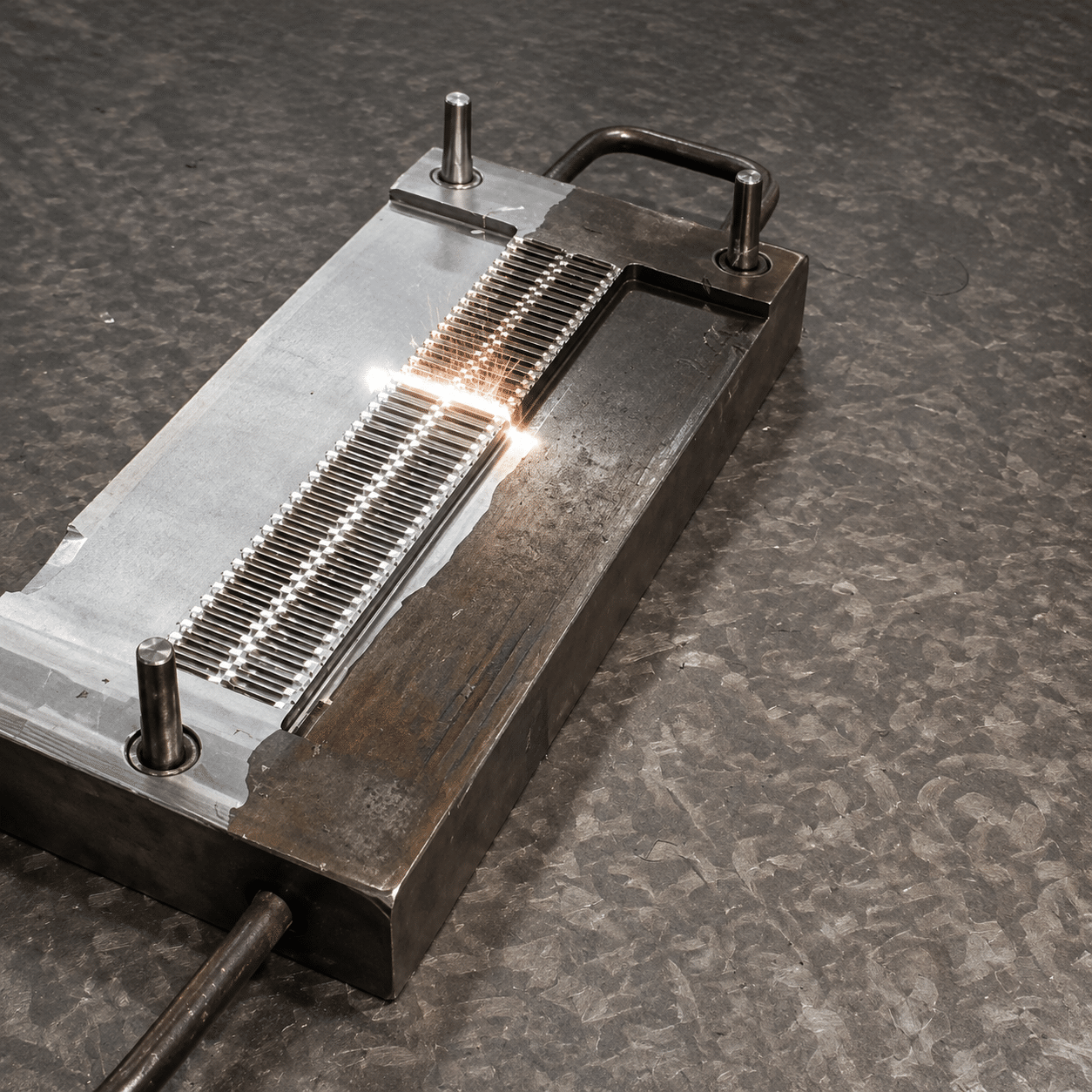 Comparison, not a sales shortcut
Compare the accepted surface after cleaning—not only whether the residue disappears.
Start with the maintenance constraint, not the machine.
Use these four signals to decide which process deserves the first controlled trial. The accepted mold surface and the complete stop-to-start cycle are more important than a headline cleaning speed.
Coated, mirror-polished, aluminum or unknown surfaces require a controlled trial before production.
No blasting-media residue; recurring pellets, compressed air, noise and CO₂ ventilation remain.
No dry-ice supply chain; requires laser controls, fume capture and a qualified parameter window.
Inspect texture, dimensions, coating condition and production cleanliness after a representative test.
Which method is better for mold maintenance?
Dry ice blasting usually earns the first trial when the job is frequent, broad and residue-heavy: release agent, resin off-gas, uncured or cured polymer residue and rubber buildup on molds that must stay hot and in the press. The dry ice particles are consumed by sublimation, so the process adds no separate abrasive media to recover. The removed mold contamination still remains, and the expanding CO₂ gas must be managed.
Pulsed laser cleaning usually earns the first trial when the job is selective, repeatable or automation-oriented: carbonized deposits, oxide, rust, localized coating, oil film or contamination around features that must not be mechanically contacted. The laser can deliver a controlled scan path without pellets, but a bad process window can change color, roughness, hardness, coating or geometry. A laser is not automatically non-damaging simply because it is non-contact.
Frequent in-press cleaning; rubber or plastic residue; complex cavities; broad refresh; protective coating must be preserved; the plant already supports compressed air, pellet logistics, noise control and CO₂ monitoring.
Localized carbon, oxide, rust or coating; repeatable recipe; sensitive edges or microfeatures; robotic path; no pellet storage; the plant can establish a laser-controlled area and source-capture extraction.
Mirror polish, reflective aluminum, PVD/DLC or other valuable coatings, unknown alloys, deep texture, mixed residues, tight dimensional acceptance or a production target that cannot tolerate surface change.
They remove contamination by different physical routes.
Understanding the mechanism explains the different utilities, risks and best applications.
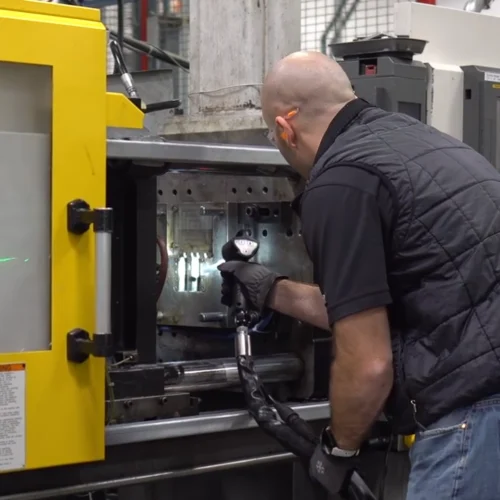

Impact, thermal effect and sublimation
Compressed air accelerates solid CO₂ particles through a nozzle. Cleaning depends on the combination of particle impact, the temperature difference at the contamination interface and rapid sublimation of dry ice into gas.
The jet transfers momentum and helps fracture or loosen the unwanted layer.
Cooling can change the bond between residue and tooling, but the response depends on both materials.
The dry ice becomes CO₂ gas; it does not remain as blasting media on the tool.
No secondary blasting media does not mean zero waste. Removed resin, rubber, oil, coating and other contamination still require collection or extraction.
Selective optical absorption and ablation
A scanning beam delivers short optical pulses. The contamination and substrate absorb energy differently. Within a qualified process window, the unwanted layer can detach, fragment or vaporize before unacceptable surface alteration occurs.
Power, pulse energy, frequency, spot size, scan width, overlap and dwell shape the interaction.
Thermal expansion, vapor pressure and other rapid effects can break the residue-substrate bond.
Particles and vapors leave the interaction zone and must be captured near the source.
Non-contact does not equal risk-free. Excess fluence, slow travel, high overlap or the wrong wavelength/material combination can alter a surface or remove a coating.
Match the method to your actual maintenance task.
This is an early planning aid, not a qualified production recipe. Use the result to choose which process to test first.
Describe the mold and residue
The recommendation updates when you change an input.
Light polymer film and frequent in-press work often align with dry ice cleaning. Confirm access, pellet flow, nozzle distance, CO₂ concentration and the accepted surface after cleaning.
Dry ice cleaning vs laser cleaning: the full mold-maintenance picture
Use this table as a quotation and trial checklist. The winner can change from one residue or mold finish to another.
| Decision factor | Dry ice cleaning | Pulsed laser cleaning |
|---|---|---|
| Removal mechanism | High-velocity solid CO₂ particles, thermal differential and sublimation assist debonding. | Controlled optical pulses create localized thermal and mechanical removal effects. |
| Frequent mold residue | Often strong: release agent, resin off-gas, uncured/cured polymer and rubber residue. | Often strong: carbonized residue, oil film, oxide, rust and selected coatings. |
| Fine features | Nozzles can reach cavities and vents, but line of access, pellet size and jet behavior still matter. | Scan patterns can target features precisely, but optical line of sight and focus geometry matter. |
| Mold temperature | Commonly promoted for hot, in-press cleaning; verify thermal response of the real tool and coating. | Can support in-place work, but heat accumulation and fire risk require a qualified process window. |
| Consumables | Recurring dry-ice pellets plus compressed air; storage and sublimation losses affect planning. | No cleaning media, but electricity, extractor filters, protective windows and optics are operating items. |
| Secondary material | Dry ice becomes gas; removed contamination remains for capture or collection. | No abrasive media; removed contamination becomes particles/vapor that must be extracted and filtered. |
| Surface risk | Generally described as non-abrasive, yet jet pressure, thermal response and fragile coatings still require testing. | No mechanical contact, yet excessive fluence, overlap or dwell can alter texture, color, coating or metallurgy. |
| Reflective / polished surfaces | Often a useful first trial where a coating or polish must remain; verify the specific finish. | Reflection and low absorption can narrow the usable window; wavelength-specific hazard analysis is essential. |
| Utilities | Dry-ice supply, storage, suitable compressed air, ventilation, noise control and debris capture. | Electrical supply, laser-controlled area or enclosure, interlocks/area controls and local extraction. |
| Operator environment | Noise, projectile/debris, frostbite and CO₂ accumulation are principal hazards. | Direct/reflected laser radiation, fire, electrical hazards and laser-generated contaminants are principal hazards. |
| Automation | Automation is possible but requires media delivery, hose/nozzle management and process sensing. | Well suited to repeatable scan paths, robotics and recipe control after qualification. |
| Best cost pattern | Can favor intermittent, high-variety work where lower capital cost outweighs recurring media/logistics. | Can favor frequent use where higher capital cost is spread over many hours and pellet cost is avoided. |
| Evidence required | For either method: before/after photos, accepted cleanliness, surface roughness or replica, dimensional/texture inspection, coating condition, cycle time, utilities, captured waste and operator exposure controls. | |
Planning comparison only. Machine design, nozzle or beam delivery, mold alloy, finish and residue can reverse the general direction above.
Start from the mold, residue and acceptance limit.
Off-gas, resin film and release agent
Dry ice often fits frequent hot, in-press refresh. Laser may fit selective carbonized zones, gates or detailed restoration.
Cured rubber, carbon and vent fouling
Dry ice can clean broad textured areas and vents. Laser can target stubborn carbon and repeat automated paths.
Finish or protective layer must remain
Treat coating preservation as a hard constraint. Prove gloss, roughness and coating condition before production use.
Oil, oxide and localized rust
Pulsed laser often deserves the first trial for selective oxide or rust removal. Oil may require staged cleaning and extraction.
Residue around inserts and cavities
Dry ice is widely used for in-place mold cleaning. Validate food/packaging cleanliness and the collection of removed contamination.
Judge the process by the surface left behind.
A visually clean tool can still have altered texture, blocked vents, coating loss or residue in a critical feature. Document the accepted result.
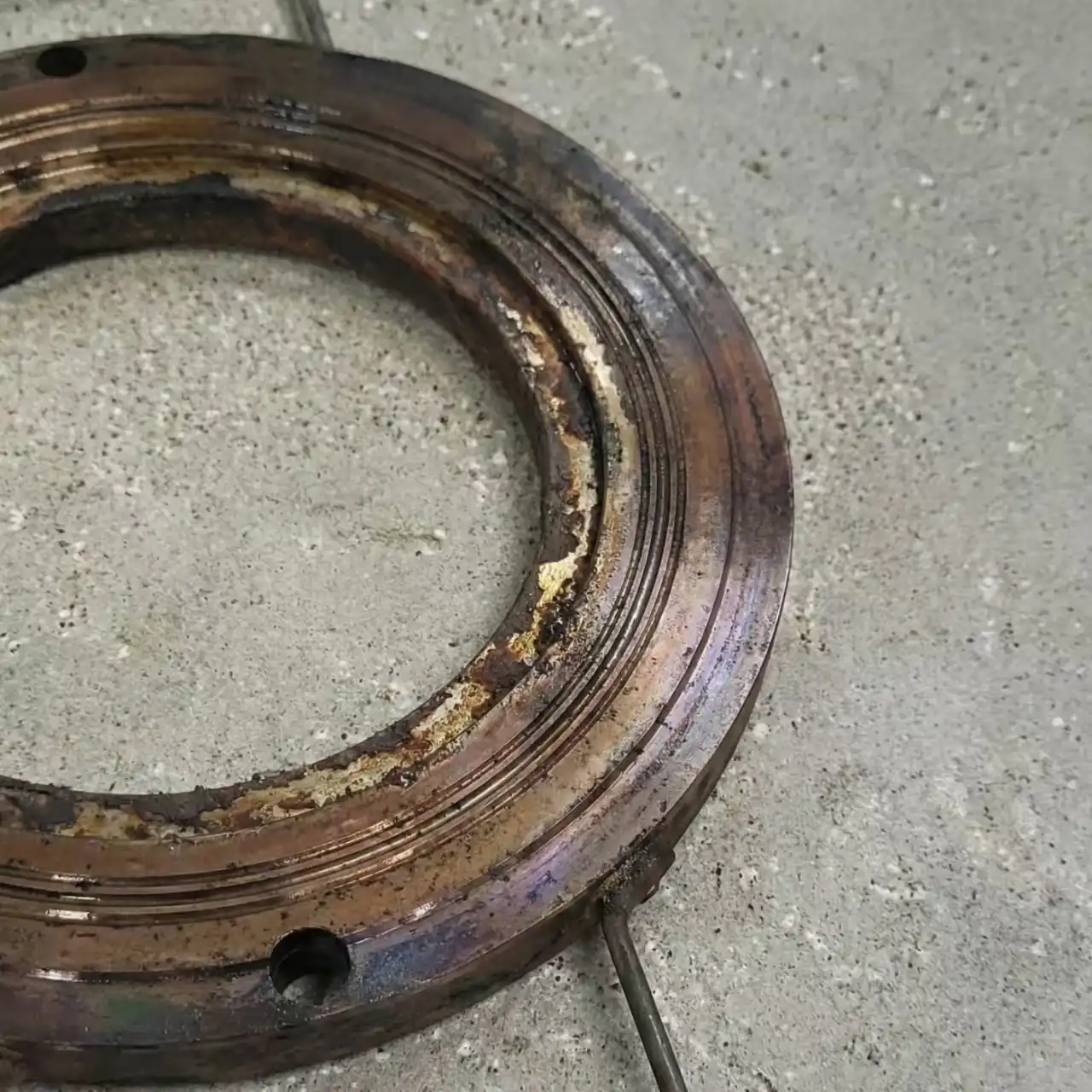
Oceanplayer application imagery. Final results depend on mold material, contamination, surface finish and qualified process settings.
Compare the cost of a clean mold returned to production.
Equipment price alone hides pellets, compressed air, extraction, filters, setup, line stoppage and rejected parts.
Dry ice cost boundary
Recurring-media modelLaser cost boundary
Capital-spread modelAnnual mold-cleaning cost = equipment ownership + media/energy + extraction and filters + labor + setup + inspection + downtime value + scrap/rework risk.“No chemicals” does not mean no hazards.
Both processes replace one set of consumables with a different safety and facility-control problem.
Dry ice cleaning controls
CO₂ is colorless, odorless and denser than air. Ventilation and atmospheric monitoring may be needed, especially in pits, enclosed presses or poorly ventilated rooms.
Dry ice can cause frostbite. Storage, handling and pellet loading require suitable insulated protection and procedures.
High-velocity air and dislodged debris require hearing, eye/face and exclusion-zone controls determined by the risk assessment.
Hoses, couplings, pressure, nozzle reaction and air quality are part of the machine safety review.
Laser cleaning controls
Industrial handheld cleaning commonly creates a Class 4 work process. Establish the hazard zone, controlled access, beam stops, screens/enclosure and wavelength-specific protection.
The removed layer becomes airborne particles and vapors. Capture close to the interaction point and select filtration from the actual contaminant.
Assess combustible residue, surrounding materials, hidden cavities and the suitability of extraction equipment.
Follow the manufacturer’s instructions and the standards applicable to the laser product, processing machine and workplace.
A hybrid maintenance plan can outperform a single-method rule.
The best method may change between routine refresh, periodic deep cleaning and restoration.
Routine production cleaning
Use the method with the fastest approved setup for common residue—often dry ice for hot in-press polymer or rubber mold refresh.
Precision corrective cleaning
Use pulsed laser for qualified selective areas, carbon, oxide or features where a documented scan path adds value.
Periodic tool verification
Inspect vents, texture, roughness, edges, coating, dimensions and molded-part quality; adjust the interval from evidence.
Run a comparison that procurement can actually use.
Do not compare a vendor’s best laser sample with an unoptimized dry ice trial—or the reverse. Use the same mold condition and acceptance criteria.
Record the tool
Alloy, hardness, finish, texture, coating, critical dimensions, vents, inserts and repair history.
Define the contamination
Resin, rubber, carbon, release agent, oil, rust, oxide or mixed layer; include thickness and time in service.
Freeze the acceptance criteria
Required cleanliness, allowable roughness/color change, coating preservation, vent openness and molded-part quality.
Measure the complete cycle
Setup, access, cleaning, repositioning, extraction, inspection, teardown and return-to-production time.
Document utilities and consumables
Pellets, compressed air and CO₂ controls versus electricity, filters, optics and laser safety infrastructure.
Inspect the surface
Use appropriate magnification, roughness, replicas, dimensions, coating tests or hardness/metallurgy checks for the risk level.
Run production evidence
Make parts after cleaning; inspect release, appearance, flash, burns, short shots, contamination and scrap.
Approve a controlled work instruction
Lock the machine setup, safe operating method, inspection frequency, retraining and change-control triggers.
Send the mold condition—not just the mold name.
Oceanplayer can assess whether pulsed laser cleaning deserves a trial and recommend a test route. A useful request includes the exact surface, contamination and production target.
Turn the comparison into a project decision.
Laser Cleaning Feasibility Checker
Screen the material, contamination and surface risk before selecting power.
Check feasibility → Laser routePulsed vs CW Comparison Tool
Compare control, heat input and throughput if laser cleaning is feasible.
Compare laser types → Production planningCleaning Efficiency Calculator
Estimate coverage from validated width, travel speed, overlap and passes.
Plan throughput → Tool centerFind My Cleaner
Move through machine selection, parameters, site planning and cost tools.
Open tool center →Dry ice vs laser mold cleaning FAQ
Short answers to common procurement and maintenance questions.
Is dry ice cleaning better than laser cleaning for molds?
Not universally. Dry ice often fits frequent in-press cleaning of polymer, rubber, release-agent and off-gas residue. Pulsed laser often fits selective carbon, oxide, rust or coating removal and repeatable automated paths. The mold material, finish, coating and acceptance criteria decide which process should be tested first.
Which process is faster for mold maintenance?
Either can be faster in the right application. Dry ice can cover broad, complex surfaces and avoid cool-down or disassembly in many molding operations. Laser can be fast on localized contamination and repeatable scan paths. Compare the complete stop-to-start cycle, not only nozzle or beam-on time.
Does dry ice blasting leave residue?
The dry ice particles sublimate into CO₂ gas, so they do not remain as blasting media. The contamination removed from the mold still remains as chips, particles, film or dust and must be captured or collected.
Does laser cleaning create waste?
Laser cleaning avoids abrasive media and chemical baths, but the removed contamination becomes particles and vapors. Extraction filters collect material and eventually require handling or disposal based on what was removed.
Can either method damage a mold surface?
Yes, if the method or settings are inappropriate. Dry ice jet conditions and thermal response can matter on fragile or coated surfaces. Laser fluence, overlap, dwell, focus and absorption can alter a surface or remove a coating. Test representative areas and inspect the required surface characteristics.
Can dry ice and laser cleaning be used on hot molds in the press?
Both are used for in-place mold maintenance, but the approved method depends on machine access, guarding, residue, mold temperature and the plant’s safety controls. Do not assume an open press is safe for either high-pressure blasting or an open Class 4 laser process.
Which method has lower operating cost?
Dry ice has recurring pellet, storage, delivery and compressed-air costs. Laser avoids pellets but adds electricity, extraction filters, optics, training and safety infrastructure. Laser can have a lower marginal cost at high utilization, while dry ice can be attractive for intermittent work. Use actual local costs and annual hours.
Which method is more environmentally friendly?
There is no universal winner. Both can avoid solvent baths and abrasive media. Dry ice uses CO₂ and compressed air; laser uses electricity and filtration. Both leave removed contamination to manage. Compare energy source, dry-ice source/logistics, filters, waste and actual process efficiency.
Is dry ice cleaning safe in enclosed mold shops?
It requires a specific assessment. CO₂ can accumulate in enclosed or low areas and displace breathable air. Ventilation, atmospheric monitoring, access controls and emergency procedures may be required. Follow the applicable occupational exposure rules and equipment instructions.
What should be sent for a laser mold-cleaning sample test?
Send a representative tool or coupon, clear photos, mold alloy and finish, coating information, residue identity, current cleaning method, critical dimensions or texture limits, desired cleaning interval and target line-stop time.