

Hot Rolled vs Cold Rolled Steel: Which Should You Choose?
Hot rolled steel is shaped at high temperature; cold rolled steel is further reduced after cooling. For ordinary carbon-steel sheet, hot rolled is often the economical starting point, while cold rolled offers a smoother surface and tighter dimensional control. Choose by grade, delivery condition and finished-part requirements—not by assuming cold rolled is always stronger or better.
Compare the options for your part Hot rolling reduces heated steel. Further surface treatment and cold reduction create different purchasing options.
Which steel fits your part: hot rolled, HRPO or cold rolled?
Start with the problem you need to solve. A concealed welded frame and a smooth enclosure door do not need the same starting surface. Between black hot rolled and cold rolled, there is also HRPO: hot rolled pickled and oiled.
This guide focuses on uncoated carbon-steel sheet and common fabrication needs. Stainless steel, coated sheet, plate, bars and structural sections have additional product-specific requirements.
| Your main requirement | Useful starting point | Check before ordering |
|---|---|---|
| Low-cost frame or concealed bracket | Hot rolled, if its available surface and dimensional limits suit the part. | Allow for scale removal, coating preparation and any machining. |
| Scale-free sheet without paying for cold reduction | HRPO, where the required grade and size are available. | Oil removal, surface defects and the actual hot-rolled tolerances. |
| Smooth visible panel or close-fitting enclosure | Cold rolled in a suitable forming condition. | Surface class, thickness tolerance, flatness and finished appearance. |
| Deep-drawn shell or demanding bends | An appropriate drawing/forming grade, often annealed cold rolled. | Ductility, bend or draw trials, grain direction and tooling—not just the rolling label. |
| High strength from retained cold work | A specified full-hard or other controlled cold-worked product. | Whether reduced ductility is acceptable for every later operation. |
| Machined shaft, pin or bar component | Compare hot rolled bar with the appropriate cold-finished bar. | Bar tolerances, finishing route, machining allowance and movement after cutting. |
On smaller screens, scroll the table sideways to read all three columns.
These are selection starting points, not interchangeable material approvals. The grade and ordered condition still need to meet the drawing and service requirements.
What is the manufacturing difference between hot rolled and cold rolled steel?
Hot rolling shapes steel while it is hot
A mill passes heated steel through rolls to reduce its thickness. In the basic distinction, hot working happens above the material’s recrystallization temperature: the range where new grains can form during processing. It is not one universal temperature for every steel.
For sheet production, the hot strip is cooled and coiled. Oxide forms on the hot surface. This layer is called mill scale; it explains the dark surface of ordinary black hot rolled steel.
Cold rolling adds reduction and finishing steps
The mill removes scale from hot-rolled feedstock, then reduces it further below the recrystallization range, commonly near room temperature. The pressure changes thickness and work-hardens the metal.
For conventional formable sheet, annealing follows to restore ductility—the ability to deform without cracking. A light temper-rolling pass can then control surface texture and mechanical behavior. Dofasco distinguishes this route from full-hard material, which has not received that softening treatment.
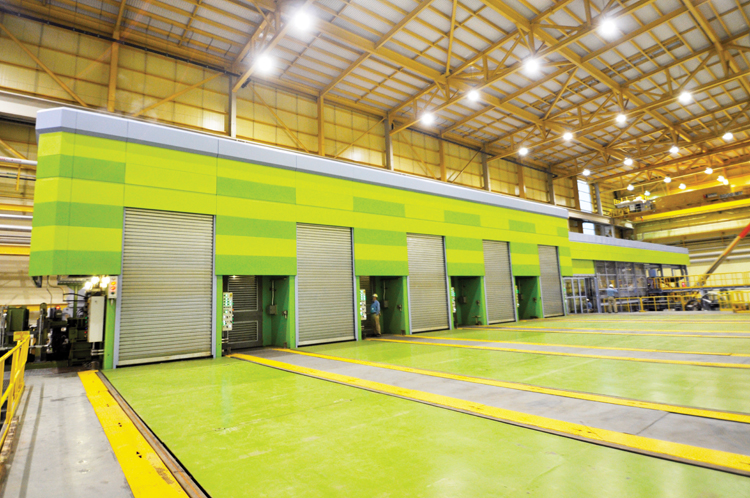 Cold reduction adds a controlled thickness-reduction step after hot rolling and scale removal.
- Hot rolled / HRPO
- Hot rolling → cooling → supplied with scale, or pickled and oiled.
- Conventional cold rolled sheet
- Hot rolling → pickling → cold reduction → annealing → temper rolling and finishing.
Temper rolling is not the same as heat-treatment tempering. Here it means a light rolling pass. “Cold rolled” also does not mean the steel was never heated: its production starts with hot rolling, and annealed products are heated again.
What is HRPO steel, and when is it a useful alternative?
HRPO is hot rolled steel with the mill scale removed by pickling, followed by an oil film. It is useful when scale is the main problem, but the job does not need all the extra control of a cold-rolled product.
For example, a fabricated bracket may meet its dimensional requirements in hot rolled sheet, yet require too much descaling before painting. Quoting HRPO lets you compare a cleaner incoming surface against that preparation work.
Pickling does not add a cold-reduction step. Do not assume HRPO has cold-rolled thickness tolerances or surface quality. Additional leveling may be available, so request the supplier’s actual condition rather than relying on the abbreviation. Dofasco’s hot-rolled product guide explains the black and pickled/oiled routes.
Scale-free does not mean ready for every weld or coating. Oil, rust from storage, surface contamination and the required coating profile may still need attention. The oil film is temporary protection, not a permanent outdoor coating.
 Mill scale is an oxide layer. Removing it changes the surface, but does not turn hot rolled steel into cold rolled steel.
Is cold rolled steel stronger than hot rolled steel?
Not automatically. Retained cold work can increase strength and hardness, but annealing changes the result. Compare the actual grade and delivery condition, not a generic “hot versus cold” strength percentage.
Full-hard cold rolled steel retains cold-work strength
Cold reduction makes further deformation more difficult. This can increase yield strength—the stress where permanent deformation starts—and tensile strength. The trade-off is less ductility. Material that looks ideal on a strength number may crack during a bend or require more forming force.
Annealed cold rolled steel restores formability
Annealing softens the cold-worked structure. This is why a cold-rolled sheet intended for drawing is not equivalent to full-hard strip. A high-strength hot-rolled grade can also be stronger than a mild, formable cold-rolled grade.
Ask for specified yield strength, tensile strength and elongation, with the test direction and product condition. When those properties are essential, confirm what the grade guarantees and what the material test report actually includes.
Do not buy “extra strength” without checking the next operation. A drawing that requires easy forming and one that requires high hardness call for different material conditions. The ASTM A1008/A1008M scope includes several cold-rolled sheet categories; it is not a single strength grade.
How do surface finish and dimensional tolerances compare?
Cold rolled sheet generally offers a smoother, more controlled starting surface and tighter thickness control than ordinary black hot rolled sheet. Those benefits matter most when they reduce a real assembly or finishing problem.
A smooth sheet is not necessarily mirror-bright. A matte finish and protective oil are normal for many cold-rolled products. Likewise, a bright ground patch does not prove that steel was cold rolled. For identification, use the order, product marking and certificate; appearance is only a clue.
Specify the dimension that controls the part
Thickness, flatness, width and straightness are different requirements. Tight thickness control does not guarantee that a long panel will remain flat after laser cutting. Rolling, coiling, leveling and later processing can leave internal stresses that redistribute when material is removed.
- For a close-fitting welded joint: check thickness variation, edge position and the gap in the actual fixture.
- For a visible panel: define acceptable scratches, surface texture and waviness after the intended coating.
- For a machined part: check stock allowance and movement after rough machining, not just incoming size.
Use the agreed measurement locations and sampling method. Record thickness in millimeters or inches, flatness over a stated length, and surface roughness in a named parameter such as Ra where needed. A gauge number alone is not a tolerance specification; see the sheet-metal thickness and tolerance guide.
Neither uncoated route is rust-proof. Keep stock dry, prevent condensation and follow the supplier’s storage instructions. Select the final corrosion-protection system for the actual environment. Nippon Steel’s cold-rolled sheet guide covers handling and rust-prevention precautions.
Which steel is better for bending, welding and laser cutting?
Both routes can work well. Grade, condition, thickness and process control decide the result. The rolling route mainly changes the starting surface and the property or dimensional options you can buy.
Bending and deep drawing
A suitable hot rolled or HRPO forming grade may work for ordinary brackets. For deep-drawn parts or demanding visible panels, a specified annealed cold-rolled drawing grade is often a useful starting point.
Test the intended thickness, rolling direction, cut edge, bend radius and tooling. A harder incoming condition may need more force and greater springback compensation. Do not replace ductile sheet with full-hard material because both are sold as “cold rolled.”
Welding and laser welding
Suitable low-carbon grades from either route can be welded. Chemistry, thickness, joint design and the qualified welding procedure matter more than the label. Black hot rolled steel may need scale removal; HRPO and cold rolled sheet may need oil removal.
For laser welding, check the joint gap and flatness after cutting and bending. Cold rolled stock can help where its tighter control solves a fit-up problem, but it cannot correct a poor fixture or an unsuitable joint design. Inspect the required penetration and defects, not only the top-bead appearance.
Use the sheet-metal laser welding guide for joint planning. If scale or oxide is the obstacle, evaluate laser cleaning before welding on the actual surface. High-power laser processing needs appropriate beam containment, extraction and trained operation.
Laser cutting and machining
Both hot rolled and cold rolled steel can be laser cut. Check scale, oil, coating, thickness and flatness when establishing the cutting settings. Inspect parts after they are released from the sheet: acceptable stock flatness does not by itself prove acceptable cut-part flatness.
For shafts and pins, compare the correct bar products. Cold-finished bar may reduce stock removal, while hot rolled bar can make sense when most surfaces will be machined anyway. Confirm the finishing route; “cold finished” can involve drawing, turning or grinding and is not simply another name for cold-rolled sheet.
Painting and powder coating
Cold rolled sheet can reduce cosmetic surface work. HRPO can reduce scale-removal work. Neither eliminates the need for preparation matched to the coating: oil, soluble contamination, surface profile and rust can affect the result. Test a coated sample through the actual preparation and curing process.
Why does cold rolled steel usually cost more?
Cold rolled sheet adds processing, but there is no fixed price premium. Grade, thickness, width, quantity, surface, availability, freight and quotation date all affect the price. Compare equivalent requirements, not two unrelated stock listings.
The better business measure is cost per accepted finished part. A lower steel price can be lost through descaling, extra finishing or rejected panels. Equally, paying for cold rolled precision adds little value if it solves no production problem.
Example: compare finished-panel cost, not only steel cost
The figures below are hypothetical USD values for two batches of 100 starting blanks. They show the calculation only; they are not steel quotations or Oceanplayer Laser test results. Both routes are assumed capable of meeting the same finished-panel specification.
| Batch item | Hot rolled route | Cold rolled route |
|---|---|---|
| Landed material | $200 | $250 |
| Surface preparation | $90 | $25 |
| Other processing and inspection | $600 | $600 |
| Total batch cost | $890 | $875 |
| Accepted finished panels | 95 | 98 |
| Cost per accepted panel | $890 ÷ 95 = $9.37 | $875 ÷ 98 = $8.93 |
Scroll sideways on small screens to compare both cost columns.
In this example, the extra material cost is offset by less preparation and fewer rejected panels. With equal preparation and equal yield, the result could reverse. Use your own batch costs, include all rework, apply scrap credits consistently and divide by accepted output only.
A useful HRPO comparison: if the main saving comes from removing scale, quote HRPO as a third route. It may avoid the preparation cost without requiring cold reduction. Confirm the finished surface and dimensional requirements before treating that saving as achievable.
Can hot rolled steel replace cold rolled steel?
Sometimes—but only if the replacement still meets the part and process requirements. Matching nominal thickness or a familiar chemistry designation is not enough.
Consider two illustrative jobs. A concealed frame that is blasted, painted and finish-machined may gain little from a smoother incoming sheet. A visible enclosure door with close gaps and a demanding painted finish may benefit from controlled cold-rolled stock. The difference is the required finished result, not a universal quality ranking.
- Check the drawing and approval route. If a material or standard is fixed, get the required engineering or customer approval before substitution.
- Compare grade and condition. Confirm required strength, ductility, surface and dimensions. Do not replace an annealed condition with full hard by accident.
- Run the complete process on representative stock. Include cutting, bending, welding, cleaning and coating steps that could change the result.
- Release against the same acceptance criteria. Check finished dimensions, function, weld quality and appearance. Test realistic lot variation before committing to production.
Stop the substitution if a critical requirement is missing. A successful-looking sample is not evidence of an unspecified strength, tolerance or service requirement.
What should you specify when ordering hot rolled or cold rolled steel?
Order a defined product, not just “hot rolled” or “cold rolled.” Give the supplier enough information to quote the material you can actually use.
- Grade, product standard and agreed edition. Include strength, ductility or other supplementary requirements that the part needs.
- Product form and delivery condition. State sheet, coil, plate or bar; then black, HRPO, annealed cold rolled, full hard or the required finishing condition.
- Dimensions and measurement basis. Give thickness, width, length, tolerances, flatness requirements, edge condition and the applicable sampling method.
- Surface and downstream use. Identify visible faces, texture requirements, oil restrictions, welding, forming and the planned coating system.
- Evidence and commercial terms. Agree traceability, test documents, quantity, packaging, delivery and how nonconforming material will be handled.
| Reference | Product scope | Important boundary |
|---|---|---|
| ASTM A1011/A1011M | Several categories of hot-rolled steel sheet and strip. | It is not a general specification for all plate, bar or structural shapes. |
| ASTM A1008/A1008M | Several categories and conditions of cold-rolled steel sheet. | The scope excludes cold-rolled strip covered by A109/A109M. Specify the correct product category. |
| ASTM A568/A568M | General requirements for applicable hot- and cold-rolled sheet specifications. | Individual product requirements control where they conflict with the general specification. |
| ASTM A108 | Cold-finished carbon and alloy steel bars. | Use the bar requirements; do not carry sheet tolerances into a shaft or pin order. |
Scroll sideways on small screens to read the standard boundaries.
Use the standard system required by your market and contract, whether ASTM, EN, JIS or another applicable system. Similar descriptions do not prove grade equivalence. Obtain the full agreed specification before setting acceptance limits. If it provides separate SI and inch-pound tables, use the ordered system; the tables may not be exact conversions.
At receipt, match material tags and documents to the purchase order, measure the agreed dimensions, and inspect rust, scratches, scale and transit damage. For a new source, verify the first production trial before treating the material as an established substitute.
Need to validate laser cleaning or welding on your steel?
Share the grade, delivery condition, thickness and surface photos, plus the joint or coating requirement and target output. Ask Oceanplayer Laser to assess a sample test around the result your production process needs.
Discuss your steel-processing applicationTechnical sources
- ArcelorMittal Dofasco: Hot rolled products — black and pickled/oiled conditions.
- ArcelorMittal Dofasco: Cold rolled products — full-hard and conventional processing routes.
- Nippon Steel: Cold-Rolled Steel Sheets and Coils — processing, surface, handling and storage guidance.
- American Iron and Steel Institute: Steel industry glossary — cold reduction and temper-mill terminology.
- ASTM public scope pages linked in the ordering table identify the relevant product families. Full standards and the purchase contract govern acceptance.
Oceanplayer Laser
Practical guidance for material preparation and laser-processing decisions. This article supports comparison; the project’s engineering requirements and qualified production procedures govern final selection.