

15CrMo Steel: Composition, Properties, Heat Treatment and Uses
15CrMo is a Chinese chromium-molybdenum alloy steel designation associated with elevated-temperature strength, weldability that requires procedure control, and several distinct product standards. This guide explains what the name means—and what it does not mean.

The 60-second 15CrMo verdict
Start with the engineering document that governs the component. Chemistry is only one part of material identity; product form, heat treatment, mechanical testing, dimensions, inspection and traceability also matter.
Structural alloy product, seamless boiler tube and pressure-equipment plate belong to different standards even when their grade names look closely related.
Allowable stress, creep life, wall thickness, environment and design code determine suitability. A single “maximum temperature” is not universal.
Preheat, filler, heat input, interpass control and post-weld heat treatment depend on thickness, restraint, hydrogen control and the governing code.
ASTM A335 P12 or A387 Grade 12 may be useful comparison directions, but they cannot replace a Chinese grade without an engineering review.
What is 15CrMo steel?
The short name is useful, but it is not a complete purchase specification. The same chemistry family appears in different product standards because a pressure-equipment plate, seamless boiler tube, round bar and forging have different manufacturing routes, dimensions, delivery conditions and mandatory tests. A buyer who writes only “15CrMo” on a purchase order may leave critical requirements undefined.
15CrMo is commonly discussed for boilers, hot piping, pressure-containing components, petrochemical equipment and fabricated parts exposed to heat and pressure. Its usefulness comes from a balance: more elevated-temperature capability than plain carbon steel, yet lower alloy content and usually easier fabrication than higher-chromium heat-resistant steels. That balance does not eliminate risk. Incorrect heat treatment, uncontrolled welding hydrogen or an unverified grade substitution can reduce toughness and service reliability.
Why chromium and molybdenum are paired
Chromium contributes hardenability, oxidation resistance and carbide formation. Molybdenum supports elevated-temperature strength and helps resist softening during long service. The two elements do not make 15CrMo a stainless steel: its chromium content is far below the level normally associated with stainless corrosion resistance. Surface protection and corrosion allowance may still be required for the actual environment.
15CrMo, 15CrMoG and 15CrMoR: three different purchasing routes
The suffix changes the product context. Always verify the current governing standard and the exact edition named by the project.
15CrMo
Used as an alloy structural steel designation under GB/T 3077. It may be encountered in bars or other structural alloy products, subject to the dimensional and delivery standards applied to the order.
Start with GB/T 3077 and the relevant product/dimensional standard.15CrMoG
The “G” grade is associated with seamless steel tubes and pipes for high-pressure boilers. The tube standard controls far more than chemistry, including manufacture, dimensions and required testing.
Start with GB/T 5310-2023 and the design code.15CrMoR
The “R” grade is used for pressure-equipment plate. Plate thickness, heat treatment, mechanical testing and inspection requirements must be taken from the plate standard and project documents.
Start with GB/T 713.2-2023 and the vessel code.Official standard records: GB/T 3077-2015, GB/T 5310-2023, and GB/T 713.2-2023.
15CrMo steel chemical composition
The table below shows commonly cited composition limits for generic 15CrMo under GB/T 3077. It is a useful identification reference, not a substitute for the current standard, material certificate or product-specific grade requirements.
| Element | Typical specified range, wt.% | Engineering role |
|---|---|---|
| Carbon (C) | 0.12–0.18 | Strength and hardenability; excessive effective carbon increases weld cracking sensitivity. |
| Silicon (Si) | 0.17–0.37 | Deoxidation and contribution to strength. |
| Manganese (Mn) | 0.40–0.70 | Strength, deoxidation and sulfur control. |
| Chromium (Cr) | 0.80–1.10 | Hardenability, carbide stability and improved hot-service performance. |
| Molybdenum (Mo) | 0.40–0.55 | Elevated-temperature strength and resistance to softening. |
| Phosphorus / sulfur | Restricted residuals | Controlled to protect toughness and fabrication reliability. |
Verify limits against the current GB/T 3077 record and the material purchase order. Limits can differ by product standard and edition.
Chromium and molybdenum work as a system.
The nominal chemistry helps explain the alloy family, while section size, cooling rate and subsequent heat treatment determine the structure and final properties.
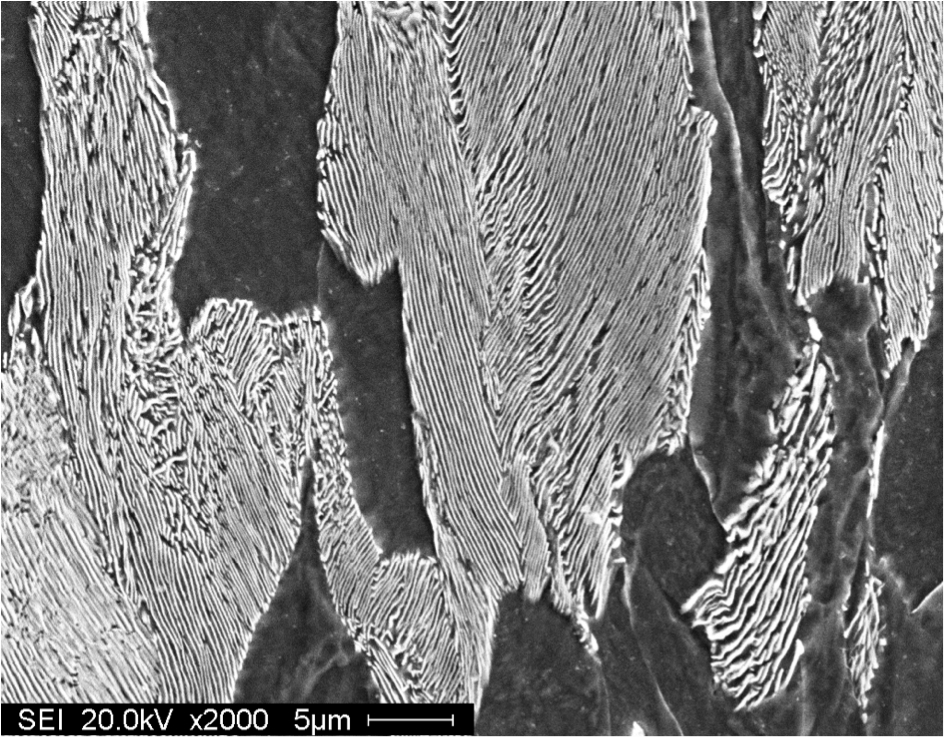
This representative ferrite-pearlite image explains a common low-alloy steel structure. It is not presented as an actual 15CrMo metallograph; heat treatment, section size and cooling rate determine the real microstructure.
Representative micrograph: Michelshock / McGill University, Wikimedia Commons, public domain.
Why elevated-temperature design needs more than a tensile certificate
Room-temperature yield and tensile strength describe a short test. Hot equipment must also address time-dependent deformation, microstructural change, oxidation and weld behavior.
Strength depends on form and treatment
Do not quote one universal strength for all 15CrMo products. Plate thickness, tube condition, bar heat treatment and the applicable standard set the required values.
Allowable stress comes from the design code
Design temperature and pressure must be assessed with code-approved material data, wall calculations, joints, corrosion allowance and service environment.
Creep becomes time-dependent
Under sustained stress at elevated temperature, strain can accumulate even below the room-temperature yield strength. Cavitation and damage may develop with time.
Actual history matters
Metal temperature, pressure cycles, weld condition, oxidation, wall loss and prior overheating must inform inspection and remaining-life assessments.
Research: Long-term creep behavior of 15CrMoG steel.
15CrMo “equivalents”: use comparison, not automatic substitution
International grades can be compositionally close while differing in product form, heat treatment, mechanical tests, dimensional tolerances, inspection and design-code recognition.
| Grade / standard | Product context | Nominal alloy direction | How to use the comparison |
|---|---|---|---|
| 15CrMo / GB/T 3077 | Alloy structural steel | Approximately 1Cr–0.5Mo | Chinese structural alloy reference; specify actual product and delivery standard. |
| 15CrMoG / GB/T 5310 | Seamless high-pressure boiler tube | Related 1Cr–0.5Mo family | Use for tube projects only when the code and current standard accept it. |
| 15CrMoR / GB/T 713.2 | Pressure-equipment plate | Related Cr–Mo plate family | Use with the vessel code, plate thickness, heat treatment and inspection requirements. |
| ASTM A387 Grade 12 | Pressure-vessel plate | Nominal 1.00Cr–0.50Mo | Closer nominal plate comparison than Grade 11, but not an automatic equivalent. |
| ASTM A387 Grade 11 | Pressure-vessel plate | Nominal 1.25Cr–0.50Mo | Higher nominal chromium direction; compare full requirements and class. |
| ASTM A335 P12 | Seamless high-temperature pipe | Cr 0.80–1.25; Mo 0.44–0.65 | Useful nominal pipe comparison; product and code acceptance still govern. |
| ASTM A335 P11 | Seamless high-temperature pipe | Cr 1.00–1.50; Mo 0.44–0.65 | Not the same grade; wider/higher chromium range than generic 15CrMo. |
| EN 13CrMo4-5 | Pressure-purpose flat product family | European Cr–Mo comparison direction | Review EN product standard, delivery condition and design approval before substitution. |
Standard references: ASTM A387/A387M, ASTM A335/A335M, and EN 13CrMo4-5 product information.
15CrMo heat treatment: define the objective before the temperature
Heat treatment determines microstructure, strength, toughness, hardness and residual stress. The correct route is not one universal furnace recipe. It depends on the product standard, section thickness, starting condition, required properties and whether the operation is mill heat treatment, fabrication heat treatment or post-weld heat treatment.
Normalizing and cooling
Heating into the austenitic range and controlled cooling can refine and homogenize the structure. Section size and cooling rate strongly influence the result because chromium and molybdenum increase hardenability. A thick section can respond differently from a thin test coupon even at the same furnace setpoint.
Tempering
Tempering reduces excessive hardness and adjusts the balance between strength and toughness after a hardening or normalizing operation. Temperature, holding time and prior microstructure must be treated as a system. More tempering is not automatically better: excessive thermal exposure can reduce strength, while inadequate tempering can leave brittle regions.
Post-weld heat treatment is a qualified operation
PWHT can reduce residual stress and temper hardened weld heat-affected zones, but it also changes base-metal and weld-metal properties. A study on 15CrMoR examined PWHT at 595°C, 620°C, 675°C and 690°C and found measurable changes in strength, hardness and impact behavior. That result supports procedure qualification; it does not authorize one temperature for every thickness or code.
Research reference: Effect of PWHT temperature on 15CrMoR steel properties.
How to weld 15CrMo steel without turning a guideline into a recipe
15CrMo can be welded successfully, but the Cr–Mo alloy system makes cooling rate, diffusible hydrogen and subsequent heat treatment more important than for many mild steels.

Image: Vronmikah2024, Wikimedia Commons, CC0.
Confirm the exact base metal
Check standard, suffix, thickness, delivery condition and actual material certificate. Positive material identification may be appropriate for mixed-alloy facilities.
Calculate cracking risk
Use the approved carbon-equivalent or weldability method required by the code. Joint restraint, thickness, heat sink and hydrogen level influence required preheat.
Control consumables and surfaces
Select filler through the qualified procedure. Keep low-hydrogen consumables correctly stored and remove oil, rust, moisture, coatings and sulfur-bearing contamination.
Control heat input and interpass
Too little heat can accelerate cooling and harden the HAZ; too much can enlarge grains or overtemper prior passes. Record actual parameters rather than relying on machine display alone.
Execute PWHT and inspection as specified
Follow the qualified heating cycle. Use the required NDE timing, hardness checks, mechanical tests or production test plates defined by the code and project.
15CrMo steel applications
The alloy family is attractive where temperature and sustained load exceed the comfortable range of ordinary carbon steel—but each component must use the correct product standard.
Superheater and hot piping routes
15CrMoG tube may be considered where the boiler design code and operating conditions recognize the grade. Tube quality, bend treatment and weld control remain critical.
Shells and fabricated components
15CrMoR plate belongs to the pressure-equipment plate route. Thickness, heat treatment, impact requirements, formed condition and PWHT must be coordinated.
Hot process piping and equipment
Cr–Mo steels are used in elevated-temperature process service, but hydrogen exposure, sulfidation, oxidation and corrosion mechanisms require project-specific materials selection.
Heat-loaded structural parts
Generic 15CrMo structural alloy products can serve heat-resistant mechanical parts when the applicable standard, heat treatment and design calculations support the duty.
Replacement parts and weld restoration
Existing equipment requires positive grade verification, damage assessment and a code-approved repair plan. “Same nominal chemistry” is insufficient for life extension.
Wet corrosion or stainless duties
15CrMo is not stainless steel. Severe aqueous corrosion, chlorides or oxidizing chemicals may require a different alloy, lining, coating or corrosion-control strategy.

Temperature, pressure, corrosion, hydrogen exposure, cycling, weld details and inspection strategy belong in the same materials decision.
Image: Bitjungle, Wikimedia Commons, CC BY-SA 3.0.
A practical 15CrMo procurement checklist
A reliable purchase order describes the material and the proof required to accept it. The list below can be adapted to the project code and supplier quality plan.
Standard, edition and grade
State 15CrMo, 15CrMoG or 15CrMoR explicitly, plus the complete standard number, year/edition, product form and applicable dimensional standard.
Condition and dimensions
Define heat-treatment condition, thickness or diameter, length, tolerances, straightness, surface quality and any machining or forming allowance.
Required tests
List tensile, yield, elongation, impact, hardness, flattening, flaring, bend or other tests required by the product standard and project.
NDE and pressure testing
Specify ultrasonic, eddy-current, radiographic, magnetic-particle, penetrant or hydrostatic requirements where applicable, including acceptance level.
MTC and marking
Require heat number, material certificate type, chemical analysis, mechanical results, heat treatment record and traceable transfer of markings after cutting.
Welding and forming data
Request suitable documentation for weld procedure qualification, filler, forming heat treatment and PWHT when the supplier performs fabrication.
Independent checks
Define witness points, third-party inspection, sample retention, PMI, dimensional inspection and document review before release.
No silent grade changes
Require written approval before any alternative grade, standard, heat-treatment route, mill or manufacturing process is accepted.
How to estimate 15CrMo steel weight
These formulas use a planning density of approximately 7,850 kg/m³. Actual ordered mass depends on dimensional tolerances, surface condition and the density value specified by the project.
kg = length (m) × width (m) × thickness (mm) × 7.85
Example: a 2 m × 1 m × 20 mm plate is approximately 314 kg before tolerance and processing allowance.
kg/m ≈ (OD − t) × t × 0.02466
Use outside diameter and wall thickness in millimetres. The equation is a geometric estimate for steel tube, not a certified shipping weight.
kg/m ≈ diameter² (mm) × 0.006165
Add cutting allowance, scale loss and machining stock when estimating purchased quantity for finished parts.
When 15CrMo is a good starting point—and when to stop
Consider the 15CrMo family when
- The governing code recognizes the exact product-form grade.
- Elevated-temperature strength is needed beyond a conventional carbon-steel option.
- The supplier can provide the required heat treatment, testing and traceability.
- A qualified welding and PWHT route is available for the actual thickness and restraint.
- Inspection and remaining-life plans address the intended temperature and service duration.
Reconsider or escalate when
- The purchase order contains only “15CrMo” without a product standard or suffix.
- The supplier proposes P11, P12, A387 Grade 11/12 or 13CrMo4-5 as a direct replacement.
- The design relies on a generic maximum temperature, pressure or creep-life claim.
- Wet corrosion, hydrogen attack, sulfidation or thermal cycling has not been assessed.
- Welding must proceed without a qualified procedure, material certificate or thermal controls.
Validate Cr–Mo steel cleaning or laser welding on the real material.
Share the standard, grade suffix, thickness, joint, delivery condition and required acceptance criteria. Oceanplayer can help plan a representative laser-process sample rather than recommend settings from the grade name alone.
- Material standard, edition and MTC
- Part dimensions and joint drawing
- Surface condition or contamination
- Required penetration, appearance and tests
15CrMo steel FAQ
Short answers to the questions that most often cause specification, welding and purchasing errors.
What is 15CrMo steel?
15CrMo is a Chinese low-alloy chromium-molybdenum steel designation, nominally around 0.15% carbon, 1% chromium and 0.5% molybdenum. The complete specification must include the applicable product standard and delivery condition.
Is 15CrMo a stainless steel?
No. Its chromium content is much lower than that of stainless steel. It can provide useful hot-service properties, but it should not be assumed to have stainless corrosion resistance.
What is the difference between 15CrMo, 15CrMoG and 15CrMoR?
Generic 15CrMo is associated with alloy structural steel, 15CrMoG with seamless high-pressure boiler tube, and 15CrMoR with pressure-equipment plate. Their product standards, tests and acceptance requirements differ.
What is the ASTM equivalent of 15CrMo?
There is no automatic ASTM equivalent. A335 P12 pipe and A387 Grade 12 plate can be closer nominal chemistry comparisons than P11 or Grade 11, but product form, heat treatment, mechanical properties and code acceptance must be compared in full.
Is 15CrMo the same as P11?
No. ASTM A335 P11 has its own chemistry range and pipe requirements, including a nominally higher/wider chromium range. Do not substitute P11 for 15CrMoG or another Chinese grade without engineering and code approval.
What is the maximum working temperature of 15CrMo?
There is no universal maximum temperature that is safe for every 15CrMo component. The design code, exact product grade, allowable stress, duration, pressure, wall thickness, environment, welds and inspection history determine suitability.
Can 15CrMo steel be welded?
Yes, when an appropriate welding procedure is qualified. Preheat, filler, heat input, interpass temperature, hydrogen control and PWHT depend on the code, thickness, restraint and service requirements.
Does every 15CrMo weld need PWHT?
Not as a universal rule. The governing fabrication code, wall thickness, material form, joint, service and qualified WPS determine PWHT requirements. When PWHT is required, the complete cycle must be controlled.
Can laser welding be used on 15CrMo?
Potentially, but process feasibility must be demonstrated on representative material and geometry. Penetration, gap tolerance, cooling rate, HAZ hardness, defects, shielding and post-weld requirements must be qualified.
How should 15CrMo be identified at receiving inspection?
Review the MTC, standard and grade marking, heat number, dimensions, heat treatment and required test results. Use traceable PMI or laboratory verification when the quality plan or alloy-control program requires it.
What is the density of 15CrMo steel?
Approximately 7,850 kg/m³ is commonly used for planning calculations. Certified mass should account for the exact dimensions, tolerances and project-specified density.
What information should a 15CrMo purchase order include?
Include the exact standard and edition, grade suffix, product form, dimensions, delivery condition, tests, NDE, certification, marking, supplementary requirements and a rule prohibiting unapproved substitutions.
References and standards
- State Administration for Market Regulation — GB/T 3077-2015, Alloy structure steels
- State Administration for Market Regulation — GB/T 5310-2023, Seamless steel tubes and pipes for high pressure boiler
- State Administration for Market Regulation — GB/T 713.2-2023, Steel plate, sheet and strip for pressure equipment
- ASTM International — A387/A387M, Pressure-vessel plates, alloy steel, chromium-molybdenum
- ASTM International — A335/A335M, Seamless ferritic alloy-steel pipe for high-temperature service
- Peer-reviewed study — Long-term creep behavior and damage evolution in 15CrMoG steel
- Pressure Vessel Technology — Effect of PWHT temperature on 15CrMoR properties