

3-in-1 Laser Welding Machine: Is It Worth Buying?
A 3-in-1 machine can be a practical choice when welding is the main job, cleaning supports that job, and cutting is occasional. It is less suitable when precision surface treatment, repeatable production cutting, or simultaneous work is essential. Buy the tested configuration and workflow—not the promise of three complete machines in one cabinet.
What Does “3-in-1” Actually Include?
In this guide, 3-in-1 means a handheld platform sold for welding, cleaning, and cutting. A common arrangement shares one fiber-laser source, controller, cooling system, and delivery cable. The head, optics, nozzle, gas arrangement, and software settings determine what each mode can do.
The label is not a standardized capability specification. Some packages use one convertible head; others need an additional head or optic kit. “Multifunction” can also mean welding with pre-weld and post-weld cleaning. For example, IPG’s LightWELD overview describes welding and cleaning, so that wording alone should not be read as confirmation of a cutting mode.
Ask for the exact model, laser source type, installed head, accessory list, manual revision, and included functions. Confirm which items are standard, optional, or not supported. A screen with three icons is not evidence that the quoted package meets three production requirements.
Source + controller + cooling + delivery system
Welding head configuration, joint, wire where needed, and shielding.
Compatible scanning optics, surface target, and removal settings.
Approved cutting nozzle, focus, assist gas, and work support.
For a single-source, single-output handheld package, these are sequential modes—not three independent production stations. A different multi-head architecture must be assessed from its own documentation.
What Can the Welding, Cleaning, and Cutting Modes Really Do?
Each function solves a different problem and needs its own success measure. A strong welding result does not establish cleaning quality or cutting accuracy.
| Function | Useful capability | Important limit |
|---|---|---|
| Welding | Join suitable metal seams, with or without filler, using a proven joint and setup. | Power and a neat bead do not establish fusion, strength, leak performance, or tolerance to changing gaps. |
| Cleaning | Remove a defined surface layer where the installed optics and source produce an acceptable result. | Removal may heat or alter the substrate. Scan width and a bright appearance do not establish accepted area output or coating readiness. |
| Cutting | Separate suitable sheet for approved trims or simple cuts using the required nozzle and gas. | A handheld head does not add CNC motion, automatic height control, nesting, or guaranteed dimensional repeatability. |
Welding: Prove the Joint, Not Just the Material Name
Accessible sheet-metal seams with controlled edges, clamping, and gaps are useful trial candidates. Specify the alloy and condition, actual thickness, butt/lap/corner/T-joint geometry, position, surface, wire, and required product performance. “Stainless steel” or “aluminum” is not a complete welding requirement.
Concentrated heating can reduce surrounding heat and finishing on a suitable application, but it does not prevent burn-through, porosity, lack of fusion, or distortion. Wire and beam oscillation can help develop a usable joint window; they do not repair every fit-up problem.
TWI’s fit-up guidance explains how clamping, filler, and beam movement affect gap tolerance. Do not convert its general process guidance—or a supplier’s wire-diameter rule—into a guaranteed gap allowance for every handheld joint.
Require representative inspection against the product requirement. A sound-looking surface can hide internal defects, and a single section describes only the sampled location. Qualification of one part family does not automatically cover a different alloy, thickness, joint, or service duty.

Cleaning: Judge Removal and Surface Damage Separately
A cleaning mode may remove light rust, oxide, or a coating from a controlled zone. Around a weld, its value can be avoiding a separate preparation or finishing step. The result still depends on the starting layer, substrate, beam delivery, passes, and required endpoint.
Many welding-led platforms use a continuous-wave source, sometimes operated with modulation. A frequency or duty-cycle control does not by itself prove nanosecond pulsed-cleaner capability. Ask for the actual pulse duration, energy, peak and average power, and supported operating mode when the surface task needs that distinction.
P-Laser’s technology overview distinguishes short-pulse ablation from continuous thermal processing. Pulsed cleaning can offer useful control for sensitive surfaces, but it is not automatically damage-free. CW cleaning is not automatically unsuitable: it must meet the removal and substrate limits of the actual job.
Inspect the condition needed by the next process. A clean-looking stainless seam does not prove restored corrosion performance, passivation, or readiness for a demanding coating. Where required, compare residue, roughness, wetting, dimensions, and functional performance—not color alone.
For large areas, count accepted area per elapsed production hour, including repeated passes, handling, inspection, and interruptions. A wider scan is only a geometric setting; it does not guarantee proportionally higher accepted output. The laser cleaning guide covers the wider process choice.
Cutting: Separate Severing Capacity From Usable Part Quality
Cutting needs the beam to separate the thickness along a controlled path. Focus, nozzle condition, gas delivery, head motion, material, and work support all affect the result. TWI’s cutting overview explains the role of beam delivery and motion control in a cutting system.
A supported hand-guided cutting mode can be useful for occasional trimming or simple profiles when the drawing permits the demonstrated variation. Check whether the job starts at an edge or requires piercing; successful edge-start cutting does not prove reliable internal holes or small features.
The head alone does not provide a CNC table, programmed path, sheet nesting, or an automatically controlled nozzle height. If dimensional repeatability, burr/dross limits, edge finish, or sheet throughput is the main business requirement, compare a dedicated cutter or an existing cutting service.
Keep the distinction between maximum severable thickness and recommended production thickness. Neither is a universal value without material, gas, speed, edge quality, and inspection conditions. Use the material-specific laser cutting thickness guide for the broader variables, not as approval of a particular handheld model.
What Must Change When You Switch Between Modes?
A changeover is a controlled setup change, not merely a screen selection. The exact hardware and sequence are model-specific. Obtain instructions covering both the destination mode and the return to welding.
As one documented example, JASIC’s product page describes a nozzle-tip change for cutting and a lens plus operating-mode change for cleaning. Its V2024A1 manual also requires power disconnection before lens replacement or maintenance. These are examples of why accessories and safe-state requirements must be checked—not instructions for a different machine.
| Transition | Configuration to verify | First-piece release check |
|---|---|---|
| Welding → cleaning | Approved cleaning head/optic, working distance and scan field, feeder state, gas, extraction, and mode-specific protection. | Required removal endpoint, residue, substrate change, and accepted area/time on the actual surface. |
| Welding → cutting | Supported cutting nozzle, focus and standoff, assist-gas specification, work support, offcut path, and beam containment. | Complete separation plus drawing tolerance, kerf, edge finish, dross, and any required piercing. |
| Cleaning or cutting → welding | Correct welding optic/nozzle and recipe, intact windows, shielding and feeder setup, focus, joint fixture, and safety checks. | The approved weld geometry and inspection result; restoration of the previous recipe alone is not release. |
Use the Manual’s Safe State Before Handling Process Hardware
Qualified personnel should follow the specified isolation, access, component-handling, and restart procedure. Do not treat “standby” on a display as proof that optical or electrical maintenance is safe. Confirm how the supplier prevents an incompatible optic, wrong recipe, or incorrect gas connection from being accepted.
Review the beam path and protection for every mode. Cleaning at a different working distance and cutting through the part can change exposure beyond the weld zone. If a contact or other protective function behaves differently between modes, require documented intended operation and validated protections; do not bypass a safeguard to make the demonstration run.
Time From the Last Accepted Part to the First Accepted Part
Include reaching the specified safe state, changing and checking hardware, confirming utilities and settings, restarting, making the verification piece, and inspecting it. Measure both directions and repeat with intended trained operators.
This timing definition is more useful than “lens change takes one minute.” A fast physical swap can still leave a long delay before the next mode produces accepted work. Capture incorrect setups, damaged/dirty optics, rejected starts, and delays as part of the trial.
What Do 1500W and 2000W Specifications Actually Tell You?
Rated output power describes the source, not the complete process capability. Keep input power, welding thickness, penetration, scan width, and production output separate. More watts may expand a tested operating window, but do not establish better welds, precision cleaning, or CNC-quality cuts.
These selected values come from JASIC’s product table for these models only—not Oceanplayer Laser data or independent test results.
| Published item | LS-15000F | LS-20000F |
|---|---|---|
| Laser output / input power | 1500 W / 5.8 kW | 2000 W / 7.8 kW |
| Single-wire/self-fusion: welding thickness / penetration | 0.5–5 mm / 0.5–3 mm | 0.5–6 mm / 0.5–4.5 mm |
| Cutting: recommended / maximum thickness | ≤3 mm / 5 mm | ≤5 mm / 6 mm |
The source separates thickness and penetration under its single-wire/self-fusion categories. It does not supply a complete acceptance report for every alloy, joint, and listed thickness. The cutting rows likewise do not establish dimensional tolerance, edge quality, or sustained output for your job.
Read each number with its equipment configuration. A nominal welding thickness may describe joining thicker stock without full-thickness penetration; whether that is acceptable depends on the joint requirement. If full penetration is required, inspect it with an agreed method rather than relying on the material-thickness headline.
Cleaning width is also gun- and lens-dependent. Confirm the supplied optics, working distance, and accepted removal result; do not combine data from different configurations.
For a quoted 1500W or 2000W package, obtain matching source, head, controller, cooling, utility, and manual details. Resolve differences between the quotation, website, and manual before ordering. Electrical service must be sized from the complete installed system—not optical watts alone.
How Do Changeovers and Shared Capacity Affect Output?
One cabinet may reduce transfers and duplicate equipment, but one shared source also creates a queue. Cleaning cannot use that source while welding is running. Count the real schedule, not the sum of each mode’s best advertised rate.
Include mode-specific production time, normal loading and inspection, batch changeover, first-piece verification, maintenance, and the interruptions expected in the shop. Avoid double-counting inspection already included in the changeover. Review the busiest period and delivery deadlines as well as the annual average.
Illustrative shared-station schedule—not a measured machine result. Suppose a shop has 400 usable minutes in a shift. The planned jobs need 210 minutes of welding, 60 of cleaning, 25 of cutting, and 50 of other non-overlapping handling and inspection.
If each complete mode change takes 10 minutes, four changes give 210 + 60 + 25 + 50 + 40 = 385 minutes. Eight changes give 425 minutes, exceeding the available shift by 25 minutes. The same processing capability fits one schedule and fails the other.
The 15-minute margin in the first schedule is not a reliability guarantee. These assumed times exclude any additional losses not already budgeted. Test realistic interruptions and consider batch grouping, outsourcing an occasional task, or a separate station before committing to delivery capacity.
Batching can reduce switches, but may increase work-in-progress and waiting. Keeping a part in one station can reduce handling, but may require more switches per part. Compare those two routes rather than assuming one-piece flow is always the cheaper choice.
A shared source, head, or controller failure can interrupt all assigned modes. Check recovery time, spares, warranty exclusions, service access, and a backup route. Separate machines provide independent capacity only to the extent that staff, utilities, fixtures, and other shared resources allow it.
Which Procurement Scenarios Favor a 3-in-1 Machine?
Choose the equipment architecture from the work that must pass inspection and ship on time. The following are purchasing scenarios, not claims that every machine qualifies for the named industry.
Welding-Led Sheet-Metal Work With Local Cleaning
A shop making accessible cabinet or enclosure seams may benefit when the laser welding route is proven and local cleaning removes a real transfer or finishing step. Occasional low-demand trimming can add flexibility if its cut quality meets the drawing.
The purchase case should still work if optional cutting is used only rarely. Confirm repeatable joints, a workable mode-change schedule, and enough eligible work to support the installed cost. Controlled small batches can be a good fit; high volume is not a universal requirement.
Cleaning-Led Work With Tight Surface Limits
If most paid work is mold cleaning, sensitive-part restoration, or surface preparation with defined roughness or damage limits, evaluate the cleaning source first. A welding-led package should not be the default merely because it includes a cleaning icon.
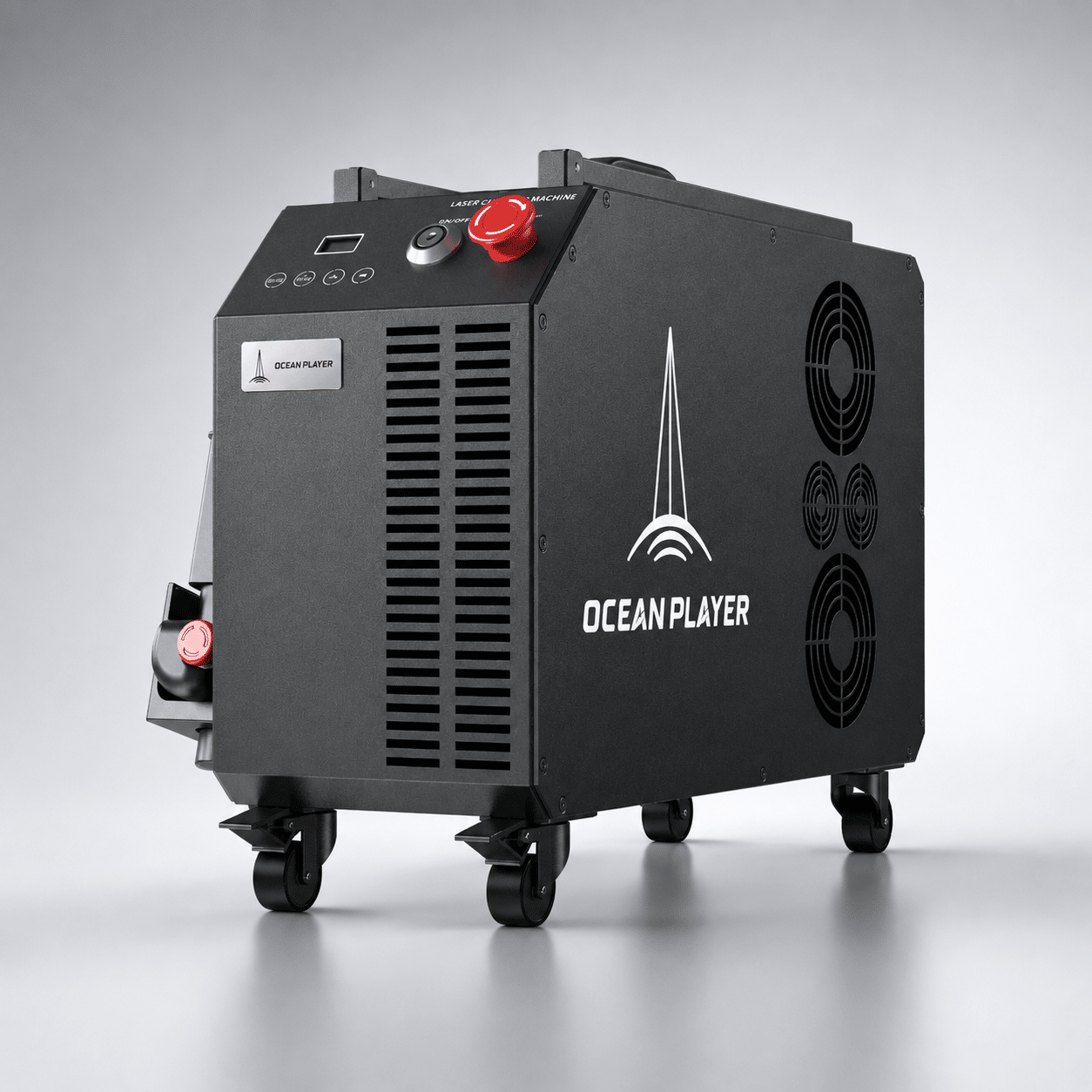
Compare a dedicated pulsed cleaner, an appropriate CW cleaner, and the multifunction configuration on the same surface and endpoint. The deciding result is accepted removal without unacceptable substrate change, at a usable rate—not the number of functions. Oceanplayer Laser’s 300W pulsed laser cleaner shown here is a dedicated cleaning system, not a 3-in-1 welding platform.
Cutting-Led Work Sold by Drawing Tolerance
If nested profiles, repeatable holes, edge quality, and sheet output drive revenue, evaluate a dedicated cutting system or an established cutting supplier. A shared handheld mode can be useful for exceptions without becoming the primary blank-production route.
Do not buy a higher-power multifunction machine simply to rescue a motion-control requirement. More optical power does not create the positioning, support, and automation the part needs.
Independent Teams or Processes That Must Run Together
When welders need the source at the same time as a cleaning or cutting team, separate stations may be more useful despite a higher equipment count. Verify the overlap from actual batch schedules, not a guess about utilization.
A welding-only system plus existing or outsourced secondary processes is also a valid option. The comparison is not limited to “one 3-in-1 machine versus buying three new lasers.”
Variable Repair or Regulated Welding Work
Repair jobs can introduce unknown alloys, coatings, prior heat treatment, changing gaps, or restricted access. Resolve those conditions and the applicable repair procedure first. Extra modes do not remove metallurgical, joint, or customer-approval constraints.
Retain a qualified arc route or other appropriate process where the demonstrated laser configuration does not meet the job. Structural or code-governed work is not approved simply because a sample looks clean.
How Should You Test All Three Functions Before Buying?
Use real workpieces and define separate release conditions for welding, cleaning, and cutting. A supplier demonstration establishes only what was actually tested. It does not approve missing functions or a different configuration.
| Mode | Representative input | Evidence to record |
|---|---|---|
| Welding | Exact grade/condition, thickness, joint, gap range, surface, fixture, wire, and service requirement. | Required fusion geometry, dimensions after release, functional or mechanical checks, finish, rejects, rework, and complete route time. |
| Cleaning | Actual substrate and layer, including thickness/coverage variation and the next process. | Agreed removal endpoint, residue and substrate-change checks, accepted area, repeated passes, handling, and elapsed time. |
| Cutting | Actual alloy/thickness, drawing features, edge starts or pierces, work support, and intended operator. | Dimensions, kerf, edge/dross condition, successful separation, finishing, rejects, and accepted output over the stated observation period. |
- Freeze the requirement. Agree sample IDs, normal material variation, drawing revision, inspection methods, and the source of each acceptance limit.
- Record the exact configuration. Identify the source and mode, head, optics, protective window, nozzle, focus/working distance, motion settings, gas, filler where used, cooling, and software revision.
- Test each task and the transitions. Use independent representative samples and intended trained operators. Include both directions of mode change and realistic workload interruptions.
- Report and decide by function. Link every sample to actual settings, methods, units, measured results, limits, and Pass/Fail/Not demonstrated status. Define any restricted application scope before release.
Repeated readings on one coupon are not independent production samples. Choose sample quantities and locations to cover the important variation and inspection risk. A missing penetration, coating-readiness, or dimensional check must not be silently recorded as a pass.
If cutting fails but welding and cleaning pass, a welding/cleaning package or a combined system used only for those approved tasks may still make sense. Its price and workload case must reflect the restricted use; do not assign savings to the failed mode.
What Safety Conditions Must Be Met for Each Mode?
Assess the proposed installation before any live demonstration. High-power handheld laser work introduces direct and reflected beam hazards as well as process emissions, fire, hot-material, electrical, and gas risks. The mode name does not reduce those hazards.
AWS’s handheld laser safety guidance explains Class 4 hazards, controlled areas, qualified oversight, and why ordinary welding helmets are not adequate laser-beam protection. Obtain a qualified assessment of the actual source, modes, beam paths, workpieces, openings, fixtures, and nearby people.
Define the enclosure or controlled area, access and emission controls, suitable barriers and viewing protection, emergency functions, procedures, training, and system-specific PPE. Cutting may expose the space behind a separated part; cleaning can involve a different scan field and working distance. Validate the intended safeguards in each mode rather than copying only the welding setup.
Identify coatings, oil, filler, and base metals when specifying extraction and fire controls. Removal does not make the contamination disappear: captured dust, filters, residue, and any hazardous materials need appropriate handling.
ISO 11553-2:2026 addresses hand-held or hand-operated laser processing machine hazards and design requirements. Confirm the requirements applicable to the quoted machine and site. A catalog statement or a single built-in interlock is not proof that an installation is compliant or safe.
How Should You Compare the Installed Cost and Operating Cost?
Compare a matched workflow: the same approved tasks, accepted annual output, quality, and delivery needs. Include the machine and accessories, optics/nozzles, feeder, electrical service, cooling, gas, extraction, safety installation, training, trials, qualification, maintenance, and service support.
Use realistic duty and mode-change schedules for operating cost. Count preparation, processing, handling, inspection, rejected starts, rework, final rejects, utilities, consumables, and downtime. “No abrasive media” does not mean no windows, nozzles, gas, filters, cooling service, or labor.
- Operating benefit before additional annual fixed costs
- (Current variable cost per accepted unit − proposed variable cost per accepted unit) × eligible annual accepted units
- Net modeled annual benefit
- Operating benefit − additional annual fixed costs not already included above
Apply the formula only to matching units and a defined workload. For mixed welding parts, cleaning area, and cutting parts, calculate each eligible task separately, then combine non-overlapping costs. Add the shared changeover and capacity effects once. Do not count the same operator time as both a welding saving and a cleaning saving.
Alternatively, compare fully allocated annual costs on both routes; then do not subtract ownership cost again. Initial cash outlay is separate from annual cost allocation. Released hours do not become cash savings or sales automatically, and a fast sample does not establish payback.
Value the extra modes only when they have scheduled work and accepted results. If a dedicated welder and a 3-in-1 package meet the same welding requirement, compare the premium for accessories and changeovers with the secondary work it can genuinely replace.
What Should Be Confirmed in the Quotation?
A useful quotation connects the equipment list to the tasks it must perform. Ask for written scope rather than an unrestricted “weld, clean, cut” promise.
- Function and accessory scope: exact source/head/controller, each supported mode, lenses, nozzles, feeder, tools, and any option needed for the tested result.
- Switching conditions: the model-specific safe-state procedure, component checks, training, complete changeover time, and first-piece release requirement.
- Accepted operating window: material, surface, thickness, joint or feature, configuration, actual test results, and the limits of the demonstrated scope.
- Site and protection scope: electrical and cooling requirements, gas specifications, extraction, mode-specific safeguards, responsibilities, and installation costs.
- Service and lifetime costs: stocked consumables, maintenance intervals, source/fiber/head warranty coverage, exclusions, response arrangements, and a recovery plan.
- Acceptance and change control: the test plan for the delivered configuration, required records, permitted substitutions, and how a failed or untested function will be handled.
A 3-in-1 platform is worth considering when the approved modes solve actual sequential work at a lower complete cost or with better flow. Choose dedicated or existing processes when the quality requirement, concurrency, or operating risk outweighs that flexibility.
Discuss Your Workload With Oceanplayer Laser
Send the welding materials, thicknesses, joints and gap range; the cleaning substrate and layer; the cutting drawing and tolerance; and the batch schedule, current route costs, inspection requirements, and proposed work area.
Request a configuration and trial scope tied to those tasks, including complete mode changes. Use the results to decide between a multifunction platform, welding-only equipment, or separate processes.
Discuss your three-mode applicationSources and Image Credit
- JASIC: LS-15000F / LS-20000F product data — model-specific functions, selected specifications, and optics options.
- JASIC user manual, V2024A1, sections 2.1, 3.1, and 6.1 — documented operating modes and lens-maintenance precautions.
- IPG Photonics: LightWELD systems — a manufacturer example of welding with pre/post-weld cleaning.
- P-Laser: cleaning applications and source types — pulsed and continuous-wave processing distinctions.
- TWI: laser welding and joint fit-up — clamping, wire, and beam movement.
- TWI: What Is Laser Cutting? — beam delivery and motion control.
- AWS: Handheld Laser Welding Safety — laser-specific hazards and controls.
- ISO 11553-2:2026 — scope of hand-held/hand-operated laser processing machine safety requirements.
- Photograph: RexA by Weldscientist, Wikimedia Commons, CC BY-SA 4.0; resized and display-cropped. It shows handheld stainless-steel welding, not a specific 3-in-1 model, Oceanplayer Laser trial, or validated safety arrangement.