

Density of Iron, Carbon Steel and Cast Iron: Complete Chart and Weight Formula
Use 7,874 kg/m³ for high-purity iron and 7,850 kg/m³ for ordinary carbon-steel estimates. Cast iron needs a grade-specific value: graphite-bearing grades commonly fall near 7,000–7,350 kg/m³, while white iron can be closer to steel. Calculate theoretical mass with mass = density × net metal volume.

Equal to 7.874 g/cm³ or about 0.28447 lb/in³. Do not use this as a guarantee for commercial iron products.
Equal to 7.85 g/cm³, 490.06 lb/ft³ or 0.28360 lb/in³. This is the normal planning constant.
Gray, ductile, CGI and malleable iron differ. Select the family and use supplier data for critical work.
Use net metal volume. Subtract holes and cavities, then add coatings, inserts, welds and packaging separately.
What Is the Density of Iron, Carbon Steel, and Cast Iron?
These values are practical calculation references for solid material near room temperature. A range means the family varies with chemistry, graphite, matrix, porosity and condition. Use the supplier's grade data when mass, balance, inertia or commercial settlement is critical.
| Material or calculation basis | kg/m³ | g/cm³ | lb/ft³ | lb/in³ | How to use it |
|---|---|---|---|---|---|
| High-purity iron at 20°C | 7,874 | 7.874 | 491.56 | 0.28447 | Reference for high-purity solid iron—not every commercial iron product. |
| Carbon steel: standard estimate | 7,850 | 7.850 | 490.06 | 0.28360 | Best general value for plate, bar, tube and stock-weight estimates. |
| Low-carbon steel: representative | 7,850–7,870 | 7.85–7.87 | 490.1–491.3 | 0.2836–0.2843 | The 7,850 kg/m³ shortcut is normally close enough for quotations. |
| Medium-carbon steel: representative | 7,830–7,850 | 7.83–7.85 | 488.8–490.1 | 0.2829–0.2836 | Use grade and condition data for precision mass properties. |
| High-carbon steel: representative | 7,810–7,840 | 7.81–7.84 | 487.6–489.4 | 0.2822–0.2832 | Carbon level and heat treatment can move the value. |
| Gray cast iron | 7,050–7,300 | 7.05–7.30 | 440.1–455.7 | 0.2547–0.2637 | Use a foundry value for the specified class, matrix and casting quality. |
| Ductile or nodular cast iron | 7,100–7,200 | 7.10–7.20 | 443.2–449.5 | 0.2565–0.2601 | A 7,150 kg/m³ midpoint is useful only for early planning. |
| Compacted graphite iron (CGI) | 7,000–7,200 | 7.00–7.20 | 437.0–449.5 | 0.2529–0.2601 | Confirm grade, nodularity, matrix and supplier material card. |
| Malleable cast iron | 7,270–7,350 | 7.27–7.35 | 453.9–458.8 | 0.2626–0.2655 | About 7,300 kg/m³ is a common early estimate. |
| Unalloyed white cast iron | 7,600–7,800 | 7.60–7.80 | 474.5–486.9 | 0.2746–0.2818 | Closer to steel because more carbon is held in carbides. |
| Alloy white iron | 7,300–7,800 | 7.30–7.80 | 455.7–486.9 | 0.2637–0.2818 | High-Cr and Ni-Cr classes need grade-specific data. |
Important: density is not usually a fixed acceptance value in a grade name alone. It also does not prove strength, hardness, soundness or suitability. The ranges above are planning references, not inspection guarantees.
How Do You Calculate Metal Weight from Density and Volume?
Choose a material, shape and unit system. The calculator uses net geometry and shows both mass per piece and total mass. Cast-iron presets are representative planning values; enter a supplier density when the grade is known.
Carbon steel rectangular plate using 7,850 kg/m³.
What Is the Difference Between Density, Mass, and Weight?
Density tells you how much mass fits into a given volume. A 1-liter block of carbon steel is about 7.85 kg, while a 1-liter gray-iron block using 7.15 g/cm³ is about 7.15 kg. The outside size can be the same, but the mass is different because the materials have different densities.
The one formula to remember: mass (m) = density (ρ) × net material volume (V). “Net” means the metal that is really present—not the outside bounding box around holes, tubes, cores or cavities.
Density
Mass divided by volume. The SI unit is kg/m³. Metal tables also use g/cm³, lb/ft³ and lb/in³. Always keep the unit attached to the number.
Mass
The amount of matter in a part. Purchasing, CAD, inventory and freight documents usually report kilograms, tonnes or pounds mass.
Weight force
In physics, weight is a force: W = mg, measured in newtons. Shops often say “weight” when they mean mass, so this page follows the common search term but reports kg and lb.
Specific gravity is related, but it is not the same unit
Specific gravity compares a material's density with a reference, usually water. It has no unit. In everyday shop use, “specific gravity 7.85” is often treated like 7.85 g/cm³, but a formal drawing or calculation should state the density and units directly.
Why temperature belongs in the description
Heating a solid expands its volume while its mass stays almost the same. Its density therefore falls. The table on this page is for solid material near room temperature. Do not use it for molten iron or a casting simulation.
For most stock quotations, the small difference between 20°C and 25°C is much less important than thickness tolerance, casting porosity or missing geometry. For hot machinery or precision metrology, use temperature-dependent material data.

Why Does Density Vary Between Iron, Carbon Steel, and Cast Iron?
“Iron,” “steel” and “cast iron” describe broad material families. Carbon form, alloy content, matrix structure and pores all change how much mass occupies the same volume. That is why a calculator needs a named material basis—not just the word “metal.”
Carbon level changes steel slightly
Historical measurements show a general decrease in carbon-steel density as carbon rises. For ordinary estimating, however, 7,850 kg/m³ remains the clearest default.
Free graphite lowers cast-iron density
Graphite is much less dense than the iron-rich matrix. Gray, ductile and compacted graphite irons therefore tend to be lighter than carbon steel for the same net volume.
White iron sits closer to steel
White iron holds more carbon in cementite or alloy carbides instead of free graphite. Its density can move much closer to the steel range.
Porosity and shrinkage reduce bulk density
A void adds volume without adding metal mass. A sound laboratory coupon can therefore be denser than a production casting with microshrinkage.
Heat treatment and cooling matter
Ferrite, pearlite, martensite, austenite and carbides do not have identical specific volume. Heat treatment can matter in precision work.

Do not rank cast-iron quality by density alone. Graphite form, matrix, soundness, hardness and strength must be judged against the drawing and material specification.

Gray iron: graphite flakes
Flake graphite supports damping, machinability and thermal performance, but the final density still depends on graphite fraction, matrix and casting soundness.

Ductile iron: graphite nodules
Rounded nodules improve mechanical behavior compared with flakes. They do not create one universal density; chemistry, nodule count, matrix and porosity still vary.
Which Density Value Should You Use for Estimating or Buying?
| Application | Recommended basis | What to confirm |
|---|---|---|
| Ordinary carbon-steel quotation | 7,850 kg/m³ and net nominal geometry | State that it is the theoretical calculation basis. |
| Published structural section | Use the governing section table or contract value | Do not override official unit mass with a homemade constant. |
| Specific steel grade or heat treatment | Supplier datasheet, approved CAD card or measured value | Confirm grade, condition, temperature and lot relevance. |
| Gray, ductile, CGI or malleable casting | Foundry value for the specified grade and condition | Ask whether the number represents a coupon or typical production casting. |
| Early casting concept | Use a clearly labeled midpoint from the chart | Replace it when the foundry and grade are selected. |
| Freight, customs or commercial settlement | Verified actual net, tare and gross mass | Use the required scale, packaging and reporting definition. |
| Rotor, counterweight, lifting or restraint | Conservative verified as-built mass properties | Include fixtures, liquids and attachments; follow the applicable code. |
| Molten-metal or solidification model | Temperature- and composition-dependent data | Do not use this room-temperature chart. |
Which Weight Formula Fits Your Part Shape?
The shortcut coefficients below use carbon steel at 7,850 kg/m³. Dimensions must match the stated units. For another material, multiply the result by your density ÷ 7,850, or use the full volume equation.
Length × width × thickness
kg = 7.85 × L(m) × W(m) × t(mm)If all dimensions are in millimeters: kg = 7.85 × 10⁻⁶ × L × W × t. Subtract holes and cutouts.
Cross-section × length
kg/m = 0.00785 × b(mm) × h(mm)Multiply kg/m by actual length in meters. Use real corner radii if the mass tolerance is tight.
Circle area × length
kg/m = 0.00616538 × d(mm)²This assumes a full solid circle. Diameter tolerance affects area twice as strongly as the same percentage change in length.
Outer circle minus inner circle
kg/m = 0.00616538 × [OD(mm)² − ID(mm)²]Use actual outside and inside diameters—not nominal pipe size.
OD and wall shortcut
kg/m = 0.0246615 × t(mm) × [OD(mm) − t(mm)]Inside diameter equals OD − 2t. Add lining, coating, couplings and retained liquid separately.
Regular hexagon × length
kg/m = 0.00679830 × F(mm)²Confirm that F is measured across flats. Across-corners dimensions need a different area calculation.
Net model volume
kg = ρ(kg/m³) × V(mm³) × 10−9Check model units, suppress construction geometry and subtract every core, bore and pocket.
Fast foundry shortcut
kg = ρ(g/cm³) × V(L)A 12.6 L ductile-iron model at 7.20 g/cm³ has a theoretical mass of 90.72 kg.
Imperial basis: use mass(lb) = density(lb/in³) × volume(in³). The carbon-steel reference is 0.283599 lb/in³.
How Do You Calculate Plate, Tube, and CAD Part Weight?
A correct formula is only half the job. Write the density basis, convert dimensions before multiplying, and round only after the final result.
2 m × 1 m × 10 mm
Formula: 7.85 × L(m) × W(m) × t(mm)
7.85 × 2 × 1 × 10 = 157.00 kg.
The same result comes from 7,850 kg/m³ × 0.020 m³.
60.3 mm OD × 3.9 mm wall × 6 m
Inside diameter = 60.3 − 2(3.9) = 52.5 mm.
0.00616538 × (60.3² − 52.5²) = 5.4245 kg/m.
5.4245 × 6 = 32.55 kg.
3.5 L of net metal
Gray iron at 7.15 g/cm³: 7.15 × 3.5 = 25.03 kg.
Steel at 7.85 g/cm³: 7.85 × 3.5 = 27.48 kg.
Same volume does not mean the same part design or performance.
Subtract missing metal before multiplying by density
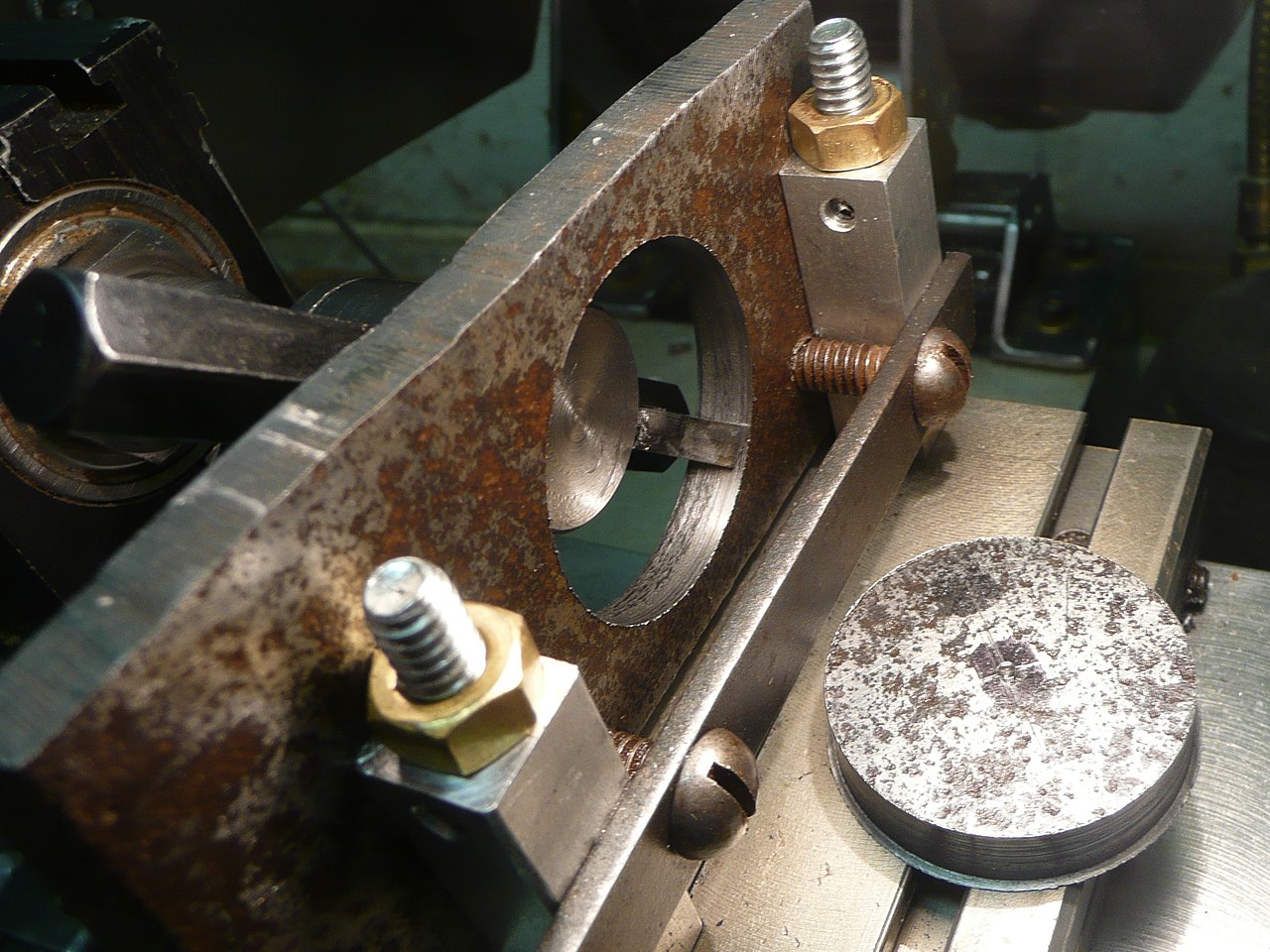
A 36 mm circular hole through an 8 mm plate removes a cylinder, not a square. Calculate the plate first, calculate the hole volume with πd²t/4, then subtract it. The same method applies to bores, slots and pockets.
For repeated complex parts, do not rebuild every cutout by hand. Export a checked net volume from CAD and confirm the unit. One cubic centimeter equals 1,000 cubic millimeters; confusing them changes the result by a factor of 1,000.
Percentage language needs a reference. Gray iron at 7.15 is about 8.9% less dense than steel at 7.85. Steel is about 9.8% denser than that gray iron. Both statements are correct because they use different denominators.
How Should You Use CAD Volume to Estimate Cast-Iron Weight?
Use the CAD system's net solid volume and a density for the specified cast-iron grade. Keep separate models for the finished part and the rough casting. Gates, runners and risers belong to a foundry process calculation—not the customer's finished-part weight.
Confirm the geometry
Check drawing revision and units. Remove construction bodies, cores, holes and nonmetal components.
Select the grade basis
Start with a labeled planning value, then replace it with foundry data for the chosen grade and condition.
Name the mass stage
Finished part, rough as-cast part and total poured metal are different numbers for different decisions.
Reconcile the first article
Compare theoretical mass with a clean, dry production part and investigate any meaningful difference.
| Mass concept | Calculation basis | What it includes | Best use |
|---|---|---|---|
| Finished theoretical mass | Finished net CAD volume × grade density | Metal left after all machining | Assembly model and finished drawing |
| Rough as-cast mass | As-cast CAD volume × grade density | Draft, stock and as-cast features | Foundry handling and machining plan |
| Machining removal | Rough mass − finished mass | Nominal metal removed as chips | Machining and yield discussion |
| Total poured metal | Rough mass ÷ defined foundry yield | Casting plus feed system and process loss on the stated basis | Melt and process costing |
| Net shipment mass | Measured accepted product | Parts and agreed loose accessories | Invoice and packing list |
| Gross shipment mass | Measured complete package | Product, pallets, dunnage and packaging | Freight, receiving and customs |
Example: A ductile-iron finished model is 12.60 L. At a provisional 7.20 g/cm³, finished mass is 90.72 kg. A rough model at 13.05 L is 93.96 kg. If the foundry defines yield as rough accepted casting divided by poured metal and estimates 65%, poured metal is 144.55 kg. These three figures must not be mixed.
Why Does Calculated Weight Differ from Scale Weight?
Theoretical mass is a model: assumed density × nominal geometry. Actual mass belongs to a real product. A difference does not automatically mean the calculator or the part is wrong; first check whether the two numbers describe the same condition.
Theoretical mass is useful for
- Early design and comparison
- Quotations using a common pricing basis
- Stock planning and nesting
- Preliminary freight and packaging studies
- Checking CAD assemblies and BOM logic
Verified actual mass is needed for
- Final shipping and customs documents
- Commercial settlement by actual mass
- Safety-critical lifting or restraints
- Rotors, balance and center-of-gravity work
- First-article acceptance when mass is specified
Thickness, diameter and tube wall change volume directly. A 1% diameter change produces about a 2% area change in a solid round bar.
Voids lower bulk mass. Do not apply a second arbitrary porosity discount if the foundry density already reflects normal production.
The rough casting includes stock that is missing from the finished-part model. Keep both CAD configurations.
Paint, zinc, oil, scale, rust and dirt add or remove mass compared with a clean bare-metal model.
An assembly may combine several materials. Model the BOM and weld volume instead of assigning one density to everything.
Pallets, dunnage, end caps, liners and retained test water can make gross or handled mass much higher.
Safety boundary: do not size lifting devices, transport restraints, high-speed rotating systems, counterweights or safety structures from one generic density and nominal drawing. Use the governing code, conservative load cases and verified as-handled mass.
What Errors Make Metal Weight Calculations Unreliable?
Using 7.85 as kg/m³
7.85 is normally g/cm³. The matching SI value is 7,850 kg/m³.
Mixing mm and m
One mm³ is 10−9 m³. Convert before multiplying by kg/m³.
Using steel density for cast iron
The same-volume error can approach 10% for graphite-rich gray iron or CGI.
Using the outside box
Cores, bores, slots, pockets and cavities must be removed from volume.
Using nominal pipe size
Use actual OD and schedule wall from the governing dimensional standard.
Measuring hex stock the wrong way
Across-flats and across-corners dimensions produce different areas.
Ignoring coatings and hardware
Bare-metal formulas do not include paint, plating, weld metal, fasteners or packaging.
Reporting false precision
Extra decimals do not improve an estimate based on approximate density and nominal size.
Better habit
Write the density, units, geometry revision, included items and rounding rule beside the result.
What Should You Put in a Metal Weight RFQ?
A useful purchase request asks more than “How much does it weigh?” It tells the supplier which material, geometry and mass definition must control the answer.
State the standard, grade, product form, heat treatment or matrix, and relevant specification edition.
State the value or supplier data source, reference temperature and whether it represents typical or guaranteed material.
Choose finished theoretical, rough as-cast, actual net, tare, gross or total poured metal.
Identify drawing revision, CAD units, net volume, machining stock, cores, cavities and optional features.
List coatings, oil, scale, welds, inserts, liners, couplings, fasteners, accessories and packaging.
Define quantity, rounding, scale capacity, calibration status, weighing condition and first-article sampling.
RFQ example: “Calculate finished theoretical mass from the released net CAD volume using 7,850 kg/m³ for the specified carbon steel. Report first-article actual net mass in the clean, dry, uncoated condition. Verify packaging gross mass separately.”
What information does Oceanplayer need to verify your metal-part weight?
Send the material grade, part drawing, surface condition, dimensions and production goal. If the part will be laser cut, welded, cleaned or marked, Oceanplayer Laser can help you connect the material basis to a practical process review.
What Questions Do Buyers Ask About Metal Density and Weight?
These answers cover the questions most often asked by estimators, buyers, CAD users and fabricators.
What is the density of iron in kg/m³?
High-purity solid iron has a reference density of about 7,874 kg/m³ at 20°C. Commercial iron products can differ because of residual elements, slag, porosity, processing condition and temperature. Do not use the pure-iron value as a guarantee for cast iron or wrought commercial products.
What is the density of carbon steel?
Carbon steel is commonly estimated at 7,850 kg/m³. This equals 7.85 g/cm³, 490.06 lb/ft³ or 0.28360 lb/in³. Grade, composition and heat treatment can shift the true value slightly, so use grade-specific data for precision mass properties.
What is the density of cast iron?
There is no single cast-iron density. Gray iron is commonly about 7.05–7.30 g/cm³, ductile iron about 7.10–7.20 g/cm³, CGI roughly around 7.0–7.2 g/cm³ in published planning data, malleable iron commonly about 7.27–7.35 g/cm³, and white iron depends strongly on alloy class. Use supplier data for critical work.
Can I use 7.85 g/cm³ for every steel?
Use 7.85 g/cm³ as a clear default for ordinary carbon-steel estimating. Do not present it as an exact value for every steel grade, stainless steel, high-alloy steel, powder-metal product or heat-treated condition. A supplier material card should replace the shortcut when precision matters.
How do I calculate carbon-steel plate weight?
When length and width are in meters and thickness is in millimeters, theoretical mass in kilograms is 7.85 × length × width × thickness. If every dimension is in millimeters, use 7.85 × 10⁻⁶ × length × width × thickness. Subtract cutouts and add coatings separately.
How do I calculate cast-iron weight from CAD volume?
Multiply net CAD metal volume by the density of the specified cast-iron grade. If volume is in liters and density is in g/cm³, the numerical shortcut is mass(kg) = density × volume(L). Keep finished and rough-casting models separate.
Which Sources Support These Density Values?
- NBS/NIST: Properties of High-Purity Iron — experimental density of 7.874 ± 0.001 g/cm³ at 20°C and the effect of specimen defects.
- NIST STAR: Composition and Density of Iron — current elemental iron reference density of 7.87400 g/cm³.
- NBS: Density of Hot-Rolled and Heat-Treated Carbon Steels — measured effects of carbon content and heat treatment.
- NIST Guide to the SI, Chapter 8 — density, mass and weight definitions.
- NIST SP 811, Appendix B.9 — mass-density and unit conversion factors.
- Penticton Foundry: ASTM A48 Class 30 Gray Iron — first-party gray-iron data listing 7.15 g/cm³ for this example class.
- SinterCast: Compacted Graphite Iron Material Data Sheet — representative CGI density data and material-condition context.
- Matsushita et al.: Thermal Expansion and Density of CGI and SGI — measured density and temperature response for defined cast-iron specimens.
- ASTM International: Cast Iron Standards — official route to gray, ductile, white and compacted graphite iron specifications.
- Foseco: Ferrous Foundryman's Handbook — foundry reference covering cast-iron families and physical-property ranges.
Engineering values on this page are intended for comparison and planning. The applicable drawing, contract, material standard, supplier data and verified measurement take priority for production acceptance.