

How to Choose the Right Protective Gas for Laser Welding
Argon is a practical starting point for many laser welding jobs, but it is not a universal answer. The best shielding gas depends on the alloy, laser source, weld depth, nozzle design, required appearance, root protection and the qualified welding procedure.
For many handheld fiber-laser welds, begin trials with argon. Consider argon-helium or helium when penetration, plume control or a specific material justifies the cost. Treat nitrogen and active-gas mixtures as material- and procedure-specific choices, not generic substitutes.
 Gas + delivery + procedure
Nozzle geometry, flow distribution, standoff, trailing coverage and root protection can matter as much as the gas name.
Image: TRUMPF GmbH + Co. KG / Wikimedia Commons, CC BY-SA 3.0 DE.Start with the process requirement, not the cheapest cylinder.
A defensible gas choice protects the hot metal, supports a stable laser-material interaction and reaches every surface that must remain protected. These four decisions prevent most early specification errors.
It is widely available, inert and dense enough to provide useful coverage when the nozzle and flow are correctly designed.
Higher ionization potential and thermal conductivity can help certain high-power or penetration-critical processes, especially classic CO2-laser conditions.
It can be acceptable for some steels, but it may change phase balance or form nitrides in reactive and nonferrous alloys.
A high flow through the wrong nozzle can entrain air. Validate the gas, nozzle, standoff, angle, purge and acceptance criteria as one system.
For many stainless steel, mild steel and aluminum jobs made with a modern handheld or fixed fiber-laser system, argon is the most sensible first trial. It is inert, commonly stocked and usually easier to justify economically than helium. That does not make argon automatically correct. A gas that protects a thin cosmetic seam may not control plume behavior in a high-power keyhole weld, protect the root of a full-penetration joint or keep hot titanium away from air while it cools.
The phrase laser welding protective gas also hides several different functions. The gas around the molten pool is a shielding gas. A separate jet can be used to influence vapor, plume or plasma above the keyhole. A trailing shoe may protect the cooling weld. A backing or purge gas may protect the underside of a full-penetration seam. One cylinder can feed more than one zone, but the flow requirements and delivery hardware are not necessarily the same.
Laser type matters. Research summarized by TWI shows that the classic need for helium to suppress plasma is especially associated with high-power CO2 laser welding. Near-infrared solid-state lasers such as Nd:YAG and fiber lasers interact differently with the plume, so conclusions from a CO2-laser study should not be copied blindly into a handheld fiber-laser procedure.[2][3]
A practical decision hierarchy
- Confirm the exact alloy, product form, coating and weld acceptance requirements.
- Identify the laser source, wavelength, power, beam delivery, joint type and whether filler wire or an arc process is involved.
- Decide which surfaces need shielding: top bead, plume zone, trailing heat-affected zone and/or root.
- Select a conservative starting gas permitted by the material and equipment documentation.
- Optimize nozzle geometry, position and flow before changing gas composition.
- Qualify the complete window with visual inspection, cross-sections, porosity testing and the relevant mechanical or corrosion tests.
ISO 14175 classifies gases and mixtures for fusion welding and allied processes, including laser welding, according to chemical properties and metallurgical behavior.[1]
The laser source and welding-head manufacturer may limit acceptable gases, pressure, cleanliness and flow. Their documentation outranks a generic blog recommendation.
When a WPS, PQR, customer specification or industry code defines the gas, changing it can require requalification even if the weld still looks acceptable.
Four jobs must be separated before you compare argon and helium.
Gas selection is easier when the process engineer treats shielding, plume control, trailing protection and backing protection as distinct design tasks.
Shield the molten pool
Exclude oxygen, moisture and other atmospheric species from the molten and newly solidified metal. The required protection level rises sharply for reactive materials.
Control plume or plasma
A correctly aimed jet can help prevent vapor, particles or an ionized plume from disturbing energy delivery. The effect depends strongly on wavelength and power.
Protect the cooling bead
Titanium and other reactive alloys can absorb oxygen or nitrogen above ambient temperature. A trailing shoe extends inert coverage after the laser has passed.
Protect the weld root
Full-penetration joints expose the underside to air. Backing gas, a purge chamber or a sealed fixture can be required even when the top bead looks clean.
Weld quality is governed by a gas envelope.
The visible top bead is only one part of the result. Shielding has to stay attached to the intended surface without drawing surrounding air into the flow.
- Nozzle diameter and internal flow conditioning affect velocity.
- Standoff and angle determine where the jet meets the molten pool.
- Travel speed changes how long the cooling bead needs coverage.
- Fixtures can block, redirect or destabilize the gas envelope.
- Root gaps and open seams change purge behavior.

Argon, helium, nitrogen and active mixtures each create a different process window.
The useful question is not “Which gas is strongest?” It is “Which gas and delivery system can meet the specified weld quality at an acceptable total cost?”
Argon: the common baseline
Argon is inert, widely available and denser than air, which can make stable local coverage easier to establish. It is a practical starting point for many fiber-laser applications, including stainless steel and aluminum, when the machine documentation permits it.
- Strength
- Accessible, economical and effective for many alloys.
- Watch
- Low ionization potential can matter in high-power CO2-laser plasma conditions.
- Best use
- Baseline trials, thin-to-medium sections, cosmetic shielding and purge service.
Helium: a targeted upgrade
Helium has a higher ionization potential, high thermal conductivity and low density. It can improve plasma control in certain CO2-laser processes and may support penetration or speed in some thick-section or conductive-material trials.
- Strength
- Useful plasma-control behavior and potential energy-transfer benefits.
- Watch
- Higher cost and greater flow demand can erase the benefit.
- Best use
- Evidence-based CO2-laser, thick-section or Ar-He comparison trials.
Nitrogen: economical but reactive
Nitrogen is often inexpensive and may be acceptable for selected steels. It is not inert in the metallurgical sense: dissolved nitrogen or nitrides can change hardness, phase balance, corrosion behavior and defect risk.
- Strength
- Potential cost and process benefits for selected qualified steel welds.
- Watch
- Avoid generic use on titanium, aluminum and other nitride-sensitive alloys.
- Best use
- Grade-specific procedures supported by testing and acceptance data.
Mixtures: procedure-specific tools
Ar-He blends can combine argon coverage with some helium behavior. Nitrogen- or hydrogen-bearing blends can alter metallurgy. CO2- or O2-bearing mixtures belong mainly to defined active or hybrid processes.
- Strength
- Can tune coverage, plume behavior, arc coupling or metallurgical response.
- Watch
- Small reactive additions are not harmless and may trigger requalification.
- Best use
- Supplier-approved, WPS-defined or controlled development work.
Why “helium always gives deeper penetration” is too simple
Helium can reduce plasma interference in some high-power CO2-laser processes, but penetration is also controlled by wavelength, absorptivity, focus, power density, travel speed, keyhole stability, joint fit-up and gas delivery. TWI reported different gas effects for CO2 and Nd:YAG laser welding, illustrating why the laser source must be named when gas performance is discussed.[3]
Use this matrix as a trial route—not as a substitute for a qualified procedure.
Alloy chemistry, coating, thickness, filler wire, joint geometry and customer requirements can change the answer. “Steel” or “aluminum” alone is not enough information.
| Material family | Practical starting route | When to compare another gas | Important cautions | Validation focus |
|---|---|---|---|---|
| Carbon and low-alloy steel | Argon is a conservative baseline for many autogenous fiber-laser trials. Nitrogen may be considered where the grade and procedure allow it. | Compare N2 for a qualified cost or bead-performance objective. In hybrid laser-MAG welding, use the WPS-defined active mixture. | Hydrogen can promote cracking in susceptible steels. CO2/O2 additions are process-specific, not generic laser recommendations. | Hardness, porosity, undercut, tensile/fatigue performance and coating condition. |
| Austenitic stainless steel | Argon is common for the top shield; root purge may be needed for full penetration or corrosion-critical work. | Grade-specific nitrogen additions or Ar-He trials may be evaluated for phase balance, appearance or penetration. | Nitrogen can alter ferrite/austenite balance. Heat tint can signal insufficient coverage but color alone does not prove internal quality. | Color, root oxidation, ferrite where required, corrosion testing, porosity and profile. |
| Aluminum alloys | Argon or an approved Ar-He route. TWI guidance for thin-sheet laser welding identifies Ar, He or He-Ar as suitable starting gases for aluminum.[4] | Compare Ar-He when section thickness, high conductivity or travel-speed targets justify it. | Do not treat nitrogen as a universal low-cost substitute. Control oxide, hydrogen/moisture contamination and joint fit-up. | Porosity, penetration, oxide inclusion, hot cracking, appearance and distortion. |
| Copper and copper alloys | Argon baseline with an Ar-He comparison when penetration or plume behavior is limiting. | High-power or thick-section trials may justify helium content, but wavelength, beam quality and absorptivity often dominate. | Brass introduces zinc-vapor and fume issues. Gas cannot compensate for an unstable keyhole or unsuitable source wavelength. | Spatter, porosity, penetration, electrical performance, zinc loss and fume capture. |
| Titanium and zirconium | High-purity argon or helium with multi-zone protection. Shield top, trailing HAZ and root until the material cools below the procedure limit. | Compare delivery concepts before changing gas: chamber, trailing shoe, ring nozzle, backing fixture and flow conditioner. | Avoid N2, O2, CO2 and H2 in generic procedures. NASA's titanium arc-welding specification is a useful example of stringent purity, dew-point and oxygen controls, but the exact laser requirement must come from the applicable specification.[6] | Shielding color standard, oxygen pickup, ductility, hardness, surface contamination and root condition. |
| Nickel-based alloys | Argon is a common starting shield; Ar-He may be evaluated for high-power or penetration-critical work. | Compare helium content only against defined process and acceptance targets. | Hydrogen-bearing mixtures are not universal and can be unacceptable for susceptible alloys or service conditions. | Cracking, porosity, segregation, corrosion performance and mechanical tests. |
| Coated or dissimilar metals | Do not select gas from the substrate name alone. Identify coating chemistry, vapor path and each alloy at the interface. | A special gas or local extraction arrangement may help, but joint design and coating removal are often the controlling decisions. | Zinc, oil, plating or adhesives can generate vapor, instability and hazardous fume. Active mixtures can worsen reactions. | Intermetallic layer, porosity, coating vapor escape, fume, strength and corrosion. |
ISO 14175 provides a classification framework for welding gases; it does not replace the material and procedure qualification needed for a specific joint.[1]
Choose a conservative starting gas route.
This tool narrows the first trial. It deliberately avoids prescribing a universal flow rate because nozzle design, pressure, standoff, travel speed and shielding area must be developed together.
Start with argon
Use argon as the initial shielding-gas baseline, then qualify nozzle position, flow and acceptance criteria on representative joints.
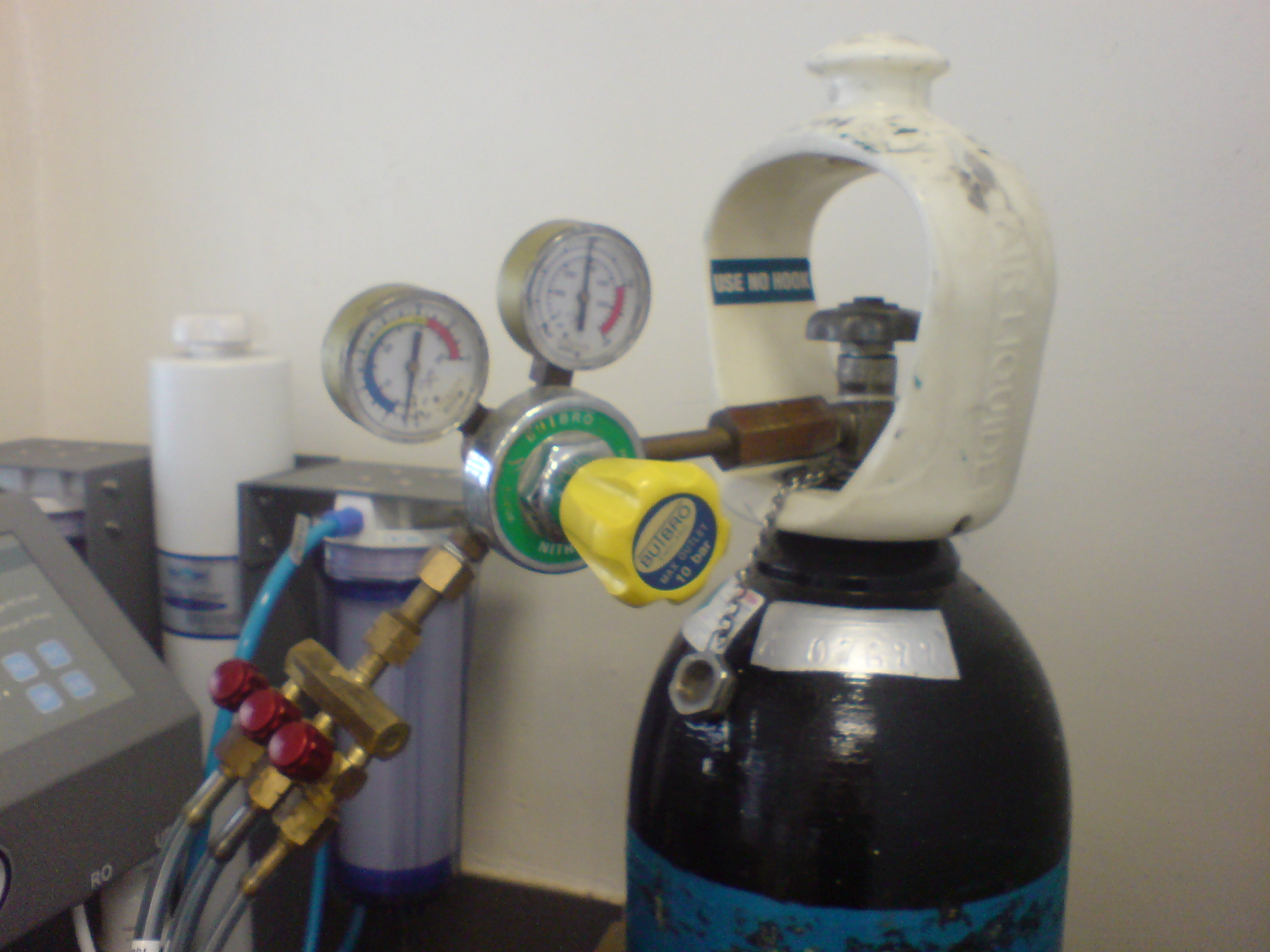
A correct cylinder can still deliver contaminated or unstable shielding through a leaking regulator, dirty hose, permeable tubing or poorly controlled outlet.
Image: Rifleman 82 / Wikimedia Commons, public domain.More flow is not the same as better shielding.
A high-velocity jet can become turbulent, disturb the molten pool or pull surrounding air into the shield. TWI and industrial gas guidance both emphasize that nozzle diameter, position, angle, impingement point and distribution affect results.[5][9]
Define the protected area
Map the top pool, plume-control zone, cooling bead and root. A single coaxial nozzle may not cover all four.
Choose the delivery concept
Options include coaxial nozzles, side jets, ring nozzles, trailing shoes, purge dams, backing bars and sealed chambers.
Control gas cleanliness
Specify gas grade, regulator condition, clean compatible tubing, leak integrity and purge time. Sensitive work may also require dew-point and residual-oxygen limits.
Optimize velocity and position
Set pressure and flow for the actual nozzle. Verify standoff, angle and distance from the keyhole rather than copying a flow number from another head.
Verify under motion
Test at production speed with the real fixture, extraction and part geometry. Extraction can compete with shielding if its capture flow is poorly positioned.
Monitor the failure endpoint
For reactive alloys, use the specified oxygen measurement or shielding-color criteria. For other alloys, use cross-sections, porosity and the actual service requirement.
Do not blame the gas composition before checking the delivery system.
Several shielding failures look similar. Diagnose by mechanism, then change one variable at a time.
Blue, brown or heavy heat tint
Possible causes include low coverage, late gas arrival, excessive standoff, poor trailing protection, root exposure, leaks or extraction pulling the shield away.
Check first: timing, nozzle position, leaks, backside condition and gas envelope.Porosity below a clean top bead
Internal porosity can come from coating vapor, moisture, oil, unstable keyhole behavior, joint gaps or dissolved gas—not only visible oxidation.
Check first: cleaning, coating escape path, cross-section, gas purity and parameter stability.Spatter or keyhole instability
Gas velocity may be disturbing the pool, but focus position, power density, wobble, travel speed, fit-up and vapor pressure can produce the same symptom.
Check first: process stability with controlled flow changes, not a gas swap alone.Oxidation gets worse at higher flow
The jet may have become turbulent or started entraining air. A smaller nozzle at the same volumetric flow produces higher velocity and can worsen the problem.
Check first: nozzle diameter, flow conditioning, angle and distance from the surface.Good face, oxidized root
Top shielding cannot protect a full-penetration root through solid metal. The backing arrangement may be leaking, under-purged or displaced by the joint gap.
Check first: purge volume, vent path, seal, backing fixture and pre-purge time.Cracking or unexpected hardness
Gas composition may have changed weld chemistry, but cooling rate, filler, dilution, alloy condition and hydrogen contamination also require investigation.
Check first: material certificate, gas certificate, hardness map and fracture location.Compare cost per accepted weld
Cylinder price alone ignores consumption, rejected parts, downtime and the labor required to repair oxidized or porous welds.
Helium cost is justified only by a measured process benefit.
Helium may improve a particular welding window, but its lower density can demand higher volumetric flow and its supply price can be volatile. The correct comparison measures weld speed, gas consumption, first-pass yield, downstream cleaning and the value of avoided defects.
Argon often wins as the baseline because it is widely available and easier to cover with. Nitrogen may look attractive on gas price, yet any change in metallurgy, corrosion behavior or qualification burden can outweigh the saving. A mixture can be the lowest-cost choice when it solves a repeatable defect—but only after a controlled test demonstrates that benefit.
Inert shielding gas is chemically quiet—but it can still create an oxygen-deficiency hazard.
Laser safety, welding fume, compressed gas and ventilation controls must be designed together. OSHA notes that gases including helium, argon and carbon dioxide can displace oxygen, while welding also generates hazardous fume and process gases.[8]
Oxygen displacement
Argon, helium and nitrogen can accumulate in enclosures, pits and poorly ventilated rooms. Assess leakage and provide ventilation or oxygen monitoring where required.
Compressed cylinders
Secure cylinders, use compatible regulators, protect valves, separate transport caps from operating hardware and follow the gas supplier's handling rules.
Welding fume and gases
Shielding gas does not remove metal fume, ozone, nitrogen oxides or coating decomposition products. Use source-capture extraction that does not destroy the shield.
Reactive additions
Hydrogen-containing mixtures introduce flammability and metallurgical risks. Oxygen and CO2 additions change process chemistry. Use only approved systems and procedures.
Validate the gas window on representative joints.
A useful trial compares gas routes while holding the material, joint, optics and acceptance criteria constant. Record the complete setup so the winning condition can be reproduced on the production line.
Lock material identity
Record alloy, thickness, coating, filler, surface condition, heat treatment and material certificate.
Record the gas system
Gas designation, purity, flow, pressure, nozzle, angle, standoff, purge and extraction position.
Hold energy variables
Source, wavelength, power, focus, spot, wobble, speed, wire rate and joint gap.
Inspect beyond appearance
Cross-section, penetration, porosity, hardness and the specified mechanical or corrosion tests.
Test variation
Verify the route across expected part gaps, contamination, temperature, speed and gas-supply variation.
Freeze the approved procedure
Document gas, delivery hardware, limits, inspection method and change-control requirements.
Connect the gas decision to the machine, material and test.
Shielding gas cannot rescue an unsuitable laser source, poor joint fit-up or unverified production target. Use these pages to plan the complete system.
Handheld Laser Welding Machines
Compare compact laser welding systems for sheet metal, fabrication and repair work.
Explore laser welders → ApplicationStainless Steel Laser Welding
Review heat input, appearance, fit-up and corrosion-related process considerations.
Open application guide → ApplicationAluminum Laser Welding
Understand oxide, porosity, conductivity and gas-selection challenges in aluminum joints.
Open aluminum guide → ValidationLaser Welding Sample Test
Turn material, joint and production requirements into a measurable welding trial.
Plan a sample test →Laser welding shielding gas FAQ
Answers are intentionally conditional because the alloy, laser and qualified procedure determine the final choice.
What is the best protective gas for laser welding?
There is no universal best gas. Argon is a practical first trial for many handheld and automated fiber-laser welds because it is inert, available and economical. Helium or Ar-He may be worth comparing for selected penetration, plume-control or thick-section problems. Nitrogen and active mixtures require material- and procedure-specific justification.
Is argon or helium better for laser welding?
Argon usually offers lower cost and easier local coverage. Helium has a higher ionization potential and can improve plasma control in some high-power CO2-laser processes; it may also help certain penetration-critical trials. The better choice is the one that meets the acceptance criteria at the lowest cost per accepted weld.
Can nitrogen be used for laser welding?
Yes, in selected qualified applications—particularly some steels—but nitrogen is not metallurgically inert. It can affect hardness, phase balance, corrosion behavior or nitride formation. It should not be used as a universal substitute for argon, and it is generally unsuitable as the default shield for titanium or aluminum.
What shielding gas is commonly used for stainless steel laser welding?
Argon is a common starting choice. Nitrogen may be considered for specific stainless grades and property targets, while Ar-He can be evaluated for process-performance goals. Full-penetration or corrosion-critical stainless joints may also need root purging and control of heat tint.
What gas should be used for aluminum laser welding?
Argon, helium or an approved Ar-He blend are common starting routes. Argon is often the economical baseline; helium content may be tested where thickness, conductivity or speed justifies it. Nitrogen is not a general-purpose shielding gas for aluminum laser welding.
Does helium always increase penetration?
No. Helium may improve certain laser-material interactions, especially plasma control in high-power CO2-laser welding, but penetration also depends on wavelength, focus, power density, speed, keyhole stability, joint fit-up and gas delivery. A controlled comparison is required.
Can I use an argon-CO2 mixture for laser welding?
Only when the equipment supplier, material procedure or qualified WPS permits it. Ar-CO2 mixtures are strongly associated with MAG welding and may be used in specific hybrid laser-MAG processes. They should not be copied into autogenous fiber-laser welding without evidence.
How much shielding-gas flow does laser welding need?
There is no reliable universal flow rate. Required flow depends on nozzle diameter, outlet geometry, pressure, standoff, angle, travel speed, shielding area, extraction and part shape. Too much velocity can cause turbulence and air entrainment. Use the equipment starting range, then qualify the actual gas envelope.
Why does a weld oxidize even with high gas flow?
The gas may be arriving too late, missing the pool, leaking, becoming turbulent or being pulled away by extraction. The root or trailing heat-affected zone may also be unprotected. Check coverage, nozzle position, gas purity, seals and purge before increasing flow.
Does shielding gas protect the laser lens?
Gas flow can help keep vapor and spatter away from the process head, but it is not a substitute for the manufacturer's protective-window, cover-slide and air-knife design. Use only approved gas paths and maintain the consumable optics as instructed.
Do titanium laser welds need trailing and root shielding?
Often yes. Titanium can absorb oxygen and nitrogen while hot, so the top pool, cooling bead and root may all require high-quality inert protection. The allowable oxygen, dew point, gas purity and shielding duration must come from the applicable procedure or specification.
How should shielding gas be validated before production?
Use representative material and joints. Record gas designation, purity, delivery hardware, flow, pressure, standoff and purge. Then inspect appearance, root, cross-section, penetration and porosity, followed by the mechanical, corrosion, hardness or electrical tests required by the application.
References and further reading
- ISO 14175:2008, Welding consumables - Gases and gas mixtures for fusion welding and allied processes. The standard includes laser welding in its scope and was confirmed current in 2023.
- TWI: Gas shielding, plasma control and plume control in laser welding.
- TWI: Effects of gas environments on CO2 and Nd:YAG laser welding process efficiencies.
- TWI: Laser welding automotive steel and aluminium.
- TWI: Optimization of plasma-control parameters for Nd:YAG laser welding.
- NASA PRC-0002: Process specification for manual arc welding of titanium. Used here only as an example of stringent titanium shielding controls, not as a laser-specific universal rule.
- International Journal of Electrical Machining: Shielding-gas behavior in wide-area vertical laser welding of pure titanium.
- OSHA Fact Sheet: Controlling Hazardous Fume and Gases during Welding.
- Air Liquide: Laser nozzle shielding and gas distribution.
Send the alloy, joint and quality target—not just the gas name.
Oceanplayer can review the laser-welding application and help define a practical equipment and sample-test route. A useful request includes the exact material, thickness, joint, production target and acceptance method.