

How to Match Laser Welding Machine Power to Your Needs
Choose laser welding machine power from the hardest repeat job you must weld at the required speed—not from thickness alone and not from the biggest wattage you can afford.
For thin, well-fitted sheet, 1000W can be an efficient starting class. A 1500W system adds headroom for mixed fabrication. A 2000W system can expand thickness and throughput on a qualified machine. Above 2000W, the purchase should be treated as an engineered process decision because optics, cooling, electrical service, enclosure rating, reflection control and production validation become even more important.
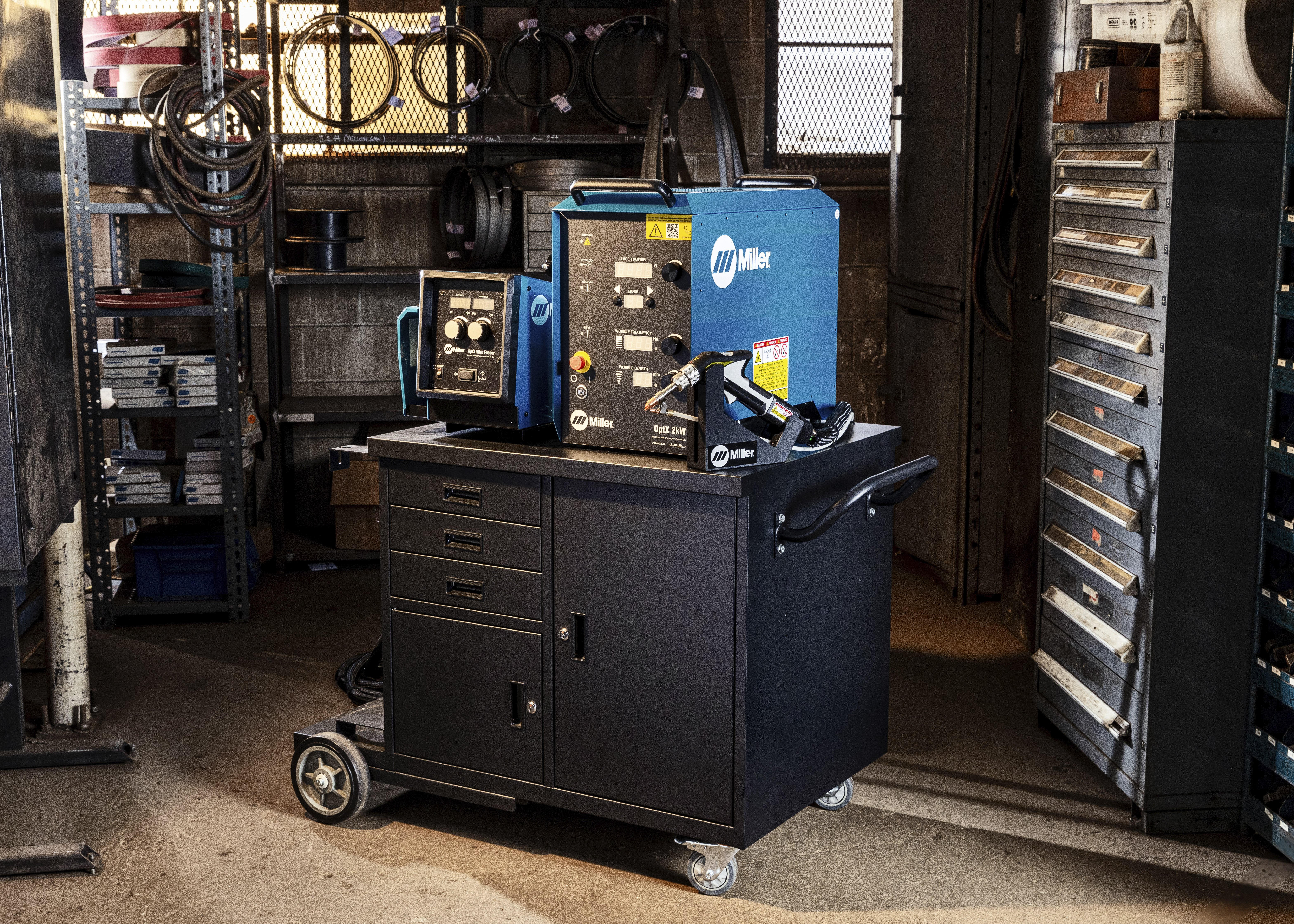
Image source: Miller OptX 2kW handheld laser welder.
Buy a usable process window—not a headline wattage.
The best machine has enough verified capability for your material, joint, gap and target cycle while still giving the operator a controllable low-energy window for thin work. Rated laser output matters, but beam quality, focus, wobble, actual workpiece power, cooling, duty cycle and preset quality determine how useful that output becomes.
Best when the core work is clean, well-fitted sheet and the priority is control, portability and lower system demand.
A common middle route for varied sheet-metal work, moderate thickness and more production headroom.
Useful when the supplier can prove higher travel speed or thicker qualified joints on your real material.
Justify it with trials, complete-cell safety, cooling, utilities, optics and a real throughput requirement.
Seven inputs determine the right laser welding power.
Start with a part-family list rather than a machine catalog. For each recurring job, record the following factors. The most demanding commercially important job usually sets the required upper capability; the thinnest or most heat-sensitive job tests whether the machine can also operate with sufficient control.
Alloy, temper, reflectivity, thermal conductivity, coating and cracking behavior can shift the power window. Copper, brass, galvanized sheet and highly reflective alloys need system-specific evidence.
For a lap joint, total stack thickness is not the same as required penetration. For a fillet, effective throat and leg size matter. State top and bottom thickness separately.
Butt, lap, corner and fillet joints couple energy differently. Wobble and filler may help within a controlled gap range, but cannot rescue large or changing gaps reliably.
Define full penetration, partial penetration, interface fusion width, allowable root profile and required effective section before asking how many watts are needed.
A lower-power system may make the weld at a slower speed, while higher usable power can create throughput headroom if the joint, optics and pool remain stable.
The pool must melt both base metal and filler at the required feed rate. Wire position, diameter, alloy and gap-filling target can determine whether more power is useful.
Daily arc-on time, ambient temperature, electrical service, chiller, extraction, enclosure rating, torch reach and maintenance support can rule a machine in or out.
Request the lowest stable setting, nominal production setting and upper approved limit on the proposed machine, together with coupon sections and cycle evidence.
If one oversized part appears twice a year but 95% of production is thin stainless sheet, compare the cost of outsourcing or using another process for the exception against buying a larger laser system, enclosure and utility package for every day of the year.
Rated power is important, but it is not welding capability.
Laser output power describes the energy rate emitted by the source under defined conditions. The workpiece responds to energy density, interaction time, absorption and molten-pool behavior. A machine's optical train and control system decide how effectively rated power reaches and moves across the joint.
Power and speed must be read together
A useful planning comparison for continuous welding is nominal line energy:
Line energy (J/mm) ≈ laser power (W) ÷ travel speed (mm/s)
At the same speed, higher power raises nominal energy per millimeter. At the same power, slower travel also raises it. This can increase penetration, but it can also increase burn-through, distortion, spatter, undercut or collapse. It is a directional indicator—not a portable welding procedure.
Compare Welding Heat InputWhy two 1500W machines can behave differently
A smaller focused spot can increase power density. Beam quality can change focusability and depth of focus. Wobble spreads energy across the joint. Focus position, protective-window condition, wavelength and actual power at the workpiece also influence performance.
TWI's controlled research at constant 4 kW showed that spot size and beam quality changed penetration and achievable speed. The lesson for buyers is not to copy those experimental settings—it is to avoid comparing machines by watts alone.
Average, peak and cleaning power are different
Read the data sheet carefully. A system may publish average welding output, peak power for a pulsed mode and a different peak value for cleaning. Do not compare a cleaning peak number with another machine's continuous welding output.
Laser output is not wall-plug consumption
A 2000W laser output does not mean the complete machine draws only 2 kW. The source, cooling system, controls, wire feeder, extraction and auxiliaries add electrical load. Size utilities from the manufacturer's input specification and site plan.
Where 1000W, 1500W, 2000W and 3000W+ usually fit.
These are purchasing profiles, not universal thickness ratings. Actual capability belongs to a specific machine, optics, material, joint, program and acceptance requirement.
A sensible starting class for thin-sheet fabrication, precision work and shops whose main jobs have tight fit-up and moderate cycle demand.
- Lower maximum process headroom
- Often lighter system demand
- Good fit when the real workload is thin
- Prove reflective materials separately
Often selected by mixed fabrication shops that need more thickness and speed flexibility without designing around the highest handheld output.
- Broader mixed-material potential
- More margin for wire and moderate gaps
- Still requires a controllable thin-sheet mode
- Validate the hardest alloy
Useful when qualified results show a meaningful gain in travel speed, penetration or application range for recurring production.
- Higher potential throughput
- More energy for thicker or demanding joints
- Greater consequence of setup error
- Check enclosure, cooling and input power
Consider only when the process, system and site are designed for it. Higher output does not automatically make a handheld process better or more economical.
- Demand a representative test program
- Review reflection and enclosure loading
- Verify duty, chiller and optics
- Compare automation or another process
Use a current manufacturer range to understand why machine-specific data matters.
IPG currently publishes separate welding-capability limits for LightWELD 1000, 1500 XR and 2000 XR. These values belong to that product family and its defined conditions; they are useful evidence that capability changes with the complete system, but they are not universal ratings for every machine carrying the same wattage.

IPG lists steel capability up to 0.156 in. (about 4.0 mm), 3/5-series aluminum up to 0.129 in. (about 3.3 mm) and wire welding support. Copper is not listed for this model.

IPG lists steel capability up to 0.234 in. (about 5.9 mm), 3/5-series aluminum up to 0.229 in. (about 5.8 mm) and copper up to 0.081 in. (about 2.1 mm).

IPG lists steel capability up to 0.313 in. (about 8.0 mm), 3/5-series aluminum up to 0.325 in. (about 8.3 mm) and copper up to 0.129 in. (about 3.3 mm).
Product images and system-specific capability data: IPG Photonics LightWELD product comparison. Values are manufacturer-published maximum capabilities, not Oceanplayer universal recommendations; availability may vary by region.
A published limit may assume a particular material grade, joint, mode, wire, fit-up and acceptance basis. Ask the supplier to demonstrate your part at your required cycle time and document the actual penetration, section, distortion and defect result.
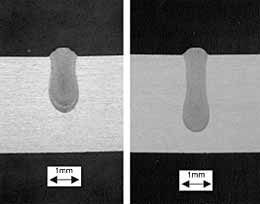
In TWI's controlled 4 kW tests, different focused spot sizes changed the cross-sectional geometry. For equipment selection, request beam, optics and test evidence—not only source wattage.
Research image source: TWI, “Spot Size, Laser Quality and Welding Performance”. The research used specific 4 kW laboratory systems and is shown here to explain the mechanism, not to prescribe handheld settings.
How the same thickness can require different power headroom.
Material absorption and thermal transport matter, but so do alloy chemistry, surface films, joint restraint and the required result. Use the material name to define the test plan—not to select a wattage from a generic chart.
| Material or condition | Why power selection changes | What to provide the supplier | What the sample test must prove |
|---|---|---|---|
| Carbon steel | Usually a practical baseline, but grade, scale, thickness, joint mass and required mechanical properties still control the window. | Exact grade, thicknesses, joint drawing, coating and required penetration. | Fusion profile, undercut, hardness or mechanical performance where specified. |
| Stainless steel | Heat tint, distortion and surface-finish requirements may favor faster travel and controlled heat even when penetration is easy. | Grade, finish, sanitary or cosmetic criteria, shielding arrangement and distortion limit. | Penetration, color, root oxidation, surface finish and dimensions. |
| Aluminum | Reflectivity, oxide, thermal conductivity and alloy-specific cracking sensitivity can make the useful window machine-dependent. | Alloy and temper—not simply “aluminum”—plus joint, cleaning method and filler plan. | Porosity, cracking, fusion, distortion and required strength across production variation. |
| Copper | High reflectivity and thermal conductivity can demand higher beam brightness or a system explicitly rated for copper. | Copper grade, conductivity requirement, surface condition, thickness and electrical function. | Stable coupling, penetration, porosity, electrical resistance and mechanical result. |
| Brass | Volatile zinc can destabilize the pool, create porosity and generate zinc-containing fume; raw power does not remove this risk. | Alloy designation, zinc content if known, joint and fume-control plan. | Internal porosity, fusion, surface condition, dimensional result and extraction performance. |
| Galvanized or coated sheet | Coating vapor and joint venting can dominate stability. A thicker coating may behave differently from bare steel at the same gauge. | Coating type and mass, overlap geometry, gap/vent path and allowable coating damage. | Porosity, spatter, coating condition, strength and repeatability. |
| Butt joint with gap | More power alone can enlarge the opening. Wobble and filler need a controlled, qualified range. | Minimum, nominal and maximum gap plus edge mismatch and fixture repeatability. | Root continuity, fill, reinforcement and strength at tolerance extremes. |
| Lap or fillet joint | Required interface fusion or effective throat may be more important than total stack thickness. | Both thicknesses, overlap, beam location, access angle and required weld size. | Interface width, lower-sheet penetration, leg size and peel/shear performance if applicable. |
When higher power creates value—and when it only creates unused capacity.
Higher rated power has value when it expands the qualified process window or raises usable travel speed on a bottleneck operation. It has little value when loading, fixturing, inspection or changeover dominates the cycle.
Measure welding duty
Separate shift length from beam-on time. Record loading, tacking, fixturing, gas setup, parameter change, welding, inspection and unloading. A faster weld may save little if the torch fires for only a small fraction of the cycle.
Compare at equal acceptance
Time a 1000W, 1500W and 2000W candidate only after each produces the same required penetration, geometry and defect level. Comparing one good weld with one cosmetically fast weld creates a false productivity result.
Protect the thin-work window
A shop handling mixed gauges needs both upper capability and low-end control. Confirm that the higher-power source, preset and motion system can weld the thinnest recurring part without burn-through or excessive distortion.
| Production question | Evidence to collect | Why it changes power selection |
|---|---|---|
| What is the daily product mix? | Hours or units by material, thickness and joint family. | Prevents an unusual thick job from oversizing the machine used for routine thin work. |
| Where is the actual bottleneck? | Cycle breakdown for loading, fitting, welding, finishing and inspection. | Shows whether more welding speed can affect completed parts per shift. |
| Is the speed manual or automated? | Measured torch speed variation and operator-to-operator results. | High power may narrow tolerance to pauses and inconsistent manual travel. |
| How much wire is required? | Wire alloy, diameter, feed rate, joint gap and deposited section. | Additional melting demand can justify power headroom, but only with stable feeding. |
| What uptime is expected? | Duty rating, cooling capacity, ambient range and maintenance plan. | A machine that reaches the weld once but cannot sustain the shift is underspecified. |
| What rework is avoided? | Current grinding, straightening, polishing, scrap and inspection time. | Often the best business value comes from reduced post-processing rather than maximum travel speed. |
Compare the complete system—not a laser source price.
Universal price ranges age quickly and often compare incomplete packages. Build a like-for-like total cost that includes everything required to operate safely, qualify the process and support production.
| Cost category | Questions to ask | How higher power can change it |
|---|---|---|
| Base welding system | Laser source, cooling, torch, cable, controls, modes and warranty included? | Higher output may change the source, chiller, optics, weight and service tier. |
| Wire and process package | Wire feeder, conduits, drive rolls, contact tips, nozzles and gas regulator included? | Higher deposition targets may require more capable feed hardware and consumables. |
| Laser safety | Enclosure, interlocks, laser-rated viewing panels, warning system, LSO support and PPE? | Power density and reflection risk must remain within the enclosure's documented rating. |
| Fume and hot-work controls | Source capture sized for actual alloy, coating and production rate? | More throughput can increase fume generation and filter loading. |
| Utilities and installation | Voltage, phase, breaker, grounding, cooling, gas, compressed air, floor space and HVAC? | Higher-power packages may increase electrical, thermal and site requirements. |
| Training and qualification | Operator, maintenance, safety and process-development training included? | A more capable system can create more parameter combinations that require control. |
| Consumables and service | Protective windows, lenses, nozzles, filters, response time and local stock? | Optics contamination or damage at high output can create costly downtime. |
| Production economics | Measured cycle, labor, gas, wire, electricity, rework, scrap and uptime? | Only verified annual savings—not theoretical watts—justify the price difference. |
Do not calculate operating cost by treating a 2000W laser as a 2 kW appliance. Use the complete machine's rated input and measured duty, then add extraction, wire feeding, gas supply, enclosure systems and other auxiliaries.
From part list to purchase specification.
A supplier can recommend power much more accurately when the enquiry contains engineering evidence. Use this sequence before requesting final quotations.
Build a part-family matrix
List recurring materials, exact grades, minimum and maximum thicknesses, joints, gaps, weld lengths and monthly volumes. Mark the jobs that drive revenue or cause the current bottleneck.
Define acceptance criteria
State penetration, fusion width, weld size, appearance, distortion, leak, conductivity, mechanical test and applicable code or customer requirements before discussing wattage.
Identify the process extremes
Select a thin heat-sensitive part, a typical production part and the hardest high-demand part. These three samples reveal low-end control, routine economics and upper capability.
Screen machine classes
Use current manufacturer capability data to shortlist 1000W, 1500W or 2000W systems. Treat 3000W+ as an engineered route requiring stronger evidence and site review.
Run representative sample tests
Use production material, surfaces, joint geometry, wire and fit-up. Record power, speed, focus, wobble, shielding, wire feed, fixture and actual cycle for every candidate.
Inspect at equal quality
Compare sections, mechanical or functional tests, distortion, surface finish and repeatability. Reject any speed claim that does not meet the same acceptance target.
Verify the complete site package
Review enclosure, extraction, electrical service, cooling, gas, access, torch reach, duty, ambient limits, consumables, local service and operator training.
Specify and lock the purchase
Put demonstrated part capability, included accessories, training, documentation, warranty, acceptance test, delivery, installation and service response into the quotation and purchase order.
What to send—and what the supplier should return.
A convincing power recommendation is traceable to the part. Videos are helpful for context, but the final decision should be based on parameter records and acceptance evidence.
Provide grade, temper, coating, surface finish, thickness and whether the sample represents production stock.
Send a drawing or clear section showing gap, mismatch, overlap, weld size, access and fixture condition.
State weld length, parts per shift, allowable cycle, changeover, expected beam-on time and automation plans.
Define penetration, appearance, distortion, leak, electrical or mechanical requirements and the inspection method.
Request machine model, mode, power, speed, focus, wobble, gas, wire, nozzle and fixture used for the sample.
Request photos, cycle video, cross-section or approved test results, observed limitations and proposed operating window.
Test the realistic gap and surface-condition boundaries, not only the cleanest perfect coupon.
Agree how the delivered machine will be accepted at your site and what happens if the demonstrated result is not repeated.
Questions for the supplier
Ask whether the published limit is full or partial penetration, which alloy and joint were used, whether wire was required, how speed was measured, what duty was sustained, which enclosure rating applies and which consumables are locally stocked.
Red flags in a quotation
Be cautious when the recommendation is based only on “maximum thickness,” when cleaning peak power is presented as welding power, when utility input is missing, when test sections are unavailable or when safety and extraction are treated as optional accessories.
Higher power also increases the consequence of a poor system design.
Handheld laser welders are commonly Class 4 laser products. Select the complete cell with a qualified laser safety assessment: enclosure and viewing-panel ratings, access interlocks, reflection control, fume extraction, hot-work controls, gas safety, operator authorization and wavelength-specific eye and skin protection.
Confirm the enclosure system is documented for the wavelength, power density, expected reflections and dwell time of the selected laser—not merely described as “laser safe.”
Material, coating, wire and production rate determine exposure. More output and throughput can increase fume and filter loading.
Power selection, parameter editing and maintenance must be limited to trained personnel under the site's laser and welding safety program.
For current safety context, see the Miller handheld laser safety guidance and OSHA laser hazards chapter.
Send the material, thickness, joint and cycle target.
Oceanplayer can compare 1000W, 1500W and 2000W handheld laser welding routes against your actual application. Include photos or drawings, alloy, thicknesses, gap tolerance, filler requirement, weld length, daily volume and acceptance target so the answer is based on the part—not a generic thickness chart.
Related machines and engineering tools.
Laser welding machine power FAQ.
What laser welding machine power do I need?
Choose from the hardest recurring material, thickness, joint, gap and required travel speed, then confirm the machine can also control your thinnest part. Start with current manufacturer capability data and make the final selection through representative sample welding and inspection.
Is a 1000W laser welder enough for sheet metal?
A 1000W system can be a strong fit for thin, well-prepared sheet metal when its manufacturer has approved presets and demonstrated your material and joint. It may be underspecified when the job needs more penetration, faster production, significant wire deposition or reflective-material capability.
Should I buy a 1500W or 2000W laser welder?
Choose 2000W only when trials show that its additional usable power produces a valuable gain in qualified thickness, speed or process margin. A 1500W machine can be the better economic choice when it covers the production mix and utilities, portability or low-end control matter more.
Is higher laser welding power always better?
No. Higher power can expand capability and speed, but it also increases the risk of burn-through, collapse, spatter and sensitivity to travel pauses. It may require more cooling, electrical capacity and safety infrastructure. Useful controllability matters more than unused maximum output.
Can a 2000W laser welder weld thicker metal faster?
Potentially, but only when the complete machine, beam, focus, joint, material and process remain stable. Compare candidate systems at the same penetration and quality acceptance. Higher rated power does not guarantee higher productive speed on every alloy or joint.
How thick can a handheld laser welding machine weld?
There is no universal thickness by wattage. Manufacturer-published limits vary by model, material family, joint and mode. Ask whether the value means full or partial penetration, whether wire was used and what inspection confirmed the result; then test your production part.
Does aluminum always need more laser power than stainless steel?
Aluminum can be more challenging because of reflectivity, thermal conductivity, oxide and alloy-specific cracking behavior, but “more power” is not a universal rule. Beam quality, wavelength, surface preparation, joint, focus, filler and machine presets determine the useful window.
Can the same laser welder process steel, stainless steel and aluminum?
Many fiber-laser systems support multiple material families, but each needs its own approved settings, shielding, preparation and validation. Confirm the exact grades and thicknesses are within the proposed model's published and tested capability.
Does a 2000W laser welder consume only 2 kW of electricity?
No. The 2000W figure usually describes laser output, not complete input demand. Source efficiency, cooling, controls, wire feeder, extraction and accessories add load. Use the manufacturer's input-voltage, phase, current and site requirements for utility planning.
When should I consider a 3000W laser welding machine?
Consider 3000W or more when a recurring process has been tested and the higher power produces a justified capability or throughput gain that lower classes cannot meet. Review optics, cooling, duty, electrical service, enclosure rating, reflections, extraction and whether automation or another process is a better solution.
How should I compare laser welding machine prices?
Compare complete installed packages: welder, cooling, torch, wire feeder, consumables, gas hardware, enclosure, interlocks, extraction, PPE, utilities, training, qualification, warranty and service. Then compare verified annual output, labor, rework and uptime at equal weld quality.
What should a laser welding sample test include?
Use the exact production material, thicknesses, joint, gap, coating, wire and fixture. Record power, speed, focus, wobble, gas and cycle time. Inspect penetration, fusion, geometry, defects, distortion and required mechanical or functional performance before selecting power.
Sources used for this guide.
- IPG Photonics — Current LightWELD 1000, 1500 XR and 2000 XR product comparison
- Miller — OptX 2kW system capability, included equipment and technical specifications
- Miller — OptX 1kW specification sheet, May 2026
- Miller — Laser welding process, materials and system-selection overview
- TWI — Effect of focused spot size and beam quality on welding performance
- OSHA — Guidelines for laser hazards
- OSHA — Laser hazards and control measures