

What Is Galvanized Steel and Why Can It Last 50+ Years?
Galvanized steel is steel coated with zinc to slow corrosion. The coating blocks moisture from the steel and can protect small exposed areas by corroding first. A service period beyond 50 years is possible for suitable hot-dip galvanized structures, but the coating thickness, environment and maintenance endpoint must support that claim.

The steel carries the load; the zinc limits corrosion
“Galvanized” describes a protective coating, not a steel grade. A galvanized sheet, beam, tube or bracket still needs the right base steel for its strength, forming and welding requirements. The word alone does not tell you its yield strength or how much zinc it carries.
In batch hot-dip galvanizing, a cleaned article is immersed in molten zinc. Zinc and iron react at the surface to form bonded alloy layers, often with a zinc-rich outer layer. In continuous sheet production, strip moves through a coating line before it is cut or formed into parts.
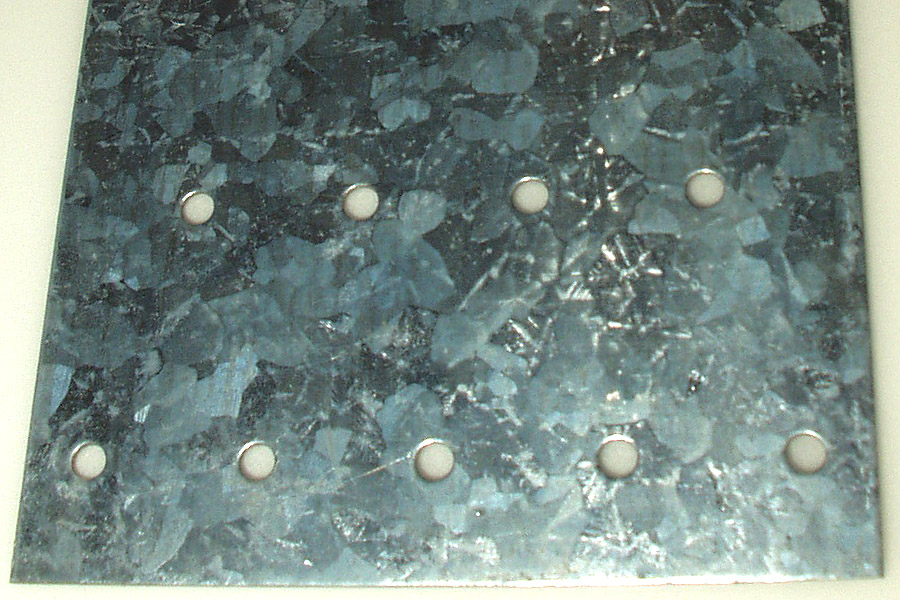
The visible crystal pattern is called spangle. Its size and brightness do not establish coating thickness. A smooth or dull gray finish can also provide effective protection.
For the broader material and grade choices, see galvanized steel types, grades and uses.
How zinc protects the steel underneath
Zinc provides a barrier and electrochemical protection. Its own weathered surface helps slow the rate at which that protection is consumed.
A physical barrier
An intact coating separates the steel from water and oxygen. Hot-dip galvanizing after fabrication can cover prepared surfaces reached by the bath, including suitable internal surfaces when the article is correctly vented and drained.
A protective patina
Air, moisture and carbon dioxide gradually produce a compact film of zinc corrosion products. Normal wet and dry cycles help this patina develop. It slows further zinc loss; it does not stop corrosion completely.
Sacrificial protection
At a small scratch with moisture present, nearby zinc can corrode preferentially and protect exposed steel. Zinc does not grow back across the gap. Large bare areas and damaged weld zones still need assessment and repair.
Mechanisms: American Galvanizers Association (AGA), corrosion protection.
What does “50+ years” actually mean?
For an atmospheric durability estimate, first identify the endpoint. The AGA’s time to first maintenance chart uses a point where 5% of the base-steel surface is rusting. It is a prompt for maintenance, not a prediction of structural collapse or a promise of zero visible change.
The AGA’s structural-steel example uses 3.9 mils of zinc, about 99 μm, and gives approximately 72–73 years to first maintenance on its industrial-atmosphere curve. This explains why a target beyond 50 years can be credible for an appropriate coating and exposure.
That chart example does not cover every industrial site, and it should not be transferred to buried steel, immersion, marine splash or a salt-filled joint. A thin sheet coating also needs its own assessment.
The chart’s maintenance endpoint
5% rusting
of the base-steel surface. Your project may require earlier intervention for appearance, hygiene, function or local damage.

The coating route changes what “galvanized” means
A beam galvanized after welding and a bracket formed from galvanized coil follow different manufacturing sequences. The beam’s accessible welds and edges can be coated in the bath. Cutting and welding pre-coated sheet can expose steel after the coating has been applied.
Also distinguish galvannealed and electrogalvanized products. Similar names do not establish equal coating thickness or outdoor durability.
Swipe the table sideways to compare all columns.
| Route | How it is made | What to check |
|---|---|---|
| Batch hot-dip | The article is dipped after fabrication; zinc reacts with the prepared steel surface. | Product category, minimum coating thickness, venting, drainage and accepted repairs. |
| Continuous galvanized sheet | Strip passes through a zinc bath; air knives control the coating before it solidifies. | Steel grade, coating mass, face distribution and protection after cutting or welding. |
| Galvannealed sheet | Coated strip is reheated to develop a zinc–iron alloy coating. | Paint system and forming behavior; the harder coating can powder during severe forming. |
| Electrogalvanized sheet | Zinc is deposited using an electrical process. | Specified coating on each face and intended exposure; a smooth finish alone says little about durability. |
Process details: GalvInfo, Galvanizing 2022. Coating thickness must come from the product specification or measurements, not a generic range for the process name.
G90 and Z275 describe coating mass, not 90 or 275 μm
For common ASTM A653/A653M sheet designations, coating mass is stated as the total on both faces. G90 means a minimum triple-spot average of 0.90 oz/ft²; Z275 uses 275 g/m². They are commonly paired, but the standard’s two unit systems must be applied independently.
Swipe sideways to see the thickness assumptions.
| Designation | Minimum triple-spot total, both faces | Calculated μm per face, equal split |
|---|---|---|
| G30 | 0.30 oz/ft² | 6.4 |
| G60 | 0.60 oz/ft² | 12.8 |
| G90 | 0.90 oz/ft² | 19.2 |
| Z275 | 275 g/m² | 19.3 |
| G185 | 1.85 oz/ft² | 39.5 |
Worked conversion: Z275
275 ÷ (2 × 7.14) ≈ 19.3 μm per face
275 is the total mass in g/m²; 2 assumes equal distribution; 7.14 is zinc density in g/cm³. These units give thickness in μm.
This is an equivalent average, not a guaranteed local minimum. Actual production mass, single-spot requirements and minimum coating on one side are separate matters.
Basis: GalvInfoNote 1.1, pp. 1–2 and 5. G185 coating mass is also documented in Simpson Strong-Tie’s coating table (p. 18). Inch-pound thicknesses use the GalvInfo 0.00168 in per oz/ft² conversion. These values cannot be used to calculate a service life without an appropriate exposure model.
What makes a 50-year claim stronger—or weaker?
Start with evidence about the coating and the location where it must work. “Outdoor,” “coastal” and “industrial” are broad labels. A sheltered lap joint that stays salty and wet may behave very differently from an exposed surface that drains and dries.
Swipe sideways to read the evidence and action columns.
| Condition | Evidence needed | Practical response |
|---|---|---|
| Unknown or light coating | Coating standard, mass or measured thickness, sampling record. | Establish the coating first. A heavy structural-coating example cannot stand in for an unidentified sheet. |
| Sea salt, deicing salt or trapped deposits | Local salt sources, spray, cleaning and time spent wet. | Assess sheltered surfaces and splash separately. Review a heavier or duplex system where appropriate. |
| Standing water or tight wet laps | Drainage details and inspection of the least ventilated surfaces. | Remove water traps and allow drying. Do not assume normal atmospheric exposure inside the joint. |
| Copper or brass nearby | Electrical contact, wetness, exposed areas and direction of runoff. | Isolate wet mixed-metal connections and prevent copper-bearing runoff reaching zinc. |
| Bare welds or damaged areas | Damage extent, repair method and completed repair inspection. | Restore the required protection; local corrosion can begin before the general coating is consumed. |
Where paint or powder coating is applied over galvanizing, the combined protection is called a duplex system. Its performance depends on suitable surface preparation, coating compatibility and maintenance of the finish.
For chemical washdown, record the chemical, concentration, temperature and contact duration. A pH value alone does not establish compatibility. For long-term continuous heat exposure, the AGA recommends a maximum of about 200°C (392°F); this is distinct from brief temperature excursions.
See AGA guidance on mixed metals, chemical exposure and service temperature.
Salt-spray hours do not convert directly to outdoor years. Continuous wet testing does not reproduce zinc’s normal weathering cycle. Use exposure data and a model suited to the coating and service conditions.
White deposits and red rust call for different checks
White or gray deposits
Newly galvanized parts stored wet with restricted airflow can develop wet-storage stain: deposits of zinc corrosion products. A light film does not automatically mean the underlying steel is rusting. Heavy deposits can consume appreciable zinc, so check remaining coating after appropriate cleaning.
Keep stored parts dry, ventilated and arranged to drain. Tightly packed wet sheets are especially vulnerable. Surface treatment helps only when storage and handling also control moisture.
Red rust or localized attack
Red rust indicates iron corrosion. Check whether zinc has been lost, whether a cut or weld left exposed steel, and whether a local moisture trap or mixed-metal connection is accelerating attack. Record location and extent before selecting a repair.
For thick fabricated-article coatings, inspect with calibrated thickness measurements and the governing sampling procedure. A shiny finish is not an acceptance test.
Inspection context: AGA storage and wet-storage-stain guidance.

Welding changes both the fume exposure and the coating
Heating galvanized steel can generate zinc oxide fume, a cause of metal fume fever. Plan the welding or cutting task with an appropriate exposure assessment, local fume extraction and any required respiratory protection. Confined-space work needs additional controls. A visually clean weld does not demonstrate adequate fume control.
If coating removal is part of the procedure, use a controlled method suited to the work. There is no universal removal width or laser setting for every coating and joint. Inspect the weld against its required criteria, then restore corrosion protection in affected areas.
For hot-dip galvanized coatings, ASTM A780/A780M describes repair with zinc-rich paint, zinc-based solder or sprayed zinc (metallizing). Preparation, material selection and final repair thickness matter. A silver-colored aerosol is not evidence that the repair meets the specification.
Sources: OSHA welding-fume hazards and controls; AGA repair-material guidance.
For joint design, zinc-vapor escape and sample validation, continue to galvanized steel laser welding.
Specify the product, coating and maintenance target together
A useful specification identifies the steel grade, coating route and acceptance requirements, then connects them to actual service conditions. The coating standard must match the product being supplied.
Swipe sideways to compare the standards.
| Specification | Main application | Boundary to remember |
|---|---|---|
| ASTM A123/A123M | Hot-dip zinc coatings on many fabricated and unfabricated iron and steel articles. | Product category and steel thickness affect coating requirements; it is not the continuous-sheet standard. |
| ISO 1461:2022 | Hot-dip coatings on fabricated iron and steel articles. | Continuously galvanized sheet, wire and mesh are outside its scope. Its requirements are not interchangeable with ASTM A123. |
| ASTM A653/A653M | Galvanized or galvannealed steel sheet in coils and cut lengths. | Specify the steel designation/grade as well as the coating designation and unit system. |
| ASTM A780/A780M | Repair of damaged or uncoated areas of hot-dip galvanized coatings. | A repair practice does not replace the primary product’s coating acceptance requirements. |
Hardware and other specialized products may use different standards. State the applicable edition in the order and resolve conflicting requirements before fabrication.
- Identify the material: grade, product form, dimensions, coating process and coating designation or thickness requirement.
- Describe the exposure: salts, wetness, chemicals, temperature, drainage and mixed-metal connections.
- Define the endpoint: appearance, first maintenance, function and inspection access. These are different from structural design life.
- Require evidence: coating inspection records, treatment details and repair records linked to the supplied parts.
For coil and sheet purchasing, use the more detailed galvanized sheet metal selection guide.
When should you compare another material or finish?
Galvanized steel combines steel’s mechanical properties with a coating that can be maintained and repaired, but the entire assembly must suit its environment. Compare alternatives when weight, chemical exposure, appearance or maintenance access changes the decision.
- Stainless steel: consider a suitable grade when corrosion resistance must come from the alloy itself; chloride and crevice conditions still matter.
- Aluminum: consider it when low mass is important, while checking stiffness, joint design and compatibility with adjoining metals.
- Painted steel or a duplex finish: consider color, surface preparation, damage repair and access for future recoating.
Compare the installed system and its maintenance needs, including cuts, welds and fasteners. A raw-material price comparison leaves out the details most likely to determine corrosion performance.
Technical references
The links below identify the basis for coating terminology, durability estimates and product scope. The service environment and project specification determine how those references apply.
- AGA: time to first maintenance — chart endpoint, zinc thickness and atmospheric example.
- GalvInfoNote 1.1 — total coating mass, face distribution and thickness conversions.
- GalvInfo: Galvanizing 2022 — continuous coating routes and product behavior.
- ASTM A123/A123M-24 — public scope for hot-dip coated iron and steel articles.
- ASTM A653/A653M-25 — public sheet-product scope and independent unit systems.
- ISO 1461:2022 — fabricated-article coating scope and exclusions.