

Gold Boiling Point vs Melting Point: Exact Values and Why They Differ
Pure bulk gold melts at 1064.18°C (1947.52°F; 1337.33 K). Its commonly cited normal boiling point is about 2856°C (5173°F; 3129 K) at 1 atm. The melting value is a precise ITS-90 fixed point; the boiling value is an extreme-temperature estimate that varies slightly by source.
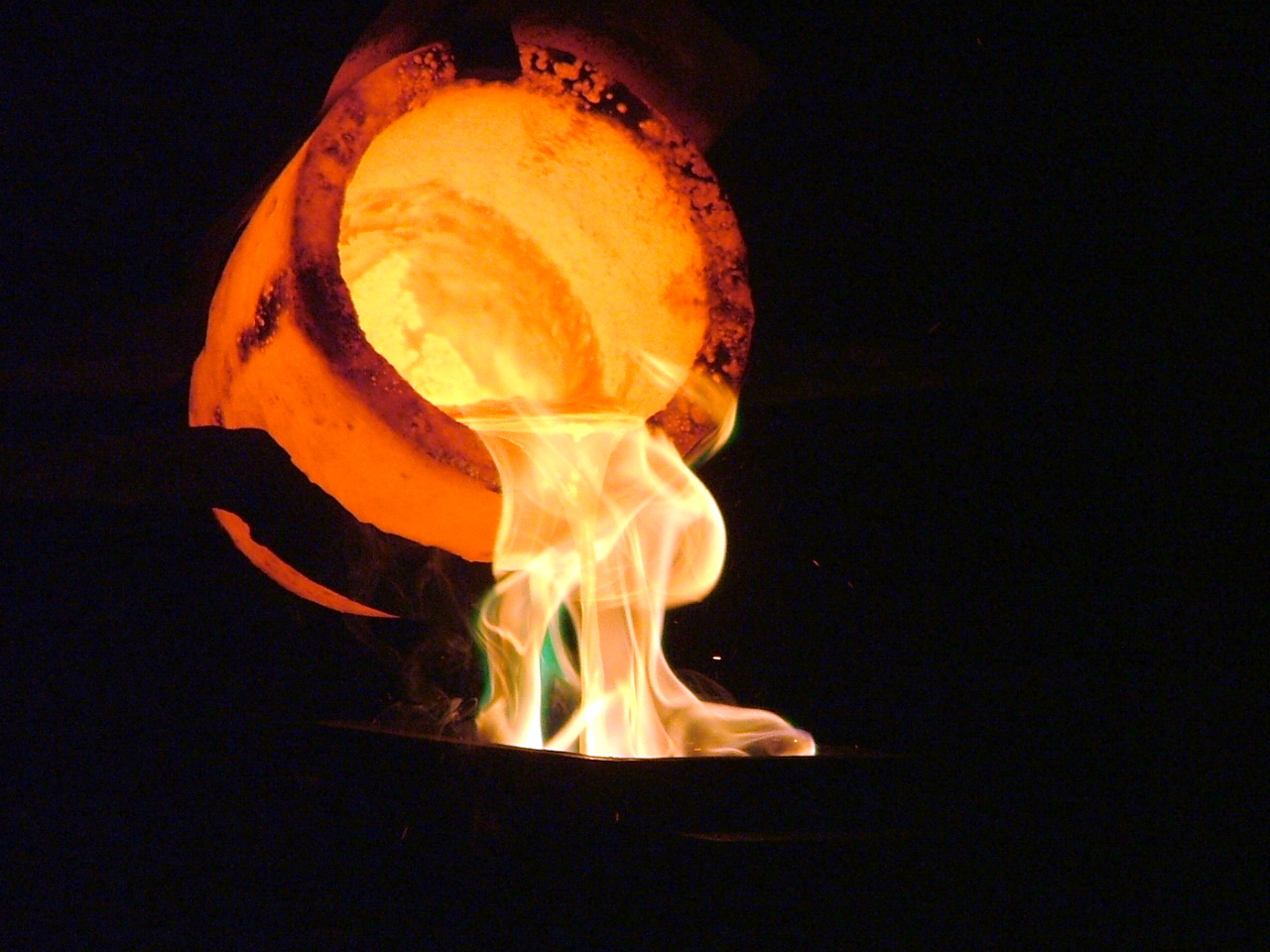
1947.52°F or 1337.33 K for high-purity bulk gold on ITS-90.
About 5173°F or 3129 K at one standard atmosphere.
Boiling needs far more atomic separation than melting.
Alloy chemistry, pressure and the real process window come first.
What Are Gold's Melting and Boiling Points at 1 atm?
For a quick technical reference, quote 1064.18°C as the melting/freezing point of high-purity bulk gold and about 2856°C at 1 atm as the common normal-boiling value.
The word exact needs care. The melting value is assigned on the International Temperature Scale of 1990 and is used as a high-temperature fixed point. The boiling value is built from difficult vapor-pressure and thermodynamic measurements, so reputable sources do not all publish the same number.
A modern thermodynamic evaluation gives 3131 K, or about 2858°C, at one atmosphere. Many engineering tables use 3129 K, or about 2856°C. The two-degree difference is small for a general comparison but important when a document claims unrealistic precision.
- Pure gold: one well-defined solid-liquid boundary under controlled conditions.
- Gold alloys: usually melt across a solidus-to-liquidus range.
- Normal boiling: means the vapor pressure equals 101,325 Pa.
- Vacuum work: gold can evaporate far below its 1-atm boiling point.
This is a reading aid, not a gold phase diagram or an operating recipe. Surface evaporation occurs below the boiling marker.
| Your situation | Use this value or method | Evidence to request | Stop or revise when |
|---|---|---|---|
| Pure-gold reference or calibration | Use 1337.33 K / 1064.18°C as the ITS-90 freezing-point reference. | Purity, fixed-point cell design, traceable calibration and uncertainty. | A shop crucible is being treated as a metrology standard without a qualified cell. |
| General material lookup | Use about 2856°C / 3129 K at 1 atm for a rounded normal-boiling reference. | Pressure basis, source edition and whether the value is measured or evaluated. | A document presents extra decimals as an exact universal constant. |
| Jewelry or gold alloy processing | Use the alloy's solidus, liquidus and validated process window, not pure-gold values. | Full chemistry, lot, solidus/liquidus data and representative trial results. | Karat alone is the only material information available. |
| Vacuum coating or laser work | Use vapor-pressure, absorption and rate data at the actual pressure and power. | Pressure, source temperature, geometry, wavelength, power and measured rate. | The 1-atm boiling point is being used as a machine setpoint. |
| Gold property | Kelvin | Celsius | Fahrenheit | How to interpret it |
|---|---|---|---|---|
| ITS-90 melting/freezing fixed point | 1337.33 K | 1064.18°C | 1947.52°F | Assigned value for high-purity bulk gold under defined fixed-point conditions. |
| Common normal-boiling reference | ≈3129 K | ≈2856°C | ≈5173°F | Widely used approximate value at 1 atm; not an ITS-90 fixed point. |
| Modern evaluated boiling result | 3131 K | ≈2858°C | ≈5176°F | Arblaster's derived equilibrium result at 1 atm. |
| Gap using 3129 K | ≈1792 K | ≈1792°C interval | ≈3225°F interval | A derived comparison; its precision cannot exceed the boiling input. |
How Do You Convert Gold Temperature Values and Check the Phase?
Enter a temperature in Celsius, Fahrenheit or kelvins. The tool converts it and shows the likely equilibrium phase region for pure bulk gold near 1 atm.
Use this to check a specification, furnace display or reference table. It does not replace a metal-temperature measurement or an alloy datasheet.
At 1064.18°C, high-purity gold is at its ITS-90 solid-liquid fixed point under defined conditions.
Why is gold's boiling point so much higher?
Melting changes the arrangement of gold atoms. Boiling must pull those atoms far apart. That second change needs much more energy.
1. Solid gold
Atoms occupy ordered positions in a face-centered-cubic crystal. Heating makes them vibrate more strongly, but the solid keeps its shape.
2. Liquid gold
Long-range order is gone, so the metal can flow. The atoms are still close together and strongly interacting in a dense liquid.
3. Gold vapor
Atoms or small vapor species are widely separated. Creating that large separation takes much more energy than simply losing crystal order.
Melting uses a smaller energy step
Representative data put gold's enthalpy of fusion near 12.4 kJ/mol. At the phase boundary, added energy changes solid into liquid instead of immediately raising the equilibrium temperature.
The liquid does not become a loose cloud. It still has high density, surface tension, electrical conductivity and short-range atomic structure. In other words, much of the metallic cohesion remains.
Vaporization uses a much larger energy step
Reported vaporization values are roughly 324–335 kJ/mol, depending on the dataset, temperature and reference state. That is more than 25 times the fusion energy scale. Treat the ratio as an explanation of size, not as a universal process constant.
A real furnace must also heat the charge, crucible, mold, insulation and surrounding hardware. Heat escapes by radiation, conduction, ventilation and cooling systems. This is why the machine's power rating and controller temperature do not directly tell you the metal's phase or heating time.

How Are Melting, Boiling, and Evaporation Different in Gold?
Gold does not need to reach its normal boiling point before atoms can leave the surface. That distinction is important in casting, vacuum coating and laser processing.
Melting
Solid gold becomes liquid at the solid-liquid phase boundary. For pure gold under controlled conditions, melting and freezing describe the same equilibrium boundary.
Evaporation
Atoms escape from the surface. It occurs below the normal boiling point whenever the surrounding gold-vapor pressure is lower than the equilibrium value.
Boiling
Vapor bubbles can grow throughout the liquid when gold's saturation vapor pressure reaches the pressure acting on the liquid.
Freezing
Liquid gold forms an ordered solid and releases latent heat. Undercooling and nucleation can affect what an operator observes.
Smelting
A chemical extraction or separation process that uses heat and reactions. It is not another word for melting refined gold.
Laser ablation
A fast, localized and often non-equilibrium event. Melt ejection, vapor, plasma and recoil can appear without the whole part reaching one uniform temperature.
Why do reliable boiling-point sources disagree?
Extreme-temperature boiling values are usually evaluated from vapor-pressure curves and thermodynamic data. They are not as easy to realize as the gold freezing-point fixed point.
At temperatures above 3000 K, containment, thermometry, contamination, radiative heat loss and vapor composition are difficult to control. Researchers may use different experiments, temperature scales, equations, gas-species models or extrapolation methods.
A handbook may also preserve an older selected value or round a result for easy use. Two sources can therefore be reputable and still disagree by several or even many kelvins.
Write “about 2856°C at 1 atm” for a concise engineering reference. For scientific work, name the source and pressure, such as “3131 K at one atmosphere, derived by Arblaster.”
1 atm is part of the value
A “normal” boiling temperature is defined at 101,325 Pa. One bar is 100,000 Pa, so these pressure bases are close but not identical.
Extra decimals can be false precision
Converting 3129 K produces 2855.85°C, but the source value is already rounded. Publishing 2855.850°C would make the result look more exact than the data.
| Reference approach | Published or derived value | Pressure basis | How to use it |
|---|---|---|---|
| Arblaster thermodynamic evaluation | 3131 K / about 2858°C | 1 atm | Strong modern evaluated value; label it as derived rather than an exact fixed point. |
| Common engineering / PubChem value | 3129 K / about 2856°C | 760 mmHg / about 1 atm | Clear general reference when rounded and pressure-qualified. |
| Royal Society of Chemistry table | 3109 K / 2836°C | Summary table | Shows that respected compilations can select a different high-temperature value. |
| NIST-hosted Antoine correlation | A curve over 2142–3239 K | Pressure calculated from temperature | Use only within its range and dataset. Do not rename an inverted result “the NIST boiling point.” |
Optional engineering note: why pressure curves matter
At phase equilibrium, a boiling point is the temperature where the liquid's saturation vapor pressure equals the stated external pressure. The Clapeyron and Clausius-Clapeyron relationships describe how that boundary changes. NIST's Chemistry WebBook also hosts an Antoine correlation for gold over 2142–3239 K, but a fit is valid only for its stated range and underlying data. It should not be mixed with another evaluation as though both form one exact curve.
How Does Pressure Change Gold Evaporation and Boiling?
Lower pressure lowers the temperature needed for a useful vapor flux. That is why vacuum deposition does not require heating a gold source to its one-atmosphere boiling temperature.
At any temperature, an equilibrium vapor pressure can be assigned to a suitable phase. Near gold's melting point, that pressure is small but not zero. As temperature rises, it grows quickly.
In a vacuum chamber, pumps continually remove vapor and other gases. The gold partial pressure above the source can remain below the equilibrium value, so net evaporation continues. The useful deposition rate also depends on source area, geometry, temperature uniformity, chamber pressure, pumping speed and condensation surfaces.
For production, use a validated vapor-pressure curve and a measured deposition rate. Do not design from the normal boiling point alone.

Each bar is scaled only against the largest value shown. The increase is steep even though every point remains far below one atmosphere.
Does 18K or 14K gold melt at 1064.18°C?
No. The 1064.18°C fixed point applies to high-purity bulk gold. Jewelry gold contains other metals and usually melts across a range.

Karat describes gold content, not one recipe
Twenty-four-karat gold is nominally pure, while 18K contains 75% gold and 14K contains about 58.3% gold by mass. The balance may include silver, copper, palladium, nickel, zinc or other elements.
Two alloys with the same karat can have different color, hardness, casting behavior and melting range. A white-gold alloy is not interchangeable with a yellow- or rose-gold alloy simply because all are labeled 18K.
| Material form | Use 1064.18°C directly? | What you actually need | Risk if misapplied |
|---|---|---|---|
| High-purity bulk gold | Yes, as a reference boundary | Purity, pressure, sample condition and measurement uncertainty | Assuming a shop melt reproduces a metrology cell to 0.01°C |
| 22K, 18K or 14K jewelry alloy | No | Full chemistry, solidus, liquidus and pouring range | Incomplete melting, segregation, excess superheat or composition drift |
| Gold solder / brazing alloy | No | Exact product flow range and joint window | Melting the parent metal, weak flow or poor color match |
| Gold-plated component | Usually no | Substrate limit, coating thickness, adhesion and process method | Damaging the substrate while chasing a bulk-gold temperature |
| Nanoparticles or nanoclusters | No | Particle size, shape, support, surface chemistry and test method | Applying a bulk equilibrium value where surface effects dominate |
| Gold-containing scrap | No | Assay, contaminants, flux/slag system and recovery plan | Unexpected fumes, metal loss or incomplete separation |
Which temperature matters in a real process?
The headline melting and boiling points answer a material-property question. A production decision needs the property that matches the process.
Jewelry casting
Use the exact alloy's solidus, liquidus and validated pouring range. Charge mass, crucible, mold, atmosphere and transfer time determine the required superheat.
Refining and bullion
Refining does not normally mean boiling gold. Assay, separation chemistry, slag or flux behavior, atmosphere and precious-metal recovery control the process.
Vacuum deposition
Use vapor pressure, net evaporation rate, chamber pressure and film requirements. A 1-atm boiling number is not the source-temperature recipe.
Laser welding
Use absorbed energy, spot profile, travel speed, joint geometry and quality limits. Gold's high reflectivity and alloy chemistry strongly affect the process window.
Laser marking or ablation
Short pulses create steep, fast thermal gradients. Melting, plume formation and ejection may occur without a uniform equilibrium temperature across the part.
Temperature metrology
Use a qualified gold fixed-point cell, traceable radiometry and a full uncertainty budget. An ordinary crucible of “pure gold” is not automatically a standard.
Laser processing is not slow furnace heating
A focused laser can heat a tiny region in microseconds or less. The surface may melt or create vapor while the bulk remains cool. Absorption changes with wavelength, surface condition, angle, temperature and alloy composition.
Vapor can produce recoil pressure that moves the melt pool or supports a keyhole. Spatter, porosity and plume shielding may follow. A single equilibrium boiling point cannot predict those effects by itself.
For gold or gold-alloy laser work, qualify the actual material and joint. Record wavelength, pulse or continuous-wave mode, spot size, power or pulse energy, speed, shielding, extraction and the acceptance criteria.
For more context, see Oceanplayer Laser's guide to metal reflectivity at fiber-laser wavelengths and the laser welding working principle.

How Do You Measure Gold Temperature in a Loaded Process?
The controller may report a sensor, wall or heater temperature. The center of a loaded crucible can be hotter or colder, especially during heat-up and transfer.
Sensor location
A thermocouple outside the crucible sees a different thermal path from the metal. State where and how the temperature is measured.
Pyrometer emissivity
Gold is reflective. Wavelength, spot size, view angle, window transmission and emissivity assumptions can shift a noncontact reading.
Load uniformity
A small empty-furnace test does not prove that the largest production charge is homogeneous or fully liquid.
Heating rate
Fast heating increases gradients and lag. The controller can reach its target before the entire charge reaches the same temperature.
Contamination
Unknown scrap, flux, crucible reaction or alloy loss can change phase behavior and the observed plateau.
Acceptance test
Validate the worst-case charge with the actual alloy, atmosphere, cycle, sensor method and measurable quality limits.
Optional engineering note: pressure has little ordinary effect on melting
The BIPM guide gives a gold fixed-point pressure coefficient near 6.1 × 10⁻⁸ K/Pa. A pressure change of one atmosphere therefore shifts the fixed point by only about 0.006 K. That is important in metrology, but far smaller than the process uncertainty of most furnaces. Extremely high pressure is a different regime and can change the melting temperature substantially.
What Should You Specify Before Buying Gold-Processing Equipment?
A useful supplier review begins with your material, load and outcome—not with the melting-point number alone.
What Mistakes Can Make Gold Temperature Data Misleading?
1. Calling 2856°C exact
It is a useful rounded normal-boiling reference. Pressure, source and uncertainty still matter.
2. Averaging all tables
Different datasets and methods should be compared, not blindly averaged into a new unsupported value.
3. Treating karat as chemistry
Karat gives gold fraction, not the identity and amount of every alloying element.
4. Using boiling as a furnace target
Melting and casting occur far below boiling. Excess heat can increase contamination, vapor loss and equipment stress.
5. Ignoring evaporation
Gold and more volatile alloying elements can be lost below visible bulk boiling, especially under vacuum.
6. Trusting the display alone
Controller, wall, crucible and metal temperatures can differ during a real loaded cycle.
7. Confusing melting with smelting
Melting changes physical state. Smelting or refining requires feed-specific chemistry and separation.
What Safety Controls Are Needed for Molten or Vaporized Gold?
Gold's chemical nobility does not make molten-metal work safe. Burns, radiant heat, steam explosions, crucible failure, fumes and fire all require engineered controls.
- Keep charge, tools, molds and flux dry. Moisture can flash to steam and eject molten metal.
- Identify alloying elements, plating, oils and unknown scrap before heating; zinc, cadmium, nickel, lead and coatings can create added hazards.
- Use suitable guarding, ventilation, extraction, personal protective equipment, training and emergency procedures.
- Vacuum and induction equipment add stored electrical energy, cooling-water, implosion and hot-zone risks.
- Lasers add direct and reflected optical radiation, smoke, fire, high voltage, motion and interlock requirements.

What Questions Do Buyers Ask About Gold's Melting and Boiling Points?
What is the exact melting point of pure gold?
The ITS-90 assigned freezing point of high-purity bulk gold is 1337.33 K, equal to 1064.18°C or 1947.52°F. It is a precise assigned value on that scale, but a real measurement still has uncertainty from purity, pressure, cell construction and technique.
What is the boiling point of gold?
A common normal-boiling reference is about 2856°C, 5173°F or 3129 K at 1 atm. A modern evaluation reports 3131 K, about 2858°C. State the pressure and source because the boiling value is not a metrological fixed point.
Why do reliable sources list different gold boiling points?
The value is derived from difficult high-temperature vapor-pressure and thermodynamic data. Sources may use different experiments, temperature scales, gas-species models, correlations, extrapolations and rounding. Do not average them without a scientific basis.
Does gold evaporate before it boils?
Yes. Gold has a nonzero vapor pressure below its normal boiling point. Net evaporation increases quickly with temperature and when the surrounding gold-vapor partial pressure stays low, as it does in a pumped vacuum chamber.
Do 18K and 14K gold melt at 1064.18°C?
No. They are alloys that contain substantial amounts of other metals and usually melt over a solidus-to-liquidus range. Use the full chemistry and the supplier's alloy data, not karat alone.
What furnace temperature is needed to melt gold?
There is no universal setpoint. The correct value depends on purity or alloy liquidus, charge mass, crucible, atmosphere, heater power, sensor location, uniformity, transfer time and the required superheat. Validate the complete loaded process.
Which Sources Support These Gold Temperature Values?
The fixed-point, boiling, pressure and process statements were checked against standards bodies, government databases, peer-reviewed work and industry specifications. Values from different boiling datasets are intentionally not averaged.
- BIPM, Guide to the Realization of the ITS-90: Radiation Thermometry — gold freezing point at 1337.33 K.
- NIST, Kelvin and the International Temperature Scale of 1990 — role of high-temperature fixed points.
- J. W. Arblaster, Thermodynamic Properties of Gold — evaluated equilibrium boiling point of 3131 K at one atmosphere.
- PubChem, Gold Element Summary — widely cited element-property values.
- Royal Society of Chemistry, Gold — an alternative compiled boiling value illustrating source variation.
- IUPAC Gold Book, “normal” boiling temperature — defined at 101,325 Pa.
- NIST Chemistry WebBook, Gold phase-change data — Antoine vapor-pressure correlation and stated range.
- U.S. Geological Survey / National Bureau of Standards compilation — representative fusion and vaporization energy data.
- LBMA Good Delivery Rules, Technical Specifications — bullion production and casting context.
- OSHA Technical Manual, Laser Hazards — laser hazard-control context.
How Can You Move from Gold Property Data to a Qualified Process?
Share the alloy, thickness, joint or surface goal, required cycle time and acceptance standard. Oceanplayer Laser can review the application and recommend a practical validation path.
- Gold purity or full alloy chemistry
- Part thickness and joint / surface geometry
- Target result and quality limits
- Production rate or cycle-time goal
- Current equipment and test evidence