


Air-Cooled vs Water-Cooled Handheld Laser Welders
Neither cooling method is automatically “better.” Choose the complete machine whose rated laser power, duty cycle, ambient limits, electrical demand, portability and service plan fit your real production—not a rule that all air-cooled welders are light-duty or all water-cooled welders produce better seams.
Buy the rated system, not the cooling label
A proven air-cooled 2 kW platform may suit continuous shop work better than an underspecified water-cooled unit. Compare the exact model, not a generic category.
Compact deployment
No water tank, pump or coolant circuit usually means a smaller footprint, simpler transport and fewer liquid-loop maintenance tasks.
Thermal reserve
An active chiller can regulate coolant temperature and support higher thermal loads, but it also adds power demand, weight, alarms and maintenance.
Read the nameplate
Confirm rated duty cycle, ambient range, total input power, cooling instructions and service response before approving a machine.
What is the practical difference between air-cooled and water-cooled laser welders?
The cooling architecture removes heat from the laser and related components; it does not create the weld by itself. The useful comparison is how that architecture changes the complete machine's rating, size, utilities, maintenance and operating envelope.
| Decision factor | Air-cooled handheld laser welder | Water-cooled handheld laser welder | What to verify |
|---|---|---|---|
| Heat rejection | Fans move ambient air through a designed heat exchanger or laser heat sink. | A pump circulates coolant through the laser circuit; a refrigeration unit rejects the collected heat. | Rated ambient temperature, airflow clearance, alarm thresholds and actual duty cycle. |
| Portability | Often smaller and lighter because there is no separate water tank, pump or liquid circuit. | Usually cabinet-style and heavier, though wheels can make it mobile within a shop. | Total machine, feeder, cable and accessory weight—not only torch weight. |
| Installation | Typically fewer startup steps, but still needs correct supply, ventilation, gas, extraction and laser-safe controls. | Adds fill, purge, leak check, coolant quality, temperature setting and freeze/condensation controls. | Site electrical load, phase, breaker, grounding, coolant procedure and commissioning checklist. |
| Maintenance | Inspect filters, fans, air passages and heat-exchanger cleanliness at the maker's interval. | Inspect the condenser plus coolant level, quality, filter, pump, seals, hoses and temperature alarms. | Consumable schedule, permitted coolant and local parts availability. |
| Power and duty | Modern products span meaningful industrial power; some current 2 kW systems are rated for 100% duty cycle. | Commonly offered from 1.5 to 3 kW and beyond, with active temperature control for the liquid loop. | Never infer duty cycle from cooling method. Obtain the exact model specification. |
| Environmental sensitivity | Cooling headroom falls as intake air gets hotter or airflow is blocked by dust. | Chiller performance still depends on ambient temperature; freezing, condensation and water quality add new risks. | Lowest/highest site temperature, humidity, dust load and seasonal storage conditions. |
| Operating cost | May reduce auxiliary electrical demand and liquid-loop service, depending on design. | Chiller compressor and pump add electrical load and maintenance but can support a wider thermal envelope. | Measure total machine input, not laser output watts. |
| Weld quality | Either can make acceptable welds when the laser, optics, joint, gas, wire and procedure are qualified. Cooling helps keep the system within its operating range; it does not replace process control. | Run representative samples and inspect penetration, fusion, porosity, distortion and repeatability. | |
Both systems move heat—the route and control hardware are different
Fiber lasers convert electrical input into optical output efficiently, but the remaining heat must still be controlled. The cooling method affects packaging and support systems; the laser source design and manufacturer's thermal engineering determine actual performance.
Ambient air becomes part of the thermal design
Fans draw shop air across a heat exchanger or heat sink. That eliminates a water loop, but it makes clear airflow, clean filters and adequate clearance essential. A hot or dust-loaded intake can reduce thermal margin even when the laser's output rating has not changed.
Do not judge only by enclosure size. IPG's LightWELD range lists air cooling across systems up to 2,000 W, while Maxphotonics lists air-cooled handheld systems from 800 to 1,500 W. These examples show what engineered products can achieve; they are not universal ratings for every air-cooled machine.

Air-cooled product example shown for configuration context. Image and product data: IPG Photonics.
What the water loop adds
A typical water-cooled system integrates a reservoir, pump, hoses, heat exchanger or refrigeration circuit, sensors and alarms. Coolant absorbs heat at the laser and returns to the chiller, which rejects the heat and regulates supply temperature.
This can provide strong temperature control, but it also creates failure modes that an air-only design does not have: insufficient flow, low level, blocked condenser, leaks, incorrect coolant, freezing and condensation.
Maintenance is part of the purchase
JASIC's current LS-15000F/LS-20000F manual specifies an 8 L water tank, daily coolant-system checks and periodic condenser, filter and coolant maintenance. It also warns against operating below the dew point and gives cold-weather antifreeze requirements.
The correct coolant, replacement interval and temperature setting are manufacturer-specific. Never substitute a generic internet recipe for the machine manual.
Cooling type alone does not tell you the duty cycle
Duty cycle is the percentage of a defined period that equipment can operate at a stated load under stated conditions. If a supplier says “continuous,” ask for the test conditions, maximum ambient temperature, alarm behavior and whether the rating applies at full laser output.
Miller's OptX manual, for example, describes a thermal sensor monitoring its air-cooled laser heat sink and stopping operation when temperature limits are exceeded. That is controlled protection, not proof that all air-cooled systems share one operating limit.
Compare complete systems, not idealized diagrams
These official product examples show why the categories overlap. They are useful reference points, not a declaration that two brands or models are equivalent.
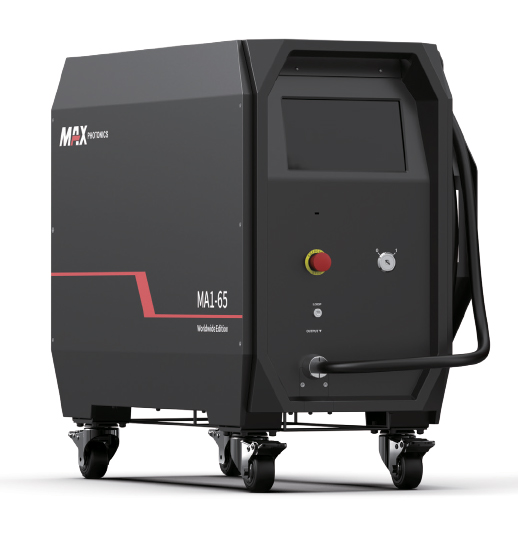
Compact integrated platform
Air cooling can remove the external water loop and reduce the package size. Current official examples range from 800 W portable systems to 2 kW machines.
- Prioritize weight, dimensions and electrical connection.
- Confirm full-power duty cycle and ambient rating.
- Plan clean intake air and filter access.

Integrated chiller cabinet
Water-cooled systems often package the laser, chiller and controls into a wheeled cabinet. JASIC's current 1.5 and 2 kW examples list 85 and 92 kg source weights and an 8 L tank.
- Include chiller input power in site planning.
- Verify coolant, freeze and condensation controls.
- Budget access for condenser and water-loop service.
Eight factors that should decide the cooling system
Use this list in supplier conversations and site reviews. It converts a vague “air versus water” preference into measurable requirements.
Laser power and real material range
Start with material, thickness, joint type, wire requirement and required travel speed. Cooling does not compensate for an undersized laser or unsuitable process head. Request sample welds at the exact production condition.
Minutes welding at stated power
Ask whether the rating is 100% at maximum power or only at a reduced output or ambient temperature. Review thermal alarms, recovery behavior and recorded production data.
Heat, cold, humidity and dust
Air-cooled equipment needs clean intake air and adequate temperature headroom. Water-cooled equipment also needs condenser airflow, plus freeze and dew-point management. Both require a suitable environment.
How the system actually moves
Compare total weight, lifting method, wheel size, cable length, feeder arrangement and transport orientation. A “portable” machine can still be impractical across stairs, rough floors or service vehicles.
Total input, not optical output
A 1.5 kW laser does not mean the whole machine draws 1.5 kW. Include conversion losses, cooling, controls, extraction and wire feeder. Water-chiller compressor and pump loads can materially change the supply requirement.
Work that your team can sustain
Air systems need clean filters, fans and passages. Water systems add coolant chemistry, filter, level, pump, seals, hoses and leak management. Choose the maintenance regime your operators will actually perform.
Parts, alarms and local support
Confirm who diagnoses a thermal alarm, how quickly fans, pumps or chillers can be supplied, whether remote diagnostics exist and what work is allowed without voiding warranty.
Purchase, utilities and downtime
Compare delivered price, installation, electrical upgrades, scheduled service, coolant or filters, energy, floor space and expected downtime. A lower purchase price can be the more expensive production choice.
Which type fits your operating scenario?
These are starting routes, not universal prescriptions. A qualified machine can legitimately fall outside the pattern.
Mobile repair and changing work areas
Air cooling is attractive when the machine is repeatedly transported and the work consists of controlled batches.
- Verify vehicle and lifting limits.
- Provide clean air around the intake.
- Confirm available single- or three-phase supply.
Fixed high-throughput fabrication
A water-cooled cabinet can suit a dedicated cell where floor space, utilities and scheduled maintenance are already controlled.
- Match chiller capacity to the laser.
- Monitor coolant and condenser condition.
- Validate the longest production sequence.
Mixed shop with varied parts
When jobs alternate between short repair work and long production runs, compare two actual machines or test both cooling options.
- Log welding minutes per shift.
- Map seasonal temperatures.
- Compare service and backup plans.
Neither system is automatically protected
Air heat exchangers and water-chiller condensers both lose performance when airflow is dirty or obstructed. Treat enclosure filtration, cleaning access and room ventilation as part of the system.
Water loops need freeze planning
Use only the coolant and antifreeze process specified by the manufacturer. Storage, transport and startup temperatures matter even when the machine is not welding.
Test process stability, not the cooling label
For kitchenware, cabinets and stainless assemblies, evaluate bead appearance together with penetration, underfill, distortion and repeatability through corners and tacks.
Does water cooling produce a better laser weld?
Not by itself. Cooling keeps the laser system within its designed thermal range. Weld quality is then governed by delivered laser power, focus, wobble settings, travel speed, joint fit-up, shielding gas, wire delivery, surface condition and operator technique.
What stable cooling can improve
- Reduced thermal alarms and avoidable interruption.
- More consistent laser operation within rated limits.
- Predictable production when ambient conditions are controlled.
- Protection against overheating when sensors and interlocks work correctly.
What cooling cannot fix
- A gap larger than the qualified joint can tolerate.
- Incorrect material, filler wire or shielding gas.
- Contaminated optics or dirty workpieces.
- Excessive heat input, poor focus, wrong angle or unstable hand travel.

Integrated water-cooled system example. Image: JASIC.
“Compact” and “portable” need measurements
One current water-cooled example lists an 8 L tank and an 85–92 kg source cabinet. One current air-cooled family lists systems up to 2 kW, while another begins at 28 kg. Those numbers are valuable only when tied to exact models.
For procurement, record machine dimensions, loaded mass, feeder mass, cable reach, supply voltage, total input power, gas and extraction needs. A product photo cannot answer whether a machine fits your floor, vehicle or electrical panel.
Information to request before placing an order
A strong quotation should make the cooling choice auditable. Ask the supplier to answer these points in writing for the exact configured machine.
Prove the choice with the longest realistic welding cycle
A short demonstration can hide thermal limits. Validate the machine through the hottest expected shift conditions and inspect weld quality before, during and after the test.
Define the production case
Material, thickness, joint, wire, seam length, parts per batch, breaks, ambient temperature and target shift output.
Run accepted settings
Use the supplier's approved process window and log power, speed, wobble, gas, wire and thermal alarms.
Inspect at intervals
Compare start, middle and end samples for penetration, fusion, porosity, appearance, distortion and repeatability.
Review support burden
Record setup time, filter or coolant work, electrical load, operator handling and recovery from intentional alarms.
Cooling does not change the Class 4 laser hazard
Both machine types require a laser-controlled work area, trained personnel, appropriate interlocks and protective measures based on the actual wavelength and exposure assessment. Shielding gas, fumes, hot metal, electrical power and fire risks also remain.
Do not use portability as permission to weld in an uncontrolled area. Follow the machine manual, local regulations and a qualified laser-safety assessment.
Before startup
- Check interlocks and emergency stop.
- Inspect the torch, optics and work clamp.
- Confirm shielding gas and source capture.
- Verify cooling alarms are clear.
- Keep reflective bystanders out of the controlled zone.
Send the job requirements, not only a desired power number
Share material, thickness, joint drawings, longest continuous welding period, shift output, ambient range, available supply and mobility needs. Oceanplayer can recommend an air-cooled or water-cooled configuration and plan a representative sample test.
Related laser welding resources
Air-cooled vs water-cooled handheld laser welder FAQ
Which is better, an air-cooled or water-cooled handheld laser welder?
Neither is universally better. Air cooling often improves compactness and reduces liquid-loop maintenance. Water cooling can add controlled thermal capacity. The correct choice depends on the exact model's power, duty cycle, ambient limits, electrical demand, service plan and your production case.
Can an air-cooled laser welder run continuously?
Some can. IPG states that its LightWELD system can operate at 100% duty cycle at maximum laser power. This is model-specific, so obtain the duty-cycle rating and test conditions for the machine you plan to buy.
Are air-cooled handheld laser welders limited to low power?
No. Current official product ranges include air-cooled machines at 1.5 kW and 2 kW. Power availability and operating limits depend on the laser and thermal design, not the category name alone.
Does a water-cooled laser welder make stronger welds?
Cooling method alone does not determine weld strength. Joint design, delivered power, focus, speed, shielding, wire, surface condition and procedure qualification control the result. Cooling helps the machine remain within its operating range.
Is an air-cooled laser welder always lighter?
It is often lighter because it omits the water tank, pump and liquid circuit, but compare total configured weight. The feeder, cable package, cart and accessories can change practical portability.
What maintenance does an air-cooled laser welder need?
Typical tasks include inspecting and cleaning intake filters, fans, heat exchangers and ventilation paths, plus the normal torch and protective-optics maintenance. Follow the exact manufacturer interval.
What maintenance does a water-cooled laser welder need?
In addition to normal machine and optics maintenance, the liquid loop may require level, temperature, pressure, coolant, filter, condenser, pump, hose and leak checks. Use only the coolant and schedule specified by the manufacturer.
Can I use tap water in a water-cooled laser welder?
Do not assume so. Some manuals explicitly prohibit tap water and specify distilled or deionized water, filters and approved additives. Use the documentation for the exact laser and chiller because incompatible water chemistry can damage the circuit.
Which type is better in a hot workshop?
Review the rated ambient range. Hot intake air can reduce air-cooling headroom, while a water chiller also rejects heat into the room and has its own ambient limit. The answer depends on ventilation, dust, temperature and the complete machine rating.
Which type is better for mobile welding?
Air-cooled equipment often has the portability advantage, but verify total weight, lifting method, cable reach and site power. A compact water-cooled machine may still be practical on smooth factory floors.
Does water cooling use more electricity?
An active chiller adds compressor and pump loads, so it can increase auxiliary consumption. Compare maximum total input power for the complete machines rather than estimating from laser output watts.
How should I compare two handheld laser welders before buying?
Send both suppliers the same material, thickness, joint, seam length, batch size, ambient range and shift target. Compare sample-weld acceptance, rated duty cycle, total utilities, maintenance, safety package, warranty and local service.
Primary sources used for this guide
- IPG Photonics — LightWELD Handheld Laser Welding & Cleaning Systems: current product powers, cooling method and capability examples.
- IPG Photonics — LightWELD FAQ: manufacturer statement on 100% duty cycle at maximum laser power.
- Maxphotonics — MA1 Series: current air-cooled 800 W, 1,200 W and 1,500 W examples and system weights.
- JASIC — LS-15000F / LS-20000F Operator's Manual: water chiller parameters, coolant circuit and maintenance requirements.
- Miller — OptX Handheld Laser Welder Owner's Manual: air-cooled heat-sink monitoring and system safety controls.
- SENFENG — Laser Welding Machines Brochure: current air- and water-cooled product-family examples.