


Industrial laser selection guide · 2026
5 Essential Types of Lasers by Gain Medium
Fiber, gas, diode, bulk solid-state and dye lasers can all produce coherent light—but they solve very different manufacturing and scientific problems. The fastest way to choose is to start with the required wavelength and process result, then verify power, pulse format, beam delivery, service needs and safety.
Decision ruleThe gain medium defines the available emission band. The complete laser architecture determines how efficiently, cleanly and reliably that light reaches the workpiece.
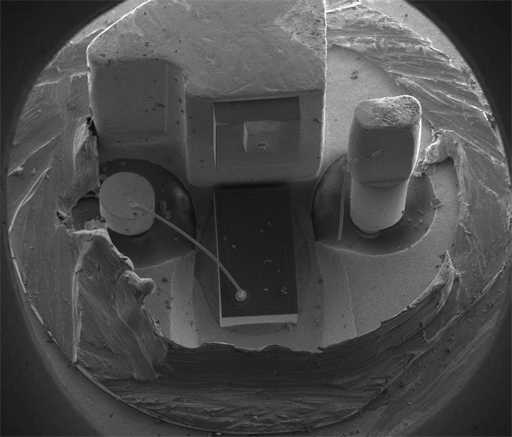
Image: Idaho National Laboratory, Wikimedia Commons, CC BY 2.0.
Industrial metal workhorse
Compact beam delivery, high electrical efficiency in modern systems and scalable power for cutting, welding, cleaning and marking.
Best-known for CO₂
Mid-infrared output is highly useful for many polymers, wood, paper, textiles and other organic materials.
Efficient direct source
Semiconductor emitters serve as both pump engines and direct-processing sources for heating, cladding, brazing and welding.
Precision pulse platform
Bulk crystals or glass support fundamental and frequency-converted wavelengths for marking and micromachining.
Wide spectral tunability
Liquid organic dyes remain valuable where researchers need adjustable wavelength, narrow linewidth or specialized spectroscopy.
Answer first
There is no universal “best laser type.”
For mainstream metal production, ytterbium fiber lasers are often the first family to evaluate. For cutting and marking many organic materials, a CO₂ gas laser is usually a more natural starting point. Direct diode lasers excel when high electrical efficiency and a controlled, often larger spot are useful. Bulk solid-state DPSS lasers are strong candidates for precise pulsed work and frequency-converted green or UV processing. Dye lasers are specialist laboratory tools chosen primarily for tunability.
The gain medium is the material in which stimulated emission amplifies light. It sets the wavelengths that can be generated and influences gain bandwidth, energy storage, thermal behavior and achievable pulse formats. It does not determine the complete result alone. The resonator, pump source, beam-delivery optics, cooling, control system and workpiece absorption all matter.
What happens inside a laser?
A practical laser needs an energy source, an amplifying medium and optical feedback. The output coupler releases a controlled portion of the circulating light as the usable beam.
Why classify lasers by gain medium?
The classification is useful because it connects the physics to practical purchase questions. A buyer can quickly estimate the likely wavelength family, power scalability, beam-delivery method and maintenance profile. It also prevents a common mistake: comparing two machines only by wattage even though their wavelengths, pulse durations and spot characteristics are fundamentally different.
“A 100 W laser” is therefore incomplete information. A 100 W pulsed fiber source, 100 W sealed CO₂ laser and 100 W direct diode module can interact with the same material in very different ways. Average power describes energy per unit time; it does not by itself describe peak power, pulse energy, fluence, focal intensity or material absorption.
Engineering comparison
Five laser types at a glance
Ranges below are representative, not universal. Commercial products can sit well outside them, and system efficiency must not be confused with the optical efficiency of only the laser source.
| Laser family | Gain medium | Representative wavelengths | Typical strength | Common applications | Main trade-off |
|---|---|---|---|---|---|
| Fiber | Rare-earth-doped silica fiber, commonly Yb or Er | Yb systems near 1.03–1.08 µm; Er families near 1.55 µm | Efficient, compact, scalable and fiber delivered | Metal cutting, welding, cleaning, engraving, marking, communications | Near-IR coupling varies strongly with material and surface; back-reflection control matters |
| Gas | Excited gas mixture, including CO₂ or He-Ne | CO₂ commonly 9.3–10.6 µm; He-Ne commonly 632.8 nm | Excellent mid-IR processing of many nonmetals; mature technology | Cutting and engraving polymers, wood, paper, textiles; alignment and metrology with He-Ne | Beam delivery, size and electrical efficiency differ from modern fiber platforms |
| Diode | Semiconductor p-n junction or related heterostructure | Visible blue through near-IR; industrial systems often around 450 or 900–1000 nm | Very high electrical efficiency and direct electrical pumping | Pumping other lasers, heat treatment, brazing, cladding, welding, drying | Beam quality and spot geometry vary by architecture and may limit fine focusing |
| Bulk solid-state | Doped crystal or glass, such as Nd:YAG or Nd:YVO₄ | 1064 nm fundamental; often converted to 532 or 355 nm | Precise pulsed output and useful harmonic wavelengths | Marking, drilling, PCB processing, micromachining, scientific systems | More optics and thermal alignment than an all-fiber architecture |
| Dye | Organic dye, usually in a circulating liquid solvent | Different dyes collectively cover UV, visible and near-IR regions | Broad gain bandwidth and wavelength tunability | Spectroscopy, research, isotope studies and specialized diagnostics | Dye degradation, solvent handling, alignment and maintenance burden |
Choose by the job
Start with the process result—not the laser label
A short list based on the workpiece and quality target is more useful than a generic ranking of laser technologies.
Cut or weld common production metals
Evaluate a near-IR fiber source first, then test the actual alloy, thickness, joint, surface, assist gas and required cycle time. Copper and aluminum need special attention to reflectivity and process stability.
Cut or engrave polymers and organics
CO₂ is often the natural starting point because many organic materials absorb strongly in its mid-IR band. Verify composition, flame behavior, fumes and edge quality before production.
Mark, scribe or micromachine precisely
Compare pulsed fiber, MOPA, green and UV DPSS options. The correct choice depends on feature size, heat sensitivity, contrast mechanism, ablation threshold and acceptable heat-affected zone.
Heat, braze, clad or dry a wide area
Direct diode sources can deliver efficient, shaped spots with high power. Beam homogenization and process optics may matter more than achieving the smallest possible focus.
Remove rust, paint or oxide selectively
Pulsed and CW fiber cleaning systems are common. Match fluence, scan pattern, repetition rate and thermal budget to the contaminant and substrate—not merely to contamination thickness.
Tune wavelength for spectroscopy
Dye and other tunable laser families deserve evaluation when spectral flexibility and linewidth are primary. Laboratory handling, pump requirements and long-term repeatability become central selection criteria.
01 Fiber lasers
High-power production with the gain medium inside the fiber
In a fiber laser, rare-earth ions are incorporated into a glass fiber core. Pump diodes inject energy into the active fiber, and fiber Bragg gratings or another resonator arrangement provide optical feedback. The long interaction length and large surface-area-to-volume ratio support efficient gain and thermal management.
Ytterbium-doped systems near 1 µm dominate many industrial metal applications. They can be built for continuous-wave cutting and welding, nanosecond marking, short-pulse cleaning and ultrafast micromachining. Erbium-doped families near 1.55 µm are prominent in telecommunications and sensing. The words “fiber laser” therefore do not specify power or pulse duration; they describe the gain and delivery architecture.
- Best fit: scalable metal processing, compact beam delivery, low routine optical alignment and automated production.
- Watch: reflected energy, process window, protective optics, delivery-fiber handling and whether the quoted efficiency covers the complete machine.
- Evidence: modern high-efficiency products can exceed 50% wall-plug efficiency, but that is model-specific—not a guarantee for every fiber laser.

02 Gas lasers
CO₂ defines the industrial gas-laser category
A gas laser uses an electrically or optically excited gas mixture as its gain medium. The category covers very different sources: CO₂ lasers emit in the mid-infrared and are industrial processing tools, while helium-neon lasers commonly emit a low-power visible red beam used for alignment, education and measurement.
Commercial CO₂ laser families are offered at approximately 9.3, 9.6, 10.2 and 10.6 µm. That wavelength range couples effectively into many plastics and organic materials, supporting marking, engraving and cutting of paper, wood, rubber, leather and textiles. For common bare metals, near-IR fiber systems are usually the first modern choice, although high-power CO₂ lasers and special process conditions can also process metals.
- Best fit: polymers, wood, paper, textiles, rubber and application-specific mid-IR absorption.
- Watch: mirror-based beam delivery, cooling, extraction, material fumes and the exact CO₂ wavelength offered.
- Do not assume: one “CO₂ efficiency” value applies to sealed low-power, slab and multi-kilowatt platforms.

03 Diode lasers
Semiconductor gain with direct electrical pumping
A laser diode generates light in an electrically driven semiconductor junction. Compact diodes power communications, sensing and consumer devices, while arrays, stacks and wavelength-combined modules scale optical output into the kilowatt range. Diodes also pump many fiber and bulk solid-state lasers, so they sit both inside other laser architectures and in direct-processing systems.
Industrial direct-diode lasers are attractive when electrical efficiency, a shaped spot and controlled heat delivery matter. Applications include brazing, cladding, polymer welding, heat treatment, coating curing, electrode drying and selected metal welding. A direct diode source may have higher wall-plug efficiency than a system that converts diode pump light through another gain medium, but beam quality and focusability depend on architecture.
- Best fit: efficient heating, brazing, cladding, drying and processes that benefit from line or rectangular beam shapes.
- Watch: brightness, beam-parameter product, homogenization, focal geometry and wavelength sensitivity of the material.
- Current example: specialized industrial direct-diode products can exceed 50% wall-plug efficiency; compare complete product data, not category averages.
04 Bulk solid-state lasers
Crystal and glass gain media for precise pulsed work
In this guide, “bulk solid-state” refers to a discrete doped crystal or glass—such as Nd:YAG or Nd:YVO₄—rather than a doped fiber. These media are commonly pumped by laser diodes. The fundamental infrared output can be used directly or passed through nonlinear crystals to create shorter harmonic wavelengths.
A familiar chain is 1064 nm infrared, 532 nm green and 355 nm ultraviolet. Shorter wavelengths can focus to smaller diffraction-limited spots and may couple better to specific materials, while UV photons can enable lower-heat marking or ablation on sensitive polymers and electronics. These advantages are application-specific: the frequency-conversion stage adds optics, conversion losses and service considerations.
- Best fit: fine marking, PCB and electronics processing, drilling, scribing and controlled micromachining.
- Watch: pulse duration, repetition rate, pulse energy, nonlinear conversion stability, crystal temperature and optical alignment.
- Representative product: commercial UV DPSS platforms are available around 355 nm with tens of watts for precision micromachining.

05 Dye lasers
A specialist platform for tunable wavelength
Dye lasers use organic dye molecules—usually dissolved in a liquid solvent—as the gain medium. Their broad gain bandwidth permits wavelength selection with intracavity gratings, prisms or filters. Different dyes and optical coatings are needed to cover different spectral bands; one dye does not continuously span the entire visible range.
The same flexibility that makes dye lasers valuable for spectroscopy also increases their operating burden. Dye solutions degrade, many solvents need controlled handling, circulation systems require maintenance and the cavity may need careful alignment. Solid-state tunable sources and optical parametric systems have replaced dye lasers in many roles, but dye systems remain relevant where a specific tunable band, pulse format or research method is required.
- Best fit: absorption spectroscopy, specialized diagnostics, wavelength-scanning research and historical or established experimental methods.
- Watch: dye and solvent compatibility, photodegradation, pump-laser requirements, cavity optics, chemical controls and repeatability.
- Selection rule: define the required tuning band, linewidth, pulse energy and scan behavior before selecting the dye and resonator.

Beyond gain medium
Four specifications that can reverse the decision
Gain medium is a useful first filter. A production process is qualified on the complete beam and machine, not on the family name.
Wavelength
Controls photon energy, optical compatibility and material coupling. Absorption changes with alloy, surface film, temperature, wavelength and intensity.
Pulse format
CW, nanosecond, picosecond and femtosecond sources distribute energy differently. Average power alone cannot predict peak intensity or heat input.
Beam quality
M² or beam-parameter product influences focusability and working distance. A larger, homogenized spot may be preferable for heating even when it is not diffraction limited.
Delivery optics
Fiber, free-space mirrors, scanners, focusing heads and protective windows determine accessibility, maintenance and how the source integrates with automation.
Operating cost
Compare the complete system, not a headline efficiency
Wall-plug efficiency is optical output divided by electrical input under defined conditions. It is useful, but it does not include every production cost or guarantee the lowest cost per accepted part.
Non-negotiable
Laser type does not determine safety class by itself.
Hazard classification depends on accessible emission, wavelength, power or energy, pulse conditions and the final product configuration.
Design controls around the finished system and process
- IEC 60825-1 addresses laser-product classification and manufacturer requirements across 180 nm to 1 mm.
- ANSI Z136.1 is a core U.S. consensus standard for safe use of lasers; workplace obligations also interact with applicable OSHA rules.
- High-power industrial equipment commonly contains a Class 4 source. A properly engineered enclosure may make normal operation of the final product Class 1, but service modes can expose the embedded hazard.
- Controls may include enclosure, interlocks, beam stops, access restriction, wavelength-specific eyewear, training, written procedures, extraction and management of fire, electrical and process-fume hazards.
- Handheld processing deserves special attention because beam direction, reflected energy and the work environment can change during use.
Never select protective eyewear by visible beam color. Optical density and wavelength range must match the evaluated hazard, and eyewear is not a substitute for containment where engineering controls are practicable.
Procurement checklist
Specify the job before requesting a laser quote
A supplier can recommend responsibly only when the workpiece, process target and acceptance criteria are specific.
Material and surface
Provide alloy or polymer grade, surface finish, coating or contaminant, thickness, geometry and representative photographs.
Required result
Define penetration, removal depth, contrast, roughness, heat-affected zone, feature size, edge quality or cleanliness standard.
Production target
State parts or area per shift, available loading time, automation level, changeover needs and planned duty cycle.
Laser variables
Compare wavelength, average power, pulse duration, pulse energy, repetition rate, beam quality, spot and scan strategy.
Facility constraints
Record electrical supply, cooling, extraction, floor space, environmental limits, network integration and permitted utilities.
Acceptance test
Run representative samples and evaluate the hidden result—not just an attractive top surface. Record settings and inspection evidence.
Continue the decision
Related laser selection guides
Move from laser family to wavelength, machine configuration and a representative process test.
Common questions
Types of lasers by gain medium: FAQ
Short answers for buyers, engineers and students comparing laser architectures.
What is a laser gain medium?
A gain medium is the material in which incoming pump energy creates a population capable of amplifying light by stimulated emission. It can be a doped glass fiber, semiconductor, gas mixture, crystal, glass or organic dye solution. Its energy levels and gain bandwidth strongly influence the wavelengths and pulse formats the laser can support.
What are the five main laser types by gain medium?
This industrially useful classification separates fiber, gas, diode, bulk solid-state and dye lasers. Other valid categories exist, including chemical, excimer, free-electron and quantum cascade lasers. The five selected here cover the families most often encountered in manufacturing, communications and general photonics discussions.
Is a fiber laser a solid-state laser?
Yes in physics: its active ions are embedded in solid glass. It is separated in this guide because the active fiber is also a waveguide, and the resonator, pumping, cooling and beam-delivery architecture differ substantially from a bulk crystal or glass laser.
Which laser type is best for metals?
Near-IR fiber lasers are a common first choice for industrial metal cutting, welding, cleaning and marking. That is not universal. Alloy, surface condition, thickness, geometry, required quality, pulse duration, wavelength and process optics must be tested. Green, blue, UV and other wavelengths can outperform near-IR in particular reflective or heat-sensitive applications.
Which laser type is best for plastic, wood or paper?
CO₂ gas lasers are often well matched to many polymers and organic materials because of their mid-infrared wavelength. The material must still be identified: some plastics produce hazardous decomposition products or poor edges and should not be laser processed without a proper hazard evaluation.
Are diode lasers and fiber lasers the same?
No. A diode laser uses a semiconductor junction as its gain medium and can emit directly. A fiber laser uses doped glass fiber as its gain medium and is normally pumped by diode lasers. Both may be fiber delivered at the system level, so the output cable alone does not identify the gain medium.
Does higher wall-plug efficiency always mean a lower production cost?
No. Electrical efficiency affects energy and cooling demand, but cost per accepted part also depends on process speed, part handling, rework, maintenance, consumables, extraction, uptime and safety infrastructure. Compare the complete production cell under the same acceptance criteria.
What is the difference between CW and pulsed lasers?
A CW laser supplies nearly continuous optical power. A pulsed laser concentrates energy into repeated pulses whose duration may range from milliseconds to femtoseconds. Two sources with the same average power can therefore have radically different peak power, pulse energy and thermal effects.
Why does wavelength matter so much?
Wavelength affects how the beam propagates through optics and how the surface absorbs or reflects energy. It also affects the minimum diffraction-limited spot. Real coupling is process-dependent, so wavelength selection should be verified on the actual material, surface and operating intensity.
How should I compare two industrial laser quotations?
Ask for the exact source model, wavelength, output format, beam quality, spot range, delivery optics, measured facility demand, cooling and extraction requirements, classification, included safety controls, warranty and a timed sample test. Use the same acceptance criteria for both quotations.
Technical references
- IPG Photonics — High-Efficiency Fiber Lasers: manufacturer data for model-specific wall-plug efficiency above 50%.
- Coherent — CO₂ Lasers: commercial 9.3, 9.6, 10.2 and 10.6 µm wavelength families.
- Coherent — AVIA LX: UV and green nanosecond DPSS systems for precision micromachining and marking.
- Laserline — LDL Direct Diode Laser: a current high-efficiency, high-power direct-diode example.
- RP Photonics Encyclopedia — Dye Lasers: gain bandwidth, pumping, tunability and operating trade-offs.
- IEC 60825-1:2014: laser-product classification and equipment requirements.
- OSHA — Laser Hazards Standards: U.S. workplace references to ANSI Z136, IEC 60825 and applicable OSHA requirements.
- OSHA Technical Manual, Section III, Chapter 6: laser and non-beam hazards, controls and ventilation.
From category to qualified process
Not sure which laser family belongs on your shortlist?
Send Oceanplayer your material, dimensions, surface condition, target result and production rate. We can help narrow the wavelength, laser architecture, power range and sample-test plan before you compare machines.