

7 CW Laser Cleaning Machine Manufacturers in China: How to Compare Suppliers
Use this shortlist to find China-based suppliers with a public continuous-wave laser-cleaning route, then compare their machines against the same application, configuration, acceptance test and support requirements.
The short answerOceanplayer Laser, SENFENG, DXTECH, Leapion, AccTek Group, Demark and JNCT publish CW laser-cleaning equipment. Do not choose from the name list alone. First confirm that CW suits the surface, then require a configuration-controlled quotation and a repeatable test on your real workpiece.
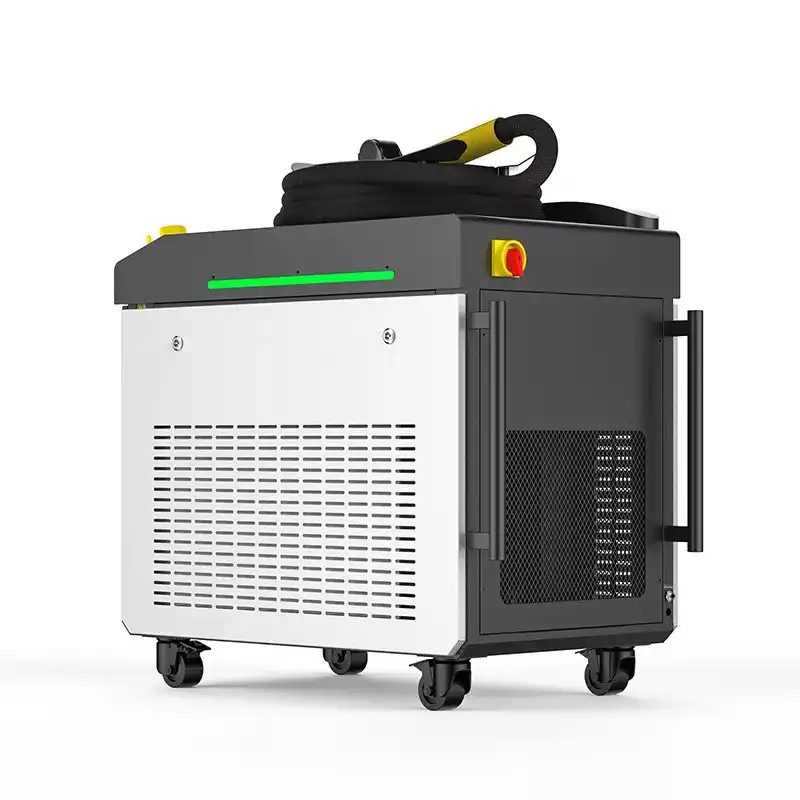 Oceanplayer Laser CW cleaning system
How should you shortlist a CW laser cleaning machine manufacturer in China?
Start with the cleaning job, not the supplier logo. Keep a candidate only when the proposed process fits the surface, the complete build is named, the result is tested, and the commercial responsibility is clear.
Robust steel, broad areas and heavy removal may favor CW. Thin, polished, coated or heat-sensitive parts may require pulsed cleaning or another method.
Record source, head, scan field, optics, fiber, chiller, controls, electrical input, guarding, extraction interface and spares.
Measure removal, surface change, accepted area per hour, handling time, fume control and repeatability on representative workpieces.
Put the FAT method, documentation, permitted substitutions, warranty owner and remedies into the contract before shipment.
What is a CW laser cleaning machine, and when is it the right process?
CW means continuous wave. A CW fiber laser delivers energy continuously while the cleaning head scans the beam across the workpiece. The contaminant can heat, decompose, vaporize or lose adhesion, but the exact interaction depends on the coating, substrate and beam path. The useful result is not merely “the rust disappeared.” It is the agreed level of removal without unacceptable melting, discoloration, roughening, distortion, redeposition or change to nearby features.
Continuous-wave systems are commonly considered for large or repeatable metal surfaces where removal rate matters: heavy rust on structural steel, paint on robust fabrications, oxide on large parts or surface preparation before a downstream operation. The same continuous thermal input can be a disadvantage on thin sheet, precision molds, plated parts, polished surfaces or components with a narrow cosmetic or dimensional tolerance.
This article uses “manufacturers” because that is the search language and the listed companies publish their own CW equipment pages. Before purchase, verify the legal seller, factory role, critical-component origin, warranty obligor, service geography and delivered configuration.
Why rated wattage does not choose the machine
Two cleaners advertised at 2,000 W can use different sources, cleaning heads, optics, scan widths, patterns, cable lengths, cooling packages, safety circuits and control software. More importantly, the same machine can behave differently on loosely attached red rust, dense mill scale, epoxy paint, oil, galvanized steel or a polished surface. Power matters, but it only becomes useful when connected to a known material, residue, geometry, target finish and production cycle.
- Define what must be removed and what must remain unchanged.
- State the material grade, thickness, surface finish and sensitive adjacent features.
- Measure accepted area or accepted parts per shift—not only laser-on speed.
- Confirm electrical power, cooling, extraction, access control and operator workflow at the installation site.
When should you compare CW and pulsed laser cleaning?
Compare both when the part is thin, polished, plated, high-value, heat-sensitive or dimensionally critical. Neither technology is universally faster, safer or cheaper; the decision depends on the accepted surface and full production cycle.
| Decision factor | CW / continuous wave | Pulsed cleaning | Evidence to request |
|---|---|---|---|
| Energy delivery | Continuous average energy; heat accumulation can become a major process variable. | Discrete pulses with different peak-power and interaction behavior. | Source mode, power range, pulse data where relevant, scan path, dwell, overlap and working distance. |
| Typical starting fit | Broad, robust metal surfaces; heavy rust, paint or coatings; maintenance and production where coverage rate matters. | Precision work, thin or valuable parts, molds and applications with a narrow thermal or cosmetic window. | Actual material, coating, thickness, geometry, heat sensitivity, finish limits and contamination. |
| Primary trade-off | Potentially strong area productivity, with thermal effects that must be controlled and inspected. | Potentially more selective control, but the process must still meet output and cost targets. | Before/after inspection, temperature or warpage check when relevant, surface condition and qualified throughput. |
| Common buying error | Choosing the highest wattage for an untested thin, polished, coated or sensitive workpiece. | Assuming “pulsed” guarantees no damage without an acceptance definition. | Run both routes when uncertainty is high and score the result against one written test plan. |
Use the Oceanplayer Laser Pulsed vs CW Laser Cleaner Comparison Tool as an early decision aid, then validate the preferred route on the real part.
Which Chinese CW laser cleaning machine manufacturers should you investigate?
These seven names are a non-ranked discovery list. Each had a public company-side CW or continuous product route when checked on September 3, 2026. Inclusion does not prove factory ownership, production capacity, legal compliance, service quality or suitability for your application.
Oceanplayer Laser publishes a dedicated CW laser-cleaner route and offers application-led equipment selection. Use it as a direct comparison candidate, while still freezing the delivered source, head, chiller, controls, utilities and acceptance test in writing.
SENFENG's HC page lists 1.5, 2 and 3 kW water-cooled models and positions them for broad, relatively flat workpieces. Treat speed, width and duty statements as supplier data until repeated under your test condition.
DXTECH publishes HC and MHC continuous-cleaning families plus a multifunction CCW route. This helps buyers compare dedicated cleaning with combined welding, cutting and cleaning, but the configurations should not be treated as equivalent.
Leapion publishes 1, 1.5, 2 and 3 kW water-cooled cleaning options with CW/modulated operation. Use the public table to build comparison fields, then require the quotation to name the exact source, head, controller, fiber and utility configuration.
AccTek publishes continuous models from 1.5 to 6 kW with several source, head and scan-width choices. “Portable” describes the enclosure format; site power, water cooling, extraction, beam control and lifting still require planning.
Demark publishes cable length, wavelength, beam width, cooling, dimensions and supplier-reported cleaning rates. These details help build an RFQ matrix, but its m²/h figures should not be transferred to a different coating, geometry or acceptance standard.
JNCT publishes a CW category with handheld and higher-power options. Some page fields require clarification before comparison, so ask the supplier to resolve any inconsistent mode, power or performance descriptions in the signed technical schedule.
Selection method: each company had a public CW or continuous-cleaning product route when checked on September 3, 2026. The list is not exhaustive and is not a factory audit, certification or endorsement. Recheck the company, model, documentation and service scope before issuing a purchase order.
Oceanplayer Laser continuous-wave cleaningWhat does Oceanplayer Laser offer for CW cleaning applications?
Oceanplayer Laser publishes a dedicated continuous-wave laser-cleaning route for buyers who need to remove rust, paint, oxide or other contamination from broad, robust surfaces. A useful enquiry should begin with the surface, not a request for “the cheapest 2 kW unit.” Send the base material, contaminant, thickness or condition, photos, part dimensions, target finish and output requirement.
For structural steel, large work areas and heavy rust or paint, a water-cooled CW configuration may be a practical direction. The final power, head, scan field, fiber length, cooling, electrical supply, extraction and safety scope still need to be defined around the actual application.
- Request the exact source, head, controller, chiller and included optical consumables.
- Agree what “clean” means and how surface change will be inspected.
- Time the complete cycle, including handling, repositioning, extraction and inspection.
- Put the test method and permitted configuration substitutions into the quotation.
How should you compare CW laser cleaning machine quotations?
Send one RFQ and require every supplier to answer the same fields. A low FOB price can hide an unclear source, unsuitable voltage, missing extraction, unpriced spares or a weak warranty. Compare the delivered system and accepted production result, not only the laser wattage.
| Comparison field | Why it changes the result | Evidence to require |
|---|---|---|
| Laser source and mode | The delivered CW source, power-control behavior, fiber interface and warranty define what you are actually buying. | Make, model, datasheet, rated output, serial traceability and warranty terms. |
| Head, scanner and optics | Scan field, focus, working distance, pattern and protective window affect heat input, access and maintenance. | Head/controller model, field drawing, lens options, protective-glass part number and replacement procedure. |
| Measured cleaning result | A visually clean surface can still have discoloration, roughness, residue, melting or redeposition. | Agreed sample, before/after evidence, parameters, raw video, inspection and repeatability result. |
| Qualified throughput | Real output includes handling, repositioning, setup, inspection, extraction interruptions and rejected work. | Timed complete-cycle test and accepted area or good parts per shift. |
| Utilities and cooling | Voltage, phase, breaker capacity, water cooling, ambient limits and extraction can determine site feasibility. | Utility schedule, electrical diagram, chiller limits, connector and destination-voltage confirmation. |
| Safety and installation | An open-beam industrial cleaner must be integrated into a controlled work area or engineered system. | Risk assessment, interlock logic, E-stop, beam-stop/guarding concept, labels, eyewear specification and layout. |
| Support and spares | Downtime is often driven by optics, head, source, chiller, cables, controls and shipping—not purchase price. | Spare list and prices, lead times, response commitment, training, manuals and escalation route. |
Ask for rust grade or coating chemistry, thickness, geometry, target cleanliness, power, width, overlap, passes and what time is excluded.
Price protective windows, lenses, filters, cooling water, maintenance parts, power, extraction filters and service labor.
Define allowed appearance, roughness, dimensions, hardness, coating adhesion, corrosion behavior or functional change.
How can you verify that a supplier is the actual manufacturer?
A website and branded cabinet do not prove who designed, assembled, tested or warrants the machine. Verify the legal and technical chain before paying a large deposit.
Ask for the company registration name, factory address, quotation entity, export entity, bank beneficiary and warranty provider. Require a written explanation when the names differ.
Use a live video call or an independent visit to see assembly, wiring, testing, packing and spare-parts areas. Ask the guide to show the current date and move to locations you choose.
Request source, head, controller and chiller model numbers, equipment nameplate, serial-number format, wiring diagram and a signed bill of materials. Put approved substitutions in the order.
Ask who will answer installation questions in your language, which time zone they cover, what can be diagnosed remotely, where critical spares ship from and how warranty freight is handled.
Do not release the main payment when the legal seller, bank beneficiary, delivered configuration, warranty owner or failed-test remedy cannot be connected in writing. A low price does not compensate for an untraceable obligation.
What should a CW laser cleaner factory acceptance test include?
Use the same sequence for Oceanplayer Laser and every comparison supplier. It connects the application, delivered configuration, measured result and commercial remedy.
Material grade, thickness, finish, contamination, condition, geometry, photos and sensitive features.
Residual limit, visual or measured finish, maximum substrate change and production target.
Record parameters, complete cycle time, before/after condition, extraction and repeatability.
Attach the source, head, optics, controller, chiller, cable, safety scope, utilities and spares to the order.
Repeat the agreed test at FAT/SAT, verify documents and serials, and link payment to the result.
What safety and compliance evidence should the supplier provide?
High-power cleaning systems are normally Class 4 laser products. OSHA guidance identifies eye and skin exposure, reflections, fire and airborne contaminants among the hazards. Eyewear alone is not a complete control plan. The final safeguards depend on the installed machine, material, site and local rules, so involve qualified laser-safety and industrial-hygiene professionals.
Define the beam path, controlled-area boundary, enclosure or shielding, beam stop, reflective surfaces, access control, labels and warning status.
Verify key control, enable logic, trigger behavior, remote interlock, E-stop, faults, shutter or cap, restart behavior and commissioning records.
Coatings, rust, oils, plating and base metals can create airborne contaminants. Design local exhaust and filtration around the actual process, not a generic filter claim.
Eyewear must carry the relevant wavelength and optical-density marking. PPE supports—but does not replace—engineering and administrative controls.
Review ignition, hot surfaces, grounding, electrical supply, cables, trip risks, weather, enclosed spaces and emergency response.
Require classification and labels, manuals, diagrams, installed-control testing, training records and destination-market review before release.
Technical references: OSHA Laser Hazards and the OSHA Technical Manual, Section III, Chapter 6.
Which Oceanplayer Laser tools can help you prepare the RFQ?
These published Oceanplayer Laser tools help organize the first decision. They are planning aids, not substitutes for a representative sample test or qualified safety review.
Review the material, contamination, surface sensitivity and likely cleaning direction.
Check the application →Translate the job and output requirement into an early equipment direction.
Find a cleaner route →Compare practical power ranges after the process mode and surface have been screened.
Explore power ranges →Build an early airflow and ducting estimate before the final industrial-hygiene design.
Estimate airflow →Send the material, contamination, photos, dimensions, target surface, area or parts per shift, utilities, workspace and destination. Oceanplayer Laser can use those facts to recommend a continuous-wave cleaning direction and prepare a quote that is easier to compare with other suppliers.
- Oceanplayer Laser — CW Laser Cleaning Machine
- SENFENG — Handheld Continuous Laser Cleaner, HC Series
- DXTECH — Continuous Laser Cleaning Machine
- Leapion — Continuous Laser Cleaner
- AccTek Group — Portable Continuous Laser Cleaning Machine
- Demark — CW Fiber Laser Cleaning Machine
- JNCT — CW Laser Cleaning Machine
- OSHA — Laser Hazards
- OSHA Technical Manual — Laser Hazards and Controls