


What Is 1018 Mild Steel?
1018 vs 1045
1018 is a low-carbon steel containing about 0.15–0.20% carbon. It is widely used for machined parts, formed components and welded fabrications. Compared with 1045, it is generally easier to weld and form; 1045 offers more potential for hardening and higher strength. Choose using the stock condition and the part’s actual load or wear requirement.
Representative steel stock; the photograph does not identify the grade. Photo: Fornax / Wikimedia Commons, CC BY-SA 3.0; cropped to fit.
What the 1018 designation tells you
SAE 1018 identifies a plain carbon steel grade. “Mild steel” is a broad description of low-carbon steel, so it does not identify one exact material. A drawing that says only “mild steel” leaves more room for substitution than one that specifies a grade, product standard and delivery condition.
The grade primarily describes chemistry. It does not tell you whether a bar is hot-wrought, cold-drawn, stress-relieved or subsequently heat-treated. Nor does it, by itself, guarantee a finished part’s yield strength, hardness or dimensional tolerance.
Swipe within each table to read all columns.
| Element | Published range or maximum |
|---|---|
| Carbon, C | 0.15–0.20% |
| Manganese, Mn | 0.60–0.90% |
| Phosphorus, P | 0.040% maximum |
| Sulfur, S | 0.050% maximum |
Selected elements, not a complete purchase specification. Check the applicable specification and the heat’s material certificate. Sources: Macsteel SAE 1018 bright-bar datasheet and the public scope of SAE J403.
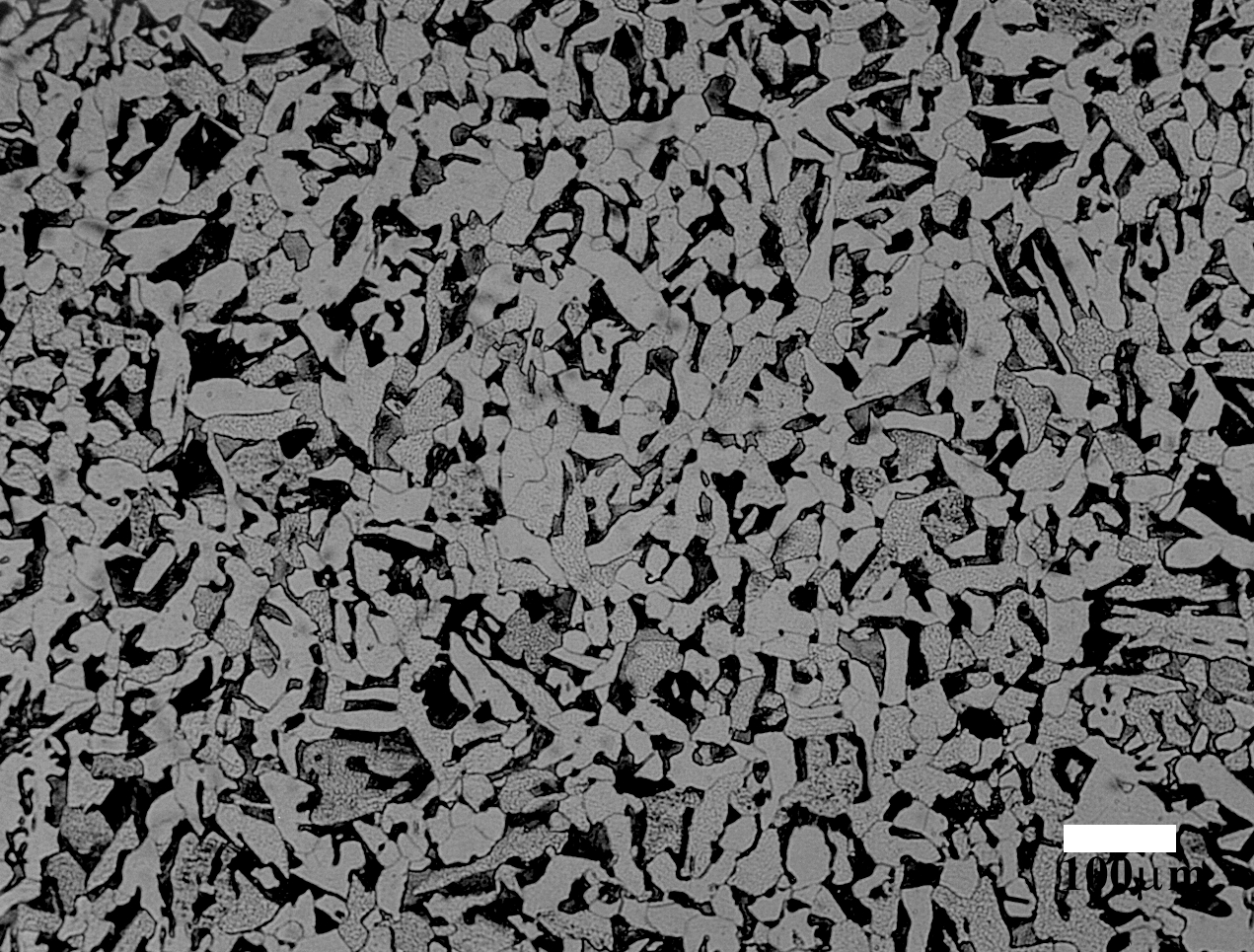
Why carbon and processing both matter
In a conventional ferrite–pearlite condition, low-carbon steel contains a large proportion of relatively soft ferrite. This helps explain why 1018 is useful when a part must be formed or machined before service.
But chemistry is only part of the story. Cold drawing increases strength through plastic deformation. Later heating can change that strength and the stresses left in the material. Two bars marked “1018” can therefore machine, bend and test differently.
Appearance is not a grade check: similar-looking steel, or steel with similar carbon content, may still have a different chemistry and specification.
Cold-drawn and hot-wrought 1018 are different buying choices
Hot-wrought stock is a starting point when the part allows more machining allowance and tight as-supplied dimensions are less important. Surface scale and the actual dimensional tolerances still need checking against the product and order.
Cold-drawn stock commonly provides a cleaner surface, closer dimensions and higher strength from cold work. These can reduce machining effort, but residual stress may become important when a long bar is cut asymmetrically or a lot of material is removed from one side.
Cold-finished is a broader term than cold-drawn. A turned, ground or polished bar is not automatically strengthened by drawing. State the actual process and any subsequent stress relief instead of using “bright bar” as a substitute for the delivery condition.
Grade and product standard answer different questions. ASTM A108 covers cold-finished steel bars, while ASTM A576 covers hot-wrought special-quality carbon steel bars. “1018 to ASTM A108, cold-drawn” communicates more than “1018 steel”; it still needs dimensions, tolerances and any required property limits.
Read 1018 strength and hardness with the size and condition
There is no single strength value for all 1018 stock. The selected data below show why: NESSteel publishes different values for bar size and for cold-drawn material followed by high-temperature stress relief.
Yield strength relates to the onset of permanent deformation. Tensile strength is the maximum engineering stress reached in a tensile test. Neither number is an allowable working stress for a shaft or bracket without a design assessment.
Swipe to see tensile strength, yield strength and hardness.
| Delivery condition | Listed size range | Tensile strength ksi (MPa) | Yield strength ksi (MPa) | Listed Brinell hardness |
|---|---|---|---|---|
| Cold-drawn | 5/8–7/8 in | 70 (483) | 60 (414) | 143 HB |
| Cold-drawn | Over 2–3 in | 55 (379) | 45 (310) | 111 HB |
| Cold-drawn, then high-temperature stress-relieved | 5/8–7/8 in | 65 (448) | 45 (310) | 131 HB |
| Cold-drawn, then high-temperature stress-relieved | Over 2–3 in | 50 (345) | 40 (276) | 101 HB |
Source: NESSteel 1018 datasheet, page 1. These are supplier-specific published values, not universal SAE 1018 minimums or test results for your shipment. Confirm the contractual test basis. 1 ksi = 1,000 psi ≈ 6.895 MPa; MPa values are rounded. 1 in = 25.4 mm.
Example: the same 20 mm bar size, two different conditions. A 20 mm diameter falls within the 5/8–7/8 in range. The source lists 414 MPa yield strength for cold-drawn stock and 310 MPa after high-temperature stress relief. This is a datasheet comparison, not a test of two actual bars. If the design depends on cold-worked strength, a later thermal operation needs review.
For rough calculations, steel density is approximately 7.85 g/cm³ (7,850 kg/m³), and Young’s modulus is about 200 GPa at room temperature. These general steel values are useful for mass and elastic-deflection estimates; they do not establish the grade’s yield strength. SSAB explains these physical properties and the distinction between strength and stiffness.
1018 vs 1045: choose for the limiting requirement
The main chemistry difference is carbon: roughly 0.15–0.20% for 1018 versus 0.43–0.50% for 1045 in the cited supplier data. The extra carbon gives 1045 more hardening potential, with a tradeoff in weldability and formability. It does not make every 1045 bar stronger than every 1018 bar, regardless of condition.
Swipe to read the condition to verify for each requirement.
| Part requirement | 1018 | 1045 | What to verify |
|---|---|---|---|
| Welding or significant forming | Usually the easier starting point because of its lower carbon content. | Welding and forming need more attention to condition and procedure. | Thickness, bend severity, joint restraint and welding procedure. |
| Resistance to permanent bending or higher core stress | May be adequate; cold-drawn strength differs from hot-wrought or heat-treated stock. | Offers more routes to higher strength when the condition is specified. | Required yield strength, fatigue loading, section size and certified properties. |
| A hard wearing surface on a lower-carbon core | Can be carburized, then hardened, for a specified case. | May suit a different hardening route; it is not an automatic replacement for a specified carburized part. | Surface hardness, effective case depth, core properties and distortion limits. |
| Induction or flame hardening | Low carbon limits the hardness achievable without first enriching the surface. | A common candidate because it has more carbon available for hardening. | Required hardened depth, geometry, process capability and acceptance tests. |
| Less elastic deflection in the same geometry | Has a similar elastic modulus to other ordinary carbon steels. | A grade change alone generally gives little improvement in elastic stiffness. | Diameter, wall thickness, span, supports and the actual cause of movement. |
1045 chemistry, condition dependence and hardening guidance: Atlas 1045 datasheet. Its mechanical-property figures are guidance unless guaranteed by the order; do not treat unrelated supplier tables as a matched comparison test.
Higher strength does not solve every bending problem
A shaft that bends under load and returns to its original shape presents a different problem from one that retains a permanent bend. For elastic deflection, changing from 1018 to 1045 while keeping the same geometry and supports usually has little effect because their elastic moduli are similar. If yielding is the issue, a verified increase in yield strength may help.
For a highly loaded shaft, also assess fatigue, notches, fits and toughness. A grade label alone does not settle those questions. See the dedicated 1045 steel properties and machining guide for a closer look at delivery conditions and processing options.
Plan machining and welding around the supplied stock
Machine for accuracy, not just easy cutting
1018 is commonly turned, drilled and milled, but its ductility can make chip control and burrs part of the job. Tool geometry, rigidity, coolant and the actual stock condition matter more than a universal cutting-speed recommendation.
For a slender shaft or a part with deep pockets on one side, plan how material will be removed. Unbalanced machining can release residual stress and move the part. Roughing allowance, balanced cuts and a suitable stress-relief route may help, but any heat cycle must remain compatible with the required final properties.

Low carbon helps weldability, but does not replace a procedure
1018 is generally easier to weld than 1045. However, “1018 never needs preheat” is too broad. Section thickness, restraint, hydrogen, heat input and the actual chemistry affect cracking risk. Remove contaminants and use a welding procedure suited to the joint and required properties.
Welding also heats material that may have gained strength from cold drawing. Review the properties needed in and around the joint after welding. With laser welding, confirm penetration, fit-up tolerance and the acceptance test on representative material; the grade alone does not establish a usable production setting.
Welding risk factors and hydrogen control: TWI’s guidance on preventing hydrogen cracks in steel welds.
Can 1018 steel be hardened?
Yes, especially by case hardening, but ordinary quench hardening is limited by its low carbon content. When a 1018 part needs a wear-resistant surface, carburizing can add carbon to the surface before hardening and tempering. The result can combine a hard outer case with a lower-carbon core.
Specify the case and the core separately
A pin or lightly loaded gear may need a hard contact surface without needing the whole section at the same hardness. Specify surface hardness, effective case depth, the required core properties and where they will be measured.
Also allow for distortion and finishing. Grinding after heat treatment removes some of the case, so a requirement on the finished part must account for that material removal. “Case-hardened 1018” alone is not a complete acceptance criterion.
1045 has more hardening potential, not unlimited depth
1045’s higher carbon supports quench, induction and flame hardening. But the hardness reached at the center still depends on section size, cooling and hardenability—the ability to develop hardness below the surface.
For a large section needing a strong, tough core, a more hardenable alloy steel may be necessary. Decide from the required hardness profile and mechanical properties rather than assuming that “1045” means uniformly hardened through any diameter.
Process explanation: Bodycote on atmospheric carburising. Grade suitability is described in the Macsteel 1018 and Atlas 1045 datasheets cited above.
Specify the stock and the finished part separately
A useful order describes what arrives at the machine and what the completed part must do. Agree on these details before comparing quotes:
- Grade and product specification. Identify 1018 and the applicable bar or other product specification. Avoid accepting “mild steel” as the only material description.
- Delivery condition. State cold-drawn, hot-wrought, turned/ground, or the agreed alternative. Include any stress relief or other heat treatment.
- Dimensions and tolerances. Include section size, length, straightness, surface condition and machining allowance where they affect the job.
- Required properties and test basis. State the strength, hardness or other limits the design needs, along with the condition and location in which they apply.
- Finished-part processing and acceptance. Identify welding, case hardening, grinding or coating. Define case depth, distortion, joint quality or other relevant acceptance criteria.
- Traceability and service exposure. Request the material certificate and heat identification where required. 1018 is not stainless steel; plan corrosion protection for moisture exposure and confirm that the finish suits the manufacturing process.
Similar grades are not automatic substitutes
A36 is a structural-steel specification covering shapes, plates and bars; it is not another name for 1018 chemistry. A structural part should follow its specified product and design requirements. See the public scope of ASTM A36/A36M.
1020 is a nearby low-carbon grade, but overlapping chemistry does not prove that an offered bar matches the ordered condition and properties. The 1020 steel selection guide explains what to check when it is proposed as an alternative.
12L14 is a leaded free-machining steel aimed at machining productivity. It is not a drop-in substitute for a welded 1018 component; Atlas specifically excludes welding for its 12L14FM product. Any substitution needs the designer’s review of joining, service requirements and material restrictions.
Planning laser processing for a steel part?
Share the drawing, certified grade, stock condition, thickness and required result with Oceanplayer Laser. For welding, include the joint fit-up and acceptance criteria so the discussion can focus on a representative sample test.
Technical references
- Macsteel — SAE 1018 bright-bar datasheet. Chemistry, available forms and case-hardening suitability.
- NESSteel — 1018 Data. Selected mechanical properties by size and cold-drawn / high-temperature stress-relieved condition.
- Atlas Steels — Atlas 1045 datasheet, revised April 2006. Chemistry, delivery conditions, welding and hardening guidance.
- SSAB — 20 questions about steel. Density, elastic modulus, strain hardening, strength and stiffness.
- TWI — Hydrogen cracks in steels: prevention and best practice. Chemistry, hydrogen, thickness and restraint in welding decisions.
- Bodycote — Atmospheric carburising. Carbon enrichment and subsequent hardening of a surface case.