
What Is a Portable Laser Cleaning Machine and How Does It Work?
A portable laser cleaning machine is a movable laser source and control system connected to a handheld scanning head. It removes rust, paint, oxide, grease and other surface layers by delivering controlled optical energy to the contamination rather than grinding the base material.
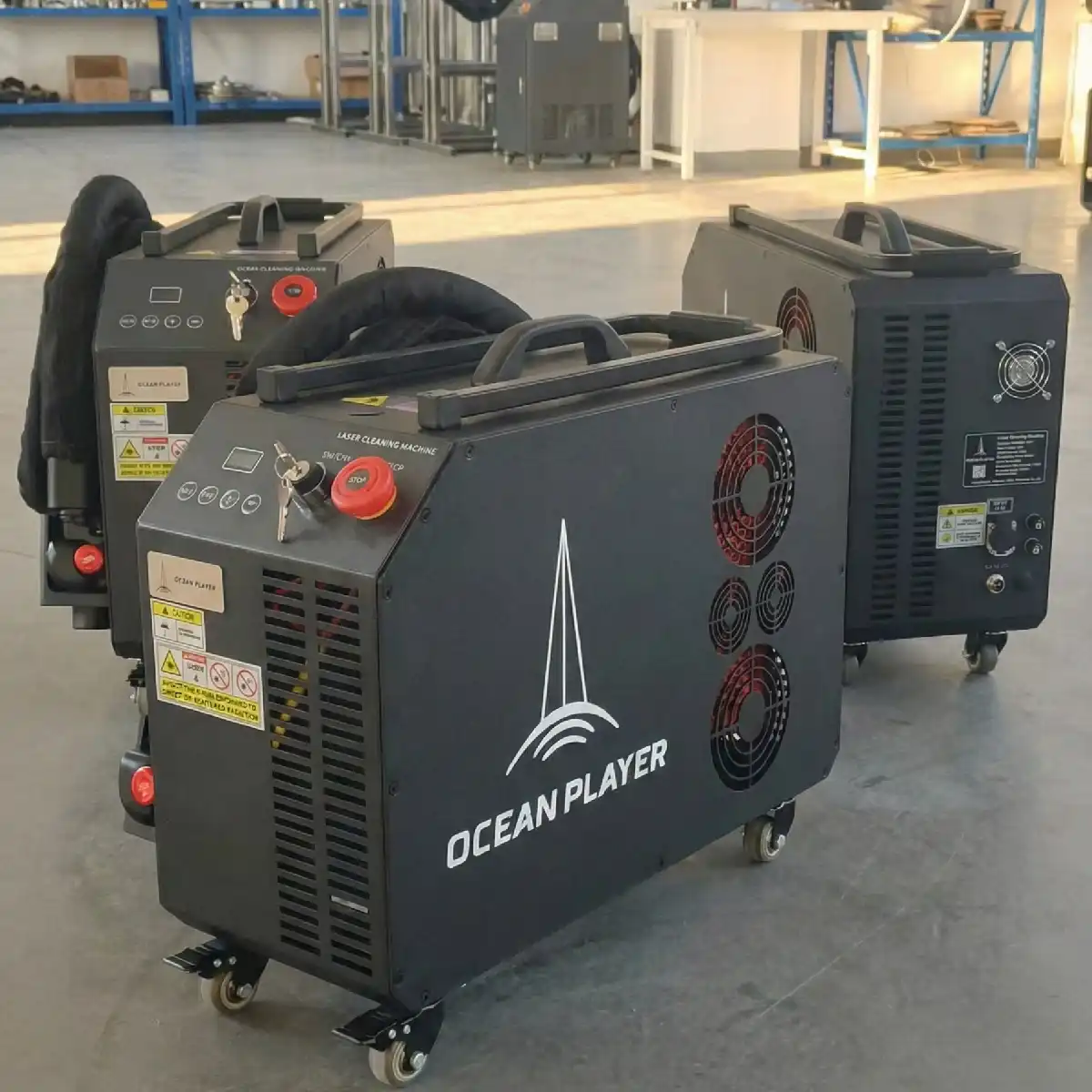
Portable laser cleaning in 60 seconds.
The machine sends a scanned laser beam across a surface. The unwanted layer absorbs energy, heats, expands, fractures or ablates, while the operator keeps the process inside a validated window that protects the substrate.
Portable systems may be suitcase, backpack, trolley or wheeled formats. A handheld head alone does not define the total system weight.
Pulsed systems are commonly chosen for sensitive surfaces and precision work. CW systems favor faster removal on robust metal structures.
Verify the complete input power, cable length, cooling, ambient limits, grounding, extraction and safe work-zone requirements.
Portable operation increases access, not safety tolerance. Reflections, plume, fire risk and uncontrolled access must be engineered.
What actually makes a laser cleaning machine portable?
Portability means the laser source, control system and beam-delivery assembly can be moved to the work area more easily than a fixed production cell. Most industrial systems use a fiber cable to connect the source to a handheld scanning head. The operator moves the head; galvanometer mirrors inside it sweep a programmed pattern across the surface.
The label does not guarantee one size or weight. A compact pulsed unit may be carried between maintenance points, while a higher-output CW cleaner may need wheels, a trolley or a vehicle. The extraction unit, barriers, cables and power distribution also travel with the job even when marketing images show only the handpiece.
Carryable pulsed unit
Useful for localized work, molds, repair benches and sites with stairs or narrow access. Confirm whether “carryable” refers to the whole machine or only one module.
Hands-free transport
Designed for access rather than long unsupported cleaning. Check total load, ventilation, battery claims, balance and how quickly the unit can be set down safely.
Workshop mobility
A common balance of source power, cooling and movement. Suitable when the unit travels across a plant floor but does not need to be carried.
Field and heavy-industry setup
Wheeled or vehicle-supported systems can serve fixed assets, ships, frames and installed machinery. The work-zone plan becomes as important as the machine.
How does a portable laser cleaning machine work?
The same five functions occur whether the cleaner is compact, trolley-mounted or integrated into a production line.
Generate the beam
A fiber laser source produces pulsed or continuous-wave energy. The machine controls average power and, for pulsed sources, pulse duration, frequency and pulse energy.
Deliver through fiber
An armored fiber cable carries the beam to the cleaning head. Cable length affects reach and handling but must remain within the supplier’s bend-radius and protection rules.
Scan a pattern
Mirrors sweep the focused beam into a line, circle, rectangle or other pattern. Scan width, travel speed, overlap and number of passes control coverage.
Remove the layer
The contamination absorbs energy and may vaporize, fracture, expand or detach. The dominant mechanism depends on wavelength, pulse behavior and material properties.
Capture the plume
Particles, condensate and gases must be captured near the source. Laser cleaning changes the waste stream; it does not make removed material disappear.
The laser does more than simply “burn off” contamination.
Real cleaning usually combines several effects. The balance changes with the laser, the unwanted layer and the substrate.
Rapid localized heating
The unwanted layer absorbs energy, rises in temperature and may decompose, melt, vaporize or eject. Excess energy can also heat or melt the substrate, so “more power” is not automatically better.
Expansion breaks adhesion
The contamination and substrate expand differently. Fast heating creates stress at the interface, helping oxide, scale or coating fragments detach from the surface.
Plume assists ejection
Rapid vapor formation and plasma effects can create pressure that drives loosened material away. This is one reason plume capture and eye/skin protection remain essential.
What creates the cleaning window?
The visible watt rating is only one input. A stable process matches energy delivery to the material while maintaining repeatable focus, path spacing and dwell. Production approval should be based on the cleaned result, not a single parameter.
Start with the application, not the highest wattage.
Choose the closest description for a planning direction. Confirm the final machine and process on your own material.
Describe your cleaning task
The result updates instantly and links to the most useful next step.
Your task sits between precision and throughput. Test both routes on the real substrate and compare surface alteration, removal rate, plume, passes and accepted finish.
Open the Pulsed vs CW Comparison Tool →Pulsed vs CW portable laser cleaning machines
Both can be portable. The key difference is how they deliver energy and how much thermal accumulation the process creates on the real part.
| Decision factor | Pulsed portable cleaner | CW portable / mobile cleaner |
|---|---|---|
| Energy delivery | Short pulses with controllable frequency, pulse duration and pulse energy. | Continuous optical output while the beam is scanned across the surface. |
| Best starting use | Precision cleaning, molds, thin oxide, selective paint, weld preparation and surfaces where alteration must be tightly controlled. | Heavy rust, broad paint removal and large robust metal structures where removal rate is the main driver. |
| Thermal behavior | Usually offers more control over localized heat input, but poor settings or excessive overlap can still alter the surface. | Greater heat accumulation risk; travel speed, scan strategy and dwell become especially important. |
| Productivity | Often lower area rate for heavy contamination, but may reduce rework when finish requirements are strict. | Often faster on large robust surfaces and thicker removable layers. |
| Typical format | Compact case, backpack, trolley or mobile enclosure depending on source and cooling. | Usually trolley or wheeled enclosure because source and cooling demand more infrastructure. |
| Validation question | Can the selected fluence and overlap remove the layer without changing roughness, dimensions or metallurgy? | Can the required speed be maintained without unacceptable heat, melting, discoloration or distortion? |
Oceanplayer’s current cleaning range lists pulsed 200W, 300W and 500W systems and CW 1000W, 2000W and 3000W systems. Availability and specifications may change; use the machine nameplate and quotation for final planning. View the current laser cleaning range.
Surface condition is part of the acceptance criteria.
Use a pulsed route when removal must be selective and the substrate’s finish, geometry or heat response matters as much as speed.
- Precision molds and tooling
- Weld preparation and post-weld oxide
- Selective coating removal
- Thin or high-value metal parts
Large-area material removal drives the business case.
Use a CW route when the base material is robust, contamination is heavy and the job requires sustained cleaning across large surfaces.
- Heavy steel rust removal
- Broad paint and coating stripping
- Ship, frame and machinery maintenance
- High-throughput field work

Plan power, cooling, reach, extraction, barriers and material handling as one system.
Portable does not mean plug it in anywhere.
Optical output power is not the same as electrical input. The complete load can include the laser source, cooling, controller, scanning head, extraction unit, air compressor, work lights and auxiliary equipment. Use the supplier’s nameplate and electrical drawing—never multiply the laser wattage by a guessed factor.
Where does portability create real value?
The strongest use cases involve installed equipment, difficult access, selective cleaning or parts that are expensive to move into a blasting room.
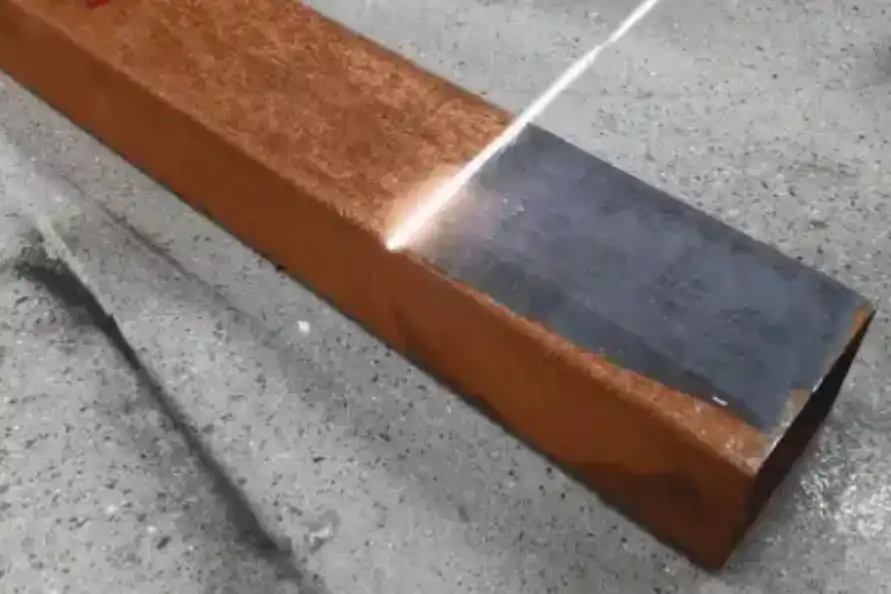
Rust and corrosion removal
Clean frames, machinery, fabricated steel and repair areas where media recovery or part transport is difficult.

Contaminated mold
Residue can obstruct vents, transfer defects or lengthen maintenance.

Controlled mold cleaning
Pulsed cleaning can target residue while preserving the qualified mold surface when parameters are validated.
The U.S. Department of Energy’s 2022 technology roadmap describes laser/photo ablation as a practical surface-preparation route for corrosion products and coatings when operated with appropriate process parameters. View the DOE roadmap.
Does a portable laser cleaning machine damage the surface?
It does not have to, but “non-contact” does not mean “zero effect.” The beam still transfers energy. A good process removes the unwanted layer while keeping roughness, dimensions, hardness, microstructure, coating adhesion or appearance within the acceptance criteria.
Damage can come from excessive fluence, slow travel, repeated overlap, defocus, too many passes, unsuitable wavelength, or choosing CW cleaning for a surface that cannot absorb the heat. Reflective metals and thin sections also require careful trial work.
Portable laser cleaning vs blasting, grinding and chemicals
No method wins every job. Compare the accepted surface, access, waste stream, preparation time and total project cost—not only the cleaning rate.
| Factor | Portable laser | Abrasive blasting | Grinding / brushing | Chemical stripping |
|---|---|---|---|---|
| Selective cleaning | Strong — scan only the required zone | Moderate — masking and nozzle control needed | Moderate — operator dependent | Moderate — masking and dwell control needed |
| Consumables | No abrasive media; filters and maintenance items still apply | Abrasive, water or additives plus collection and disposal | Discs, brushes and tooling | Chemical, rinse, neutralization and disposal |
| Surface change risk | Thermal or ablation damage if the process window is wrong | Profile change, embedding or erosion | Scratches, gouging and dimensional loss | Etching, residue or substrate incompatibility |
| Airborne hazard | Laser-generated particles, condensate and gases require source capture | Dust, media and removed coating require containment | Metal/coating dust and tool debris | Vapors, splashes and contaminated rinse |
| Best fit | Selective, repeatable, media-free cleaning near the work | Large rough surfaces and aggressive profile creation | Small low-cost jobs with tolerant surfaces | Complex geometry or coatings suited to the chemistry |
Laser cleaning reduces abrasive and chemical consumption in many applications, but it still produces captured waste and may not be the fastest or lowest-cost method for every large rough surface. Compare your actual process with the Laser Cleaning vs Sandblasting Savings Calculator.
A portable cleaner is commonly a Class 4 work process.
Mobility can expose new people, reflective surfaces and access routes. Establish controls before switching on the beam.
Risk assessment and responsibility
Assign a competent laser-safety lead, document the hazard assessment, authorize operators and define normal use, setup, service and emergency procedures.
Barriers, signs and access
Establish a controlled zone based on the beam and reflections. Prevent untrained entry and use guards, interlocks or administrative controls appropriate to the operation.
Eyewear matched to the laser
Select eyewear by wavelength, optical density and exposure assessment. Generic dark glasses or “laser glasses” without verified markings are not acceptable.
Control direct and scattered beam
Metal parts may reflect energy unpredictably. Orient work, terminate the beam, remove specular paths and protect surrounding windows and surfaces.
Capture plume at the source
Filter selection must follow the removed material. Paint, plating, oil, corrosion products and hazardous coatings can create different particles and gases.
Remove combustibles and monitor heat
Class 4 lasers can create fire hazards. Control flammable residues, hidden cavities, nearby materials and post-work smoldering risks.
Interlocks, e-stop and inspections
Check the emergency stop, key control, emission indicator, fiber protection, head, grounding, guards and extraction before each work period.
Qualified operation
Train operators on the machine, material hazards, work-zone controls, PPE, plume capture, parameter limits, abnormal conditions and incident response.
How to plan a portable laser cleaning job
A repeatable field process starts before the machine arrives and ends after the accepted surface is documented.
Identify the material
Record substrate grade, coating, contamination, thickness, prior treatments and any hazardous constituents such as lead, chromium or unknown residues.
Define acceptance
State what “clean” means: appearance, residual contamination, roughness, surface energy, dimensions, adhesion, electrical performance or inspection result.
Plan the work zone
Map access, reflections, barriers, ventilation, power, grounding, fire control, waste handling, operator position and emergency response.
Run a coupon test
Start conservatively on a representative sample. Compare pulsed and CW routes where both are plausible; document focus, pattern, width, speed and passes.
Inspect the result
Use the inspection method tied to the requirement. Visual appearance alone cannot prove bond readiness, metallurgy or absence of microscopic damage.
Lock the process window
Define acceptable ranges, not one magic setting. Include standoff, angle, overlap, operator travel, pass count, extraction position and stop conditions.
Train and release
Qualify operators on both cleaning and safety controls, then issue the setup sheet, inspection plan and maintenance checks.
Track production evidence
Record accepted area, time, rework, filter loading, consumables, downtime and abnormal results so the business case reflects real work.
What should you compare before requesting a quotation?
A useful quotation connects the machine specification to your part, site and acceptance criteria.
Material and contamination evidence
Send substrate grade, coating or residue type, thickness, photos, current cleaning method and whether hazardous material may be present.
Accepted surface and throughput
Specify the required finish, inspection method, area per part, parts per shift, available time and whether partial removal is acceptable.
Pulsed or CW architecture
Compare wavelength, average power, pulse range where applicable, scan patterns, width, focus control, recipe storage and process repeatability.
Total dimensions and handling
Ask for machine and head weight, wheel/carry design, fiber length, bend radius, transport protection, lifting points and setup time.
Electrical, cooling and extraction
Confirm nameplate input, phase, frequency, connector, grounding, ambient limits, cooling clearance, extraction airflow and filter strategy.
Protective features and documentation
Review classification, labels, key control, emission indicator, interlocks, e-stop, guards, manuals, risk information and required PPE.
Training, warranty and service
Compare commissioning, operator training, parameter support, remote diagnostics, spare parts, repair path and responsibilities across countries.
Sample result before purchase
Request a cleaning trial on the real material and judge the accepted surface, repeatability, rate, plume, heat effect and operator workload.
Test your real part with a portable laser cleaner.
Share the material, contamination and target result. Oceanplayer can compare a practical pulsed or CW starting route and document the cleaning result before you commit to a machine configuration.
Move from a general guide to your actual cleaning job.
Use these tools for early planning, then validate the final recommendation with your real part.
Review substrate, contamination, surface requirement and access before selecting equipment.
Check feasibility → Technology choicePulsed vs CW Comparison ToolCompare thermal input, control, workload and common use cases.
Compare technologies → Power directionLaser Cleaner Power SelectorNarrow the starting power range by surface sensitivity, contamination and duty.
Select power → Production planningCleaning Efficiency CalculatorEstimate effective area rate from width, movement, overlap, passes and productive time.
Estimate output →Questions buyers ask before choosing a portable cleaner
What is a portable laser cleaning machine?
It is a movable laser source and control system connected to a handheld scanning head. It is designed to bring controlled laser cleaning to parts, structures or work areas that are inconvenient to move into a fixed cleaning cell.
How does a portable laser cleaning machine remove rust?
The scanning beam deposits energy into the rust layer. Rapid heating, thermal stress and pressure effects help fracture, vaporize or eject corrosion products. The operator controls focus, pattern, speed, overlap and passes so removal occurs without unacceptable substrate alteration.
Is a portable laser cleaner the same as a handheld laser cleaner?
They overlap but are not identical terms. “Handheld” describes the cleaning head and operator method. “Portable” describes the mobility of the complete machine. A handheld head may be connected to a large trolley or mobile industrial enclosure.
Can a portable laser cleaning machine run on batteries?
Some specialized low-duty systems may offer battery arrangements, but most industrial cleaners require mains power or a properly sized generator. Confirm the complete electrical load and duty cycle; do not assume the optical watt rating represents the input requirement.
Should I choose pulsed or CW portable laser cleaning?
Start with pulsed cleaning when surface control, precision or lower thermal accumulation is important. Start with CW when heavy rust or broad coating removal on robust metal requires higher throughput. Test both when the application sits between those priorities.
Does portable laser cleaning damage metal?
It can avoid unacceptable damage when the process stays inside a validated window, but excessive fluence, dwell, overlap or passes can melt, discolor, texture or otherwise alter metal. Use representative coupons and the inspection method relevant to the finished part.
What contaminants can a portable laser cleaner remove?
Common targets include rust, oxide, paint, selected coatings, weld discoloration, oil, grease, mold residue and process contamination. Suitability depends on optical absorption, thickness, adhesion, substrate properties and the hazards created during removal.
Can a portable laser cleaner be used outdoors?
Yes, if the machine’s environmental rating and operating limits allow it and the work zone controls reflections, public access, electrical exposure, wind-driven plume and fire hazards. Outdoor use is not automatically safer than indoor use.
Does laser cleaning need fume extraction?
Yes, industrial laser cleaning should include source capture appropriate to the removed material. The plume can contain particles, condensate and gases from paint, plating, oil, corrosion products or substrate material. Filter selection requires a material-specific hazard assessment.
What information should I send for a machine recommendation?
Send the substrate grade, contamination or coating, thickness, photos, cleaning area, parts per shift, current method, required finish, inspection criteria, site power, access constraints and whether hazardous constituents may be present.
Sources used for mechanism, machine and safety context
Standards and safety requirements depend on jurisdiction and installation. Use the current controlled documents applicable to your site.
- Royal Society of Chemistry, Analytical Methods Committee Technical Brief No. 121: Introduction to laser cleaning in cultural heritage (2026) — ablation mechanisms and the need for assessment and monitoring.
- OSHA Technical Manual, Section III, Chapter 6: Laser Hazards — laser classifications and Class IV control context.
- ISO 11553-1:2020, Safety of machinery — Laser processing machines — Part 1 — laser processing machine safety requirements; confirmed current in 2025.
- IEC 60825-1:2014, Safety of laser products — Part 1 — equipment classification and requirements.
- IEC 60825-4:2022, Safety of laser products — Part 4 — laser guards, access, interlocking and labeling.
- U.S. Department of Energy, Tank Waste Acceleration Roadmap technology review — laser/photo ablation for corrosion and coating removal.
- Oceanplayer Handheld Laser Cleaning Machine and Mobile Laser Cleaner — current product formats, application routes and sample-testing pathway.
Editorial note: unsupported percentage claims and model-specific figures in the source draft were removed. Machine specifications, production rates and safety controls must be confirmed for the quoted model and destination site.