

How to Choose a Laser Welding Machine
Choose the machine around the joint, production system and acceptance criteria—not a power number on a quotation. This step-by-step guide turns material, thickness, fit-up, duty cycle, safety and service requirements into a defensible buying decision.
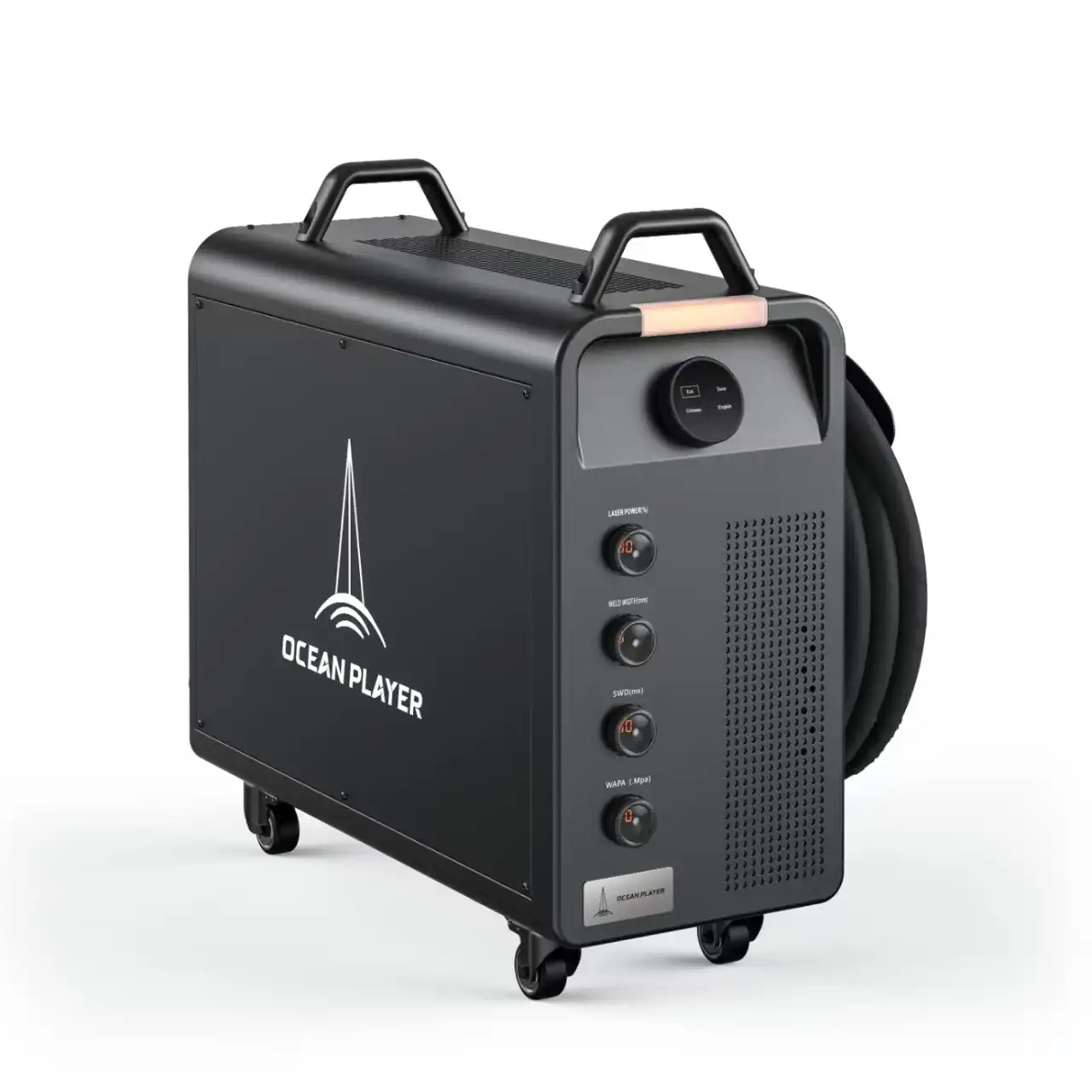 Application first
The four decisions that prevent an expensive mismatch
A capable laser source can still be the wrong purchase if the part cannot be located consistently, the operating duty exceeds the thermal design, the safety concept is incomplete or the supplier cannot demonstrate your acceptance criteria.
Material, joint and acceptance
Record alloy and condition, thickness range, joint type, gap, access, cosmetic surfaces, strength or leak requirements and inspection evidence.
Handheld, cobot or cell
Match mobility and operator judgement to mixed work; match fixtures, controlled motion and sensing to repeat production and traceability.
Power follows the sample
Thickness is only one input. Beam profile, focus, wobble, speed, shielding, filler, fit-up and material behavior define the usable process window.
Safety and service included
Evaluate enclosure or controlled-area design, extraction, training, consumables, optics care, spares, response scope and acceptance testing.
Build a welding requirement before looking at machine specifications
The best laser welding machine is not the model with the largest output. It is the system that repeatedly produces an accepted joint from your real incoming parts at the required rate. A useful requirement separates what changes from what must remain controlled.
Material identity
Record alloy, grade, temper or condition, coating, plating and supplier variation. “Aluminum,” “copper” or “stainless” is too broad for process approval.
Evidence: drawings, certificates and samplesThickness and stack-up
List minimum, normal and maximum thickness—not one nominal number. Include unequal thicknesses, overlaps, backing, heat sinks and multi-layer joints.
Evidence: worst-case part familyJoint and fit-up
Define butt, lap, fillet, corner or tube geometry, plus actual gap, mismatch, edge quality, seam-location variation and fixture access.
Evidence: tolerance study or trial fixtureProduction pattern
Separate mixed repairs and prototypes from repeat batches and continuous production. State shifts, annual volume, takt time and changeover frequency.
Evidence: load-to-unload targetAcceptance criteria
Define visual, dimensional, penetration, fusion, porosity, strength, leak, conductivity, corrosion and traceability requirements as applicable.
Evidence: approved sample and test planSite constraints
Confirm floor area, power, gas, extraction route, ambient conditions, material handling, access control, training and local compliance responsibilities.
Evidence: site-readiness checklistMaximum weld depth changes with material absorptivity and conductivity, joint geometry, focus, beam quality, travel speed, wobble pattern, filler, shielding, orientation and the quality threshold used to define “welded.” Ask for a process window proven on your parts instead of treating a brochure maximum as guaranteed production capability.
Choose how the beam and part will move before choosing power
The buyer’s most important early choice is often not fiber versus another laser family. It is whether an operator, a collaborative robot or a controlled motion system should locate the weld. That decision governs consistency, flexibility, guarding, fixturing and future automation.
Handheld fiber welder
Suited to large or awkward assemblies, mixed seams, repair-style work and lower-volume fabrication where a trained operator must adapt the torch path. Evaluate gun weight, cable reach, trigger/contact safeguards, wobble control, wire feeder, cleaning mode and the complete laser-controlled-area concept.
Best starting question: can operator variation be accepted and managed?Cobot-assisted system
Useful when parts repeat but full automation is not yet justified. A cobot can stabilize path and speed, but it does not remove the need for fixtures, programming, safeguarding, process validation or cycle-time analysis. Laser risk is determined by the laser system, not the cobot label.
Best starting question: will fixture and changeover time support the business case?Fixed automated cell
Appropriate for stable parts, high volume, tight location control and traceability. Gantries, robots, rotary axes, seam tracking, vision, monitoring and database functions can be combined around the required takt and inspection strategy.
Best starting question: which variations must the cell detect or reject?Precision pulsed system
Fine spot control, pulse shaping or low average heat input may matter more than headline continuous-wave power for thin foils, electronics, medical parts, battery features, jewelry and small precision assemblies. The correct source may be pulsed fiber, QCW, disk, diode or another engineered route.
Best starting question: what is the allowable thermal and metallurgical window?They remain relevant in installed bases and specialized applications, but a modern metal-welding purchase should not be reduced to a three-column “fiber vs CO₂ vs Nd:YAG” table. Source wavelength, beam quality, pulse format, delivery optics, power stability, monitoring and local service matter together. For most handheld metal-welding enquiries, fiber is the common route; precision and automated projects deserve a source-neutral engineering review.
Laser Welder Route Planner
Describe the production pattern and the tool will suggest a starting architecture, cooling direction, filler strategy and validation priority. This is a planning recommendation, not a qualified welding procedure or safety assessment.
Describe the application
Choose the closest production condition. Results update immediately.
Begin with a controlled handheld sample trial using representative parts, then confirm power and parameters from the accepted joint—not from thickness alone.
Measure worst-case gap, confirm joint access and submit real parts for a parameter and fixture trial.
Laser welder power selection is a multi-variable decision
Average output affects available energy and productivity, but it does not independently determine penetration, strength or speed. A responsible supplier should show how the proposed power class works with the full optical and mechanical system.
Material response
Absorptivity, conductivity, melting range, vaporization behavior, oxide or coating, cracking sensitivity and reflectivity influence coupling and stability. Aluminum and copper applications often need tighter process development than a generic compatibility list suggests.
Ask for: same grade and surface conditionJoint geometry
Butt, lap, fillet and corner joints put energy and filler in different locations. Unequal thickness, backing material, edge preparation and access can change the usable penetration range.
Ask for: worst-case stack-up sampleBeam and focus
Spot size, focus position, beam profile, delivery fiber, collimation, focusing optic and working distance affect irradiance and tolerance. Two machines with the same rated wattage may not create the same weld.
Ask for: optical configuration in the proposalTravel and wobble
Travel speed changes energy per unit length. Beam oscillation can widen the process, bridge limited variation and change mixing, but it also changes heat distribution and cycle time.
Ask for: stable operating window, not one settingFiller and shielding
Wire can help fill a joint, modify chemistry or build bead profile. Gas type, flow, nozzle geometry and coverage influence oxidation, plasma behavior and appearance. Extra hardware also affects handling and setup.
Ask for: filler and gas consumption per accepted partAcceptance threshold
A visually continuous bead is not proof of penetration, fusion, leak integrity or fatigue performance. The necessary power margin depends on what the joint must demonstrate and how production drift will be controlled.
Ask for: cross-section and functional test planA coupon that passes at one narrow setting is weaker evidence than a process-window study that challenges maximum gap, material lot, thickness, focus, speed and handling variation. Production needs margin and a control plan, not only a successful showroom weld.
Air-cooled or water-cooled is really a question of thermal duty
Air-cooled machines can reduce size, weight, water maintenance and deployment complexity. Water-cooled systems can support sustained thermal loads and stable operation in demanding production. Neither label alone tells you the usable duty cycle, environmental limit or service burden.
When air cooling may fit
Mobile work, intermittent welding, shorter seams, lower daily arc-on time and limited floor space can favor an air-cooled package—provided the manufacturer specifies the allowable output, ambient temperature, duty cycle and derating behavior for your application.
When water cooling may fit
Long seams, multiple shifts, high utilization, hotter environments, larger output classes and automated cells often favor closed-loop water cooling. Review water quality, coolant specification, filters, alarms, freeze protection, heat-exchanger cleaning and spare-pump strategy.

Use compatibility as a screening step—then validate the actual combination
Fiber laser welding is widely applied to metals, but “compatible” does not mean every grade, thickness and joint is easy. The table below replaces absolute yes/no claims with the questions that should drive sample trials.
| Material / joint | Why buyers consider laser | Primary process risks | What to prove before purchase |
|---|---|---|---|
| Stainless steel | Clean, narrow seams and low distortion can suit visible sheet-metal work and sealed assemblies. | Gap, undercut, shielding coverage, discoloration, focus and backside oxidation can change acceptance. | Worst-case thickness, cosmetic limit, penetration, distortion and corrosion-related surface requirements. |
| Carbon / mild steel | High travel speed and controlled heat input can improve throughput on repeat fabrication. | Scale, coating, contamination, carbon equivalent, porosity, hardness and joint variation need review. | Actual grade and coating, surface preparation, cross-section, hardness or mechanical tests where required. |
| Galvanized steel | Laser may support high-rate sheet assembly with the right joint and venting strategy. | Zinc vapor can destabilize the weld and create porosity or spatter when escape paths are poor. | Coating mass, joint gap/venting, fume capture, appearance, porosity and repeatability across lots. |
| Aluminum alloys | Low heat input and fast processing are attractive for lightweight structures and enclosures. | Reflectivity, high conductivity, oxide, porosity, hot cracking and alloy/filler choice can narrow the window. | Exact alloy and temper, surface condition, filler strategy, shielding, cross-section and mechanical or leak test. |
| Copper and reflective alloys | Electrical and thermal components may benefit from localized, automated joining. | High reflectivity and conductivity, coupling instability, spatter and keyhole behavior require an engineered source/process. | Alloy and plating, wavelength/source route, monitoring, electrical performance and sectioned samples. |
| Dissimilar metals | Localized energy can limit bulk heat exposure and enable specialized assemblies. | Brittle intermetallic phases, dilution, thermal mismatch, galvanic behavior and service loading may dominate. | Metallurgical review, interface geometry, layer thickness, mechanical/environmental tests and responsible engineering approval. |
| Thin or precision parts | A controlled spot or pulse can reduce distortion and protect nearby features. | Burn-through, edge position, clamping, focus, pulse stability and part-to-part tolerance become critical. | Minimum thickness, maximum gap, heat-sensitive features, fixture repeatability and magnified inspection. |
This matrix is for procurement screening. Material qualification and joint design remain the responsibility of the appropriate engineering authority for the product and jurisdiction.
Do not treat eyewear as the laser safety strategy
Industrial laser welding commonly involves high-power Class 4 sources. OSHA describes Class 4 systems as immediate eye and skin hazards from direct or reflected exposure, with possible fire risk; laser-generated airborne contaminants are another hazard. The preferred purchasing question is how the beam and process zone will be contained and controlled.
ISO 11553-1:2020 specifies laser-radiation safety requirements and manufacturer information for laser processing machines. The exact obligations for a handheld device, enclosed cell, workplace and operator depend on jurisdiction, system design and use. Require the supplier and your safety professional to define responsibility before installation.
Assess a fully enclosed, interlocked cell wherever practicable. If open handheld operation is proposed, define the laser-controlled area, nominal hazard evaluation, barriers, entry control, signs, warning indicators and responsibility for supervision.
Near-infrared beams are invisible, and specular reflections from metal can travel outside the expected path. Review every operating orientation, back reflection, workpiece edge, gap and possible mis-aim condition.
Review key control, emergency stop, access interlocks, trigger logic, workpiece/contact detection, shutter behavior, fault response, restart prevention and validation of safety functions—not only the presence of a component.
Base extraction on the alloy, coating, filler, contamination and production rate. Consider laser-generated airborne contaminants, hot metal, fire load, compressed gas, electricity, cooling fluids, ergonomics and material handling.
Define authorized operators, laser safety supervision, SOPs, inspection of guards and eyewear, optics cleaning, maintenance modes, contractor control, incident response and records before production release.
Laser welding machine price is only the first line of the business case
Published equipment prices age quickly and rarely represent the same scope. Normalize quotations around the delivered system and the cost per accepted part. A lower machine price can be erased by incomplete guarding, poor yield, weak fixtures, long changeovers, imported service travel or unavailable optics.
What is physically included?
Laser source, chiller, gun or head, optics, wire feeder, motion, fixtures, enclosure, extraction, vision, monitoring, computer, installation and acceptance test.
What is consumed?
Electricity, shielding gas, filler wire, protective windows, nozzles, coolant, filters, cleaning materials, extraction media and rejected parts.
How much accepted output?
Programming, setup, loading, tacking, welding, inspection, rework, changeover, planned maintenance and unplanned downtime determine real throughput.
How fast can production recover?
Warranty boundaries, remote diagnosis, local stock, spare source or chiller strategy, software access, training continuity and response commitments protect uptime.
Compare proof, not promises.
Adjust the weights to your risk. Score each supplier only after it returns the same application package and demonstrates the defined acceptance criteria.
A sample weld should close the largest purchase uncertainties
Do not send one ideal coupon and ask whether it can be welded. A useful sample plan represents production variation and records the configuration that created the result. For critical joints, the responsible engineering authority must define qualification and acceptance.
Submit the application package
Provide material grade and condition, thickness stack, drawing, joint, tolerance, photos, annual volume, takt target, quality requirement and site constraints.
Challenge representative variation
Include minimum and maximum thickness, actual edge quality, worst measured gap, coating or surface condition and geometry that is difficult to access or clamp.
Record the complete setup
Document source and output, optic, focus, wobble, travel, wire, gas, fixture, cleaning, orientation and any monitoring or seam-location method.
Evaluate the right evidence
Use visual and dimensional inspection plus cross-sections, leak, mechanical, metallurgical or service testing as the product requires. A top-bead photo alone is insufficient.
Confirm cycle and operator work
Time loading, locating, tacking, programming, welding, repositioning, cleaning, inspection and unloading. Record consumables, staffing and rejected samples.
Write purchase acceptance
Convert the agreed sample, parameter window, training, safety deliverables, documents and site acceptance test into the quotation and order.

Send the supplier these six items
- Drawing and revision
- Material grade, condition and thickness range
- Representative parts and worst-case variation
- Joint acceptance and test method
- Volume, shifts and takt target
- Site power, gas, extraction and safety constraints
What must be clear before you approve the purchase
| Decision | Minimum evidence | Common warning sign | Purchase-order output |
|---|---|---|---|
| Application scope | Part families, alloys, thicknesses, joints, tolerance, access and acceptance are listed. | “Works on all metals” without boundaries. | Approved application matrix and exclusions. |
| Machine architecture | Handheld, cobot or automation choice is supported by part flow and cycle study. | Architecture selected only from budget. | System layout, utilities and responsibility map. |
| Process capability | Representative samples meet visual, dimensional and functional requirements. | Only an ideal coupon or top-bead video is shown. | Sample record, process window and acceptance sample. |
| Power and cooling | Supplier states duty, ambient limits, derating, cooling service and proven cycle. | Wattage or “air/water cooled” used as the only capability claim. | Rated operating conditions and maintenance plan. |
| Safety and extraction | Risk assessment inputs, containment, interlocks, access, fume and fire controls are defined. | Eyewear is presented as the complete safety solution. | Safety deliverables, validation and training scope. |
| Quality and traceability | Inspection, calibration, data, destructive samples and record retention match product risk. | “High quality” has no measurable definition. | Inspection plan and document package. |
| Training and support | Named curriculum, trainees, language, manuals, spares and escalation terms are listed. | “Lifetime support” without channel, hours or response scope. | Training acceptance and service-level terms. |
| Total economics | Accepted-part cycle, yield, consumables, staffing, maintenance and downtime are modeled. | Quotes compared only by machine price. | Three-year cost and capacity assumptions. |
Related laser welding guides and decision tools
Laser welding machine selection FAQ
What is the first step in choosing a laser welding machine?
Define the application package: exact material and condition, thickness range, joint geometry, measured fit-up, production pattern, access, acceptance criteria and site constraints. This prevents a supplier from recommending a machine from wattage or a generic material name alone.
How much laser power do I need?
There is no universal watt-per-millimeter rule. Power must be evaluated with material, joint, optics, focus, travel speed, wobble, shielding, filler, fixture and quality threshold. Use a thickness tool for early planning, then require representative sample tests and a stable process window.
Should I choose a handheld or automatic laser welder?
Handheld equipment usually fits mixed, large or awkward work where a trained operator must adapt the path. Cobot or automated systems fit repeat parts that justify fixtures, programming and safeguarding. Compare accepted-part cycle, changeover, consistency and traceability—not only welding speed.
Is air-cooled or water-cooled better?
Air cooling can improve portability and simplify water maintenance; water cooling often supports sustained duty and demanding production. Ask for usable duty-cycle data at the proposed output and ambient temperature, plus derating behavior and maintenance requirements. The cooling label alone is not a productivity specification.
Can one fiber laser welder handle stainless steel, carbon steel, aluminum and copper?
A system may process several metal families, but each alloy and joint needs its own validated window. Aluminum and copper can introduce reflectivity, conductivity, oxide, porosity or cracking challenges. Dissimilar-metal joints need metallurgical review rather than a generic compatibility claim.
When do I need a wire feeder?
Wire may help manage limited gap, build bead profile or modify chemistry, but it adds setup and variables. Need depends on joint, tolerance, filler alloy, travel direction, wire presentation and acceptance. Test both autogenous and filler-assisted routes on representative parts where appropriate.
Is a handheld laser welder safe if the operator wears laser glasses?
No. High-power Class 4 laser operation requires a system approach: risk assessment, containment or a controlled area, access control, reflection management, interlocks, warning systems, extraction, procedures, training and appropriate PPE. Eyewear is one layer, not the complete control strategy.
What should a laser welding machine quotation include?
Normalize the laser source, cooling, optics, head, wire feeder, motion, fixture, enclosure, extraction, monitoring, installation, utilities, training, acceptance test, warranty, spares, software, shipping and exclusions. Compare the complete delivered system and operating cost.
How should I compare laser welding machine brands?
Issue the same application package to each supplier and score application proof, safety engineering, system architecture, training/service, accepted-part economics and commercial clarity. Brand recognition is useful, but local capability and evidence on your joint are more decision-relevant.
What should I ask for during a sample weld test?
Use actual material and worst-case variation. Record source, output, optics, focus, wobble, speed, filler, gas, fixture and preparation. Evaluate the weld with the inspection and functional tests your product requires, and time the complete load-to-unload cycle.
Can a demo weld prove production capability?
A single attractive bead proves only that one sample could be welded once. Production capability requires repeat samples, challenged variation, acceptance evidence, cycle data, a process window, maintenance controls and a plan for detecting drift or incorrect parts.
What SEO-style “best laser welding machine” answer should a buyer trust?
Trust an answer that states application boundaries and asks for material, joint, fit-up, volume, quality and site details. Avoid rankings that declare one model universally best. The defensible choice is the system proven on representative parts and supported through installation, safety, training and service.
Sources used to improve this buying guide
This article is an engineering and procurement planning guide, not a welding procedure, machine-safety validation or substitute for applicable codes, standards, risk assessment and qualified professional judgement. Product capability and obligations depend on the exact system, application, site and jurisdiction.
Get a laser welder recommendation based on your real parts
Send your material, thickness range, joint photos or drawing, expected output and quality requirement. Oceanplayer can review the application direction and arrange a representative sample welding test before you finalize the machine architecture.