

17-4 PH Stainless Steel H900
Verified properties, heat-treatment schedules, H900 versus H1150 trade-offs, corrosion limits, machining and welding guidance—built for engineers who must specify the condition, not just the alloy name.

“17-4 PH” alone does not guarantee H900 strength. The certificate must connect the heat, form, heat treatment and test results to your purchase specification.
Material image: Gnee 17-4 PH stainless steel bar.
The 60-second condition decision
17-4 PH is a tunable alloy. Start with the governing failure mode, then select the H-condition and qualification plan. Do not make H900 the default simply because it has the highest headline strength.
Suitable when section size, proof load, wear or compact high-strength hardware dominates and the environment is controlled.
Often a better starting point when strength must coexist with ductility, fatigue tolerance and a less aggressive hardness level.
Higher-temperature aging gives up peak strength but generally improves toughness and resistance to stress-corrosion cracking.
Sheet, plate, bar, forging, casting and additive material do not share one universal property table. Test the actual route.
Does 17-4 PH H900 really reach 200 ksi?
The distinction between typical and minimum is the most important point in this article. A typical value describes what one producer often measures for a defined material and test orientation. A specification minimum is the acceptance threshold. A designer may use yet another allowable after applying statistical basis, temperature reduction, fatigue, surface, notch and environmental factors. These numbers are related, but they are not interchangeable.
H900 means that solution-treated 17-4 PH was aged at 900°F (482°C), normally for one hour, and air cooled. That relatively low aging temperature produces a very high density of fine copper-rich precipitates in a martensitic matrix. They obstruct dislocation motion and create the peak-strength condition. The same microstructure also gives H900 its familiar trade-off: high hardness and strength with lower ductility, impact toughness and stress-corrosion tolerance than overaged conditions.
Why the alloy name is not the property
UNS S17400 identifies a chemistry range, not a finished performance state. Condition A, H900, H1025 and H1150 can all be chemically “17-4 PH” yet behave like different engineering materials. A drawing that says only “17-4 stainless” leaves unanswered questions about solution treatment, aging, final hardness, dimensional change, corrosion exposure and post-weld condition.
The safe specification chain is: alloy designation → product form → material specification → heat-treatment condition → property minimums → inspection and traceability. If welding, brazing, additive manufacturing, plating or passivation follows, include those steps because they can alter local microstructure or the final surface.
Primary property and heat-treatment references: Carpenter Technology Custom 630 datasheet and Cleveland-Cliffs 17-4 PH product data access.
17-4 PH is a chemistry-plus-heat-treatment system.
Chromium protects the surface, nickel supports the transformation path, copper provides precipitation hardening and niobium plus tantalum control carbon. The furnace cycle converts that chemistry into usable strength.
17Cr-4Ni-Cu
The shorthand “17-4” points to nominal chromium and nickel, but the controlled range contains more than those two elements. Iron is the balance and copper is central to age hardening.
Supports the passive film and general stainless corrosion behavior.
Helps control phase balance and hardenability.
Forms the fine precipitates responsible for age hardening.
Combines with carbon and supports microstructural stability.
Kept low to support toughness, weldability and corrosion behavior.
Provides the base matrix transformed and strengthened by processing.
High-temperature treatment places hardening elements into solution and prepares the matrix for transformation.
Cooling below the transformation range creates the high-strength matrix needed for predictable aging.
Controlled time and temperature form copper-rich precipitates that obstruct dislocation movement.
Higher aging temperatures coarsen the strengthening structure and generally improve ductility and toughness.
Composition ranges and processing description: Carpenter Technology, Custom 630 (17-4).
Condition A is the starting structure. Aging makes the engineering condition.
Carpenter’s published route solution treats at 1900°F (1038°C) ±25°F for one-half hour, then cools below 90°F (32°C) so the material transforms to martensite. Certified Condition A stock has already received this solution treatment.
Do not treat Condition A as a preferred final service condition. The manufacturer explicitly cautions against use without age hardening because of stress-corrosion-cracking susceptibility. Select the age after reviewing strength, toughness, section, environment and manufacturing sequence.
Schedules and dimensional-change ranges: Carpenter Technology Custom 630 datasheet.
Cool below 90°F. Cooling method and section-size limits must follow the applicable material and heat-treatment specification.
The shortest and lowest aging cycle in the common family. It produces peak strength and hardness, with the least margin for toughness and SCC resistance.
Heat at the specified temperature ±15°F for four hours and air cool. Higher temperature progressively shifts the balance away from peak strength.
Air cool after each stage. Use only when the drawing, specification and qualification call for the modified condition.
Read the property table in the right order.
First identify whether a number is typical or minimum. Then confirm product form, section, orientation and test temperature. The values below are planning references, not universal design allowables.
| Condition | Published aging schedule | Representative UTS | Representative yield | Relative hardness | Engineering emphasis |
|---|---|---|---|---|---|
| H900 | 900°F / 1 h / air cool | ~200 ksi / 1,379 MPa | ~185 ksi / 1,276 MPa | Highest; ~45 HRC typical | Maximum strength and hardness |
| H925 | 925°F / 4 h / air cool | ~190 ksi / 1,310 MPa | ~175 ksi / 1,207 MPa | Very high | Small step away from peak age |
| H1025 | 1025°F / 4 h / air cool | ~170 ksi / 1,172 MPa | ~165 ksi / 1,138 MPa | High | Strength with improved ductility and toughness |
| H1075 | 1075°F / 4 h / air cool | ~165 ksi / 1,138 MPa | ~150 ksi / 1,034 MPa | Medium-high | More damage tolerance than H900 |
| H1100 | 1100°F / 4 h / air cool | ~150 ksi / 1,034 MPa | ~135 ksi / 931 MPa | Medium | Ductility and toughness gain |
| H1150 | 1150°F / 4 h / air cool | ~145 ksi / 1,000 MPa | ~125 ksi / 862 MPa | Lower | Toughness and SCC resistance priority |
| H1150M | 1400°F / 2 h + 1150°F / 4 h | ~125 ksi / 862 MPa | ~85 ksi / 586 MPa | Lowest in this set | Modified double-age condition |
Representative room-temperature values are assembled from producer data to show the trend. Elongation, reduction of area, impact energy and even tensile values change with form, thickness, orientation and heat. Use the current certified datasheet or governing specification for acceptance and design.
Choose the condition by the first credible failure mode.
The best condition is not the one with the largest tensile number. It is the lowest-risk condition that still meets load, stiffness, wear, fatigue, environment, temperature, manufacturing and inspection requirements.
Begin with a load and environment review. Then use test coupons from the actual product route to confirm tensile, hardness, impact, fatigue or corrosion performance as the application demands.
Compare H900, H1025 and H1150. Those three conditions clearly expose the strength-versus-tolerance trade. Add H925, H1075, H1100 or H1150M only when the design or governing specification needs a narrower target.
Best when peak strength and hardness are decisive and environment, notches and residual stress are well controlled.
A practical middle condition where high strength remains important but a H900-level hardness is not necessary.
Use when the strength reduction is acceptable and improved tolerance to cracking mechanisms is valuable.
Condition selection must be connected to the applicable standard, stress state, temperature and representative validation testing.
“Stainless” and “200 ksi” do not cancel the environment.
17-4 PH provides a useful strength-corrosion combination in many industrial environments, but H900 is not a universal corrosion condition. High hardness, tensile stress, surface condition and a susceptible environment can combine to make stress-corrosion cracking the governing risk.
Producer data generally shows better SCC resistance as aging temperature increases. That trend does not mean H1150 is automatically qualified for chloride, sour or marine service. The actual exposure chemistry, temperature, stress, galvanic contacts, crevices, finish and governing industry standard still control.
Cleveland-Cliffs reports a marine-atmosphere program in which H900 specimens failed within 68 days while H1025, H1075 and H1150 specimens did not fail after more than 25 years. That is strong evidence of a condition effect for that test setup—not a blanket life prediction for every part.
Corrosion and condition trend: Cleveland-Cliffs 17-4 PH product data. Condition A warning and heat treatment: Carpenter Custom 630 datasheet.
Applied load, interference, thread root, weld shrinkage and machining residual stress can all contribute.
Peak-aged H900 offers less SCC margin than many overaged conditions.
Concentration, temperature, wet-dry cycling and crevice geometry change severity.
Grinding burn, iron contamination, scale, roughness and tensile cold work can become initiation sites.
Plating, pickling, cathodic protection and corrosion reactions may introduce hydrogen concerns.
Confirm the current sector-specific material, hardness, heat-treatment and test requirements.
Machine, age, weld and finish as one controlled sequence.
The final certificate cannot rescue a part whose manufacturing route introduced distortion, wrong hardness, weld mismatch or surface contamination.
A practical machining and finishing route
Verify heat, product form and whether the material is Condition A, aged or overaged before selecting tools and allowances.
Leave stock for finish dimensions where aging contraction, distortion or stress relief could affect tolerance.
Remove cutting fluid and contamination. Residue can create oxidation, pitting or local carburization during heat treatment.
Control temperature uniformity, load spacing, soak timing, atmosphere and calibrated instrumentation.
Re-establish critical dimensions, surface integrity and feature position after the metallurgical condition is final.
Remove free iron and heat tint using a qualified procedure compatible with the alloy, condition and end-use cleanliness.
Machining and cleanliness guidance: Carpenter Technology, passivation and electropolishing of stainless parts.
Weldability is good, but the joint condition must be designed.
Carpenter reports that 17-4 PH can be welded satisfactorily by shielded fusion and resistance processes. Solution-treated material is commonly welded and then aged. When welding stresses are high, welding in an overaged H1150 condition may be advantageous. Preheat is normally not required to prevent cracking, but the qualified procedure governs.
Laser welding can reduce total heat input and distortion compared with broad-arc processes, yet the narrow fusion zone and heat-affected zone are still metallurgically different from the parent H900 material. A visually clean bead does not prove H900-equivalent joint strength, corrosion resistance or fatigue life. Qualify penetration, porosity, hardness traverse, tensile or bend performance, and final heat treatment on representative thickness and fit-up.
General weldability guidance: Carpenter Custom 630 Project 70+ datasheet.
Printed 17-4 PH is not automatically wrought H900.
Powder chemistry, atomizing gas, laser parameters, cooling rate, retained austenite, porosity and post-processing all influence whether a printed part develops the intended martensitic and precipitation-hardened structure.

Millions of rapid melt-and-solidify events build the part layer by layer. The resulting phase balance cannot be inferred from the alloy name alone.
Laser powder-bed fusion image: NIST, 3D Printing with a Laser and Metal Powder.
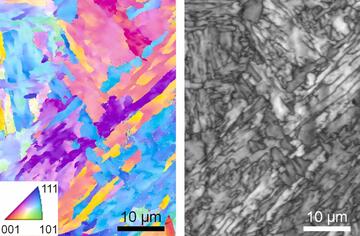
NIST research shows why composition and thermal history must be controlled before a familiar wrought heat-treatment label can be interpreted.
Retained austenite changes the answer.
NIST reported that conventionally wrought 17-4 PH is fully martensitic before aging, while laser powder-bed-fused material in one study contained a dendritic structure and nearly 50% retained austenite. A routine stress relief had little effect on that as-built structure; a more extensive homogenization route produced about 90% martensite and 10% retained austenite.
Later NIST-led research showed that carefully controlling powder composition can consistently promote fully martensitic 17-4 across a wide cooling-rate range. The lesson is not that every printed part now equals wrought stock. It is that chemistry, process and post-processing must be qualified together.
Define powder route, chemistry, build orientation, density, solution or homogenization treatment, aging, specimen location and acceptance tests.
A tensile coupon alone may not reveal dimensional stability, anisotropy, fatigue or corrosion behavior throughout a complex build.
Hot isostatic pressing, solution treatment, subzero cooling, machining, aging and surface finishing can each change the final result.
Micrograph: Q. Guo/University of Wisconsin–Madison via NIST. Microstructure evidence: NIST, post-processing heat treatment of AM 17-4 PH.
When is 17-4 PH H900 the right alloy—and when is it not?
Compare alloys by the required combination of strength, toughness, corrosion, formability, section, availability, cost and qualification burden. No single grade wins every column.
17-4 PH
Broad availability, simple aging, high strength and good general corrosion behavior. H900 is compelling when peak strength matters; overaged conditions broaden tolerance.
15-5 PH
Often selected for improved transverse properties and microstructural uniformity in demanding aerospace-type hardware. Confirm form and melt route.
13-8Mo
Used where cleanliness, toughness and SCC performance justify a more specialized alloy and processing route.
Custom 465
A premium PH stainless option when 17-4 cannot reach the required strength-toughness combination. Procurement and heat treatment are more specialized.
304 / 316L
Austenitic stainless steels are easier to form and can be superior choices for weldability or chloride resistance, but they do not age harden to H900-level strength.
Specify what the certificate must prove.
A complete purchase order connects chemistry, form, heat treatment and mechanical testing to a traceable heat or lot. For critical service, add process controls, NDT and corrosion or toughness evidence appropriate to the failure mode.
Use the current revision of the governing ASTM, AMS, ASME, API, NACE or customer standard. Public datasheets explain behavior; they do not replace contractual requirements.
State UNS S17400, the applicable material standard, revision, product form and dimensions.
Call out H900, H1025, H1150 or the required route—not merely “heat treated.”
List tensile, yield, elongation, hardness and any impact requirement with temperature and orientation.
Require mill certificate, heat number, heat-treatment lot and linkage to supplied parts.
Define furnace calibration, uniformity, soak control, atmosphere and cooling evidence as required.
Specify UT, PT, MT, inclusion, grain, surface or passivation requirements where risk warrants.
Record base condition, filler, joint, shielding, heat input, post-weld treatment and acceptance tests.
Translate chloride, sour, hydrogen, temperature and cleaning exposure into testable acceptance criteria.
Validate the joint and process before production.
Send Oceanplayer the 17-4 PH condition, thickness, joint drawing, target penetration, surface requirement and production rate. We can help plan a representative laser welding trial and document the parameters needed for the next engineering review.
- Material certificate and H-condition
- Thickness, fit-up and joint drawing
- Required penetration and bead limits
- Post-weld heat-treatment plan
- Target cycle time and inspection method
17-4 PH H900 FAQ
Short answers for specification, heat treatment, welding and procurement decisions.
What does H900 mean for 17-4 PH stainless steel?
H900 means solution-treated 17-4 PH was aged at 900°F (482°C), normally for one hour, then air cooled. It is the common peak-strength and peak-hardness condition.
Is 17-4 PH H900 always 200 ksi tensile strength?
No. About 200 ksi is a representative typical value. A common H900 procurement minimum is 190 ksi UTS, but the governing specification, form, thickness, direction and test result control acceptance.
What is the yield strength of 17-4 PH H900?
Representative manufacturer data is around 185 ksi (1,276 MPa), while common minimum requirements may be around 170 ksi. Use the value applicable to the actual product form and specification.
What hardness should H900 reach?
Typical H900 hardness is around 44–45 HRC. Some specifications define a permitted range, such as approximately 40–48 HRC for particular products. Verify the current governing table.
Is H900 stronger than H1025 and H1150?
Yes. H900 normally has the highest tensile and yield strength. H1025 and H1150 progressively trade some strength and hardness for greater ductility, toughness and generally improved SCC resistance.
Should Condition A be used as the final condition?
Normally no. Carpenter cautions against using solution-treated Condition A without age hardening because of susceptibility to stress-corrosion cracking. Select and document a final aged condition.
How much does 17-4 PH shrink during aging?
Carpenter reports approximate contraction from Condition A of 0.0004–0.0006 in/in for H900 and 0.0009–0.0012 in/in for H1150. Actual part movement also depends on geometry, residual stress, support and furnace control.
Can 17-4 PH H900 be welded?
17-4 PH is weldable, but welding changes the fusion zone and heat-affected zone. The base condition, filler, joint, heat input and post-weld heat treatment must be qualified. A clean bead does not prove H900-equivalent joint properties.
What filler is used for welding 17-4 PH?
AWS E/ER630 is commonly considered when matching base-metal properties is desired. An austenitic filler such as E/ER308L may be considered when maximum weld strength is not required. The qualified procedure and service environment decide.
Is H900 suitable for marine or chloride service?
Not automatically. H900 has less SCC margin than higher-temperature aged conditions. Evaluate stress, chloride concentration, temperature, crevices, finish and the applicable standard; representative corrosion testing may be required.
Can 3D-printed 17-4 PH use the wrought H900 property table?
Not without qualification. Retained austenite, porosity, build orientation, powder chemistry and post-processing can make AM material behave differently. Define and test the complete additive route.
What should be shown on a 17-4 PH material certificate?
The certificate should identify the heat or lot, chemistry, product form, specification and revision, heat-treatment condition, mechanical results and any required hardness, NDT or special process evidence.
Primary sources used for this guide
Material selection and design should use the current purchase specification and certified data for the actual product. These sources establish the technical framework and reported examples used above.
Chemistry, heat treatment, dimensional change, machining and representative material behavior.
Open source ↗Weldability, filler choices, base condition, machining and joint-design guidance.
Open source ↗Typical and minimum properties by condition, corrosion testing and fabrication context.
Open product library ↗Retained austenite, dendritic as-built structure and heat-treatment effects compared with wrought material.
Open source ↗Composition control, phase transformation and reproducible martensitic structure during laser powder-bed fusion.
Open source ↗Process selection, joint preparation, parameters, shielding and qualification planning for handheld laser welding.
Open guide →