

Laser Classification: Class 1 to Class 4 Explained
A laser class describes the potential hazard from accessible laser radiation—not simply the power of the source inside the machine. Class 1 products limit accessible emission during normal operation; Class 4 lasers can cause serious eye and skin injury. Lettered classes add important conditions. Use the product label and documentation to identify the class, then assess the actual task and workplace.
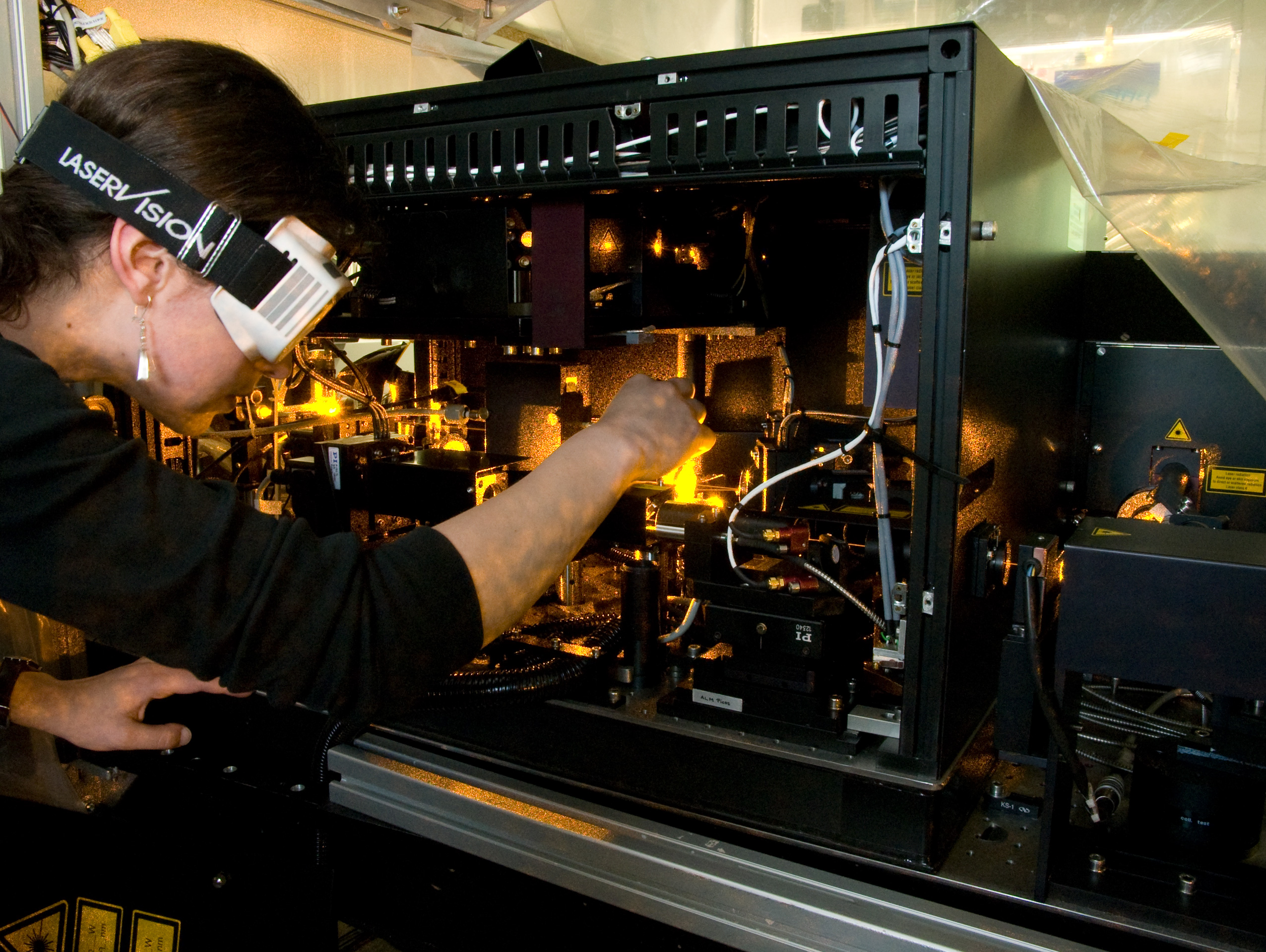
What are the different laser classes?
IEC laser classifications include 1, 1M, 2, 2M, 3R and 3B as well as Class 4. Class 1C covers a specialized contact-use category. The letters matter: a Class 1M product has a viewing restriction that an ordinary Class 1 description does not convey.
| Laser class | What it means | Important limitation |
|---|---|---|
| Class 1 | Accessible emission remains within Class 1 limits in normal operation. | An enclosure may hide a much more hazardous laser. Service work needs separate consideration. |
| Class 1M | Normally safe for viewing without collecting optics. | Binoculars, telescopes or similar optics can make viewing hazardous. |
| Class 2 | A visible-light class: 400–700 nm. Protection assumes a brief accidental exposure and an aversion response. | Do not stare into the beam or treat blinking as a safety procedure. |
| Class 2M | Similar brief-exposure basis to Class 2 for unaided viewing. | Collecting optics can increase the eye hazard. |
| Class 3R | Direct viewing can be hazardous. | “Lower risk than 3B” does not mean safe to look into. |
| Class 3B | The direct beam and mirror-like reflections are hazardous to the eyes. | Ordinary diffuse reflections are generally less hazardous, but this is not permission to view an unassessed setup. |
| Class 4 | Direct and reflected radiation can injure eyes and skin; diffuse reflections may also be hazardous. | Fire and other process hazards need attention as well as beam exposure. |
| Class 1C | Specialized skin or tissue contact products with engineering measures that prevent hazardous eye exposure. | Not a general “safer than Class 2” step. Treatment of tissue may be intentional. |
This is a plain-language comparison, not a procedure for assigning a class. Class descriptions: UK Health Security Agency and Health Canada.
No label or unclear paperwork? An unidentified laser is not automatically a low-risk laser. Keep it out of operation until the supplier and a competent laser-safety professional resolve the identification and controls.
How is a laser’s safety class determined?
Classification compares the radiation a person can access with limits defined by the applicable standard. Wavelength, exposure duration, continuous or pulsed operation, beam geometry and measurement conditions affect the result. The housing and protective features also affect what radiation is accessible.
That is why IEC 60825-1 addresses the laser product, not just a source-power number in a brochure. A finished machine, a component laser and a modified installation are not necessarily the same classification object.
- AEL: Accessible Emission Limit
- The emission limit used to classify a product under specified assessment conditions.
- MPE: Maximum Permissible Exposure
- An exposure limit used when assessing potential injury to the eye or skin under defined conditions.
For a buyer, the practical distinction is simple: the class describes the product; the workplace assessment determines how people can use it safely. Neither a class label nor a pair of glasses replaces that assessment.
Can you identify the laser class from watts alone?
No. A wattage chart without wavelength, pulse conditions and accessible-emission information is not a reliable classification method. Some simple visible continuous-wave lasers have familiar milliwatt limits, but those limits should not be applied to every laser.
As an illustrative example, a 2 kW source inside a properly assessed protective system may form part of a Class 1 product. A 2 kW handheld system with an accessible processing beam presents a very different exposure problem. The shared “2 kW” rating does not make the two finished systems equivalent.
Can a Class 1 machine contain a Class 4 laser?
Yes. A protective enclosure can keep accessible emission within Class 1 limits while a much higher-class laser performs the process inside. But a box around a laser is not, by itself, evidence that the finished machine meets Class 1 requirements.
Normal production with safeguards intact
The machine operates in its documented configuration. Protective housing, access controls and other safety functions limit exposure as assessed for that product.
Maintenance, alignment or service
The task may expose radiation that is inaccessible during production. Authorized personnel need controls suited to that task and the embedded laser—not an assumption that the exterior Class 1 label covers every situation.
Berkeley Lab’s laser-safety manual explicitly addresses service and alignment of higher-class lasers inside Class 1 products. Its example reinforces the distinction between a product’s operating classification and the hazards of a particular job.
For production teams: a larger part opening, a replaced viewing window or a changed beam path can affect the protection originally assessed. Refer proposed changes to the manufacturer and responsible safety professional. Do not bypass interlocks to make a part fit.
How do you read a laser warning label?
Start with the label on the complete product and the matching manual. Then identify any separate labels for an aperture, aiming laser, internal source or service access panel. A label for one component may not describe the whole machine.
- Read the full class. Keep suffixes such as M, R, B or C; they change the meaning.
- Check wavelength and output information. Match the stated emission to the equipment configuration. For pulsed sources, the manual may provide additional pulse data.
- Match the model and documents. A photograph of a label on a different model is not evidence for the unit being purchased.
- Read the limitations. Look for the operating configuration, access restrictions and separate maintenance or service warnings.
Health Canada’s laser-product guidance explains identification and warning information. Requirements vary by product and market, so not every detail appears on one sticker.
Why might a machine show more than one wavelength? It may have a visible aiming beam and a separate processing laser. Do not use the aiming-beam label to choose protection for an invisible processing beam. Ask the supplier to identify every accessible emission.
Are IEC, ANSI and FDA laser classifications the same?
They address related hazards, but they do not have identical roles. Use the standard, edition and destination-market requirements stated in the product documentation; do not combine names into a claim of universal approval.
| Framework | Main purpose | What a buyer should check |
|---|---|---|
| IEC 60825-1 | Laser-product classification and associated requirements. | The assessment basis for the exact finished product and configuration. |
| ANSI Z136 series | Safe-use guidance, including hazard assessment and workplace controls. | The relevant application standard and how it is used in the site’s safety program. |
| U.S. FDA / CDRH | U.S. laser-product performance, reporting and related manufacturer obligations. | The applicable U.S. compliance route, labeling and supporting records. |
Older U.S. labels may use Roman numerals such as IIIb and IV. Those names broadly correspond to familiar 3B and 4 hazard categories, but a name comparison is not a full regulatory equivalence check. See the FDA’s laser-product overview.
FDA Laser Notice 56 describes enforcement discretion for identified IEC provisions that FDA considers comparable. It does not say that any IEC label removes all U.S. obligations.
Likewise, an FDA report receipt or accession number is not product approval. The FDA explains this distinction in its reporting and certification guidance. Product documentation and workplace compliance are separate checks.
What controls do Class 3B and Class 4 lasers need?
Have a competent laser-safety professional assess the equipment, task and work area before use. A Class 4 cleaner on a shop floor, a laboratory laser and an enclosed marking machine do not share one universal control plan.
The usual priority is to prevent exposure through engineering measures, support them with controlled access and procedures, and use suitable protective equipment for the remaining risks. Berkeley Lab presents this hierarchy of laser controls.
- Contain the beam where practicable. Evaluate the enclosure, viewing windows, beam termination and foreseeable reflected paths.
- Control entry and operation. Establish the assessed work area, safety functions, warning arrangements and authorization to operate.
- Plan abnormal tasks. Alignment, service and fault recovery need defined responsibilities and procedures.
- Select suitable PPE. Match laser eye protection and any face, skin or impact protection to the assessed exposure and task.
Laser class does not cover every workshop hazard
Even where the beam is enclosed, a process can still involve fumes, dust, hot parts, electricity, gases or moving machinery. Review these hazards separately. For cutting applications, our guide to laser-cutting radiation and associated hazards explains why optical exposure and process emissions should not be treated as the same issue.
Glasses are not a substitute for containment. Giving everyone eyewear does not, by itself, make an open Class 4 beam safe for a shared workshop.
Which safety glasses are suitable for a laser?
“Class 4 glasses” is not a complete specification. Protection must cover the actual wavelengths and the exposure conditions for the task. Lens color, darkness and a generic welding-shade number do not establish laser protection.
Optical density, or OD, describes attenuation at a stated wavelength. Selection also needs suitable protective performance, including the filter and frame’s ability to withstand the relevant exposure. Visible transmission, fit and condition matter to safe use.
The Laser Institute of America’s inspection guide identifies wavelength and OD markings as checks. ANSI Z136.7 addresses testing and labeling of protective equipment. Neither provides one universal pair of glasses for every high-power laser.
Use our laser welding glasses selection guide for the detailed checks. Final selection belongs with the responsible safety professional and the eyewear manufacturer’s verified specifications.

Does the laser class tell you a safe viewing distance?
No. There is no single safe distance for all Class 4 lasers—or all lasers of the same wattage. Beam size, divergence, wavelength, operating mode, exposure time and reflections can change the hazard area.
- NOHD: Nominal Ocular Hazard Distance
- A calculated distance along a beam beyond which the specified eye-exposure limit is not exceeded, under the stated conditions.
- NHZ: Nominal Hazard Zone
- The space where direct, reflected or scattered laser radiation can exceed the applicable exposure limit.
The OSHA Technical Manual explains the hazard-zone concept. The LIA’s hazard-evaluation guidance also distinguishes class, exposure limits, protective attenuation and hazard distances.
Do not turn a supplier’s distance estimate into floor markings without checking its assumptions. The installed optics, workpiece reflections and nearby access routes must be part of the site assessment. A photograph of the beam, the brightness of a spot or the absence of visible light cannot establish a safe boundary.
What should you verify before accepting a laser machine?
Ask for evidence tied to the actual unit and intended use. The aim is to avoid discovering after delivery that the proposed equipment cannot be safely integrated into your workspace.
- Finished-product identification: model, serial number, complete class designation and applicable classification standard.
- Configuration and assessment: documentation covering the supplied enclosure, head, optics, windows and operating modes—not only the source module.
- Operating and service instructions: who may perform each task, what access is allowed and what to do when a safety function fails.
- Installation requirements: the safety assessment, beam containment, access arrangements, extraction and other utilities required for your process.
- Handover evidence: documented checks by qualified personnel that the installed safety functions and work instructions match the agreed configuration.
If labels, manuals and the supplied machine disagree, stop the acceptance process until the discrepancy is resolved. A good weld, a clean surface or a successful demonstration proves neither classification nor workplace safety.
Discuss your laser application with Oceanplayer Laser. Share the process, material, part size, planned work area and whether production must be enclosed or handheld. These details help define the equipment and documentation to review with your site’s safety professional.
Discuss the applicationAbout this guide
This article explains laser-class terminology for equipment users and buyers. It does not assign a class, certify a product or replace a task-specific safety assessment. Sources are linked beside the relevant explanations; applicable requirements depend on the equipment, use and destination market.