

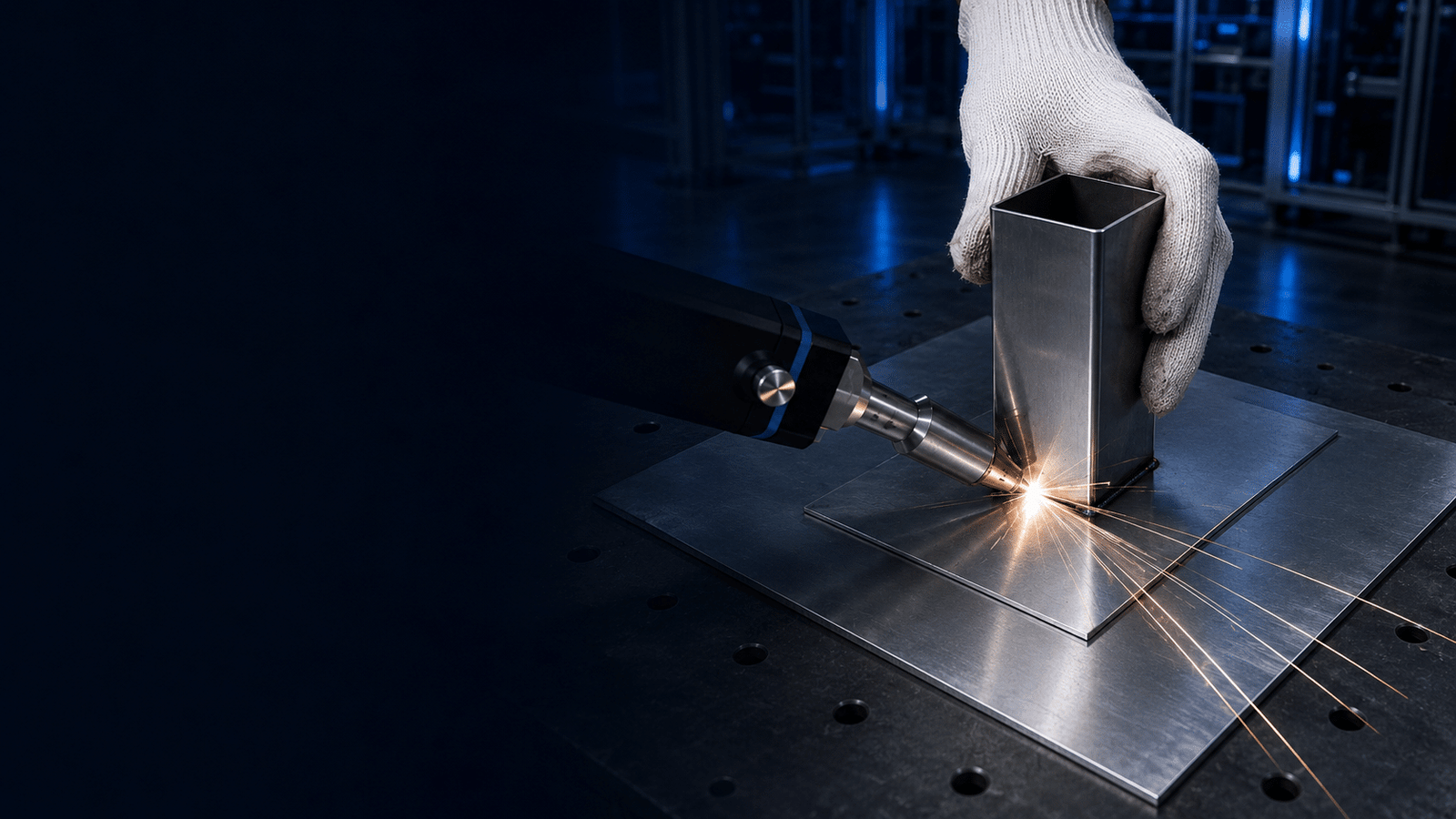
Laser welder power & thickness selector
Match 1000W, 1500W, 2000W or 3000W laser welding power to your material, thickness, joint, fit-up, penetration requirement and production workload.
- Material and thickness match
- Wire feeder recommendation
- Air or water cooling direction
- Sample-test checkpoints
Match laser welding power to your joint requirement
Enter the actual base-metal thickness and production conditions. The result is a planning direction that should be confirmed with your joint design, fit-up and sample weld.
Why plate thickness is only one part of power selection
The selector combines six practical factors. A final configuration still requires an accepted sample weld and review of the complete production cell.
Material and thickness
Thermal conductivity, reflectivity, coating and section thickness affect how readily the joint forms.
- Carbon and stainless steel
- Aluminum and reflective metals
- Coated or galvanized surfaces
Geometry and fit-up
A butt joint with tight fit-up behaves differently from a fillet joint or a seam with a visible gap.
- Joint angle and access
- Gap consistency and edge quality
- Filler wire and bead requirement
Penetration and workload
Cosmetic seams, sealing welds and structural fusion targets require different process margins.
- Travel speed and penetration
- Daily operating time
- Cooling and fixture stability
Compare common laser welder power by planning thickness band
These overlapping bands are starting references for common fabrication work, not guaranteed maximum thickness ratings. Alloy, joint, gap, speed and penetration can move a project into another range.
| Laser Power | Planning Thickness Direction | Common Buyer Need | Cooling Direction | What To Verify |
|---|---|---|---|---|
| 1000W | Thin-gauge work, often about 0.5-2 mm | Controlled heat, repair, light fabrication and intermittent use | Air cooling may fit light duty; confirm configuration | Travel speed, seam continuity and penetration margin |
| 1500W | General fabrication, often about 1-3 mm | Balanced workshop flexibility across varied metal parts | Air for selected light duty; water for regular production | Joint gap, distortion, gas and seam appearance |
| 2000W | Medium sections, often about 2-5 mm | Higher travel speed, deeper fusion and regular production | Water cooling normally preferred | Fixture stability, heat input and required penetration |
| 3000W | Thicker or high-output work, often about 3-8 mm | Demanding sections and engineered production systems | Water cooling and utility review required | Safety, extraction, optics, joint design and process qualification |
Adjust power selection for the metal you weld
Two parts with the same thickness can need different process windows because absorption, conductivity, coating and defect risks are different.
Carbon and stainless steel
Common handheld laser welding materials with a broad process window when fit-up and shielding are controlled.
- Review penetration and heat tint
- Match gas to finish requirement
- Keep edges clean and consistent
Aluminum alloys
High conductivity and reflectivity can require more process margin than steel at the same thickness.
- Confirm alloy and oxide condition
- Use suitable high-purity shielding gas
- Check porosity and cracking risk
Galvanized, copper and brass
Coatings or highly reflective metals need application-specific testing and stronger process controls.
- Control zinc vapor and fumes
- Review laser-source compatibility
- Validate defects below the surface
Do not use more power to hide an unstable joint gap
Laser welding favors consistent fit-up. Filler wire can improve gap tolerance and bead shape, but it does not replace correct joint preparation and fixture control.
| Joint Condition | Typical Direction | Wire Feeder | Main Risk | Recommended Check |
|---|---|---|---|---|
| Tight fit-up below about 0.2 mm | Autogenous welding may be practical | Optional depending on metallurgy and bead target | Edge mismatch or focus variation | Cross-section and seam continuity |
| Small gap around 0.2-0.5 mm | Use controlled filler wire and stable motion | Recommended | Undercut, inconsistent fill or bead width | Wire type, feed speed and joint repeatability |
| Gap above about 0.5 mm | Review joint design before selecting power | Usually required but may not solve the gap | Lack of fusion, excessive filler or unstable bead | Fixture, edge preparation and alternative process |
| Fillet, lap or curved joint | Confirm beam angle and access | Depends on throat and bead requirement | Path offset and unequal fusion | Macro section, fixture and motion program |
Match cooling to how long the welder operates
Power selection and cooling selection should be reviewed together. A compact system can be attractive, but sustained production creates different thermal demands.
Repair and flexible workshop use
Selected air-cooled systems can suit lighter, intermittent work when power and duty cycle stay within the manufacturer's rating.
- Confirm ambient temperature
- Review actual beam-on time
- Allow cooling between long seams
Daily fabrication
Water cooling commonly provides a stronger margin for regular welding, varied seams and consistent production output.
- Monitor water quality and temperature
- Plan chiller maintenance
- Keep extraction airflow stable
Long shifts and automation
High utilization needs coordinated review of laser source, chiller, optics, fixture, robot path, shielding and safety enclosure.
- Use measured cycle and utilization
- Confirm service access
- Qualify the complete cell
Confirm power with your actual joint
Send material grade, thickness, joint drawings, gap range, welding length and quality requirement. Oceanplayer can help compare power, wire feeding, gas and cooling before quotation.
Share joint details
Provide alloy, thickness, joint, gap tolerance and part photographs.
Define acceptance
Confirm penetration, strength, sealing, appearance and distortion limits.
Review the weld
Check surface result, section quality, cycle time and repeatability.
Continue your laser welding calculation
Use power selection together with heat input, filler wire, shielding gas and the complete welding guide.
Laser welder power and thickness questions
Use these answers to understand the result and prepare a representative welding test.