

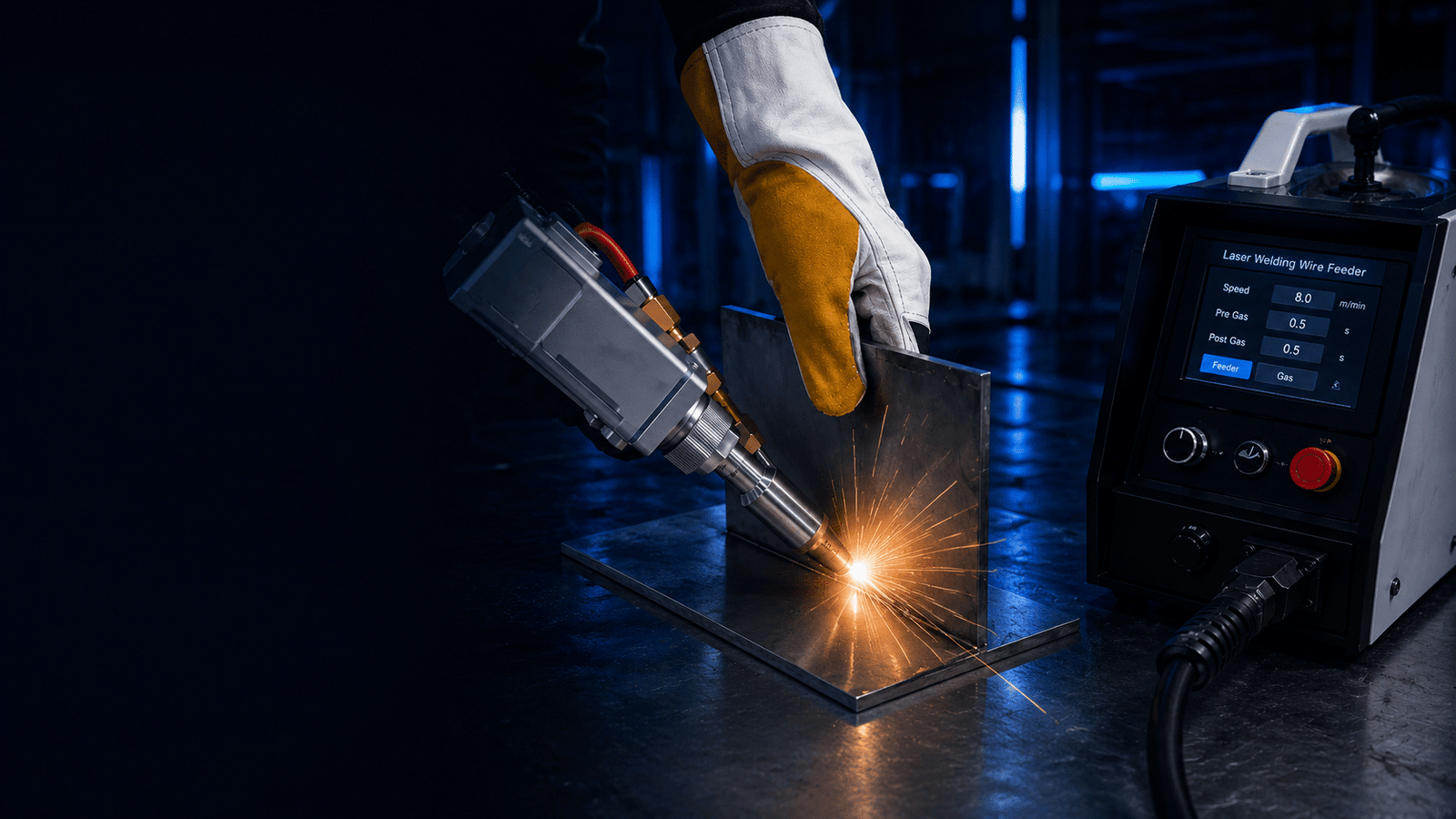
Laser welding heat input calculator
Calculate gross line energy, estimated net heat input, cumulative multi-pass input, beam-on time and energy per weld from laser power, thermal efficiency and travel speed.
- J/mm and kJ/mm results
- Four travel-speed units
- Single and multi-pass input
- No registration required
Convert welding parameters into energy per unit length
Use measured power, travel speed and a process-specific efficiency value whenever available. The result is a comparison tool, not a universal acceptance limit.
Understand the values behind welding heat input
The calculator uses a steady-power line-energy model. Wobble motion, power modulation, pulse behavior and changing travel speed require more detailed process analysis.
Egross = laser power ÷ travel speedLaser output energy delivered per millimeter before applying thermal efficiency.
Qnet = power × efficiency ÷ speedEstimated energy per millimeter treated as net heat entering the workpiece.
Qtotal = Qnet × number of passesAdds the line input from repeated passes over the same joint path.
Eweld = Qnet × weld length × passesEstimates net heat energy for the entered weld length and pass count.
Read heat input together with the actual weld result
The same J/mm value can produce different penetration, bead shape and defects when material, focus, wobble, joint gap or shielding changes.
Gross versus net input
Gross line energy uses nominal laser output. Net input applies the efficiency entered by the user.
- State which convention is reported
- Keep speed units consistent
- Document the efficiency assumption
Penetration and fit-up
Heat input does not show whether the beam is correctly placed or whether the joint gap is stable.
- Inspect fusion and cross-section
- Control gap and edge mismatch
- Review wire-feed stability
Thermal and metallurgical response
Use the calculated value with distortion, heat tint, porosity, cracking and mechanical requirements.
- Compare similar materials and joints
- Record shielding and focus
- Qualify the complete process window
See what changes when you adjust laser welding settings
Change one variable at a time during development and confirm penetration, seam shape and base-material response.
| Parameter Change | Calculated Effect | Possible Weld Effect | What To Verify |
|---|---|---|---|
| Increase laser power | Raises gross and net line energy at fixed speed | May increase penetration, bead size and thermal load | Distortion, undercut, spatter and heat-affected zone |
| Increase travel speed | Lowers energy per millimeter | May narrow the seam or reduce penetration | Fusion continuity, sealing and mechanical strength |
| Increase thermal efficiency | Raises estimated net input only | Does not physically change the weld unless the process changes | Whether the efficiency assumption is valid |
| Add another pass | Raises cumulative input and weld energy | Can increase reheating and distortion | Interpass temperature and metallurgical response |
| Increase wobble width | Not represented directly by this formula | Redistributes energy over a wider path | Bead width, edge fusion, penetration and speed |
Compare line energy across common laser powers
Examples below use 70% effective thermal efficiency and illustrate the formula only. They are not recommended welding parameters or thickness guarantees.
| Laser Power | Travel Speed | Gross Line Energy | Net Heat Input at 70% | Planning Use |
|---|---|---|---|---|
| 1000W | 30 mm/s | 33.33 J/mm | 23.33 J/mm | Compare thin-gauge and controlled-heat trials |
| 1500W | 40 mm/s | 37.50 J/mm | 26.25 J/mm | General reference used by the default calculator values |
| 2000W | 50 mm/s | 40.00 J/mm | 28.00 J/mm | Shows how higher power can be balanced by faster travel |
| 3000W | 25 mm/s | 80.00 J/mm | 56.00 J/mm | Demonstrates the strong effect of reducing speed |
Build a heat-input record that production can repeat
Record the calculated value with the settings and observations that determine the actual weld outcome.
Document the joint
- Material grade and thickness
- Joint type, gap and edge condition
- Fixture, focus and beam angle
- Gas and filler-wire specification
Record process settings
- Actual power and travel speed
- Wobble pattern and width
- Wire feed and shielding flow
- Pass count and interpass condition
Confirm acceptance
- Seam appearance and dimensions
- Penetration and cross-section
- Porosity, cracking and distortion
- Leak or mechanical test where required
Confirm calculated heat input with a real weld
Send material, thickness, joint drawings, gap range, weld length and acceptance criteria. Oceanplayer can help compare power, speed, wire feeding, shielding and cooling.
Share the joint
Provide alloy, thickness, gap tolerance and production photographs.
Define acceptance
Confirm penetration, strength, sealing, appearance and distortion limits.
Measure the weld
Record settings, cross-section, cycle time and repeatability.
Continue your laser welding calculation
Use heat input together with power selection, filler wire, shielding gas and the complete welding guide.
Laser welding heat input questions
Use these answers to interpret the calculation and prepare a representative welding test.