

What Makes a Metal a Superalloy?
A superalloy is not simply a metal with lots of nickel or a very high melting point. It is an engineered alloy-and-process system that preserves useful strength, resists time-dependent creep, survives aggressive high-temperature environments and keeps a stable microstructure for the required duty cycle.
No universal temperature gate
Superalloys are recognized by a combination of high-temperature strength, creep resistance, environmental resistance and microstructural stability—not one fixed temperature or nickel percentage.
Stable obstacles to deformation
Solid-solution atoms, ordered precipitates such as γ′ or γ″, carbides and controlled grain structures slow dislocation motion and grain-boundary damage.
Nickel, cobalt and iron-nickel
Nickel-base grades dominate many highly stressed hot components. Cobalt-base and iron-nickel systems occupy different corrosion, wear, fabrication and cost windows.
Specify duty—not the word “super”
Temperature, time, stress, atmosphere, product form, heat treatment, joining route, inspection and governing standard must all appear in the material decision.
What is a superalloy?
A superalloy is a high-performance alloy developed to carry load and resist degradation during extended exposure to severe temperatures. The commonly recognized families are nickel-base, cobalt-base and iron-nickel-base alloys. They are designed around a balance of creep resistance, fatigue and rupture strength, oxidation or hot-corrosion resistance, and phase stability.
There is no single composition or temperature at which an alloy automatically becomes “super.” The University of Cambridge materials resource describes superalloys as metallic alloys used at high homologous temperature—temperature expressed as a fraction of absolute melting temperature—with creep and oxidation resistance as prime design criteria. The Nickel Institute likewise emphasizes microstructural stability, oxidation resistance and resistance to high-temperature creep.
This means an alloy can be excellent in one superalloy role and unsuitable in another. Alloy 718 is valuable for high-strength wrought and welded components over a broad low-to-elevated-temperature range, while a high-γ′ single-crystal blade alloy is designed for a different temperature, loading and manufacturing window. A corrosion-resistant nickel alloy can survive an aggressive liquid but still lack the creep strength needed for a rotating turbine disk.
“Super” is a performance package, not a chemistry badge.
A useful definition must survive four questions. If a candidate passes only the short tensile test but loses phase stability, creeps excessively or forms a non-protective scale during the intended exposure, the designation does not solve the engineering problem.
Does it retain useful strength?
Elevated-temperature tensile strength matters, but it is only the beginning. The design must consider fatigue, dwell, stress rupture and notch behavior at the actual temperature and material condition.
Ask for: temperature-specific allowable or test data, not room-temperature strength.
Does it resist creep over time?
Creep is permanent, time-dependent deformation under load. It can govern a turbine blade, pressure component or fastener even when the applied stress is below the short-term yield strength.
Ask for: stress-rupture or creep data at the intended time, stress and temperature.
Does the surface remain protective?
Chromium- or aluminum-rich oxide scales can slow further attack, but oxidation, carburization, sulfidation, molten salts and wet corrosion are not interchangeable environments.
Ask for: data in the actual gas, salt, fuel, vapor or liquid chemistry.
Does the microstructure remain stable?
Strengthening precipitates can coarsen or dissolve. Brittle topologically close-packed, Laves or other unwanted phases can appear. Grain boundaries and coatings also evolve with time.
Ask for: heat-treatment condition, long-exposure data and acceptance criteria.
Some alloys called superalloys deliver valuable fatigue or strength performance below 650°C, while other high-temperature materials can operate above that temperature without belonging to the conventional superalloy families. Temperature is essential, but temperature without time, stress, atmosphere, section size and microstructure is not a specification.
Nickel dominates—but it is not the only route.
The three families overlap. Exact capability depends on grade, product form and heat treatment, so the table is a screening map rather than a substitute for producer data or design allowables.
| Family | Typical matrix / strengthening | What it tends to do well | Representative grades | Main selection limits |
|---|---|---|---|---|
| Nickel-base | FCC γ matrix; solid solution, γ′, γ″ and carbides depending on grade | Combines high-temperature strength, creep resistance and oxidation resistance; accommodates many alloying additions. | Alloy 625, Alloy 718, Waspaloy, René and CMSX families | High raw-material and processing cost; difficult machining; some highly strengthened grades are crack-sensitive or hard to fabricate. |
| Cobalt-base | Solid solution and carbides in many established grades; newer γ/γ′ Co systems also exist | Useful hot-corrosion, wear and thermal-fatigue behavior in selected combustor, vane, hard-facing and medical applications. | Haynes 188, L-605, MAR-M 509, selected Co-Ni-Cr-Mo alloys | Density and cobalt cost; many traditional grades do not reach the same precipitation-hardened strength as leading nickel systems. |
| Iron-nickel-base | Austenitic Fe-Ni matrix; solid solution plus γ′ or related precipitation hardening | Cost-effective strength and oxidation resistance for fasteners, casings, sheet, exhaust and power applications at moderate elevated temperatures. | A-286, Alloy 800H/HT, selected 706/901-type systems | Usually lower maximum mechanical capability than high-alloy nickel-base routes; phase stability and environment remain grade-specific. |
The word “base” refers to the principal matrix system, not a promise of identical behavior within the family. A wrought, age-hardened disk alloy and a cast single-crystal blade alloy may both be nickel-base superalloys while sharing very little processing logic.
The alloy is designed to make deformation difficult.
Nickel-base superalloys illustrate the concept most clearly: a ductile face-centered-cubic γ matrix carries a carefully designed population of solutes, precipitates and boundary phases. Heat treatment controls their size, fraction and distribution.

Composition does not show the whole material.
This Inconel 718 micrograph shows grains and boundaries at a visible scale. The strengthening precipitates and boundary phases are controlled by melting, working and heat treatment.
Ewint6 via Wikimedia Commons, CC0 1.0.γ (gamma)
The nickel-rich FCC matrix is ductile, stable and tolerant of substantial alloy additions. Cobalt, chromium, molybdenum, tungsten and other atoms can strengthen it by distorting the lattice and slowing dislocations.
γ′ (gamma prime)
Often based on Ni3(Al,Ti,Ta), γ′ can remain coherent with the γ matrix. Its ordered structure and controlled morphology make dislocation motion energetically difficult and support creep resistance.
γ″ (gamma double prime)
Ni3Nb γ″ provides much of Alloy 718’s age-hardened strength. It is valuable in the alloy’s intended window, but phase evolution during prolonged high-temperature exposure limits universal extrapolation.
Carbides and minor additions
Carbides, boron and zirconium can support boundary strength or control grain behavior. Excess, continuous or incorrectly located phases can instead reduce ductility and rupture life.
High γ′ volume fraction can increase creep capability but generally narrows forging and welding windows. Alloy designers must also avoid brittle TCP phases, harmful segregation and incipient melting. The optimum is a manufacturable, stable microstructure for a defined component—not the maximum of one constituent.
Does this application point toward a superalloy?
Choose the closest duty conditions. The result is a planning route, not a material specification or design approval.
Compare age-hardened nickel and iron-nickel routes.
The combination of sustained temperature and creep demand can justify superalloy screening. A wrought route may favor Alloy 718-, A-286- or higher-temperature γ′-strengthened candidates depending on stress, time and environment.
The failure mode decides what “high-temperature strength” means.
A short tensile test, a 10,000-hour creep exposure and repeated start-stop cycles interrogate different parts of the material. A credible selection program identifies the governing damage mechanism before comparing grades.
Creep and stress rupture
Creep accumulates under sustained load. Temperature accelerates diffusion, precipitate coarsening, grain-boundary sliding and void formation. Stress-rupture testing records time to fracture, while creep testing also tracks strain rate and deformation.
- Use the intended stress and temperature
- Check time and extrapolation method
- Separate rupture life from allowable strain
Oxidation and hot corrosion
Chromium and aluminum can form protective scales, yet scale chemistry, adhesion and growth change with temperature and gas composition. Salt, sulfur, carbon or halogens can bypass a simple “oxidation-resistant” label.
- Match fuel, salt and atmosphere
- Include coating and thermal cycles
- Inspect both mass change and penetration
Fatigue and thermal-mechanical fatigue
Start-stop duty creates strain from thermal gradients, mechanical load and expansion mismatch. Surface condition, notches, grain orientation, coating cracks and hold times can dominate life even when average stress looks modest.
- Define temperature and strain cycle
- Include dwell and environment
- Evaluate real geometry and surface
Melting, grain structure and heat treatment are part of the grade.
Superalloy chemistry is unusually sensitive to cleanliness, segregation and thermal history. The manufacturing route must therefore be designed with the service requirement—not selected after the composition is fixed.
Control reactive elements and inclusions
Vacuum induction melting and secondary remelting routes such as VAR or ESR are commonly used for critical wrought alloys. Route requirements depend on product form and governing specification.
Risk: inclusions, segregation and trace-element contamination.
Choose wrought, cast, PM or AM
Forging can build disk-quality grain structures; investment casting enables internally cooled airfoils; powder metallurgy and additive manufacturing open other geometry and segregation options.
Risk: assuming one product form inherits another form’s properties.
Solution, stabilize and age deliberately
Solution treatment dissolves selected phases and sets grain behavior. Aging then precipitates strengthening phases. Temperature, time, cooling rate and section thickness influence the outcome.
Risk: wrong precipitate size, delta/Laves retention or incipient melting.
Machine without damaging the surface
High hot strength, low thermal conductivity and work hardening concentrate heat and tool load. Rigid setups, sharp tooling and stable engagement are important.
Risk: work-hardened layers, tensile residual stress and dimensional drift.
Inspect the process-defined structure
Chemistry, grain size, heat treatment, NDT, metallography and mechanical testing should match the criticality of the part and the purchase specification.
Risk: accepting a chemistry certificate as proof of finished-part capability.
AM changes the route—not the metallurgy.
Laser powder-bed fusion can consolidate passages, lattices and shapes that are difficult to machine or cast. It also produces steep thermal gradients, rapid solidification, residual stress and build-direction effects that must be included in the material definition.
- Feedstock: chemistry, particle shape, contamination, reuse history and oxygen pickup matter.
- Build: scan strategy, energy input, support, geometry and orientation influence porosity, cracking and microstructure.
- Post-process: stress relief, hot isostatic pressing, solution/aging treatment and surface finishing may be required.
- Qualification: specimen location, orientation, defect limits and production monitoring must be tied to part requirements.
The NIST and OSTI literature on additively manufactured nickel superalloys consistently treats performance as a process–structure–property problem. Printing a recognized alloy name does not automatically reproduce wrought or cast data.

Layerwise melting supports complex superalloy parts, but heat flow, residual stress, segregation and post-processing still govern the final structure.
Chaolin Tan et al. via Wikimedia Commons, CC BY 4.0.They earn their cost where failure physics demand them.
Superalloys are valuable because they enable combinations of temperature, load, environment and life that cheaper materials cannot satisfy reliably—not because every hot component needs the most exotic alloy.
Turbine disks and airfoils
Disks need fatigue and burst capability; blades and vanes need creep, oxidation, coating compatibility and directional or single-crystal structures in the hottest stages.
Gas and steam turbines
Long service intervals make phase stability, creep, weld repair, coatings and environmental resistance central to lifecycle economics.
Furnaces and chemical equipment
Heat, carburization, sulfur, chlorine or corrosive liquids can shift the decision toward solid-solution nickel alloys, high-nickel heat-resistant alloys or purpose-built corrosion alloys.
Rocket, exhaust and turbo hardware
Thermal cycles, compact geometry, joining and transient peaks can favor weldable wrought or cast superalloys—provided the duty window is specified.

The system extends material capability.
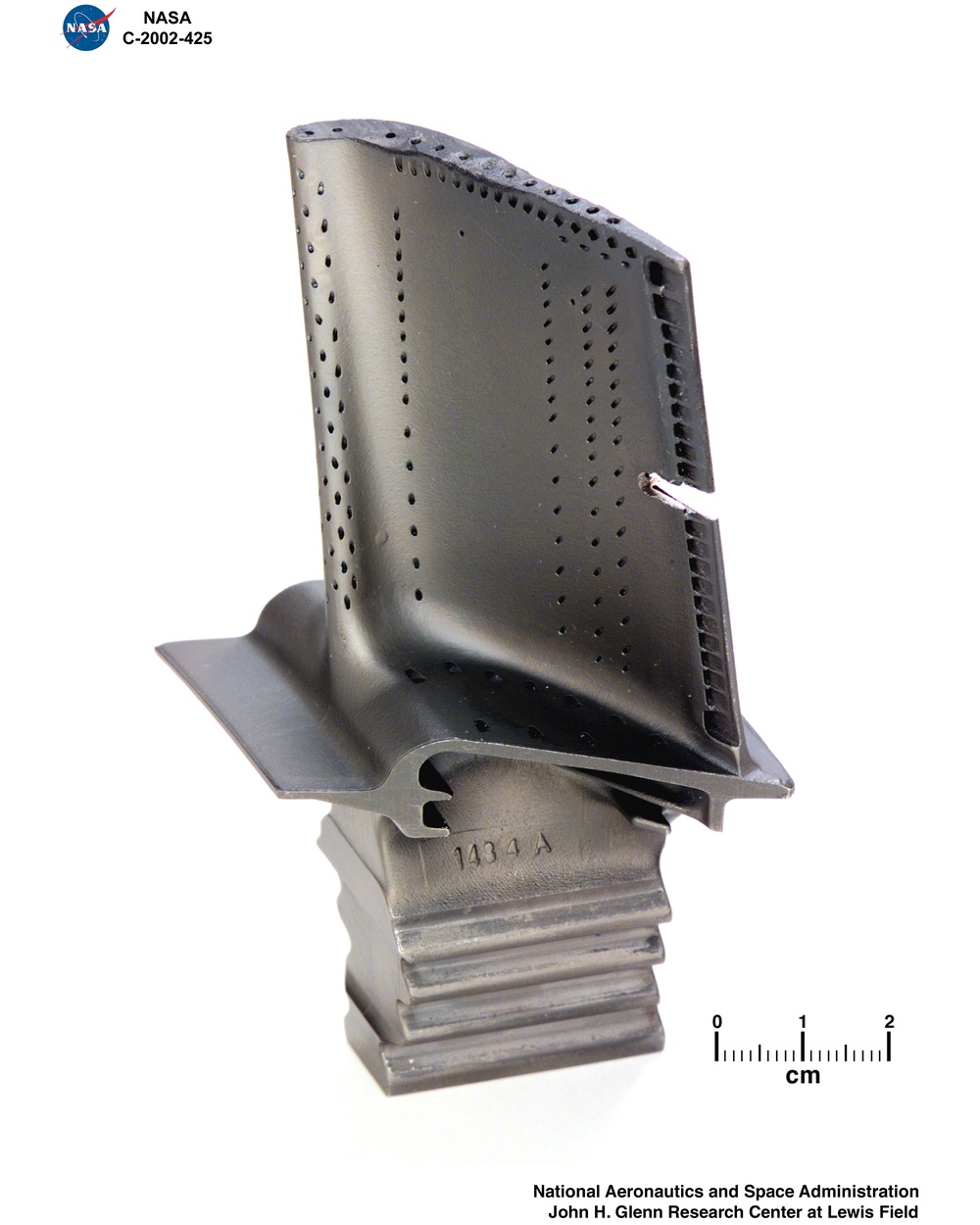
Modern hot-section performance combines superalloy microstructure with internal cooling, film-cooling holes and protective coatings. Gas temperature is not the same as metal temperature.
Tomeasy via Wikimedia Commons, CC BY-SA 3.0.Compare the governing failure mode before paying the superalloy premium.
Several material classes can look “heat resistant” for different reasons. The correct alternative depends on whether the limiting issue is load-bearing creep, oxidation, wet corrosion, weight, thermal shock or maximum temperature.
| Material class | When it may be enough | Where a superalloy may be justified | Do not confuse |
|---|---|---|---|
| Heat-resistant stainless steel | Moderate stress, oxidation-controlled sheet or structure within code and grade limits. | Higher creep strength, longer life, more severe cycling or a more aggressive hot environment. | Oxidation resistance with load-bearing creep strength. |
| Titanium alloy | Weight-sensitive components at lower temperatures where titanium retains adequate strength and environmental resistance. | Hot sections beyond the titanium grade’s oxidation and strength window. | High specific strength at room temperature with turbine hot-section capability. |
| Refractory metal | Very high temperatures in vacuum, inert gas or protected systems. | Oxidizing service, conventional fabrication or a balanced corrosion–creep requirement. | High melting point with oxidation resistance in air. |
| Ceramic / CMC | Very high-temperature, low-density applications with suitable damage tolerance and attachment design. | Ductile load transfer, impact, complex joining or established metallic inspection/repair routes. | Thermal capability with identical toughness and fabrication behavior. |
| Corrosion-resistant nickel alloy | Wet acid, chloride or reducing chemical service where corrosion—not creep—is dominant. | Significant elevated-temperature load and time-dependent deformation requirements. | The trade name or nickel content with superalloy mechanical capability. |
Can superalloys be welded?
Many can—but the answer belongs to the exact alloy, condition, product form, restraint and postweld route. “Nickel alloy” is not one weldability category.
Solid-solution and precipitation-hardened grades behave differently.
Several solid-solution-strengthened nickel alloys are commonly fusion welded, while high-γ′ cast alloys can be much more crack-sensitive. Alloy 718 is widely regarded as comparatively weldable among precipitation-hardened nickel alloys, but segregation, heat-affected-zone liquation, restraint and heat treatment still require control.
Low heat input does not remove metallurgical risk.
Laser welding can reduce overall heat input and heat-affected-zone width, yet the concentrated melt pool can still experience solidification cracking, porosity, lack of fusion, keyhole instability or unfavorable segregation. Joint fit-up, shielding, surface condition, beam profile and travel strategy matter.
Qualification should reproduce the real component.
Use the actual alloy heat, thickness, joint, coating or surface condition where possible. Evaluate crack sensitivity, penetration, porosity, microstructure, hardness, distortion and the required mechanical or corrosion performance after any postweld heat treatment.
This article is a material-screening guide. It does not supply a qualified welding procedure, design allowable, life prediction or substitution approval.
Do not buy “Inconel” or “superalloy” as a description.
A defensible purchase specification identifies the material, condition and evidence needed for the component. Trademark families, generic terms and nominal chemistry are not enough.
Use UNS or another recognized grade identifier, plus bar, plate, sheet, forging, casting, powder or AM part.
State the governing ASTM, AMS, ASME, ISO, customer or industry document and its required revision.
Define VIM, VAR, ESR, powder or other route when it is part of the cleanliness or property requirement.
Identify solution, stabilization, aging, HIP or other condition; do not assume one generic “heat treated” state.
Specify equiaxed, directionally solidified, single crystal, fine grain, coarse grain or texture requirements where relevant.
Room-temperature tensile data cannot stand in for creep, rupture, fatigue or elevated-temperature capability.
Document gas or liquid chemistry, pressure, contaminants, cycling and whether coating/cooling is part of the design.
Define chemistry, NDT, metallography, lot traceability, repair limits and written approval for any alternate grade or process.
Five shortcuts that lead to expensive mistakes.
These statements sound plausible because each contains a fragment of truth. The missing context—time, stress, environment, phase stability and product form—is what changes the decision.
“More nickel means a better superalloy.”
Reality: nickel provides a useful matrix, but chromium, aluminum, titanium, niobium, cobalt, molybdenum, tungsten, tantalum and minor elements perform different jobs. Balance and phase stability matter more than one percentage.
“A high melting point makes it a superalloy.”
Reality: tungsten and other refractory metals have extreme melting points, yet oxidation, brittleness, density and fabrication can dominate. Superalloy performance is a system of strength, creep and environmental resistance.
“Inconel is one material.”
Reality: INCONEL is a trademark covering multiple grades with different strengthening mechanisms, chemistry and service windows. Use an exact grade such as UNS N07718.
“Superalloys cannot corrode.”
Reality: protective oxide formation does not guarantee resistance to molten salts, sulfidation, carburization, halogens or wet acids. Coatings may also be essential.
“Single crystal means one phase.”
Reality: a single-crystal blade can contain a γ matrix, γ′ precipitates and other microstructural constituents. “Single crystal” describes crystallographic grain continuity, not a chemically single-phase material.
“The highest-temperature alloy is always safest.”
Reality: a highly strengthened cast blade alloy may be unnecessarily difficult to weld or forge. The safest choice is the qualified alloy, product and process route that meets the actual duty with controlled margin.
Related Oceanplayer engineering guides.
Use these pages for the next level of alloy, weldability and heat-input decisions.
Superalloy FAQ
Short answers for common definition, selection, temperature and fabrication questions.
What makes a metal a superalloy?
A metal is generally called a superalloy when its chemistry, microstructure and processing deliver a useful combination of elevated-temperature strength, creep resistance, oxidation or hot-corrosion resistance and phase stability. There is no single universal nickel content or temperature threshold.
Are all superalloys nickel based?
No. The conventional families are nickel-base, cobalt-base and iron-nickel-base. Nickel-base alloys dominate many highly stressed turbine applications because the nickel matrix supports strong solid-solution and precipitation-strengthening systems.
Is Inconel a superalloy?
Some INCONEL trademark grades are widely classified as nickel-base superalloys, but INCONEL is not one composition. Specify the exact grade and generic designation. Alloy 718, for example, is UNS N07718 and uses γ″ precipitation hardening.
Is titanium a superalloy?
Titanium alloys are normally treated as a separate high-performance material family rather than conventional superalloys. They offer excellent specific strength but have different high-temperature oxidation, creep and phase-stability limits.
What is gamma prime in a superalloy?
Gamma prime, written γ′, is an ordered intermetallic precipitate commonly based on Ni3(Al,Ti,Ta). In many nickel superalloys it remains coherent with the γ matrix and impedes dislocation motion, supporting high-temperature strength and creep resistance.
What is the difference between γ′ and γ″?
γ′ is commonly an ordered cubic Ni3(Al,Ti,Ta)-type phase. γ″ is a tetragonal Ni3Nb-type phase central to Alloy 718 strength. They have different stability, morphology and heat-treatment behavior.
What is the maximum temperature of a superalloy?
There is no universal maximum. Capability depends on the grade, stress, exposure time, product form, heat treatment, environment, coatings and cooling. Gas temperature can also be much higher than the actual metal temperature in a cooled turbine component.
Why are single-crystal superalloys used for turbine blades?
Removing transverse grain boundaries reduces fast diffusion paths and grain-boundary creep damage. Single-crystal casting also supports specialized heat treatments and high γ′ fractions, but crystal orientation, defects, coatings and cooling remain essential.
Can superalloys be laser welded?
Many can be laser welded, but weldability varies substantially by exact grade and condition. Solidification cracking, liquation, segregation, porosity, restraint and postweld heat treatment must be evaluated with representative samples.
Are superalloys corrosion proof?
No. Many form protective oxide scales, but hot corrosion, sulfidation, carburization, halogens, molten salts and wet chemical environments can still attack them. The actual environment and any coating system must be qualified.
How should I specify a superalloy?
State the exact generic grade, product form, standard and revision, melt route where required, heat treatment, grain structure, mechanical and environmental test requirements, NDT, traceability and substitution controls.
When is a superalloy unnecessary?
If a heat-resistant stainless steel, titanium alloy, refractory metal, ceramic or corrosion-resistant alloy meets the defined temperature, time, stress, environment and life requirements with suitable margin, a superalloy may add cost and manufacturing difficulty without useful benefit.
Validate the actual material, joint and acceptance criteria.
Send the alloy designation, product form, thickness, joint drawing, service temperature, environment and required test standard. Oceanplayer can help plan a representative laser welding trial and the evidence needed before equipment selection.
- UNS / alloy grade and material certificate
- Product form, condition and thickness
- Joint geometry, fit-up and surface condition
- Service temperature, time, stress and atmosphere
- Required NDT, metallography and mechanical tests
Sources used to verify the engineering framework
- Nickel Institute, “Nickel-Based Superalloys: The Power to Propel.” Definition, families, creep, oxidation and turbine context.
- University of Cambridge, “Nickel Based Superalloys.” γ/γ′ structure, high homologous temperature, creep, oxidation and blade processing.
- Carpenter Technology, “Selection of Age-Hardenable Superalloys.” Family classification, alloying effects, phase control and selection limits.
- Special Metals, INCONEL alloy 718 technical bulletin. 718 chemistry, product data, applications and processing context.
- NASA NTRS, “Effect of initial gamma prime size on elevated-temperature creep properties.” γ′ morphology and creep behavior in single-crystal nickel superalloys.
- NASA Glenn, High-Temperature Ni-Based Superalloy Composition. Coherent precipitates and high-temperature creep development.
- OSTI, “Additive manufacturing of nickel-based superalloys: A state-of-the-art review.” Process–structure–defect–property relationship.
- NIST, Co-Ni-Al-W γ/γ′ superalloy fabricated by laser fusion. Co-base γ/γ′ microstructure, creep and oxidation research.