

Why Water Quality Matters in a Laser Welding Chiller
Using the correct water in a laser welding water cooler protects small cooling passages, heat exchangers, pumps, seals, the fiber laser source and the welding head. But “use pure water” is incomplete advice. The approved coolant may be deionized water, distilled water, purified water or a manufacturer premix—and different laser systems can specify opposite choices.
Do not fill a laser welding chiller from the tap, and do not assume the purest laboratory water is automatically safest. Use the exact water grade, conductivity range, pH, temperature, filter and additive specified by the laser and chiller manuals.
 Water is a machine component
Water type, conductivity, pH, additives, filtration, temperature and replacement practice work as one controlled system.
External image: Cjp24, CC BY-SA 4.0 via Wikimedia Commons. Generic liquid-chiller hardware shown; not a laser-specific product.“Pure water” is a starting phrase, not a specification.
The safest purchasing and maintenance decision starts with the exact laser model, chiller model and coolant circuit. A water label alone cannot tell you whether the fluid is compatible with aluminum, brass, copper, seals, filters, inhibitors or the allowable conductivity window.
Calcium, magnesium, iron, chlorides and suspended solids can restrict flow or accelerate corrosion.
Some systems accept it; others prohibit pure DI water because it can be aggressive toward wetted materials.
Fresh water absorbs ions and carbon dioxide, while approved inhibitors may intentionally raise conductivity.
Confirm water grade, additives, temperature, flow, filter and service interval before filling.
Why does the chiller need controlled water quality?
A handheld laser welding system converts electrical power into optical energy, but not all of that energy reaches the workpiece. Heat is generated in the laser source, optical components, output connection and welding head. The chiller removes that heat so the laser can operate inside a stable temperature window. If the coolant flow falls, passages become insulated by scale, or corrosion products circulate through the loop, heat transfer degrades and the machine may alarm, reduce output or suffer component damage.
That is why the necessity of using “pure water” in a laser welding water cooler is real—but the phrase needs precision. The engineering objective is not maximum chemical purity. It is a coolant that transfers heat, stays compatible with every wetted material, remains inside the required conductivity and pH range, resists biological growth, avoids freezing, and does not form deposits under the system’s operating conditions.
Tap water is a poor default because its chemistry changes by location and season. Hard water can leave calcium and magnesium scale. Chlorides and dissolved salts can raise conductivity and corrosion risk. Iron, sediment and pipe debris can obstruct filters or narrow passages. Municipal disinfectants do not turn tap water into a controlled industrial coolant, and “drinkable” does not mean “laser compatible.”
Clean passages and adequate flow help the heat exchanger remove a predictable amount of heat. Deposits act as insulation even before a line is fully blocked.
Stable source and head temperatures support consistent output. Temperature excursions can trigger interlocks and interrupt welding.
Water chemistry must suit aluminum, copper, brass, stainless steel, elastomers, pumps and brazed heat exchangers in the actual loop.
Controlled water, filtration and maintenance reduce the chance that scale, corrosion debris or biological fouling become a hidden life-limiting mechanism.
The “water cooler” contains different circuits.
Technicians should not treat every hose or temperature setting as one generic loop. A laser welder may have two user-water circuits, while the refrigeration circuit is sealed and handled separately.
Typical heat-removal path
The exact layout varies, but most systems move heat through the following chain. Always identify the ports and temperature channels in the supplied manual.
Often the lower-temperature circuit. It protects the fiber-laser source and associated heat-generating components.
Many handheld systems use a second temperature channel for the welding head, QBH/output connection or related optics.
The process water gives up heat to the chiller’s refrigerant loop. The refrigerant is not the user-filled “pure water.”
Fans and condenser coils reject the collected heat to the room. Blocked air filters or poor ventilation can mimic a water-side problem.

Six ways poor coolant control can damage performance.
These mechanisms can overlap. A rising temperature alarm may begin with water chemistry, a clogged filter, trapped air, a failing pump, a dirty condenser or an incorrect setpoint.
Mineral scale
Hard-water minerals can precipitate on hot surfaces and inside small passages. A thin deposit reduces heat transfer; a heavier deposit reduces both heat transfer and flow.
Typical clue: temperature rises while the pump still runs.Galvanic and chemical corrosion
Conductive water and mixed metals can support corrosion cells. Extremely low-ion water can also be aggressive when the system lacks compatible materials or corrosion inhibitors.
Typical clue: discoloration, pitting or metallic debris.Particle blockage
Rust flakes, seal debris, dust introduced during filling and failed filter media can obstruct fine passages or damage pumps. Water clarity alone cannot prove low particle load.
Typical clue: falling flow or repeated filter loading.Biological fouling
Bacteria or algae can grow when contamination, nutrients, warmth and light are present. “Pure” make-up water does not keep an open or poorly maintained loop sterile.
Typical clue: slime, odor, biofilm or rapid cloudiness.Freezing and additive errors
Water can freeze during transport or an unheated shutdown. An unapproved antifreeze can attack seals, change viscosity, reduce heat transfer or push conductivity outside limits.
Typical clue: leaks after cold storage or poor flow at startup.Condensation
Setting water temperature too low can cool the laser or head below the room’s dew point. Condensation near optics, electronics or connectors may be more dangerous than running slightly warmer.
Typical clue: moisture on hoses, fittings or the welding head.Real manufacturer instructions can contradict each other.
This is the strongest reason not to publish a universal “DI water is best” rule. The examples below apply only to the cited products and show why model identification is the first maintenance step.
| Manufacturer example | Published coolant direction | What it proves | Maintenance implication |
|---|---|---|---|
| Raycus CW fiber-laser manual | Lists deionized, distilled or purified water for the cited model; gives a pH range, filter requirement and model-specific temperature/flow guidance. | Several treated-water types may be acceptable when the source manual says so. | The cited manual recommends monthly replacement and no more than two months, plus regular filter cleaning—for that model. |
| TRUMPF TruLaser 2030 fiber pre-installation manual | Warns against contaminated water, specifies conductivity and other chemistry, and explicitly says not to use distilled water in that system. | “Distilled” is not a universal safe answer. Additives can intentionally change final conductivity. | Use the supplied water-quality limits and approved anti-corrosive treatment rather than a generic bottle label. |
| Coherent COMPex 4.0 | Requires filtration and explicitly says not to use pure deionized water; gives system-specific corrosion/antifreeze directions. | Pure DI can be prohibited because material compatibility matters. | Filter maintenance and approved inhibitor chemistry are part of the coolant specification. |
| Coherent Vitara | Requires distilled water and explicitly says not to use tap water or deionized water. | Two products from one manufacturer can use different rules. | Never transfer a coolant practice from one laser family to another without checking. |
| Coherent water-cooled sensor guidance | Allows tap or distilled water for certain sensors but warns that DI water needs extra monitoring because it can be aggressive to aluminum and brass. | Wetted materials control the answer. | A chiller, laser source, head and sensor can each have distinct water requirements. |
Sources: Raycus manual, TRUMPF pre-installation manual, Coherent COMPex 4.0, Coherent Vitara, and Coherent sensor application note. Verify the latest revision for your serial number.
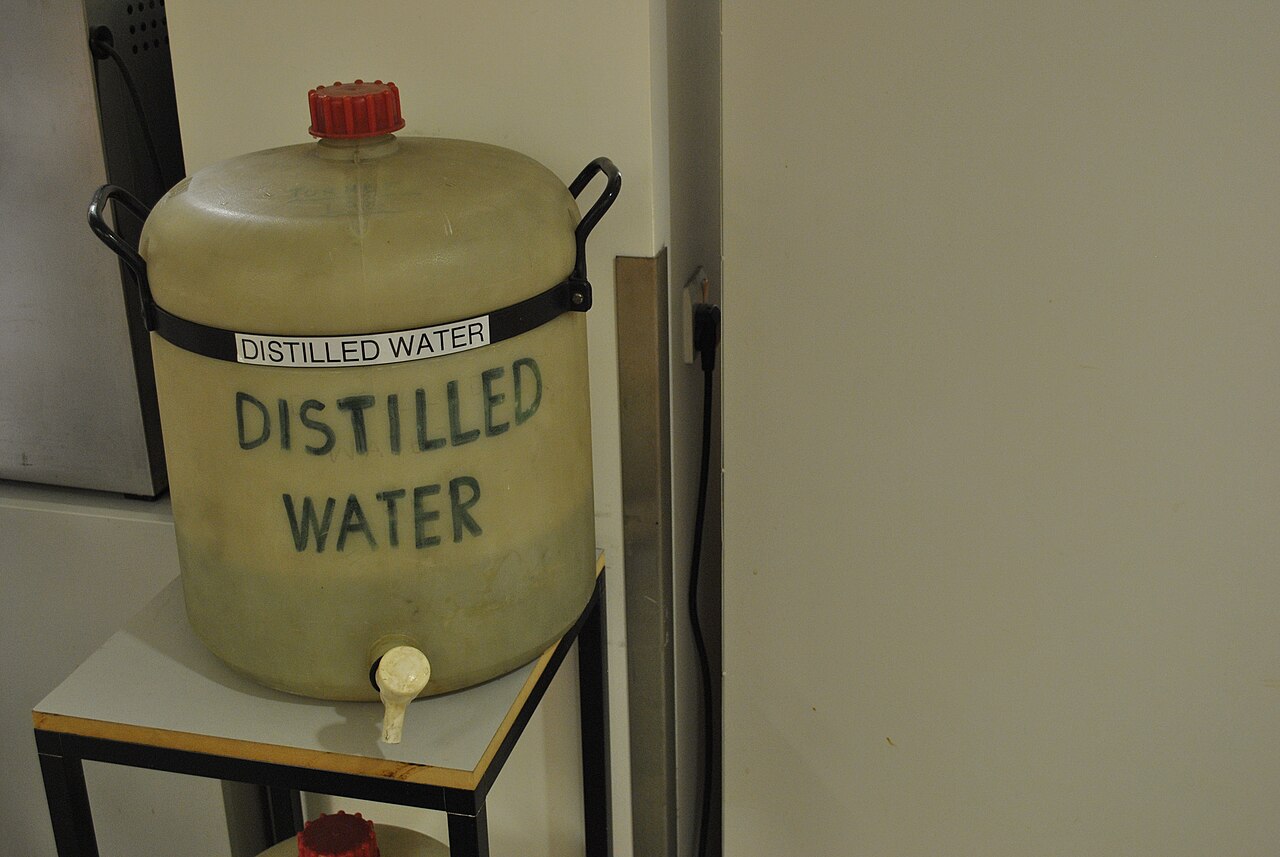
DI, distilled, RO and “purified” are not interchangeable.
Treatment methods remove different contaminants. None of these labels alone confirms conductivity, pH, particle load, biological condition or compatibility after the water circulates through a real machine.
Measure and document the properties required by the equipment manual after filling and circulation.
External image: UCL Mathematical & Physical Sciences / O. Usher, CC BY 2.0 via Wikimedia Commons.What each common label really tells you
Potable, not equipment-qualified. Hardness, chloride, conductivity, particles and biological content vary. Use only if the exact manufacturer explicitly permits it and the tested supply meets every limit.
RO removes much of the dissolved load, but rejection varies with membrane condition, pressure and feed chemistry. Post-treatment or polishing may still be required.
Produced by evaporation and condensation. It can be low in dissolved minerals, but storage container, airborne contamination and manufacturing quality still matter. Some lasers require it; others prohibit it.
Ion-exchange treatment lowers ionic content and conductivity. Fresh DI water can become corrosive or rapidly change chemistry when exposed to air and metals. Use only when the system permits it.
A broad label that may describe RO, distillation, ion exchange or combinations. Ask for measured conductivity, pH and the applicable standard rather than trusting the word alone.
A manufacturer-specified coolant may include corrosion inhibitor, biocide or freeze protection. It can be the safest choice when its part number and concentration match the machine.
Very high purity is valuable in semiconductor and laboratory processes, but it is not automatically compatible with an industrial chiller. Excess purity can increase material-extraction risk.
Laser welding coolant decision checker.
Use this conservative screening tool before filling or refilling. It does not replace the laser source and chiller manuals; it helps you identify when information is missing or a coolant plan should stop.
Proceed with documented controls
Your plan starts with current manuals and an approved fluid. Record the batch, conductivity, pH where specified, setpoints, filter status and date before commissioning.
Refill the loop like a controlled process.
The exact drain, flush, bleed and inspection steps are model-specific. The sequence below is a planning checklist, not a substitute for the service manual or lockout procedure.
Identify every component in the loop
Record the laser source, chiller, welding head, optional sensors, hoses, filter part number and any approved additive. A replacement chiller can change the water requirement even when the laser is unchanged.
Read the current manuals before draining
Confirm fill volume, allowed water type, conductivity, pH, temperature, flow, pressure, additive concentration, freeze protection and service interval. Check serial-number-specific revisions.
Shut down and isolate safely
Follow the manufacturer’s power-down, cooling and lockout instructions. Never open a hot, pressurized or energized system. Protect optical connectors and electronics from spills.
Inspect the drained coolant and loop
Document color, cloudiness, odor, particles, slime, metallic debris and sediment. Unusual findings are evidence to diagnose, not a reason to pour fresh water over the problem.
Flush only with an approved procedure
Do not introduce household cleaners, acids, bleach or unapproved descalers. If changing coolant chemistry, fully drain and flush as directed so incompatible additives are not mixed.
Replace or clean filters as specified
A fresh fluid charge cannot restore flow through a loaded filter. Use the specified micron rating and verify that seals, strainers and pump inlets are correctly seated.
Fill slowly and remove trapped air
Use clean tools and closed containers. Bleed or circulate according to the manual. Air pockets can reduce cooling, cause cavitation and create misleading level changes.
Commission and log the baseline
Check leaks, level, flow, pressure, return temperature, alarms, conductivity and pH where required. Record the date, fluid lot, additive concentration and next inspection.
What the coolant is trying to tell you.
Stop and diagnose repeated temperature or flow alarms. Resetting the machine without finding the cause can allow a small water-side issue to become an expensive source or head failure.
Cloudy or discolored water
Possible corrosion products, mixed additives, suspended solids or biological contamination. Compare a sample with fresh approved coolant and investigate the source.
Action: inspect, test and follow the manufacturer’s reconditioning procedure.Rising temperature or high-temperature alarm
Possible low flow, scale, loaded filter, trapped air, dirty condenser, poor room ventilation, incorrect setpoint or insufficient cooling capacity.
Action: evaluate the entire thermal path—not only the water bottle.Low-flow alarm
Possible low level, blocked filter, kinked hose, closed valve, air lock, pump damage, ice formation or obstructed passages.
Action: stop and verify the approved flow/pressure range before welding.Conductivity rising faster than expected
Possible ionic contamination, metal extraction, residue from a prior fluid, additive dosing or an open reservoir. The acceptable value depends on the manual and fluid chemistry.
Action: trend the measurement; do not chase “zero” by uncontrolled dilution.Slime, odor or recurring debris
Possible biological fouling or a contaminated container/fill method. Adding an arbitrary biocide may damage the laser loop or create hazardous waste.
Action: obtain an approved cleaning and biocide plan.Condensation on hoses or the head
The water setpoint may be too low for ambient temperature and humidity. Dew point can change across a shift as doors open or weather changes.
Action: follow the model’s condensation margin and environmental limits.There is no universal monthly water-change rule.
Some laser manuals call for monthly replacement; other equipment may use annual cooling-water service or condition-based reconditioning. Use the strictest applicable requirement across the laser source, chiller, head and approved coolant.
Operator checks
- Coolant level inside the allowed range
- No visible leaks or hose damage
- No unusual pump noise or vibration
- Supply and return temperatures stable
- No flow, pressure or temperature alarms
- No condensation at connectors or optics
Condition controls
- Conductivity and pH where specified
- Color, clarity, odor and sediment
- Filter loading and correct micron rating
- Condenser and air-filter cleanliness
- Hose, clamp, seal and fitting condition
- Maintenance log and fluid shelf life
Freeze protection
- Confirm minimum storage temperature
- Use only an approved antifreeze chemistry
- Measure the authorized concentration
- Account for viscosity and heat-transfer change
- Drain where the manual requires it
- Remove temporary mixture when instructed
Ask for these records before commissioning.
Good coolant management begins when the welding system is specified—not after the first alarm. Request enough information to make refilling repeatable for every operator and service technician.
Identify the system
- Laser-source model and serial number
- Chiller model and rated capacity
- Welding-head and output-cable configuration
- Number of cooling circuits and port map
- Nominal flow, pressure and temperature
- Ambient and storage limits
Specify the fluid
- Approved water type or premix part number
- Conductivity limit and measurement temperature
- pH, hardness or ion limits where applicable
- Corrosion inhibitor or biocide requirements
- Freeze-protection chemistry and ratio
- Container and shelf-life controls
Make maintenance repeatable
- Drain, flush, fill and air-bleed procedure
- Filter type, micron rating and spare quantity
- Inspection and replacement interval
- Accept/reject appearance criteria
- Baseline readings after commissioning
- Authorized service and escalation contact
Send the model numbers. Get a compatible coolant plan.
Oceanplayer can review the laser source, chiller, welding head, climate and duty cycle before recommending a handheld laser welding configuration. Include photos of the nameplates and any current water-quality or alarm readings.
Related laser welding resources.
Coolant control protects the equipment. The next step is to match the welder, process window, joint and safety controls to the production requirement.
Laser welding chiller water questions.
These answers are deliberately conservative because the wrong fluid can damage expensive components. The current manual for the exact model remains the final authority.
What water should I put in a laser welding machine chiller?
Use the water or approved coolant specified by both the laser-source and chiller manufacturers for the exact models. It may be deionized, distilled, purified or a premix. Do not choose by a generic label alone; also confirm conductivity, pH, additives, filtration, temperature and maintenance interval.
Can I use tap water in a laser welder water cooler?
Tap water is usually a poor default because hardness, chlorides, conductivity, particles and biological content vary. Use it only if the exact manufacturer explicitly permits it and a tested sample meets every published limit. “Softened” tap water is not automatically suitable.
Is deionized water always best for a fiber laser?
No. Some fiber-laser manuals accept DI water, while other laser and cooling products explicitly prohibit pure DI water because it can be aggressive toward aluminum, brass or other wetted materials. Follow the model-specific instruction and approved inhibitor plan.
Is distilled water better than deionized water?
Neither is universally better. They are produced by different treatment methods and can have different contamination and compatibility profiles. Coherent, for example, publishes one product manual that requires distilled water and another that prohibits pure DI water, while a cited TRUMPF system says not to use distilled water.
Does pure or deionized water conduct electricity?
Fresh high-purity water has low conductivity, but it is not nonconductive. It quickly absorbs carbon dioxide and ions from air, containers, hoses, metals and additives. Measure conductivity using the manual’s limit and method after filling or circulation where required.
How often should laser chiller water be changed?
There is no universal interval. A cited Raycus manual recommends monthly replacement and no more than two months for that model; other equipment may use longer service or condition-based reconditioning. Follow the strictest applicable current manual and inspect the fluid between scheduled changes.
Can I add ordinary antifreeze to a laser chiller?
Do not add automotive or generic antifreeze unless the manufacturer approves the exact chemistry and concentration. Antifreeze can change viscosity, cooling capacity, conductivity, seal compatibility and waste classification. Some brands publish model-specific cold-weather products or ratios.
Why is the chiller water becoming cloudy or green?
Possible causes include corrosion products, mixed or degraded additives, suspended particles, biological contamination or a dirty filling container. Stop, document the condition and follow the approved inspection and reconditioning procedure rather than only topping up.
Can I mix distilled and deionized water?
The more important question is whether the final fluid meets the approved chemistry. Do not mix fluids to improvise a specification, and never combine unknown inhibitors, biocides or antifreeze packages. When changing coolant type, drain and flush according to the manufacturer’s procedure.
Why does my laser welder show a high-temperature alarm after a refill?
Possible causes include trapped air, low level, incorrect hose routing, closed valves, a loaded filter, insufficient flow, an incorrect setpoint, a dirty condenser or a pump problem. Confirm the full thermal path and the specified source/head circuits before resetting production.
Can the water temperature be set as low as possible?
No. A setpoint below the room dew point can create condensation on the laser, head, hoses or connectors. Use the manufacturer’s temperature range and condensation margin for the actual ambient temperature and humidity.
What measurements should be recorded after filling?
At minimum, record fluid type and lot, additive concentration, fill date, level, supply/return temperatures, flow or pressure, filter status, leaks and alarms. Also record conductivity, pH and other chemistry when the manual requires them.
Technical references and image sources
This guide is educational and uses public manufacturer examples to demonstrate model dependence. Specifications can change; verify the latest manual and approved service bulletin for the exact serial number before filling, servicing or modifying a cooling system.