

How Thick Can a 1500W Fiber Laser Cut?
For planning, a well-configured 1500W fiber laser is strongest on thin-to-medium sheet: commonly up to about 8 mm mild steel with oxygen, 4 mm stainless steel with nitrogen and 3 mm aluminum with nitrogen. Some machine charts show occasional upper limits around 10–12 mm mild steel, 5–6 mm stainless or 4 mm aluminum, but those figures are not the same as stable, economical production.
The real answer depends on the complete cutting system: source and beam quality, cutting head, focus, nozzle, assist gas, pressure and purity, material grade, surface condition, part geometry, speed target and acceptable edge quality. Use published maximum thickness only as a screening number; qualify your own parts before purchasing.
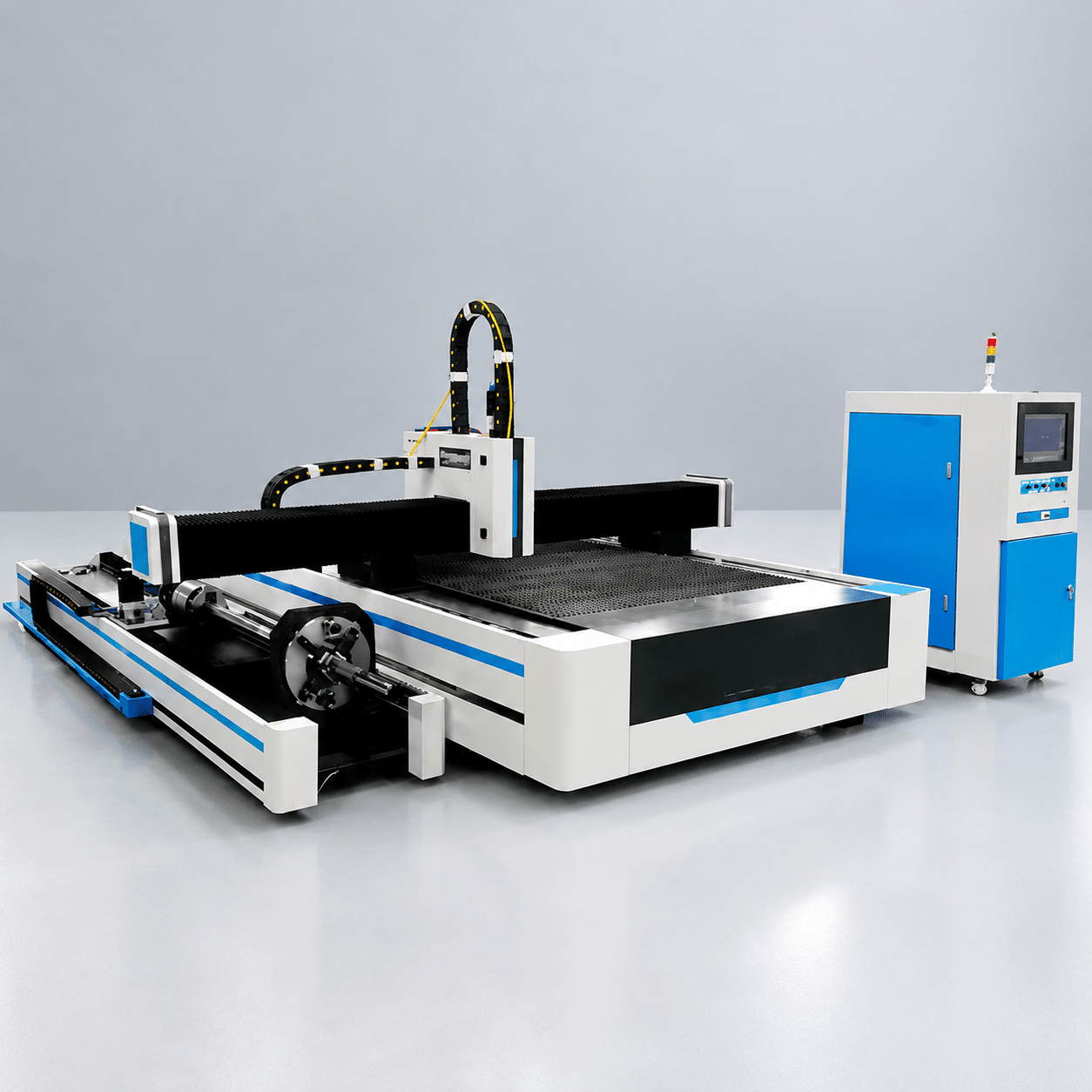
Buy for the work you repeat.
A 1500W machine can sometimes sever material beyond its comfortable production range. That does not mean it will pierce quickly, hold an acceptable edge, repeat across an entire sheet or meet your hourly output. Size the laser around the thickness that dominates your jobs—not the thickest part you may cut once.
About 0.039–0.315 in. Test 10–12 mm before treating it as a sellable production capability.
About 0.039–0.157 in. Five to six millimeters is an upper-edge application for validation.
About 0.039–0.118 in. Four millimeters may be feasible, but speed and dross can become limiting.
Plan around roughly 1–2 mm brass and up to about 1 mm copper before sample testing.
1500W describes laser output—not guaranteed thickness.
A 1500W, or 1.5 kW, fiber laser source can deliver 1.5 kilowatts of optical output at its rated condition. It does not describe the machine’s total electrical demand, nor does it define a universal cutting thickness. The focused power density and the system’s ability to maintain that focus, pierce the sheet and eject molten metal determine the usable process window.
The source rating is only one part of the chain. Delivery losses, beam quality, focus position and spot size determine how energy arrives at the workpiece.
The laser heats the kerf while oxygen, nitrogen or clean dry air helps remove material. Gas choice changes both capacity and edge chemistry.
A useful rating includes pierce time, speed, dross, roughness, heat tint, dimensional accuracy, consumable life and uptime—not just whether the beam passes through.
Manufacturers may publish the thickest sheet a particular configuration has severed under tuned conditions. Even machine brochures commonly warn that maximum-thickness data are for reference and may not be recommended for continuous use. A buyer should ask for a separate production chart showing speed, gas, nozzle, focus, pierce method and edge acceptance.
Why two 1500W machines can produce different results
The laser source may have the same nominal power while the machines differ in beam parameter product, collimation, focal length, autofocus repeatability, head contamination control, nozzle centering, Z-axis dynamics and gas delivery. A rigid bed and stable motion system also matter when small contours or tight tolerances are required.
Material variation adds another layer. Mill scale, protective film, coatings, alloy, temper, flatness and thickness tolerance all change process behavior. Reflective metals impose additional demands on source protection and head monitoring. This is why copying a parameter sheet from a different machine rarely creates a qualified process.
Use the table below as a conservative buying screen. Then request a sample cut in the exact grade, thickness and surface condition you intend to run.

Typical 1500W fiber laser cutting thickness by material
These are practical planning bands synthesized from published machine literature, common 1.5 kW applications and real-world buying examples. They are not a machine guarantee. “Routine planning” means a reasonable range to investigate for recurring work. “Upper-edge validation” means sample cutting is mandatory and a higher-power machine may deliver better economics.
| Material | Typical assist gas | Routine planning band | Upper-edge validation band | Buyer interpretation |
|---|---|---|---|---|
| Mild / carbon steel | Oxygen for thicker work; nitrogen or air for selected thin-sheet requirements | 1–8 mm 0.039–0.315 in | 10–12 mm 0.394–0.472 in | Core 1500W application Oxygen adds reaction energy, but leaves an oxidized edge. At the upper end, pierce time, scale, dross and speed must be checked. |
| Stainless steel | High-pressure nitrogen for an oxide-free edge; clean dry air for cost-sensitive work if discoloration is acceptable | 1–4 mm 0.039–0.157 in | 5–6 mm 0.197–0.236 in | Strong thin-sheet fit Nitrogen relies on laser energy for melting and gas momentum for ejection, so the comfortable range is lower than oxygen-cut mild steel. |
| Aluminum alloy | High-pressure nitrogen; air for qualified applications | 1–3 mm 0.039–0.118 in | Up to about 4 mm 0.157 in | Test alloy and surface Thermal conductivity, reflectivity, alloy and film can narrow the process window. Confirm source and head approval. |
| Brass | Nitrogen | Up to about 2 mm 0.079 in | 2–3 mm 0.079–0.118 in | System-dependent Reflectivity and alloy behavior make process protection and stable piercing important. Do not assume every 1500W system is approved. |
| Copper | Nitrogen | Up to about 1 mm 0.039 in | 1–2 mm 0.039–0.079 in | Special qualification Use only a source, delivery path and head rated for copper. Back-reflection monitoring and representative sample cuts are essential. |
| Galvanized steel | Oxygen, nitrogen or air depending substrate and edge requirement | 1–3 mm 0.039–0.118 in | Up to about 4 mm 0.157 in | Coating and fume control The zinc coating changes the cut and produces hazardous fume. Validate both edge quality and extraction. |
A supplier may report the largest sheet that one tuned machine cut during a test. That answer can be technically true while still being a poor production recommendation. Ask whether the figure is a clean production cut, a slow-quality cut, or simply maximum severance. Also request the speed, pierce time, assist gas, edge photographs and post-cut requirement.
Capacity question
Can the machine cut the sheet at all? This is the upper boundary often shown in marketing charts.
Evidence: complete separation, no uncut sections and no damaging alarm.
Business question
Can it repeatedly make accepted parts at the speed and cost your operation needs?
Evidence: repeatable pierces, edge acceptance, cycle time, gas consumption, consumable life and stable shifts.
Is 1500W a practical fit for your material?
Select a representative job. The checker compares it with conservative planning bands and explains which assist-gas route and validation step deserve attention. It is a planning aid, not a cutting parameter sheet.
What changes when a 1500W laser cuts different metals?
Thickness alone does not rank cutting difficulty. The same 3 mm sheet can require very different gas pressure, focus, speed, source protection and post-processing depending on the metal and edge requirement.
Mild and carbon steel
Best thickness reachOxygen reacts with hot iron and contributes exothermic energy, which is why a 1500W laser can cut thicker mild steel than stainless or aluminum. The trade-off is an oxide layer on the edge. That layer may need removal before powder coating, adhesive bonding or quality-critical welding.
- Use a controlled oxygen process and the OEM’s nozzle/focus table.
- Check corner burning, scale, dross and pierce spatter as thickness increases.
- For oxide-free requirements, nitrogen may work on thinner sheet but demands more laser energy and gas flow.
Stainless steel
Clean thin-sheet edgeHigh-pressure nitrogen clears the molten metal while suppressing oxidation. Because nitrogen does not add the reaction heat that oxygen supplies, thickness and speed depend more directly on available optical power and gas delivery. A good 1500W application is thin stainless enclosures, food-equipment parts and general sheet fabrication.
- Confirm nitrogen pressure, flow capacity and purity at the machine.
- Inspect lower-edge burr, striation angle and heat tint.
- When the work is regularly above 4 mm, compare 3 kW cycle time and gas economics.
Aluminum alloy
Alloy-sensitiveAluminum combines high thermal conductivity with a reflective surface, so the stable window can narrow as thickness rises. Nitrogen is typical when a clean edge is required. Alloy family, temper, surface finish and protective film can change the result.
- Confirm the source and head are approved for reflective material.
- Test the real alloy rather than a generic “aluminum” coupon.
- Monitor piercing, dross and cover-glass contamination.
Brass and copper
Special qualificationThese materials should not be treated as a simple thickness extension of steel. Cold-surface reflectivity can send energy back through the optical path, while copper rapidly conducts heat away. Modern protected fiber systems can process them, but compatibility must be confirmed for the exact source, delivery fiber and head.
- Stay within the supplier’s approved material and thickness range.
- Use monitored piercing and keep optics in verified condition.
- Do not improvise with unapproved surface coatings to “make the beam absorb.”


Assist gas can change the practical thickness as much as the wattage.
Assist gas does more than blow smoke away. It ejects molten material from the kerf, influences oxidation and cooling, protects the optical area from contamination and changes speed, edge chemistry and cost. Pressure, purity, flow and supply stability must match the machine supplier’s specification.
Oxygen for mild steel capacity
Oxygen reacts with carbon steel and contributes heat, extending thickness capability at modest laser power. The edge is oxidized and may not be ready for coating, bonding or certain weld-quality requirements without secondary cleaning.
Nitrogen for clean, oxide-free edges
High-pressure nitrogen is common for stainless and aluminum. The laser supplies the melting energy, while gas momentum clears the kerf and limits oxidation. Flow demand can be substantial, so the gas system—not just the laser—can constrain productivity.
Clean dry air for selected thin sheet
Compressed air can reduce gas cost when edge color and chemistry are acceptable. It must be dry, oil-free, stable and compatible with the cutting head. Evaluate burr, oxidation, coating adhesion and downstream welding before release.
Nozzle diameter, standoff, centering, kerf geometry, material and thickness determine the useful pressure and flow. Too little momentum leaves dross or incomplete cuts; a poor nozzle setup at high pressure wastes gas and can destabilize the process. Use the machine’s qualified parameter set, then verify supply pressure while gas is flowing.
Check dynamic pressure
A regulator reading with no flow does not prove the machine receives the required pressure during a pierce or long cut.
Protect gas purity
Moisture, oil and particles can harm edge quality and optics. Use suitable piping, filtration and changeover equipment.
Price the full supply
For high nitrogen use, compare cylinders, bundles, liquid storage or generation against expected flow and production hours.
What determines the actual 1500W cutting limit?
When a test result falls short of a brochure number, adding power is not always the first correction. Verify the complete process chain in a controlled order.
Source and beam quality
Nominal power, stability, beam parameter product and source protection affect the achievable power density and reflective-metal compatibility.
Focus position and spot
Focus changes energy distribution through the kerf. The correct position varies with material, gas, thickness and focal length.
Nozzle and centering
A damaged, dirty or off-center nozzle creates asymmetric gas flow, excess dross and loss of cutting capacity.
Assist-gas delivery
Purity, pressure, flow, piping and dynamic stability determine whether molten metal leaves the kerf reliably.
Speed and piercing
Too fast can leave an incomplete cut; too slow can enlarge the kerf, increase heat input, burn corners and create rough edges.
Material condition
Grade, mill scale, corrosion, coatings, protective film, flatness and thickness tolerance can move a job outside the nominal chart.
A part may be “cut” but still fail because of burr height, taper, roughness, heat tint, oxide, hole quality or dimensional error. Define acceptance before testing. Otherwise one supplier can call a rough severance successful while another is quoting a coating-ready, production-quality edge.

Do not validate with one straight line.
A representative test part should include the features that consume production time and reveal process weakness. Long straight cuts prove only one motion condition. Small holes, short vectors, sharp corners, closely nested contours and multiple pierces can expose heat accumulation, lag, gas demand and motion limitations.
Use the real sheet.
Match grade, supplier, thickness, film and surface condition.
Measure cycle time.
Include piercing, travel, pallet handling and part removal.
Inspect both faces.
Record dross, burr, taper, striations, heat tint and oxide.
Repeat the nest.
A first coupon does not prove multi-hour thermal and consumable stability.
When should you move from 1500W to 3000W?
More power is justified when it changes the economics or risk of your recurring work. A real customer case published by a laser manufacturer illustrates the distinction: a buyer initially considered 1.5 kW for 1–3 mm carbon and stainless steel, 2 mm aluminum and occasional 1 mm copper, then selected 3 kW to support future 4–6 mm carbon and stainless work with more stability and range.
| Decision factor | 1500W is usually attractive when… | Compare 3000W when… | Evidence to request |
|---|---|---|---|
| Thickness mix | Most cutting hours are thin sheet inside the routine bands above. | A large share of work sits near the 1500W upper edge or future orders will be thicker. | Material-by-material speed charts and cuts from your dominant thicknesses. |
| Utilization | Prototypes, job-shop work or one-shift production can tolerate moderate cycle time. | Two shifts, high nesting density or bottleneck operations make every minute valuable. | Full-nest cycle comparison, not a single straight-line speed. |
| Gas economics | Oxygen-cut mild steel or low-volume nitrogen use keeps operating cost manageable. | Nitrogen cutting at the upper range makes speed and gas-per-part critical. | Gas flow, pressure, cutting time and cost per accepted part. |
| Future capacity | Your five-year product mix is expected to remain thin-gauge. | New contracts are likely to add 4–6 mm stainless/aluminum or thicker steel. | Scenario model with annual hours, selling price, labor and financing—not just purchase price. |
| Quality reserve | The approved part has comfortable focus, speed and gas margins. | Current tests require slow cutting, frequent tuning or edge rework. | Repeat test across multiple sheets and consumable condition checks. |
A 3 kW machine still needs correct focus, gas delivery, nozzle centering, extraction and maintenance. Buy more power to create speed and process margin—not to hide unstable fundamentals.
Troubleshoot the cut in a controlled sequence.
If a previously stable job deteriorates, do not immediately reduce speed or raise pressure. Record the defect, compare with an approved part and isolate one variable at a time.
| Observed defect | Likely checks | Why it matters | Controlled response |
|---|---|---|---|
| Uncut sections or intermittent breakthrough | Power delivery, focus, lens contamination, nozzle centering, gas flow, material thickness and speed | The kerf is not receiving enough effective energy or molten-metal ejection. | Verify optics and calibration first; confirm dynamic gas supply; restore the approved parameter set before changing one variable. |
| Heavy lower-edge dross | Speed, focus, nozzle condition, standoff, pressure and flow | Molten material is not leaving the kerf cleanly or is resolidifying on the bottom edge. | Inspect nozzle and centering; confirm focus and gas; make small speed trials with documented samples. |
| Rough, angled striations | Speed-to-power balance, focus, gas, beam alignment and material consistency | The cutting front may be unstable or lagging behind motion. | Compare with the OEM chart and an approved coupon; do not chase one edge section while ignoring the rest of the contour. |
| Corner burn or oversized kerf | Corner control, acceleration, low-speed power modulation and oxygen setting | Motion slows at geometry changes, increasing local heat input. | Use controller corner functions and qualified power ramps instead of one constant setting. |
| Rapid cover-glass contamination | Pierce height, pierce strategy, nozzle, gas, material film and head sealing | Back-spatter or contamination can reduce delivered power and damage optics. | Stop and inspect according to the head supplier’s procedure; correct piercing before resuming production. |
| Reflection or source alarm | Material compatibility, focus, piercing, head condition and source protection | Reflective return can threaten the delivery system. | Stop the process. Follow the supplier’s alarm procedure and do not bypass protection or continue with improvised settings. |
Avoid random tuning
- Do not change focus, speed, pressure and power simultaneously.
- Do not judge only the top face; inspect the lower edge and cut wall.
- Do not continue cutting with a damaged nozzle or suspected contaminated optic.
- Do not use a thicker demonstration coupon as proof of full-production readiness.
Keep a process record
- Material certificate, actual thickness and surface condition.
- Source power, gas type/purity, pressure under flow and nozzle.
- Focus, standoff, speed, pierce method and controller version.
- Photos, measurement results, consumable condition and operator.
Cutting capacity is irrelevant without engineered safety.
An industrial 1500W fiber laser is hazardous to eyes and skin and can create reflected-beam, fire, electrical, compressed-gas, noise and airborne-contaminant risks. A production system should rely first on enclosure, interlocks, controlled access, extraction and approved procedures—not on eyewear as the only barrier.

Use a compliant enclosed system with functioning interlocks, viewing windows rated for the wavelength and controlled service procedures.
Laser cutting generates metal fume and particulate. OSHA guidance calls for adequate ventilation to control hazardous fumes and vapors.
Identify coatings, plating, oils and unknown materials before cutting. Zinc, chromium, nickel and other constituents change the fume hazard.
Manage oxygen enrichment, cylinder/storage hazards, hot parts, sparks and combustible material according to the facility risk assessment.
Assign laser-safety and process responsibilities, train operators and maintenance staff, and document lockout and service access.
Eye, face, hand, hearing and respiratory protection must be selected from the actual hazard assessment and applicable rules.
Warning symbol: ISO 7010 W004 / Wikimedia Commons, public domain.
How to validate a 1500W cutter before you buy
A good supplier test converts a brochure number into evidence tied to your parts. Send representative drawings and material, define acceptance in writing and request complete process data.
Build the material-thickness matrix
List each grade and thickness, then add estimated annual hours or part quantities. Highlight the combination that dominates machine time and the combination that creates the highest business risk.
Define accepted edge quality
Specify whether oxide is allowed, maximum burr or dross, dimensional tolerance, smallest hole, corner quality, visible-surface requirement and downstream welding/coating needs.
Send a representative nest
Include long and short contours, dense piercing, small holes, sharp corners and real part spacing. A single rectangle cannot predict production throughput.
Record the full parameter set
Capture gas type and purity, nozzle, pressure under flow, focus, speed, pierce method, source power and consumable condition. Ask for unedited video and both-face photographs.
Compare cost per accepted part
Include cutting and piercing time, gas consumption, secondary deburring or oxide removal, labor, consumables, expected uptime and material yield. Purchase price alone cannot show the best power level.
Repeat before sign-off
Run enough parts to reveal drift, heat accumulation and consumable behavior. Define factory acceptance and site acceptance criteria before the machine ships.
“Can you demonstrate my most common grade, thickness and geometry at the quoted cycle time, then give me the exact edge acceptance and operating conditions?” A useful answer includes evidence. “The brochure says 12 mm” is not an acceptance test.
Validate your material before selecting laser power.
Send the material grade, thickness range, drawing, annual volume, edge requirement and downstream process. Oceanplayer can review the application and help organize a representative sample test instead of relying on a generic maximum-thickness claim.
Related engineering resources
1500W laser cutting FAQ
What is the maximum thickness a 1500W fiber laser can cut?
There is no single maximum for every machine and material. As a conservative planning guide, recurring work is commonly strongest around 1–8 mm mild steel with oxygen, 1–4 mm stainless with nitrogen and 1–3 mm aluminum with nitrogen. Upper-edge cuts around 10–12 mm mild steel, 5–6 mm stainless or about 4 mm aluminum may be possible on some systems, but must be treated as sample-test territory rather than guaranteed production.
Can a 1500W laser cut 12 mm carbon steel?
Some configured 1500W systems can sever or cut approximately 12 mm carbon steel with oxygen under tuned conditions. Whether it is commercially useful depends on pierce time, speed, edge roughness, dross, scale, contour geometry and repeatability. If 12 mm is recurring work, compare a 3 kW machine rather than buying from the maximum figure alone.
Can a 1500W fiber laser cut 6 mm stainless steel?
Six millimeters is near the upper edge of many 1500W stainless-steel charts. A qualified machine may cut it, but high-pressure nitrogen demand, speed and lower-edge burr can make the process less economical. Request a full-nest sample and compare cost per accepted part with 3 kW.
How thick can a 1500W laser cut aluminum?
For recurring production, approximately 1–3 mm aluminum is a sensible planning range. Around 4 mm can be feasible on a suitable machine, but alloy, temper, surface, film, nitrogen delivery, beam quality and reflective-material protection matter. Test the actual aluminum grade and geometry.
Can 1500W cut copper or brass?
Yes, on systems specifically approved for reflective metals. A conservative screen is up to roughly 1 mm copper and about 1–2 mm brass for recurring work, with thicker attempts requiring supplier confirmation and sample testing. The source, delivery path and cutting head must tolerate reflected energy.
Is oxygen or nitrogen better for a 1500W laser?
Neither is universally better. Oxygen is commonly used to extend mild-steel capacity and speed through a reactive cut, but it leaves an oxidized edge. Nitrogen is used for clean, oxide-free stainless and aluminum edges, but requires high flow and depends more directly on laser power. Choose according to material and downstream requirements.
Can a 1500W fiber laser cut wood or acrylic?
A standard industrial metal fiber laser should not be presented as a general wood or acrylic cutter. CO₂ lasers are commonly used for many nonmetals. Machine enclosure, wavelength interaction, fire risk and toxic decomposition products must all match the material. Follow the system manufacturer’s approved material list.
What is the difference between cutting thickness and production thickness?
Cutting thickness may mean the machine can separate the material once. Production thickness means it can repeatedly pierce and cut accepted parts at a speed, gas cost, consumable life and uptime suitable for business. Production thickness is the more important buying number.
Is 1500W or 3000W better for a small fabrication shop?
1500W can be an efficient entry point when most work is thin carbon steel, stainless or aluminum and utilization is moderate. A 3000W machine becomes attractive when 4–6 mm stainless or aluminum, thicker steel, high utilization or future capacity is important. Compare full-nest cycle time and cost per accepted part.
How should I verify a supplier’s thickness claim?
Provide your actual material, thickness and drawing. Define burr, roughness, oxide, dimensional and downstream requirements. Request repeated cuts of a representative nest, record gas and parameters, inspect both faces and compare cycle time plus operating cost. Put the agreed acceptance criteria into the purchase documentation.
Sources used for this guide
Thickness ranges are presented as conservative planning bands, not copied as universal guarantees. Final settings and capacity must come from the exact machine supplier and a representative application test.
- SENFENG — Fiber Laser Cutting: Empowering Beginners in Metalworking. A documented buying example comparing a proposed 1.5 kW use case with a later 3 kW selection.
- Bodor — The Essential Guide to Choosing an Industrial Laser Cutting Machine. Material, thickness, production volume, facility and power-selection factors.
- Air Products — Optimizing Gas Supply for Industrial Lasers. Functions and trade-offs of oxygen and inert assist gases.
- Air Liquide — LASAL Lasing and Assist Gases. Nitrogen for stainless/aluminum and oxygen for carbon steel applications.
- OSHA Technical Manual, Section III, Chapter 6. Laser hazards, controls and ventilation for fumes generated by cutting and other laser interactions.
- OSHA — Laser Hazards: Standards. References to industrial laser-machine safety requirements and laser-manufacturing standards.