Laser cleaning is a better way to remove rust. You do not need strong chemicals. You make less waste. This method helps the earth and keeps workers safe. You help the planet when you use laser cleaning. Many people say it is good for the environment. It does not make much pollution. You pick a way that works well and is safe for nature.
Key Takeaways
- Laser cleaning takes away rust without using bad chemicals. This makes it safer for workers and the earth.
- This way makes very little waste. Most of the waste is dust. The dust is easy to clean up. It does not harm water or air.
- Laser cleaning works fast and is very exact. It removes rust quickly. It does not hurt the metal under the rust.
- Picking laser cleaning can help companies save money. They do not need to buy chemicals. They also spend less time cleaning up.
- Using laser cleaning is good for the planet. It helps keep the workplace safe and protects nature.
Laser Cleaning Process
How Laser Rust Removal Works
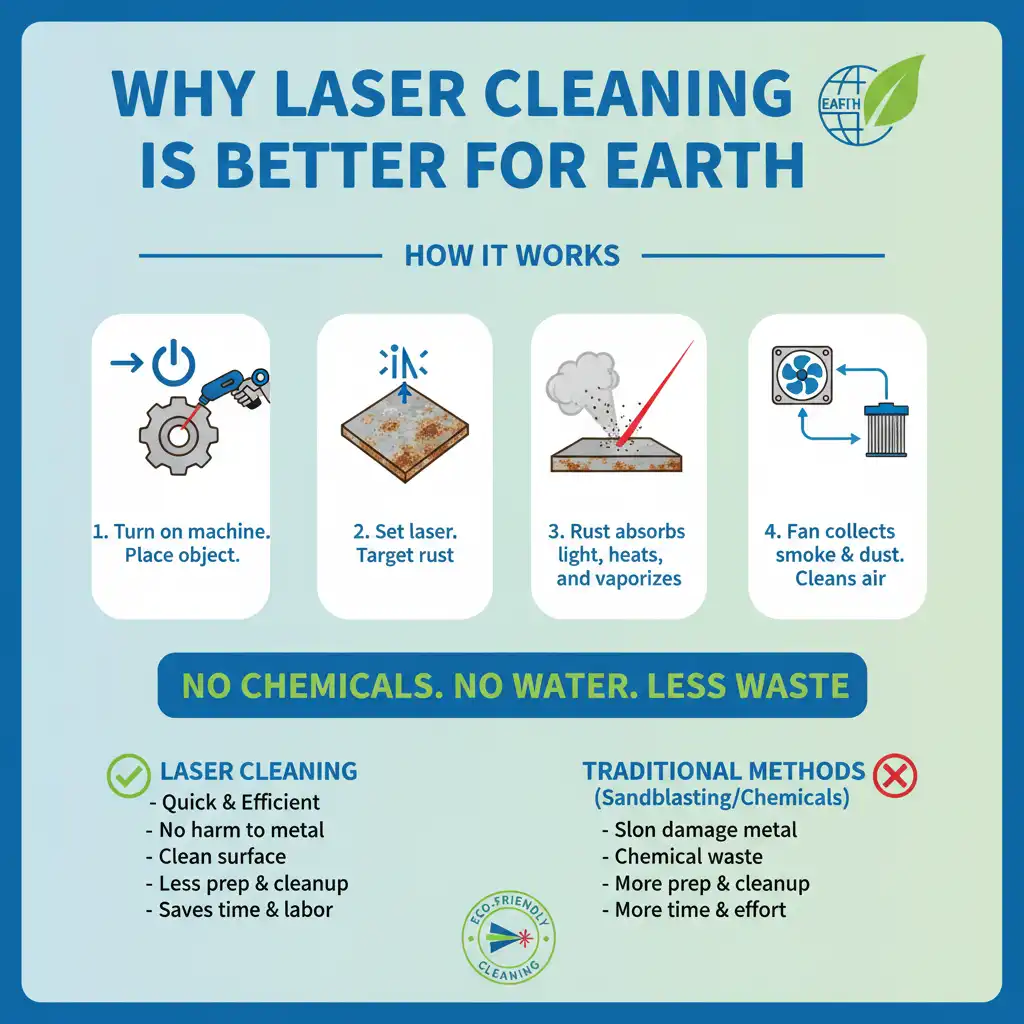
You may ask why laser cleaning is better for the earth. The reason is in how it works. When you use laser cleaning equipment, you follow easy steps:
- Turn on the laser cleaning machine. Put the object in the right spot.
- Set the laser settings. Make sure the infrared light hits the rusty part.
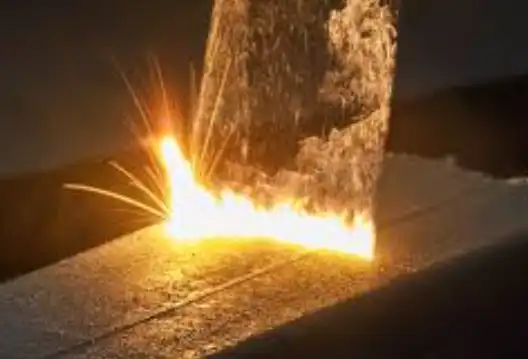
- The rust takes in the light. It gets hot fast. Then it turns into gas or comes off the metal.
- A fan pulls in the smoke and dust. This keeps the air clean.
This way does not use chemicals or water. You do not have a big mess to clean up. You make less waste. Laser rust removal is quick. It does not hurt the metal under the rust. You get a clean surface. You do not need to do extra work.
Laser rust removal works better than sandblasting or using chemicals. You do not need to get ready or clean up a lot. This saves time and helps you do more work.
Key Features of Laser Cleaning
Laser cleaning equipment has many features that make it a great choice for taking off rust:
- You can aim the laser very well. You only take off the rust and leave the metal safe.
- The process does not touch the metal. You do not scratch or harm the surface.
- Laser cleaning uses only light. You do not need to use dangerous chemicals. This helps the earth.
- The waste is very little. It is mostly dust and small bits.
- You can set up the machine to work by itself. This saves time and work.
| Feature | Description |
|---|---|
| Method | The laser does not touch the metal. It turns rust into gas without hurting the metal. |
| Efficiency | It can clean up to 15 square feet in one hour. This depends on how thick the rust is. |
| Precision | It can take off rust very carefully. It removes just a few microns. |
| Cost-effectiveness | You do not need chemicals. This can save up to 30% on upkeep over five years. |
| Safety | There are no dangerous leftovers. It is safer for people and the earth. |
You can find different kinds of laser cleaning machines for different jobs:
- Pulsed laser systems (200W–1000W) are good for most cleaning.
- Continuous wave lasers (1000W–3000W) are for tough jobs.
- Fiber lasers help save money and work well.
- CO2 lasers are for thick metal.
- YAG lasers are for special uses.
Laser cleaning is fast, safe, and good for the earth. You do not need extra stuff. You save time and do not make bad waste. That is why many companies now use laser cleaning machines to take off rust.
Traditional Rust Removal Impact
Chemical and Abrasive Waste
When people use old ways to clean rust, they often use strong chemicals and rough tools. These ways can hurt the earth in many ways. Here are some common chemicals and what they can do:
- Phosphoric acid and hydrofluoric acid can remove rust, but they can also hurt water supplies.
- Chemical agents can make pollution and can be bad for workers’ health.
- Sandblasting and wire brushing use chemicals that can leak into the ground or water.
You must be careful when you use and throw away these chemicals. If you are not careful, you can pollute the dirt and water near your work. Groups that protect the earth say that using chemicals for rust removal adds to pollution. Laser cleaning does not leave behind waste that can hurt people or nature like these ways do.
Water Use and Emissions
Many old cleaning ways use a lot of water or make dust and smoke. This can cause more pollution and waste. You can see the differences in the table below:
| Method | Environmental Drawbacks |
|---|---|
| Chemical Cleaning | Uses toxic stuff that can pollute water and hurt workers’ health. |
| Sandblasting | Makes dust and used grit, which can get in dirt and water, and makes air worse. |
When you use water to clean rust, you have to deal with dirty water. This water can carry chemicals and tiny metal pieces into rivers or drains. Sandblasting makes dust that can make the air hard to breathe. These problems do not happen with laser cleaning. You do not waste water, spill chemicals, or make bad smoke.
Picking laser cleaning helps you stop the waste and pollution from old cleaning ways. You help the earth and keep your work area safer.
Eco-Friendly Rust Removal Benefits
No Chemicals or Water Needed
You want to clean rust without hurting the earth. Laser cleaning is special because you do not need chemicals or water. You also do not need blasting media. This green way helps you skip problems from old rust removal methods. With laser rust removal, you do not need to store or throw away dangerous stuff. You do not have to worry about water spills or chemical leaks.
- You do not use chemicals or water at all.
- You do not use rough materials that make more waste.
- You only make a little dust or gas, and it is easy to handle.
- You follow tough environmental rules without extra work.
When you pick laser cleaning, your job is safer and greener. You help keep water clean and the air fresh.
Zero Emissions and Waste
Important safety note — do not treat laser cleaning as inherently “zero‑emission.” Use source capture/local exhaust ventilation (LEV) and a multi‑stage filter pack (pre‑filter → HEPA H14 ≥99.995% at MPPS → activated carbon for gases). Maintain filter logs and differential‑pressure checks, perform exposure monitoring, and require P100/N100 respirators or PAPRs plus eye and skin protection during filter changes or if monitoring shows elevated particulates/VOCs.
Laser cleaning can substantially reduce secondary waste and chemical discharge, but it is not inherently “zero‑emission.” With a properly designed source‑capture system, continuous extraction, and a multi‑stage filter pack (pre‑filter → HEPA for particulates → activated carbon or molecular beds for VOCs), emissions and airborne particulates can be kept low. Facilities must maintain filters, log differential pressure, perform exposure monitoring, and provide respirators or PAPRs during maintenance or if monitoring indicates elevated contaminants.
Laser cleaning helps you make less waste and pollution. You help your company be greener and protect nature.
Worker and Environmental Safety
You want workers and the earth to be safe. Laser cleaning helps you do both. Workers do not touch dangerous chemicals or flying pieces. The process does not make bad fumes, so the air is safe to breathe. Some laser cleaning machines can be used from far away. This keeps workers safe.
Here is how laser cleaning is different from other ways:
| Method | Worker Safety Benefits |
|---|---|
| Sandblasting | Makes dust and pieces that can hurt lungs and cause sickness. |
| Chemical Treatments | Uses strong chemicals that can hurt skin, eyes, and make bad fumes. |
| Laser Cleaning | No bad fumes or flying pieces, so workers are safer and can use machines from a distance. |
Laser cleaning also keeps nature safe. You do not use strong cleaners, so you do not make bad fumes or chemical spills. You save water because the process is dry. You do not make extra waste, so you do not pollute dirt, air, or water. The machines use energy well, so you make less pollution. Your tools last longer because laser cleaning does not scratch them.
When you use laser cleaning, you pick a safe and green way to clean rust. You make your workplace better and help the earth too.
Laser Cleaning in Industry
Industrial Applications
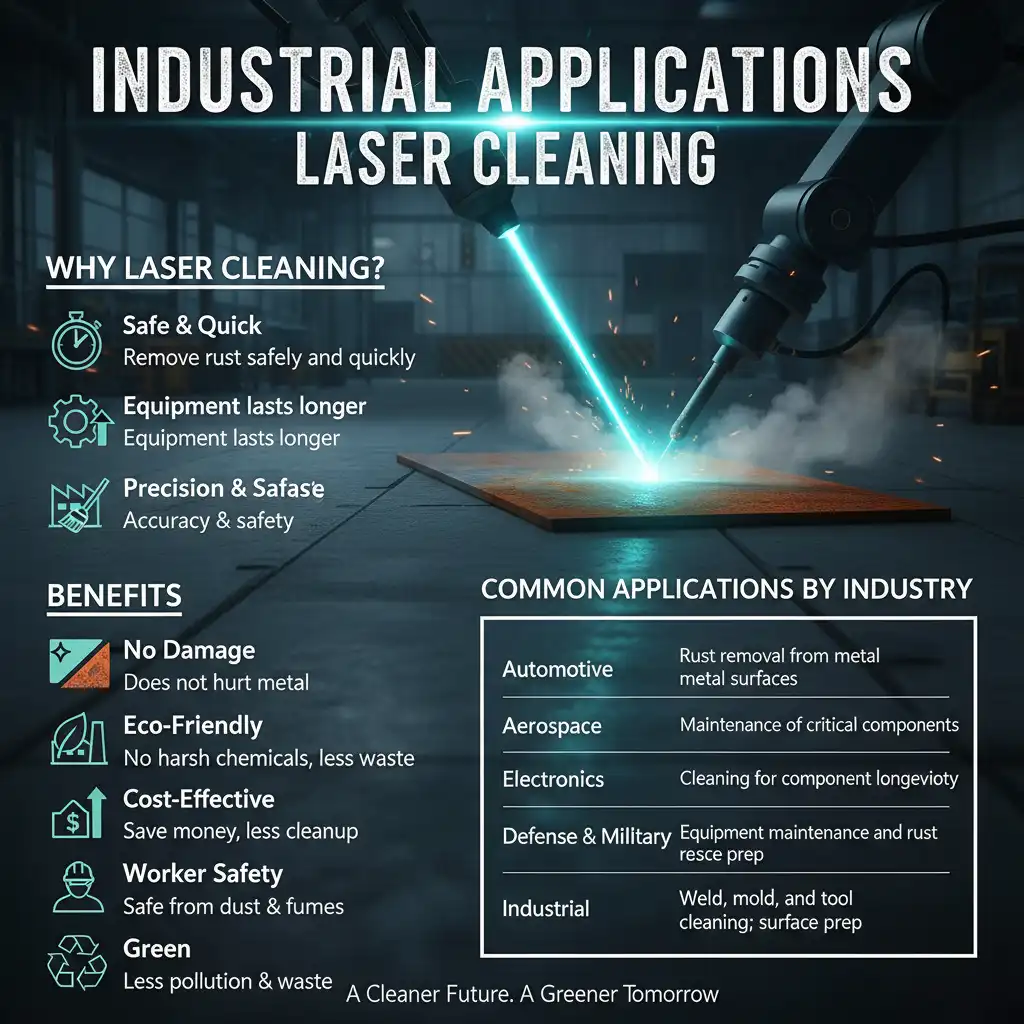
Laser cleaning is used in many industries. It helps remove rust safely and quickly. Companies want their equipment to last longer. They also want clean work areas. This technology is found where safety and accuracy are important.
| Industry | Common Applications |
|---|---|
| Automotive | Rust removal from metal surfaces |
| Aerospace | Maintenance of critical components |
| Electronics | Cleaning for component longevity |
| Defense & Military | Equipment maintenance and rust removal |
| Industrial | Weld, mold, and tool cleaning; surface prep |
Laser cleaning does not hurt the metal below the rust. You do not need harsh chemicals. You do not make extra waste. This method is fast. It helps you follow tough environmental rules. You save money because you do not buy chemicals. You also spend less time cleaning up. Workers stay safe from bad dust and fumes.
Laser cleaning helps you be more green. You make less pollution and waste. Your workplace is safer and cleaner.
Success Stories
Many companies have good results with laser cleaning:
- 🚗 Car Repair: A shop used a 300W pulsed laser. Workers took off rust fast. The metal was clean. Repairs were quicker and safer.
- 🚢 Ship Maintenance: A team used a 3000W laser on ship hulls. They got rid of thick rust and old paint. The surface was smooth for new coatings.
- ✈️ Aerospace: Technicians cleaned turbine blades with lasers. They made the blades work better. They made less waste and saved 25% on costs.
- 🚙 Automotive: Factories used laser cleaning to make welds better. Productivity went up by 40%. They also helped the environment.
- ⚓ Marine: Crews cleaned ship hulls. Fuel use dropped by 15%. Ships lasted longer and had less downtime.
Micro-case (quantified pilot)
- Pilot: 300×300 mm mild-steel coupon with surface corrosion ~50 µm average. Process: nanosecond pulsed fiber laser, 1.0 kW optical, 20 kHz repetition, raster scan at 600 mm/min with ~50% overlap. Extraction/filtration: enclosed cell with source capture, HEPA H14 plus activated carbon stage. Outcome: in-trial removal of visible rust to bare metal in a single pass; vendor-validated cleaning rate in this configuration ≈0.8 m²/hr and post-clean Ra ~1.2 µm (site-dependent). Figures and parameters adapted from a consolidated review and manufacturer notes (see Deng et al., 2022; Laserax application notes).
Laser cleaning saves time and money. It keeps people and nature safe. You get better cleaning and a safer place to work.
You want to get rid of rust in a way that is safe and quick. You also want to help the planet. Laser cleaning can do all of this. You do not need to use strong chemicals. You make less waste. This keeps your team safe and helps you follow rules. Research shows laser cleaning takes off rust fast and saves money over time.
| Why Choose Laser Cleaning? | Benefit |
|---|---|
| No chemicals or water | Cleaner environment |
| Less waste and dust | Safer workplace |
| High precision and speed | More efficient operations |
When you pick laser cleaning, you help the earth and support green choices.
Sources & standards
- OSHA — Respirable crystalline silica (29 CFR 1910.1053): OSHA’s rule and enforcement directive explain the PEL (50 µg/m³) and action level that underpin the silica-risk and compliance points. (https://www.osha.gov/laws-regs/regulations/standardnumber/1910/1910.1053)
- OSHA enforcement directive (CPL 02‑02‑080): inspection guidance cited for enforcement context. (https://www.osha.gov/sites/default/files/enforcement/directives/CPL_02-02_080.pdf)
- EU BOELV / Directive (EU) 2017/2398: EU binding OEL 0.1 mg/m³ for respirable crystalline silica (supports EU exposure comparisons). (https://oshwiki.osha.europa.eu/en/themes/respirable-crystalline-silica)
- ANSI Z136.1 / ISO 11553 / IEC 60825-1: primary laser‑safety and machine‑enclosure standards that justify Class‑1 enclosure and interlock requirements. (https://www.lia.org/resources/laser-safety-standards/ansi-z1361-safe-use-lasers; https://webstore.iec.ch/en/publication/3587)
- EN 1822 / ISO 29463 (HEPA H14) and OSHA OTM — Industrial Ventilation: support HEPA/activated‑carbon extraction and LEV design recommendations. (https://www.camfil.com/insights/standard-and-regulations/en-1822-and-iso-29463-hepa-filter-factory-test; https://www.osha.gov/otm/section-3-health-hazards/chapter-3)
- Laserax (representative system specs) and BlastOne / Elcometer: vendor data supporting laser kW draw and blasting media/nozzle heuristics used in the TCO model. (https://www.laserax.com/; https://www.blastone.com/; https://downloads.elcometer.com/PDFs/Datasheets/ASME/Nozzles.pdf)
- Selected technical review: peer‑reviewed and industry white papers on laser cleaning emissions and substrate integrity—see Journal of Laser Applications and Surface & Coatings Technology for comparative studies (seek institution access or supplier white papers for full reports).
FAQ
Why should you choose laser cleaning over chemical rust removal?
Laser cleaning does not use strong chemicals. You do not have to worry about spills. There is less pollution. This way keeps your work area safer. It also helps the earth.
Why is laser cleaning safer for workers?
You do not touch toxic stuff or breathe in bad dust. Laser cleaning uses light instead of chemicals. This lowers health risks. Workers stay safe.
Why does laser cleaning create less waste?
Laser cleaning changes rust into tiny bits or gas. You do not need to clean up sand or dirty water. There is no chemical sludge. This means less mess and it is easier to throw away waste.
Why do industries prefer laser cleaning for rust removal?
Industries want cleaning that is fast and careful. They also want to help the earth. Laser cleaning saves time and money. It helps companies follow tough rules for the environment.