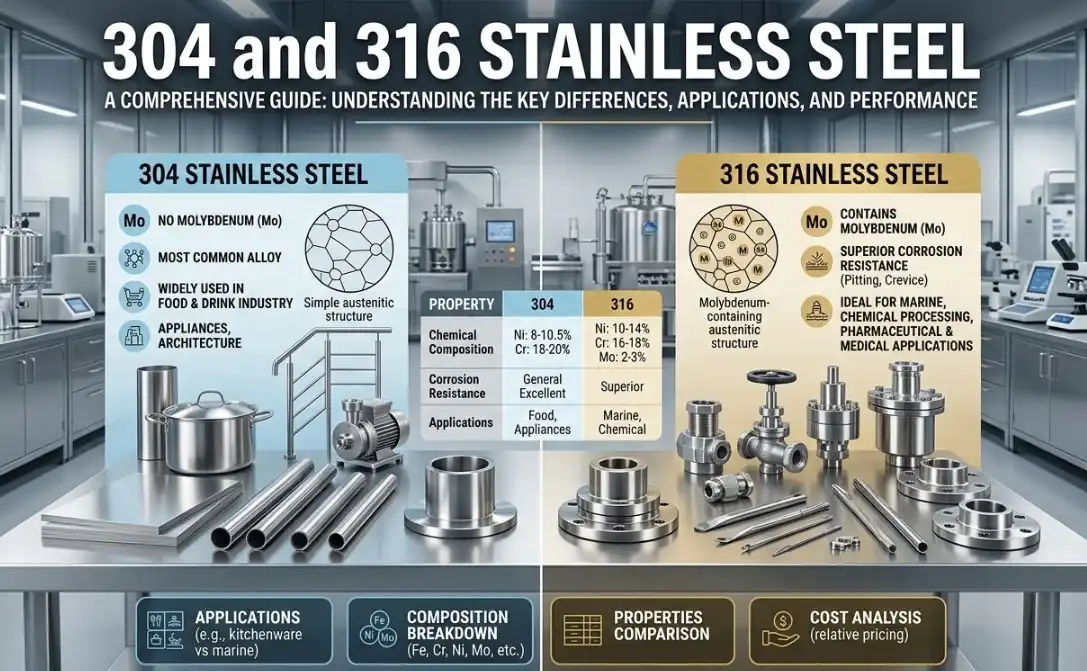
The single most reliable way to distinguish 304 from 316 stainless steel is testing for molybdenum—316 contains 2-3% Mo, while 304 contains virtually none. A $30 chemical drop test kit can detect this difference in under 60 seconds, but for mission-critical applications, handheld XRF analyzers deliver 99%+ accuracy with elemental breakdowns. This guide walks through every practical identification method available in 2026, from quick field tests to full laboratory analysis, so you can match the right approach to your budget, accuracy needs, and situation.
Quick Answer: Key Differences Between 304 and 316 Stainless Steel
Both 304 and 316 are austenitic stainless steels. They look identical to the naked eye. They feel the same. They even weigh almost exactly the same. But they are not interchangeable, and confusing them can cost you thousands—or put people at risk.
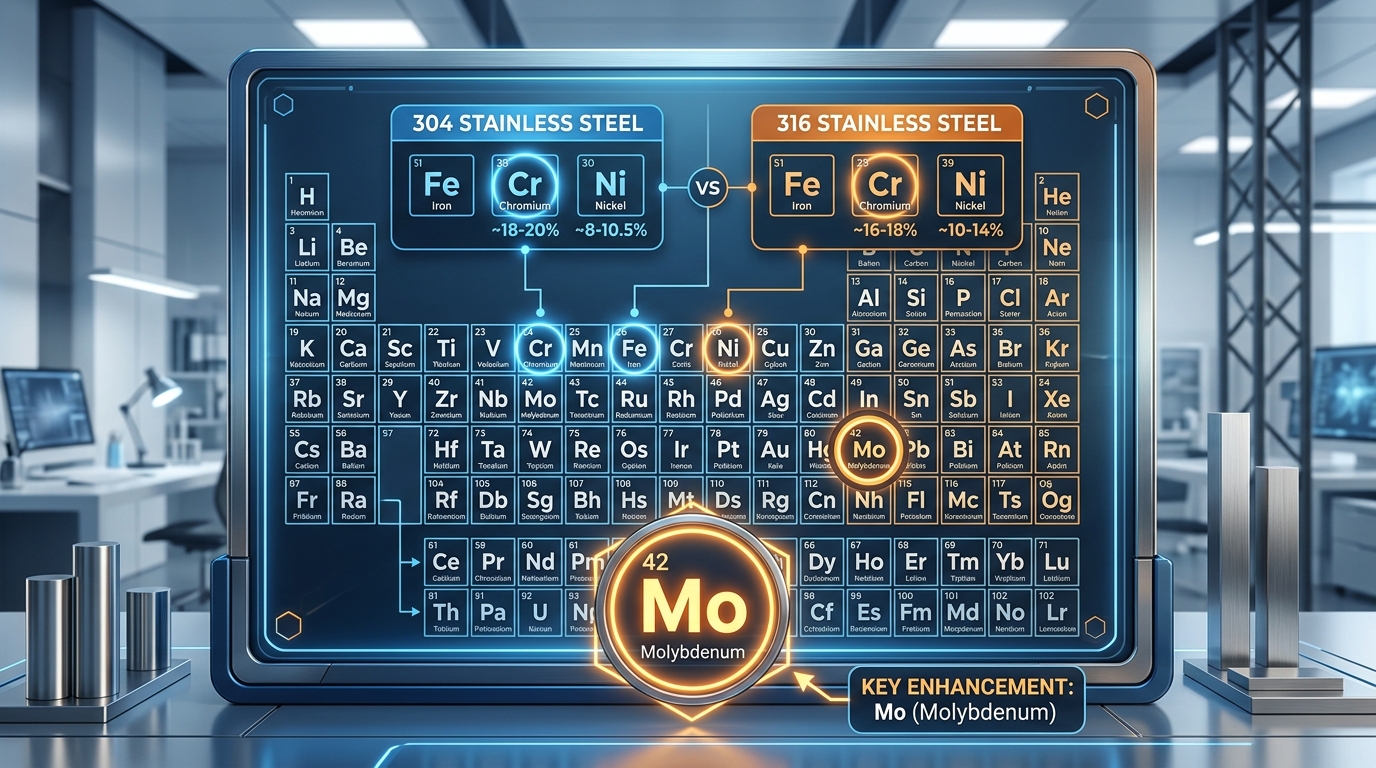
The critical difference comes down to one element: molybdenum. Grade 316 contains 2-3% molybdenum, which dramatically improves its resistance to pitting corrosion and chloride attack. Grade 304 has little to no molybdenum. That’s it. That single compositional difference is what every identification method ultimately tries to detect.
| Property | 304 Stainless Steel | 316 Stainless Steel |
|---|---|---|
| Molybdenum Content | None (or trace) | 2.0–3.0% |
| Chromium | 18–20% | 16–18% |
| Nickel | 8–10.5% | 10–14% |
| Chloride/Pitting Resistance | Moderate | Excellent |
| Typical Applications | Kitchen equipment, architectural trim, general fabrication | Marine hardware, chemical processing, pharmaceutical equipment, medical implants |
| Relative Cost (2026) | Baseline | ~20-30% premium over 304 |
Here’s the practical takeaway: if your application involves saltwater, chlorides, aggressive chemicals, or temperatures above 60°C in corrosive environments, you need 316. If it doesn’t, 304 is usually fine and saves money. The problem is proving which one you actually have.
Why Identifying 304 vs 316 Stainless Steel Matters
A stainless steel mix-up is not a minor inconvenience. It’s a liability event waiting to happen.
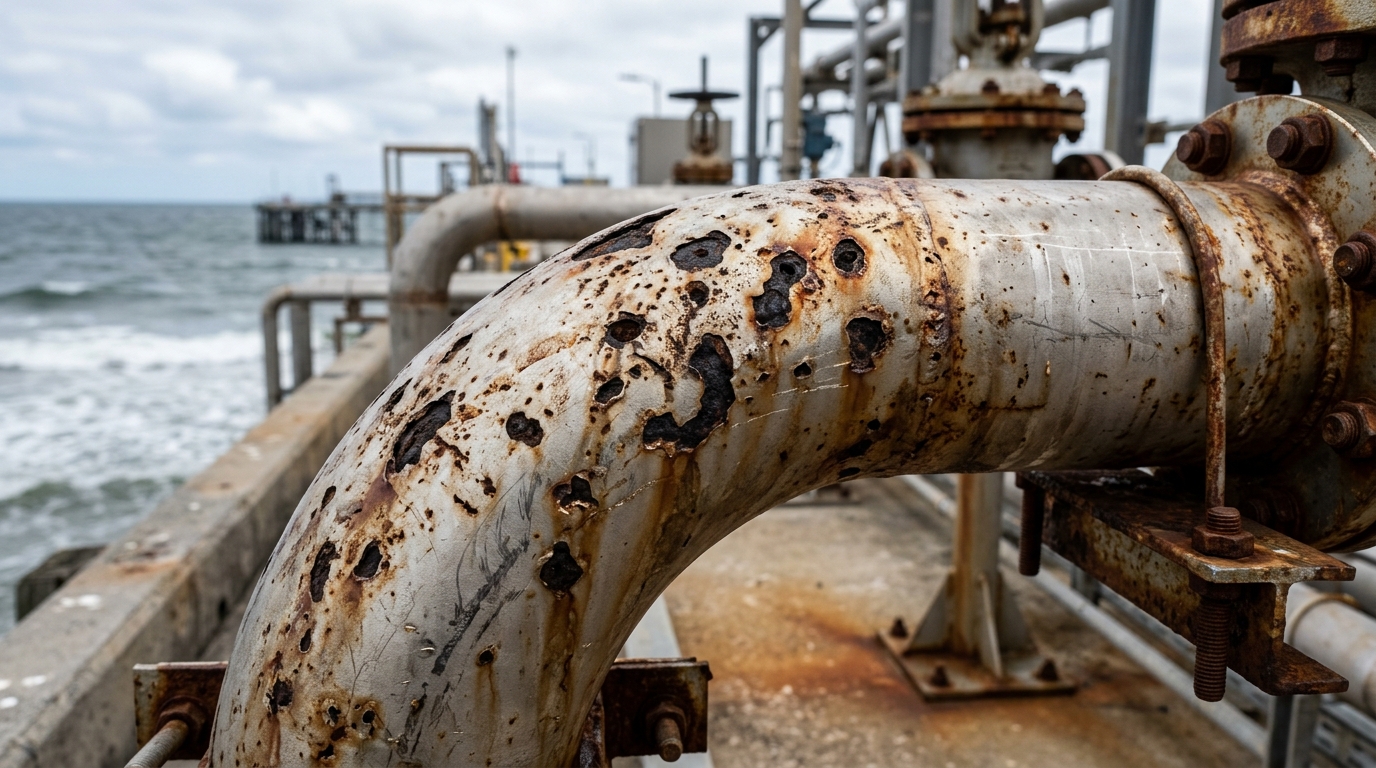
Consider a real-world scenario: a coastal desalination plant installs piping that was certified as 316 but turns out to be 304. Within 18 months, chloride-induced pitting corrosion perforates the pipes. The repair bill runs into six figures. The downtime costs even more. And someone in the procurement chain faces a fraud investigation.
This isn’t hypothetical. The ASM International has documented numerous cases where grade misidentification led to catastrophic failures in chemical processing, offshore oil and gas, and even medical device manufacturing. The consequences break down into several categories:
- Premature corrosion failure — 304 in a chloride-rich environment can develop pitting within months. 316 would last decades in the same conditions.
- Safety hazards — Structural components that corrode unexpectedly create risks ranging from chemical leaks to structural collapse.
- Regulatory violations — Industries like food processing, pharmaceuticals, and medical devices have strict material specifications. Using the wrong grade can trigger FDA warning letters or facility shutdowns.
- Financial exposure — Beyond repair costs, there’s product liability, warranty claims, and the reputational damage of a material failure.
- Insurance complications — If a failure investigation reveals you installed the wrong grade, insurance coverage gets very complicated very fast.
The price difference between 304 and 316 is typically 20-30%. That gap creates a strong financial incentive for unscrupulous suppliers to substitute 304 for 316. It also means that not testing incoming material is a gamble with terrible odds.
Chemical Composition Comparison: 304 vs 316 at the Molecular Level
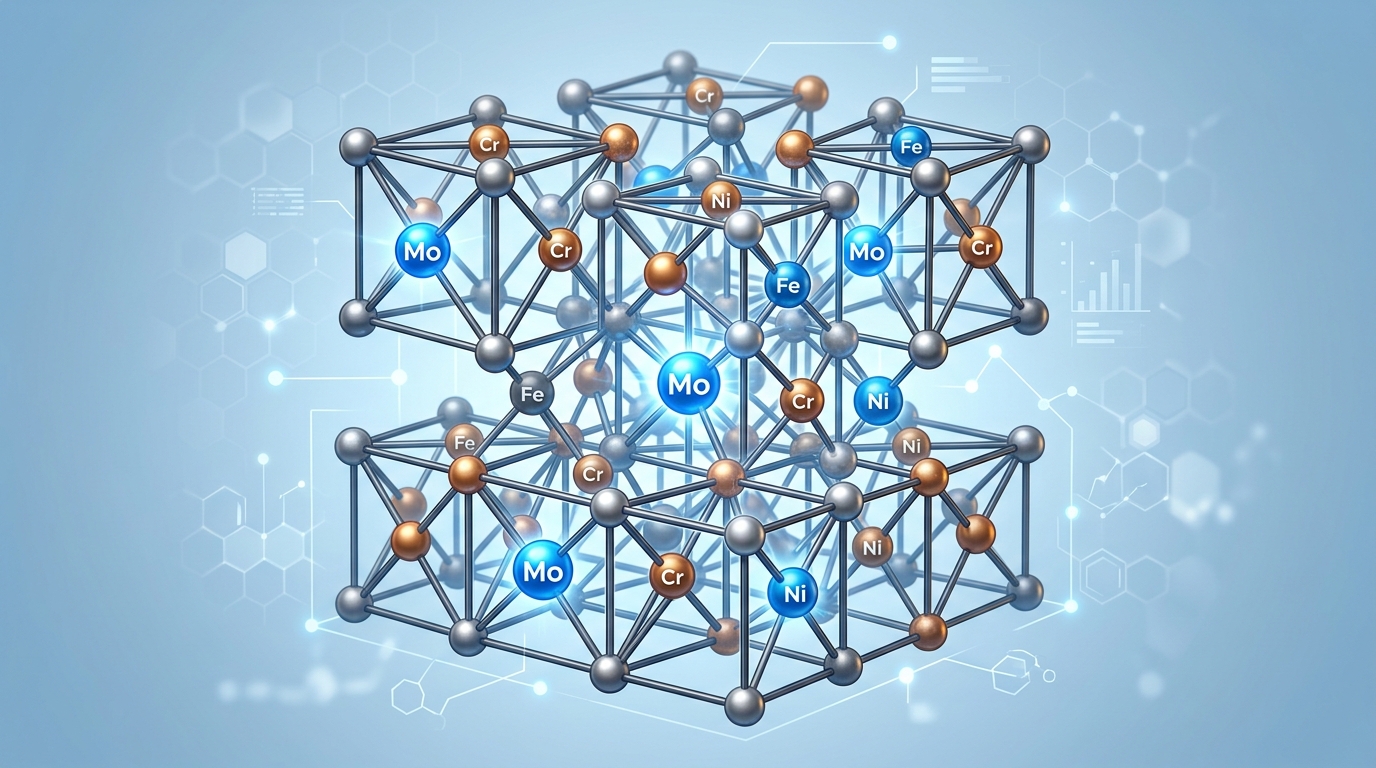
Understanding the elemental makeup of these two grades is fundamental to understanding every identification method. Each testing technique is essentially asking the same question in a different way: “What elements are in this metal, and in what proportions?”
| Element | 304 (UNS S30400) | 316 (UNS S31600) | Why It Matters |
|---|---|---|---|
| Chromium (Cr) | 18.0–20.0% | 16.0–18.0% | Forms the passive oxide layer that makes stainless steel “stainless” |
| Nickel (Ni) | 8.0–10.5% | 10.0–14.0% | Stabilizes the austenitic structure, improves formability |
| Molybdenum (Mo) | None specified | 2.0–3.0% | The key differentiator. Provides pitting and crevice corrosion resistance |
| Carbon (C) | 0.08% max | 0.08% max | Lower is better for weld corrosion resistance (hence 304L/316L variants) |
| Manganese (Mn) | 2.0% max | 2.0% max | Improves hot working properties |
| Silicon (Si) | 0.75% max | 0.75% max | Improves oxidation resistance |
| Iron (Fe) | Balance (~66-74%) | Balance (~62-72%) | Base metal |
Notice something interesting in that table? Grade 304 actually has more chromium than 316. People often assume 316 is “more stainless” because it has more of everything, but that’s wrong. The magic of 316 is specifically the molybdenum addition, which synergizes with chromium and nickel to create a much more robust passive film—particularly against chloride ions.
The molybdenum in 316 does something chromium alone cannot: it stabilizes the passive oxide layer in the presence of chloride ions. Chlorides are particularly aggressive because they can penetrate the chromium oxide film at weak points, initiating pitting corrosion. Molybdenum helps “heal” these weak points before pits can propagate. This is quantified by the Pitting Resistance Equivalent Number (PREN):
PREN = %Cr + 3.3(%Mo) + 16(%N)
304 PREN ≈ 19.0 | 316 PREN ≈ 25.0
That PREN gap of roughly 6 points translates to a massive real-world difference in chloride environments. It’s the reason 316 is specified for marine, chemical, and medical applications while 304 handles the less demanding stuff.
One more nuance worth mentioning: the “L” variants (304L and 316L) have carbon content capped at 0.03% instead of 0.08%. This lower carbon prevents chromium carbide precipitation during welding—a phenomenon called sensitization that creates corrosion-vulnerable zones near welds. Most modern mills produce dual-certified material that meets both standard and L-grade specifications, but it’s still worth verifying if your application involves welded joints in corrosive service.
How to Use a 316 Stainless Steel Chemical Test Kit
Chemical test kits are the most accessible and cost-effective way to distinguish 304 from 316 in the field. They work by detecting the presence of molybdenum through a color-change reaction. No lab, no expensive equipment, no training certification required.
What’s Inside a Typical Kit
A 316 stainless steel chemical test kit typically contains:
- A molybdenum-detecting reagent solution (usually based on potassium thiocyanate or a proprietary formulation)
- An electrolytic solution or battery-powered applicator to dissolve a tiny amount of surface metal into the reagent
- Color comparison chart
- Cotton swabs or filter paper
- Instructions (read them—different brands have different procedures)
Step-by-Step Testing Procedure
Step 1: Surface preparation. This is where most people get inaccurate results. The test area must be clean, bare metal. Grind or sand a small spot (about 5mm diameter) to remove any surface contamination, oxide layer, coatings, or passivation treatment. A fresh, bright metal surface is critical.
Step 2: Apply the reagent. Place 1-2 drops of the testing solution directly on the prepared spot. If your kit uses an electrolytic method, connect the battery leads and apply current for the specified duration (usually 10-30 seconds). The electrical current dissolves a microscopic amount of metal into the reagent.
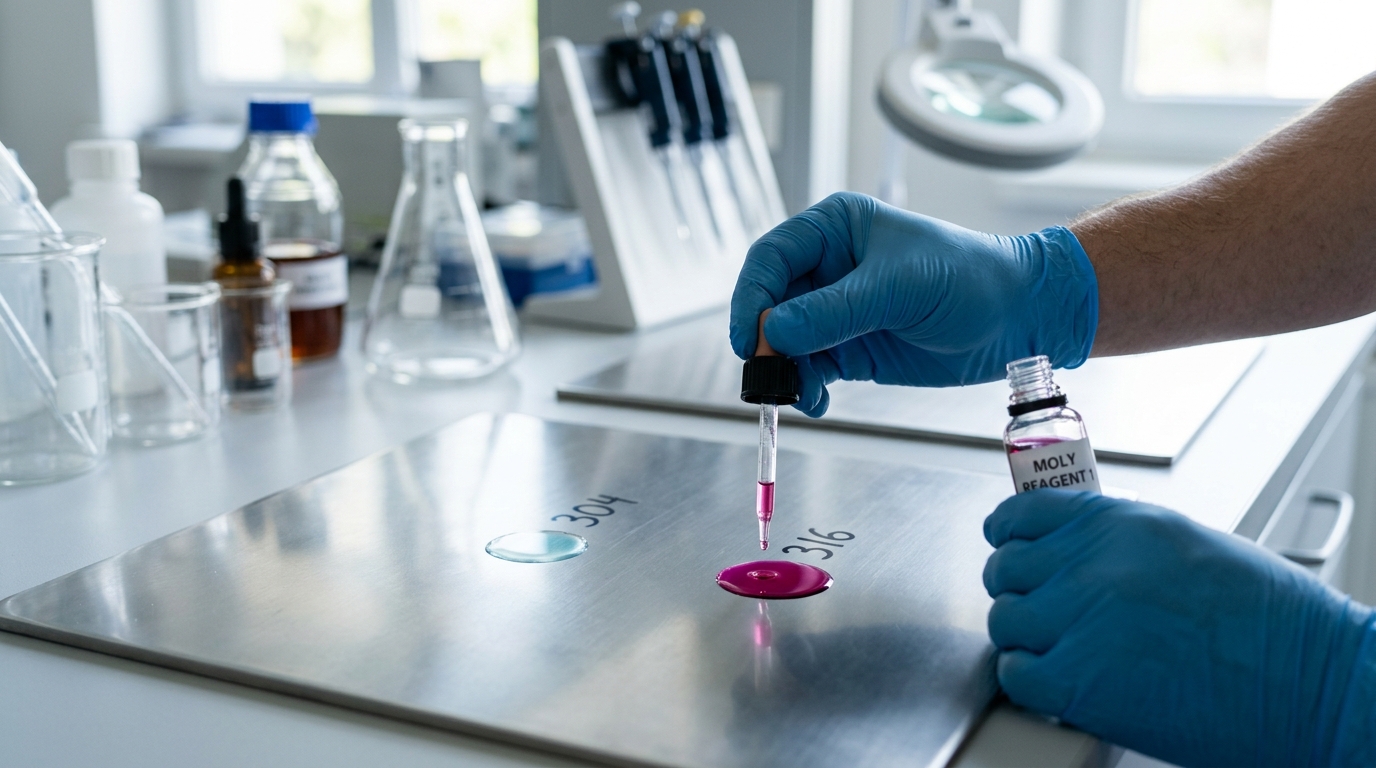
Step 3: Observe the color change. This is the moment of truth.
- 304 stainless steel: The reagent stays clear, pale yellow, or shows no significant color change
- 316 stainless steel: The reagent turns pink, reddish-brown, or dark amber (varies by brand) indicating molybdenum presence
Step 4: Compare with the reference chart. Don’t just eyeball it. Hold the test spot next to the color chart included with your kit under good lighting—preferably natural daylight, not fluorescent.
Accuracy and Limitations
Chemical test kits are roughly 85-95% accurate for distinguishing 304 from 316 when used correctly. That’s good enough for many applications, but there are important caveats:
- Surface contamination is the #1 source of false results. Inadequate surface prep will ruin your test.
- The test detects molybdenum presence, not quantity. It cannot tell you if the Mo content is 2.1% or 2.8%—just that it’s there.
- Some other molybdenum-containing grades (like 317, 904L, or duplex grades) will also produce a positive result. The test confirms Mo presence, not specifically “316.”
- Reagent shelf life matters. Expired solutions give unreliable results. Check the date.
- Temperature affects reaction speed. In cold weather (below 10°C), reactions are slower and colors may be faint.
Recommended Test Kits for 2026
Several brands have proven reliable in industrial settings:
- Koslow Moly Test Kit — The industry workhorse. Electrolytic method, clear color differentiation, widely available.
- SUS316 Quick Check — Drop-test format, no battery required, good for occasional testing.
- Circle Systems MolyDrop — Newer formulation with improved cold-weather performance.
Budget between $15 and $50 per kit. Each kit typically provides 30-100 tests depending on the brand. At roughly $0.30-$1.00 per test, it’s hard to beat the economics for small to medium volumes.
Stainless Steel Grade Test Methods: From DIY to Laboratory
Chemical test kits are just one option. Depending on your accuracy requirements, testing volume, and budget, you might need something more—or less—sophisticated. Here’s every practical stainless steel grade test method available in 2026, ranked from least to most accurate.
| Method | Accuracy | Cost Per Test | Speed | Skill Level | Best For |
|---|---|---|---|---|---|
| Magnet test | ~40% (unreliable) | Free | 2 seconds | None | Ruling out ferritic/martensitic grades only |
| Visual/weight inspection | ~30% | Free | 1 minute | Expert | Preliminary screening by experienced metalworkers |
| Spark test | ~60-70% | Free (with grinder) | 30 seconds | Advanced | Quick field differentiation between steel families |
| Chemical spot test | ~85-95% | $0.30-1.00 | 1-2 minutes | Basic | Field verification, incoming inspection |
| Density measurement | ~75% | Free (with scale) | 5 minutes | Intermediate | Non-destructive screening of small parts |
| Handheld XRF | ~98-99% | $5-15 (amortized) or $200-500/day rental | 5-15 seconds | Basic training | High-volume incoming inspection, critical applications |
| OES (Optical Emission Spectrometry) | ~99.5% | $50-150/sample | Hours (lab turnaround) | Lab technician | Certification, dispute resolution, failure analysis |
My recommendation for most situations? Start with a chemical test kit for routine checks, and escalate to XRF or lab analysis when the stakes are high. The chemical test is your daily driver. XRF is your insurance policy. OES is your courtroom evidence.
One method conspicuously absent from many guides is density measurement. Grade 304 has a density of approximately 7.93 g/cm³, while 316 comes in at about 8.00 g/cm³. That 0.07 g/cm³ difference is theoretically detectable with a precision scale and water displacement (Archimedes method), but in practice, manufacturing tolerances and measurement uncertainty make this unreliable for individual pieces. It works better as a batch screening method for large quantities of identical small parts.
The Magnet Test: Why It’s Unreliable for 304 vs 316 Identification
Let’s kill this myth right now. You cannot reliably distinguish 304 from 316 stainless steel with a magnet.
Both 304 and 316 are austenitic stainless steels. In their annealed (fully heat-treated) condition, both are essentially non-magnetic. A magnet will not stick to either one. So far, so useless for identification purposes.
But here’s where it gets worse. Cold working—bending, drawing, rolling, machining, or any mechanical deformation—can transform some of the austenite crystal structure into martensite. Martensite is magnetic. The degree of this transformation depends on the specific alloy composition, the amount of cold work, and the temperature during deformation.
Grade 304 is more susceptible to cold-work-induced magnetism than 316. In theory, you might detect a slight magnetic response in heavily cold-worked 304 while 316 remains non-magnetic. In practice? The variation is so inconsistent that it’s essentially a coin flip.
Scenarios where the magnet test fails completely:
- Annealed 304 — no magnetic response at all, identical to 316
- Lightly cold-worked 304 — maybe slightly magnetic, maybe not
- Cold-drawn 316 bar stock — can be weakly magnetic, mimicking 304
- 304 with higher nickel content (within spec) — more stable austenite, less magnetic response
- 316 with lower nickel content (within spec) — less stable austenite, potential magnetic response
The magnet test is useful for one thing: distinguishing austenitic stainless steels (300-series) from ferritic or martensitic grades (400-series). If a magnet sticks firmly, it’s almost certainly not 304 or 316. But if it doesn’t stick—or barely sticks—you’ve learned nothing about which 300-series grade you have.
Bottom line: Anyone who tells you “316 is non-magnetic and 304 is magnetic” is oversimplifying to the point of being wrong. Don’t stake material decisions on a magnet test.
XRF Handheld Analyzer: The Gold Standard for Field Identification
If chemical test kits are the screwdriver in your toolbox, handheld XRF analyzers are the power drill. They’re faster, more precise, and give you quantitative elemental data—not just a color change to interpret.
How XRF Works
X-ray fluorescence (XRF) works by bombarding the sample surface with primary X-rays from a miniature X-ray tube. These X-rays excite the atoms in the metal, causing them to emit secondary (fluorescent) X-rays at energy levels characteristic of each element. The detector reads these energy signatures and calculates the elemental composition in seconds.
Point. Shoot. Read the screen. It really is that straightforward.
A typical handheld XRF reading on 316 stainless steel will show something like: Cr 17.2%, Ni 11.8%, Mo 2.4%, Fe balance. The instrument’s onboard alloy library automatically matches this to the closest grade designation. No interpretation needed.
Accuracy and Performance
Modern handheld XRF units from manufacturers like Thermo Fisher Scientific (Niton series) and Bruker (S1 TITAN series) achieve 98-99% accuracy for common stainless steel grades with measurement times of 5-15 seconds. For molybdenum detection specifically—the key differentiator between 304 and 316—accuracy is even higher because Mo produces a strong, easily detectable fluorescence signal.
Limitations to be aware of:
- Light elements — Standard XRF struggles with elements lighter than magnesium (Mg). Carbon content, critical for distinguishing L-grades, cannot be measured by most handheld units.
- Surface condition — Heavy scale, paint, or coatings over ~50 microns thick can affect readings. Clean the test spot.
- Geometry — Very thin materials (under 1mm), small wires, or irregular shapes may give unreliable readings because the X-ray beam needs a minimum sample area.
- Alloy coatings — A nickel-plated or chrome-plated part will give readings reflecting the coating, not the base metal, unless you grind through it.
Buy, Rent, or Outsource?
This is where the economics get interesting.
A new handheld XRF analyzer costs $25,000-$50,000 in 2026. That’s a serious capital investment. Rental runs $200-$500 per day from equipment rental companies. Third-party testing services charge $5-$25 per reading if you bring samples to their facility.
The breakeven math: if you test more than 50-100 samples per month consistently, owning makes sense. For occasional verification—incoming material inspection a few times per quarter—renting for a day or two is far more economical. For one-off verification of a handful of pieces, a chemical test kit at $0.50 per test is the obvious choice.
Many metal service centers and large fabrication shops now keep an XRF on-site as standard equipment. If you’re a smaller operation, ask your material supplier whether they’ll provide XRF verification certificates with shipments. Reputable suppliers increasingly offer this as a standard service.
Spark Test and Visual Inspection Techniques
Spark testing is old-school metalworking knowledge that’s becoming a lost art. It’s not precise enough for certification, but in the hands of an experienced operator, it provides surprisingly useful information in seconds—with nothing more than a bench grinder.
How Spark Testing Works
When you press a metal sample against a grinding wheel, the friction generates tiny particles of hot metal that burn in air, creating a characteristic spark stream. The color, length, volume, and branching pattern of these sparks vary with the metal’s composition.
For stainless steel identification:
- 304 stainless: Produces a short, dark red to straw-colored spark stream with moderate volume. Sparks are relatively straight with few forks.
- 316 stainless: Spark stream is slightly shorter and darker than 304, with a more orange-red hue. The reduced spark volume compared to 304 is subtle but detectable by trained eyes.
- Carbon steel (for reference): Long, bright white/yellow sparks with extensive branching and forking—dramatically different from any stainless grade.
The honest truth? Distinguishing 304 from 316 by spark test alone is extremely difficult. The spark characteristics are too similar. Where spark testing excels is in confirming that a sample is indeed an austenitic stainless steel (not carbon steel, not a 400-series grade, not a tool steel). Think of it as a fast family-level identification, not a grade-specific test.
Visual and Surface Inspection
Can you tell 304 from 316 just by looking? Almost never. They’re visually identical in most product forms. But experienced metalworkers sometimes notice subtle differences:
- Surface finish after machining — 316 can produce a slightly different surface texture due to its higher nickel content affecting chip formation. This is extremely subtle and inconsistent.
- Stamp markings — Many (but not all) stainless steel products carry stamped or etched grade markings. Check for “304,” “316,” “CF8” (cast 304 equivalent), or “CF8M” (cast 316 equivalent). But remember—markings can be fraudulent.
- Color after heat tinting — When heated to specific temperatures, the oxide colors can differ slightly between grades. This is a destructive test that requires experience and controlled conditions to interpret.
My advice: use visual inspection and spark testing as a preliminary filter, not a final answer. If the sparks look wrong or the markings don’t match the paperwork, that’s your signal to pull out the chemical test kit or XRF.
Salt Spray and Corrosion Resistance Testing for Grade Verification
Sometimes the most convincing way to verify a stainless steel grade is to see how it actually performs under corrosive conditions. Salt spray testing does exactly that—it accelerates months or years of real-world corrosion exposure into hours or days in a controlled chamber.
ASTM B117 Salt Spray Testing
The ASTM B117 standard defines the most widely used salt spray (fog) test protocol. Samples are placed in a chamber maintained at 35°C with continuous exposure to a 5% sodium chloride solution fog. The test runs for a specified duration—typically 24 to 1,000+ hours depending on the application standard—and samples are evaluated for corrosion onset, pit depth, and surface degradation.
How 304 and 316 perform differently:
- 304 stainless steel: Typically shows visible pitting initiation within 200-500 hours of salt spray exposure. Surface staining and rust spots appear first at edges, scratches, and any areas with compromised passive film.
- 316 stainless steel: Generally withstands 500-1,000+ hours before comparable pitting appears. The molybdenum-enhanced passive film holds up significantly longer under chloride attack.
That performance gap is dramatic and consistent enough to serve as grade verification. If your “316” sample starts pitting at 200 hours alongside a known 304 control sample, something is very wrong with your material certificate.
When to Use Corrosion Testing for Identification
Salt spray testing is destructive, slow, and requires specialized equipment. It’s not a routine identification method. But it’s invaluable in specific situations:
- Dispute resolution — When a supplier claims material is 316 and your chemical test says otherwise, salt spray testing provides performance-based evidence that’s hard to argue with.
- Failure analysis — Whena component fails prematurely in service, comparative salt spray testing against known 304 and 316 reference samples helps confirm whether grade substitution was the root cause.
- Qualification testing — For critical applications (offshore, medical, nuclear), salt spray testing is often part of the incoming material qualification protocol regardless of what the mill certificate says.
Practical Considerations
You don’t need to own a salt spray chamber. Commercial testing laboratories charge $150-$500 per test run depending on duration and number of samples. Turnaround time is typically 1-6 weeks depending on the exposure duration specified. Always include known reference samples (verified 304 and 316 coupons) in the same test run for direct comparison—this eliminates variables related to chamber conditions.
One important caveat: surface finish dramatically affects salt spray results. A mirror-polished sample will outperform a rough-ground sample of the same grade because the smoother surface has fewer initiation sites for pitting. Always test samples with comparable surface conditions.
Common Mistakes and Fraud: Detecting Mislabeled Stainless Steel
Grade fraud in stainless steel is not a fringe problem. It’s an endemic issue in global supply chains, and it’s gotten worse as raw material prices have climbed.
The economics are simple and tempting: 304 costs roughly 20-30% less than 316. Stamp “316” on 304 material, produce a convincing mill certificate, and pocket the difference. Multiply that across hundreds of tons, and the profit margin for fraud becomes enormous. Some estimates from industry watchdog groups suggest that 5-15% of stainless steel sold globally as 316 may actually be 304 or a substandard variant.
Red Flags That Should Trigger Testing
- Pricing significantly below market — If a supplier quotes 316 at prices close to or below current 304 market rates, that’s not a bargain. That’s a warning sign. Check current benchmark pricing on platforms like MetalMiner or LME.
- Vague or inconsistent mill certificates — A legitimate mill test report (MTR) should include the heat number, specific chemical composition percentages for all major elements, mechanical test results, and the producing mill’s name and location. Generic certificates without heat-specific chemistry are suspect.
- Unfamiliar mills or traders — Material from well-known mills (Outokumpu, Aperam, POSCO, Tsingshan for commodity grades) carries lower fraud risk than material from obscure sources routed through multiple intermediaries.
- Reluctance to allow independent testing — If a supplier objects to you performing incoming XRF or chemical testing, walk away.
- Mixed heat numbers in a single shipment — While not inherently suspicious, material from many different heats in one delivery can indicate a broker assembling stock from questionable sources.
How to Protect Yourself
Verify mill certificates against the actual material. Cross-reference the heat number on the MTR with the heat number stamped or stenciled on the material itself. Then spot-check the chemistry with your own testing—even a $30 chemical test kit catches the most common fraud (304 sold as 316).
Implement a receiving inspection protocol. For critical applications, test a statistical sample from every incoming shipment. The cost of testing is trivial compared to the cost of a field failure. A practical approach: XRF test 10% of pieces or one piece per heat number, whichever is greater.
Use traceable supply chains. Buy from distributors who maintain full traceability from mill to delivery. Ask for dual certification (mill test report plus distributor verification). Some distributors now offer XRF-verified material as a premium service—worth the small upcharge for peace of mind.
Document everything. If you ever need to pursue a warranty claim, insurance recovery, or legal action related to material fraud, your testing records and purchase documentation are your evidence. Date-stamped XRF readings tied to specific heat numbers and purchase orders create an audit trail that holds up.
Industry-Specific Identification Requirements
Different industries don’t just prefer different grades—they mandate specific testing and documentation standards. What passes for adequate verification in architectural metalwork would be laughably insufficient in pharmaceutical manufacturing.
Food Processing and FDA Compliance
The FDA doesn’t specify stainless steel grades by number, but its regulations require that food-contact surfaces be “corrosion-resistant” and “non-toxic.” In practice, this means 304 is acceptable for most food processing equipment, while 316 is required for applications involving salt, acidic foods, or aggressive cleaning chemicals (CIP systems using chlorinated sanitizers, for example).
Identification requirement: Material certificates with full chemistry are typically sufficient for regulatory compliance, but major food companies increasingly require independent third-party verification. If you’re supplying equipment to a Nestle, Tyson, or similar operation, expect them to XRF-test your material on delivery.
Marine and Offshore
Marine environments are 316 territory, full stop. The combination of saltwater, temperature cycling, and mechanical stress makes 304 a poor choice for any structural or process-critical component. Classification societies like DNV, Lloyd’s Register, and Bureau Veritas require material certificates traceable to approved mills, and independent testing is standard practice during fabrication inspection.
For offshore oil and gas, the requirements escalate further. NACE MR0175/ISO 15156 governs material selection for sour service (hydrogen sulfide environments), and verification testing is mandatory—not optional. XRF or OES testing at multiple stages of fabrication is the norm.
Pharmaceutical and Biotech
ASME BPE (Bioprocessing Equipment) standard is the governing document here. It mandates 316L for all product-contact surfaces in pharmaceutical manufacturing. Not 316—specifically 316L, with carbon content verified below 0.03%.
This creates a testing challenge because handheld XRF cannot measure carbon content. Verification of the L-grade designation requires either OES laboratory analysis or reliance on mill certificates from approved suppliers. Most pharma companies maintain Approved Supplier Lists and require full material traceability with heat-specific MTRs.
Medical Devices
Implantable medical devices typically require 316LVM (Vacuum Arc Remelted) stainless steel, which has even tighter compositional tolerances and inclusion requirements than standard 316L. Identification and verification follow ISO 13485 quality management requirements, with full traceability from raw material through finished device.
For non-implantable medical devices and surgical instruments, standard 304 or 316 may be acceptable depending on the device classification and intended use. Testing requirements follow the device manufacturer’s quality system, which must comply with FDA 21 CFR Part 820 or EU MDR.
Architectural and Construction
This is the least demanding sector for grade verification. Architectural stainless steel (handrails, cladding, decorative elements) is predominantly 304, with 316 specified only for coastal or high-pollution environments. Testing requirements are minimal—typically limited to reviewing mill certificates. However, given the fraud risks discussed earlier, a spot-check with a chemical test kit is cheap insurance against premature corrosion staining on a building facade.
Cost Comparison: Testing Methods and When Each Makes Financial Sense
Choosing a testing method isn’t just about accuracy. It’s about matching the cost of testing to the cost of being wrong.
| Method | Equipment Cost | Per-Test Cost | Accuracy | Speed | Breakeven Volume |
|---|---|---|---|---|---|
| Chemical test kit | $15-50 per kit | $0.30-1.00 | 85-95% | 1-2 min | Any volume |
| Spark test | $0 (existing grinder) | Free | 60-70% | 30 sec | Any volume (but low accuracy) |
| XRF rental | $200-500/day | $2-10 (at 50+ tests/day) | 98-99% | 5-15 sec | 20+ tests per rental day |
| XRF purchase | $25,000-50,000 | $5-15 (amortized over 3 years) | 98-99% | 5-15 sec | 50-100+ tests/month |
| Third-party XRF service | $0 | $5-25/reading | 98-99% | Same day | Low volume, on-demand |
| OES laboratory | $0 (outsourced) | $50-150/sample | 99.5% | 1-5 days | Certification, disputes, failure analysis |
| Salt spray testing | $0 (outsourced) | $150-500/run | Performance-based | 1-6 weeks | Qualification, disputes only |
Decision Framework by Scenario
Scenario 1: You receive a small batch of fittings and want to confirm they’re 316 as ordered.
Best method: Chemical test kit. Cost: under $5 total. Time: 10 minutes including prep. Accuracy: sufficient for routine verification.
Scenario 2: You run a fabrication shop and receive weekly shipments of stainless steel plate and bar.
Best method: Rent an XRF analyzer for one day per month, test all incoming material. Cost: $200-500/month. This catches fraud before material enters production.
Scenario 3: You’re a metal service center processing 500+ tons of stainless monthly.
Best method: Purchase a handheld XRF. The $30,000-$40,000 investment pays for itself within 6-12 months through fraud prevention and customer confidence. Many service centers now XRF-verify every heat as a competitive differentiator.
Scenario 4: A customer disputes the grade of material you supplied, threatening legal action.
Best method: OES laboratory analysis by an accredited third-party lab. The $100-$150 cost is irrelevant compared to the legal exposure. Get a formal test report with the lab’s accreditation credentials.
Scenario 5: You’re qualifying a new supplier for critical 316L pharmaceutical equipment.
Best method: Full qualification protocol—OES for chemistry (including carbon for L-grade verification), salt spray testing for corrosion performance, plus ongoing XRF spot-checks on deliveries.
The biggest mistake I see companies make? Choosing no testing at all because every method seems either too expensive or too inaccurate. A $30 chemical test kit catches the most damaging fraud scenario (304 sold as 316) with 90%+ reliability. That’s infinitely better than blind trust in paperwork.
FAQ: 304 vs 316 Stainless Steel Identification
Can you tell 304 from 316 just by looking at them?
No. In virtually all product forms—sheet, plate, bar, tube, fittings—304 and 316 are visually indistinguishable. Same color, same luster, same surface texture. Anyone claiming they can reliably identify the grade by eye is either exceptionally experienced with a specific product form or overconfident. Physical testing is the only reliable approach.
Does 316 stainless steel rust?
Yes, 316 can rust—it’s stainless, not stain-proof. In extremely aggressive environments (concentrated hydrochloric acid, high-temperature chloride solutions, or prolonged exposure to deicing salts without cleaning), 316 will eventually corrode. It’s dramatically more resistant than 304 in chloride environments, but it has limits. For environments that exceed those limits, you’d step up to super austenitic grades (904L, 254 SMO) or nickel alloys (Inconel, Hastelloy).
How accurate are chemical test kits for stainless steel identification?
85-95% accurate when used correctly with proper surface preparation. The main sources of error are contaminated surfaces, expired reagents, and user interpretation of ambiguous color results. For a definitive answer, escalate to XRF or laboratory analysis. But for routine screening—catching the obvious 304-sold-as-316 fraud—chemical kits are remarkably effective for their price.
Can a jeweler test stainless steel grade?
Some jewelers have XRF equipment for precious metal testing, and these instruments can often identify stainless steel grades as well. However, jeweler-grade XRF units may be optimized for precious metals and might not have stainless steel alloy libraries loaded. Call ahead and ask specifically whether their equipment can differentiate 304 from 316. If they have a Thermo Niton or Bruker unit with an alloy analysis mode, the answer is usually yes.
Is there an app to identify stainless steel?
As of 2026, no smartphone app can identify stainless steel grades through the camera alone. Some apps claim to use image analysis, but this is marketing fiction—the grades are visually identical. What does exist: apps that connect to Bluetooth-enabled XRF analyzers to log and organize test results. The testing still requires physical instrumentation; the app just manages the data.
What does the molybdenum drop test look like on 304 stainless steel?
On 304 (which contains no significant molybdenum), the reagent typically remains clear, pale yellow, or unchanged after the specified reaction time. On 316, the same reagent turns pink, reddish-brown, or dark amber depending on the specific test kit chemistry. The color difference is usually obvious under good lighting, though borderline results can occur on grades with trace molybdenum contamination.
Summary: Choosing the Right Identification Method for Your Needs
After walking through every method from magnets to mass spectrometry, here’s the decision framework distilled to its essence:
Ask yourself two questions: (1) What’s the consequence if the grade is wrong? (2) How many pieces do I need to test?
If the consequence is cosmetic (architectural trim, decorative panels) and volume is low, a chemical test kit is all you need. Spend $30, test your material, move on with confidence.
If the consequence is functional failure (process piping, pressure vessels, marine hardware) and you test regularly, rent or buy a handheld XRF. The accuracy jump from 90% to 99% is worth every dollar when failure means downtime, liability, or safety risk.
If the consequence is regulatory (pharmaceutical, medical, nuclear) or legal (dispute, insurance claim, failure investigation), go straight to OES laboratory analysis from an accredited facility. The formal test report is your documentation of due diligence.
And regardless of which method you choose, never rely on paperwork alone. Mill certificates are only as trustworthy as the supply chain that produced them. A 60-second chemical spot test or a 10-second XRF reading is the cheapest insurance you’ll ever buy against grade fraud.
Here’s a quick-reference decision table to bookmark:
| Your Situation | Recommended Method | Budget |
|---|---|---|
| One-off verification of a few pieces | Chemical test kit | $15-50 |
| Regular incoming material inspection | XRF rental (monthly) or chemical test kit | $200-500/month or $30/kit |
| High-volume metal distribution or fabrication | XRF purchase | $25,000-50,000 one-time |
| Regulatory compliance documentation | OES laboratory analysis | $50-150/sample |
| Supplier dispute or failure investigation | OES lab + salt spray testing | $200-650 combined |
| Quick field screening (low stakes) | Chemical test kit + spark test | Under $50 |
The stainless steel you specify is only as good as the stainless steel you verify. Test it.