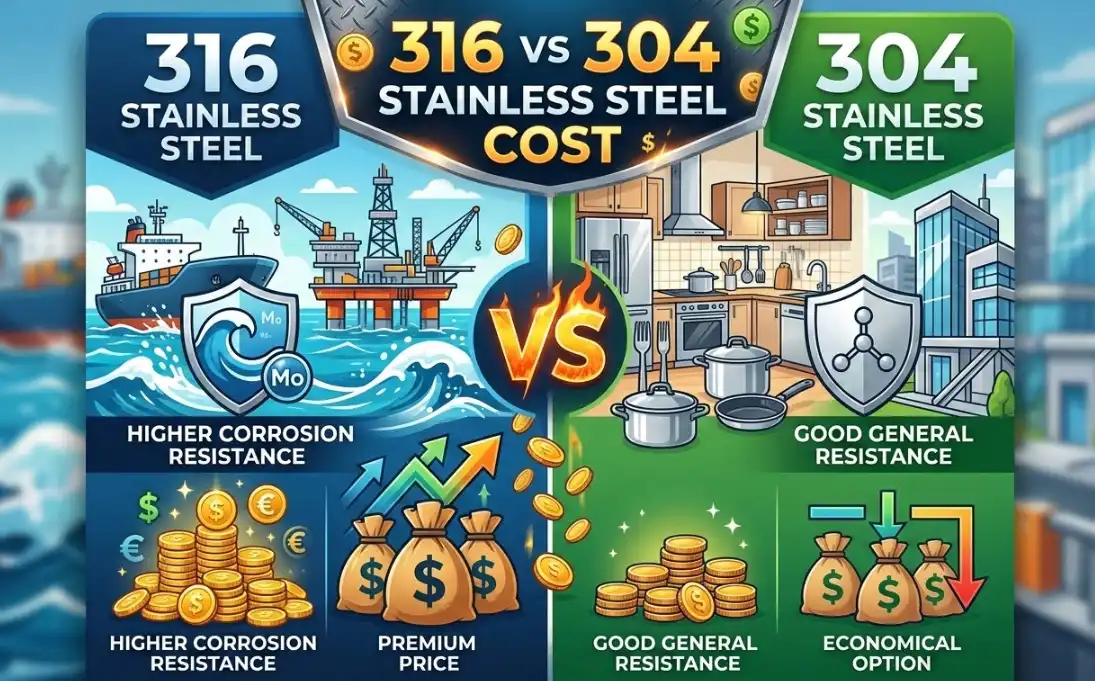
The price gap between 316 and 304 stainless steel ranges from 30% to 50% in 2026, driven almost entirely by one element: molybdenum. But here’s what most buyers get wrong — choosing the cheaper grade doesn’t always save money. In corrosive environments, 304 can fail in under three years while 316 keeps performing for two decades. This guide breaks down exact pricing, the metallurgy behind the cost difference, and a clear framework for deciding which grade delivers the best return on your investment.
316 vs 304 Stainless Steel Cost at a Glance: 2026 Price Summary
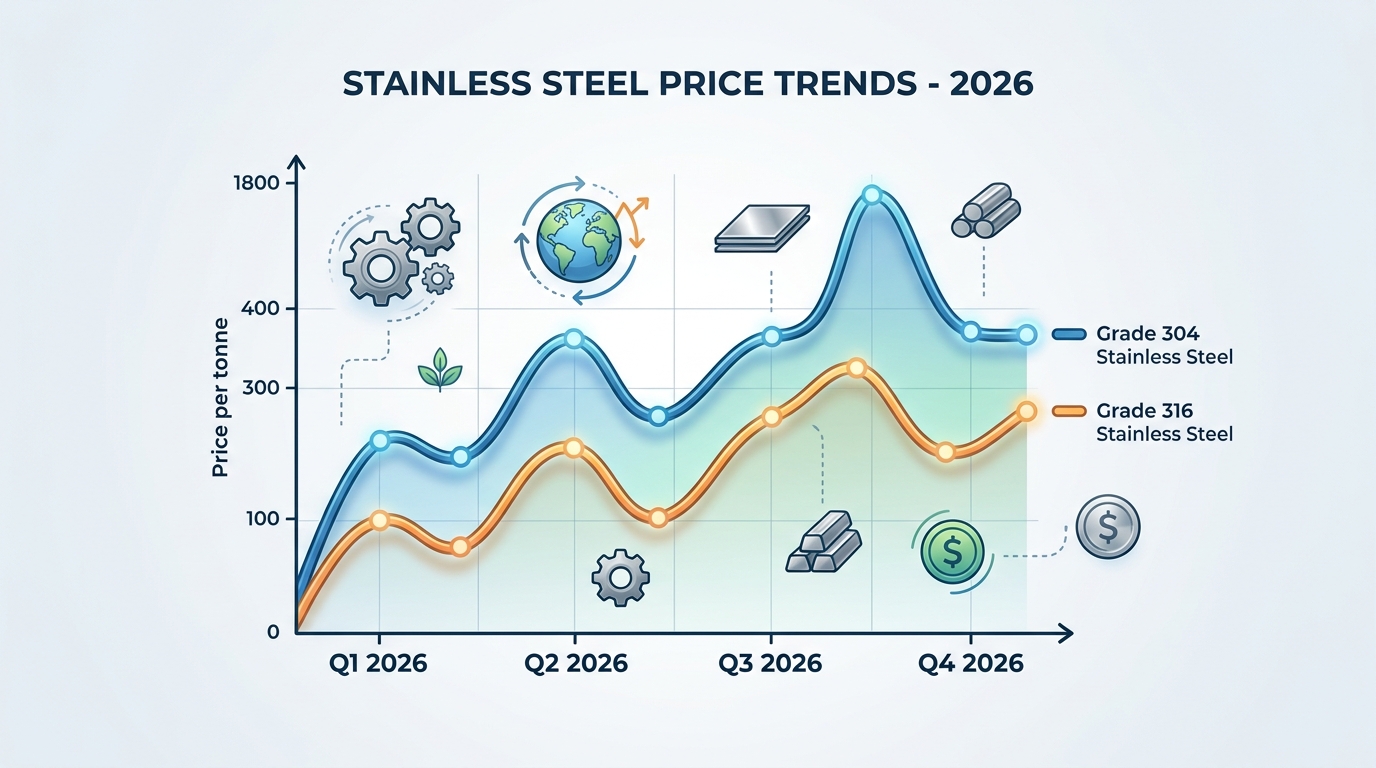
If you’re short on time, here’s the bottom line. In Q1 2026, 304 stainless steel averages $2.50–$3.50 per kg depending on form and region, while 316 stainless steel runs $3.50–$5.00 per kg. That puts the 316 vs 304 price ratio at roughly 1.3x to 1.5x — meaning you’ll pay 30% to 50% more for 316 on any given order.
But raw price per kilogram only tells part of the story. The table below captures the essential differences that drive purchasing decisions across industrial applications.
| Property | 304 Stainless Steel | 316 Stainless Steel |
|---|---|---|
| Avg. Price Per Kg (2026) | $2.50–$3.50 | $3.50–$5.00 |
| Price Premium | Baseline | 30%–50% higher |
| Molybdenum Content | None | 2%–3% |
| Chloride Resistance | Moderate | Excellent |
| Primary Use Cases | Indoor, food processing, mild environments | Marine, chemical, pharmaceutical, coastal |
| Typical Service Life (corrosive env.) | 3–8 years | 15–25+ years |
That service life difference is where the real cost conversation begins. A 40% price premium means nothing if the cheaper material needs replacing every five years in a saltwater environment. Keep reading — the math gets interesting.
2026 Price Per Kg: Current 316 vs 304 Stainless Steel Price Ratio
Pricing stainless steel isn’t as straightforward as checking a single number. The cost per kg shifts based on product form, surface finish, thickness, quantity, and where you’re buying. Here’s what the 2026 market looks like across the most common forms.
Sheet and Plate Pricing
Cold-rolled 304 sheet (2B finish, 1–3mm thickness) trades between $2.60 and $3.20 per kg in major markets as of early 2026. The same specification in 316 runs $3.70 to $4.60 per kg. Thinner gauges carry higher per-kg costs due to additional rolling and processing. Hot-rolled plate narrows the gap slightly — 304 plate at $2.40–$2.90/kg versus 316 plate at $3.30–$4.10/kg.
Bar and Rod Pricing
Round bar pricing tells a similar story. 304 round bar averages $2.80–$3.40/kg, while 316 round bar sits at $3.90–$4.80/kg. Specialty profiles (hex bar, flat bar) push both grades higher due to lower production volumes.
Tube and Pipe Pricing
Welded tube is where the premium can feel steepest. 304 welded tube runs $3.00–$3.80/kg in standard sizes, while 316 welded tube hits $4.20–$5.20/kg. Seamless tube? Add another 20–30% on top of those numbers for both grades.
Regional Price Variations
Geography matters more than most buyers realize. Chinese mill prices for both grades run 15–25% below European and North American prices, but tariffs, shipping, and lead times can erode that advantage quickly. In 2026, U.S. domestic 304 coil averages around $3.10/kg, while the same material from a Chinese mill lands at roughly $2.50/kg before duties. European pricing falls somewhere in between, with German and Italian mills quoting 304 at approximately EUR 2.70–3.00/kg.
The 316 vs 304 price ratio stays remarkably consistent across regions — hovering between 1.35x and 1.50x regardless of where you source. That consistency tells you the premium is fundamentally driven by raw material costs (specifically molybdenum), not by regional market quirks.

Why 316 Costs More: How Molybdenum Content Drives the Price Premium
Strip away the marketing and the answer is one word: molybdenum.
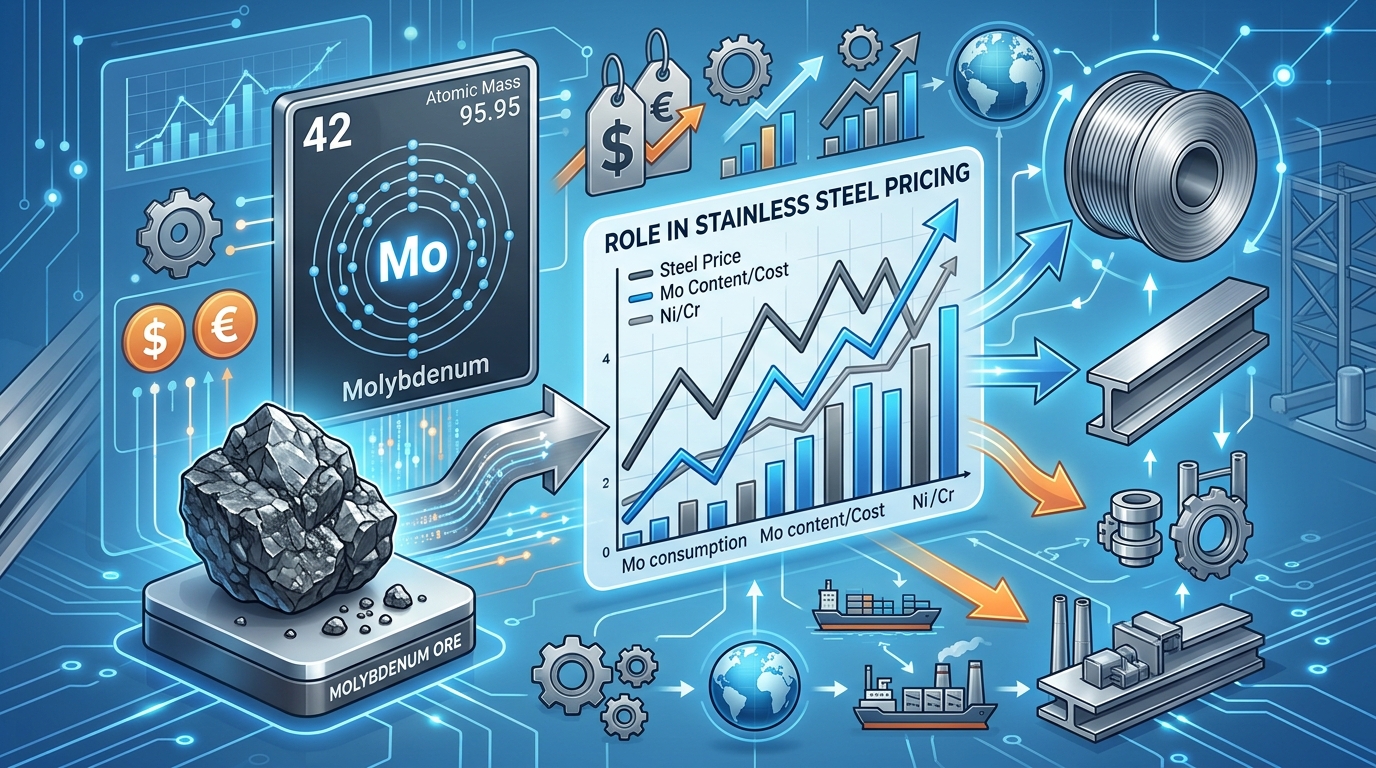
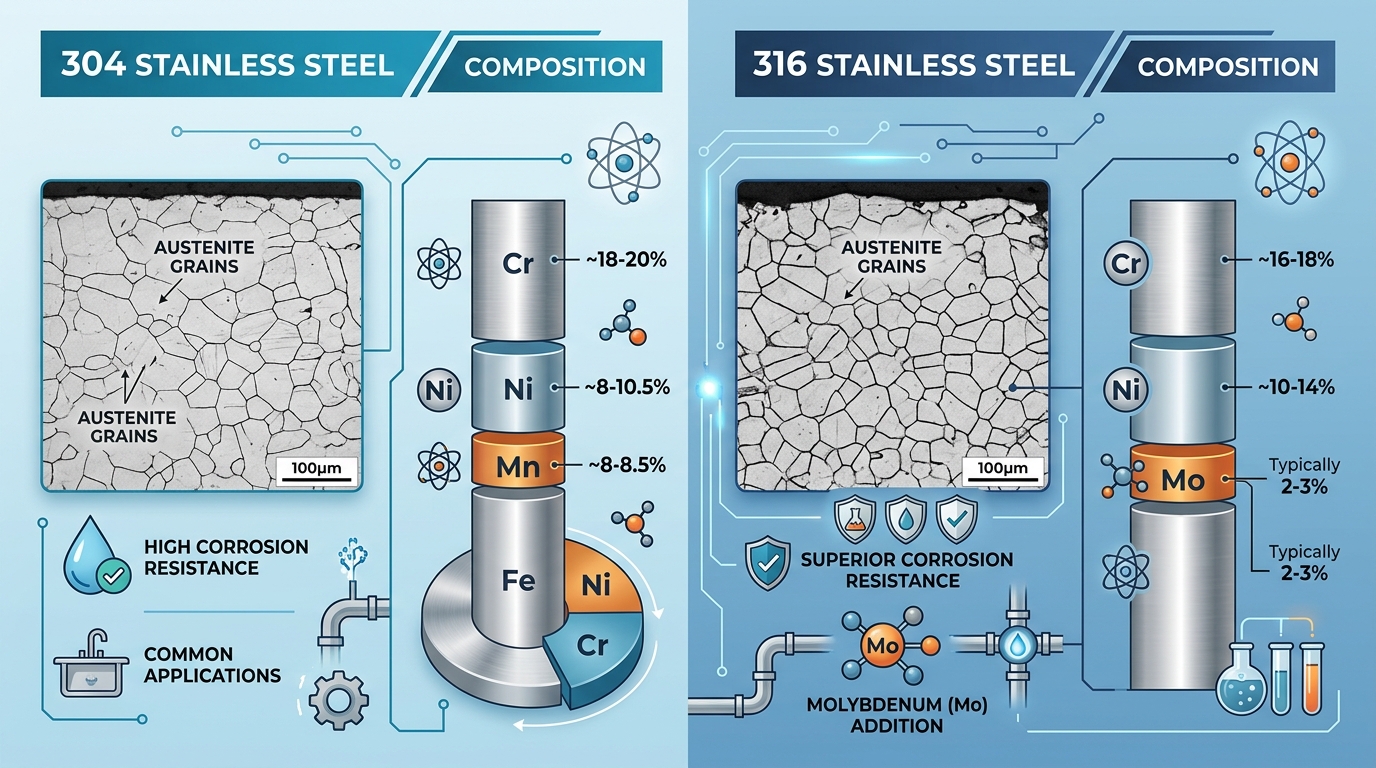
316 stainless steel contains 2%–3% molybdenum (Mo) by weight. 304 contains essentially zero. That single alloying difference accounts for roughly 60–70% of the price gap between these two grades. The rest comes from 316’s slightly higher nickel content, but molybdenum is the dominant cost driver.
Molybdenum Pricing in 2026
Molybdenum is not a cheap element. As of Q1 2026, molybdenum oxide trades at approximately $20–$24 per pound (around $44–$53/kg), according to data tracked by Mining.com. That’s a significant jump from the $12–$15/lb range seen in 2020–2021. The price has been volatile, spiking above $30/lb in late 2024 before settling into the current range.
Here’s a quick way to understand the impact. Take a metric ton of 316 stainless steel. It contains roughly 20–30 kg of molybdenum. At $50/kg for Mo, that’s $1,000–$1,500 in molybdenum cost alone per ton of finished steel. For 304, that line item is zero.
Supply Chain Constraints
Molybdenum supply is concentrated. China produces about 40% of global Mo output, with the U.S. and Chile accounting for most of the rest. Any disruption — mining permits, export restrictions, environmental regulation changes — ripples through 316 pricing within weeks. The 2024 price spike was partly triggered by reduced output from a major Chilean mine combined with surging demand from the energy sector.
This supply concentration creates a structural vulnerability that doesn’t exist for 304. Chromium and nickel (the primary alloying elements in 304) have more diversified global supply chains and larger stockpiles.
Why Small Percentage Changes in Mo Content Matter
A common misconception: “It’s only 2–3% of the alloy, how much difference can it make?” Quite a lot, actually. When molybdenum prices swing by 20%, the cost of producing 316 shifts by roughly $200–$400 per metric ton. That volatility gets passed directly to buyers. Meanwhile, 304 pricing remains relatively stable because its alloying elements don’t experience the same price swings.
This is why the 316 vs 304 price ratio isn’t fixed at exactly 40%. It fluctuates. During periods of high Mo prices (like mid-2024), the premium can push past 50%. When Mo prices cool off, the gap tightens to 30% or even slightly below.
Full Alloy Composition Comparison: Beyond Just Molybdenum
Molybdenum grabs the headlines, but the full picture is more nuanced. Both 304 and 316 are austenitic stainless steels, meaning they share the same crystal structure and general family of properties. The differences lie in the specific recipe.
| Element | 304 (Typical %) | 316 (Typical %) | Cost Impact |
|---|---|---|---|
| Chromium (Cr) | 18–20% | 16–18% | Minimal — 304 actually has slightly more Cr |
| Nickel (Ni) | 8–10.5% | 10–14% | Moderate — 316’s higher Ni adds cost |
| Molybdenum (Mo) | None | 2–3% | Major — primary cost differentiator |
| Carbon (C) | 0.08% max | 0.08% max | Negligible |
| Manganese (Mn) | 2% max | 2% max | Negligible |
| Iron (Fe) | Balance | Balance | Negligible |
The Nickel Factor
People fixate on molybdenum and overlook that 316 also contains 2–4% more nickel than 304. Nickel isn’t cheap either — LME nickel prices in early 2026 hover around $16,000–$18,000 per metric ton. That extra nickel in 316 adds roughly $300–$700 per ton of finished steel to the production cost. Not as dramatic as the molybdenum premium, but it’s real money.
The Chromium Twist
Here’s something that surprises people: 304 actually contains slightly more chromium than 316. The spec ranges overlap, but 304 typically runs 18–20% Cr while 316 sits at 16–18% Cr. This means 304 isn’t “less alloyed” across the board — it’s specifically lacking molybdenum and running lower nickel. The chromium content in both grades is sufficient to form the passive oxide layer that makes stainless steel “stainless.”
So why does 316 resist corrosion better despite having less chromium? Because molybdenum provides a different type of protection — specifically against pitting and crevice corrosion in chloride-rich environments. Chromium handles general oxidation. Molybdenum handles the aggressive, localized attacks that chlorides cause.
Corrosion Resistance vs Cost: When the 316 Upgrade Is Worth the Premium
This is the section that actually saves you money. Picking the right grade isn’t about finding the cheapest option — it’s about matching material performance to your environment.
Environments Where 316 Is Non-Negotiable
There are situations where specifying 304 is essentially throwing money away, because it will fail prematurely. These include:
- Marine and coastal installations — Anything within 1 mile of saltwater. The airborne chloride concentration alone will pit 304 within 2–5 years. 316 handles this environment for 15–25 years.
- Chemical processing with chlorides — HCl, FeCl3, NaCl solutions, bleach, and chlorinated solvents attack 304 aggressively. 316’s molybdenum content provides the pitting resistance these environments demand.
- Pharmaceutical manufacturing — Not just for corrosion reasons. Regulatory standards (FDA, EMA) often mandate 316 or 316L for product-contact surfaces. Using 304 can mean failing an audit.
- Swimming pool equipment and water treatment — Chlorinated water is a 304 killer. Heat exchangers, pumps, and fittings in these applications need 316 minimum.
- Offshore oil and gas — Saltwater spray, H2S exposure, and high-chloride drilling fluids make 316 the baseline. Many offshore specs actually require super-duplex or higher, but 316 is the absolute floor.
Environments Where 304 Delivers Excellent Value
Equally important — don’t overspend on 316 when 304 will perform identically.
- Indoor architectural applications — Handrails, elevator panels, kitchen equipment. No chloride exposure, no aggressive chemicals. 304 will last the life of the building.
- Food and beverage processing (non-chloride) — Most food-grade applications work perfectly with 304. The exception is when heavy chloride-based sanitizers are used regularly.
- Automotive trim and exhaust components — 304 handles the heat and mild corrosion from road salt adequately in most climates. 316 is overkill here.
- Freshwater systems — Tanks, pipes, and fittings handling potable water or freshwater process streams. No chloride attack vector means 304 performs just fine.
- General industrial fabrication — Brackets, frames, enclosures, and structural components in climate-controlled or covered environments.
The decision matrix is straightforward: if chlorides are present in your operating environment, go 316. If they’re absent, 304 saves you 30–50% with zero performance penalty.
Calculating Total ROI: Longevity and Maintenance Costs Over Time
Upfront material cost is the number everyone focuses on. Total cost of ownership is the number that actually matters. Let’s run real scenarios.
Scenario 1: Coastal Railing System
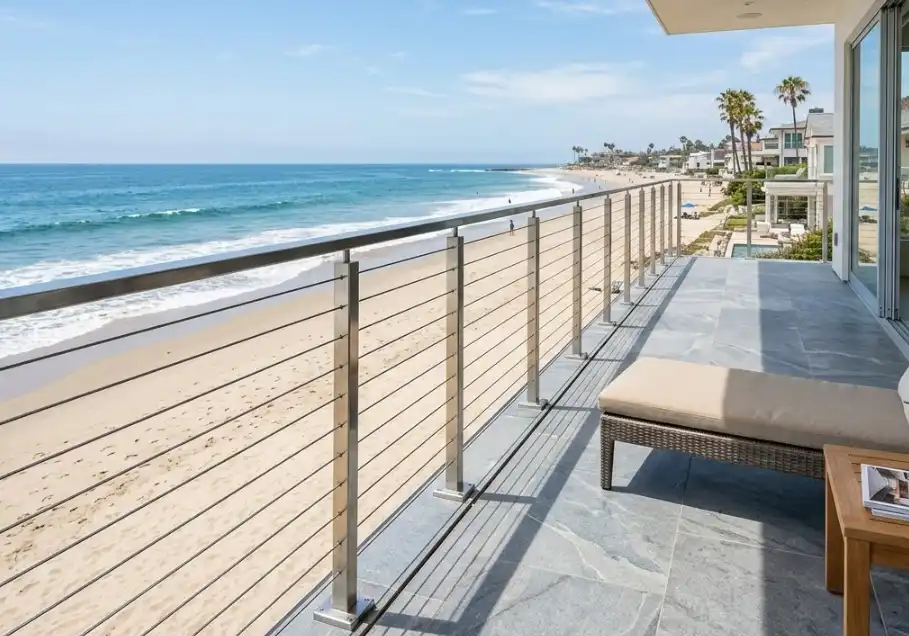
Imagine you’re specifying stainless steel railing for a beachfront commercial property. The project requires 500 kg of material.
304 option: 500 kg x $3.00/kg = $1,500 material cost. Expected lifespan in coastal salt air: 5–8 years before visible pitting and aesthetic failure. Replacement cost (including labor): ~$4,500. Over 20 years, you’ll replace it 2–3 times. Total 20-year cost: $10,500–$15,000.
316 option: 500 kg x $4.30/kg = $2,150 material cost. Expected lifespan in same environment: 20+ years with routine cleaning. No replacement needed. Total 20-year cost: $2,150 + minimal maintenance.
The 316 option costs 43% more upfront but saves $8,000–$12,000 over the project lifecycle. That’s not a marginal difference — it’s a 5x to 6x return on the incremental investment.
Scenario 2: Indoor Food Processing Tank
Now flip the scenario. A brewery needs a 1,000-liter mixing tank for an indoor, climate-controlled facility. No chloride sanitizers, standard CIP (clean-in-place) protocols.
304 option: ~$3,200 fabricated cost. Expected lifespan: 25+ years. No corrosion issues anticipated.
316 option: ~$4,500 fabricated cost. Expected lifespan: 25+ years. Identical performance to 304 in this environment.
Here, the $1,300 premium for 316 buys you absolutely nothing. Zero additional service life. Zero reduced maintenance. The ROI on the 316 upgrade in this scenario is negative.
The Maintenance Cost Multiplier
What people consistently underestimate is the indirect cost of material failure. When a 304 component fails in a corrosive environment, you’re not just paying for new material. You’re paying for:
- Production downtime (often $500–$5,000+ per hour in industrial settings)
- Emergency labor at premium rates
- Potential contamination cleanup (critical in pharma and food)
- Expedited shipping for replacement material
- Re-qualification and inspection costs
One unplanned replacement of a 304 heat exchanger tube bundle in a chemical plant can cost more than the entire 316 alternative would have cost originally — including installation.
Industrial Application Guide: Which Grade for Which Use Case
Enough theory. Here’s the application-by-application breakdown that procurement teams and engineers actually need.
Marine and Offshore
Recommended: 316 (or higher). No debate here. The combination of saltwater immersion, salt spray, and high humidity creates the exact chloride-rich conditions that destroy 304. Boat fittings, dock hardware, offshore platform components, desalination equipment — all 316 minimum. For submerged or splash-zone components, consider 316L or even duplex grades. The cost premium is insurance against catastrophic failure.
Food and Beverage
Recommended: 304 for most applications; 316 for dairy and chloride-sanitized environments. Standard food processing — mixing, conveying, packaging — works great with 304. But dairy plants that use chloride-based sanitizers heavily, or facilities processing high-salt products (pickles, soy sauce, cured meats), should specify 316 for product-contact surfaces. The cost difference is minor compared to a failed FDA inspection.
Pharmaceutical and Biotech
Recommended: 316L. Most pharma standards call for 316L specifically (the low-carbon variant) for vessels, piping, and product-contact surfaces. This isn’t optional — it’s regulatory. Budget for 316L from the start and don’t try to value-engineer it down to 304. The L-grade adds a small premium over standard 316 but prevents sensitization during welding, which matters for both corrosion resistance and regulatory compliance.
Architectural and Decorative
Recommended: 304 for interior; 316 for exterior in coastal or polluted areas. Interior architectural stainless — elevator cabs, column cladding, countertops — performs beautifully in 304 with a mirror or brushed finish. Exterior applications depend entirely on location. A building in Phoenix, Arizona? 304 is fine. A building in Miami or Singapore? 316, without question.
Automotive
Recommended: 304 for most components. Exhaust systems, trim, and structural brackets handle road salt and moderate heat exposure well in 304. The automotive industry uses 304 extensively for cost reasons, and failure rates are acceptable. 316 shows up occasionally in high-performance exhaust applications or components exposed to urea-based SCR systems.
Water Treatment
Recommended: 316 for chlorinated systems; 304 for freshwater. Municipal water treatment plants using chlorine or chloramine disinfection need 316 for anything in contact with treated water. Raw water intake structures and freshwater systems can use 304 effectively.
Chemical Processing
Recommended: 316 minimum; verify with corrosion data for specific chemicals. This is the application where getting it wrong costs the most. Chemical compatibility varies wildly. 316 handles most organic acids, mild mineral acids, and many alkaline solutions. But concentrated sulfuric acid, hydrofluoric acid, and some high-temperature acid combinations will eat through 316 just as fast as 304. Always check the specific chemical resistance data from sources like the Nickel Institute before specifying.
Hidden Cost Factors Most Buyers Overlook in 2026
The per-kg price gets all the attention. These factors quietly add thousands to your project budget if you’re not watching for them.
Fabrication and Welding Cost Differences
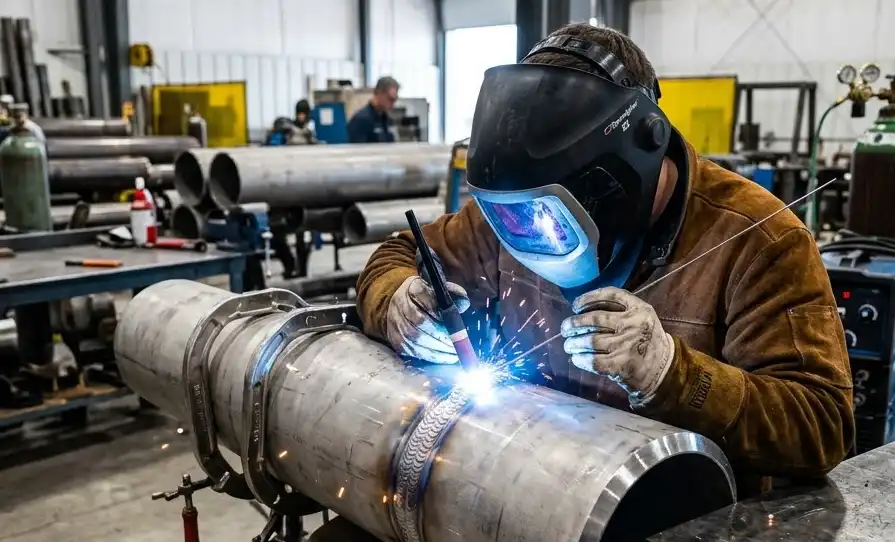
316 is slightly harder to machine and weld than 304. Not dramatically — both are austenitic and behave similarly under most fabrication processes. But 316’s higher work-hardening rate means cutting tools wear faster, and welding requires slightly more attention to heat input to avoid sensitization (especially with standard 316 vs 316L). Fabrication shops that quote per-hour rates will charge 5–10% more for 316 work. On large fabrication projects, that adds up.
Availability and Lead Time
304 is the world’s most commonly produced stainless steel — roughly 50% of all stainless production globally is 300-series, with 304 dominating that category. It’s almost always in stock at distributors in standard sizes and forms.
316 has lower inventory levels. For common sizes, you’ll find it at major distributors. But non-standard dimensions, heavy plate, or large-diameter seamless tube in 316? Expect 4–8 week lead times from mills. If your project timeline is tight, that lead time can force you into paying premium pricing at specialty distributors or accepting costly project delays.
Scrap and Recycling Value
Here’s a factor that works in 316’s favor. Because of its molybdenum and higher nickel content, 316 scrap commands a significantly higher price than 304 scrap. In 2026, 316 stainless scrap trades at roughly $1.80–$2.20/kg versus $1.20–$1.50/kg for 304 scrap. If your project generates substantial offcuts or if you’re planning eventual decommissioning, the higher scrap recovery value of 316 partially offsets its purchase premium.
The L-Grade Premium
304L and 316L (low-carbon variants, with carbon content below 0.03%) cost 3–8% more than their standard counterparts. The L-grades are essential when heavy welding is involved because lower carbon content prevents chromium carbide precipitation at grain boundaries — a phenomenon called sensitization that creates corrosion-vulnerable zones near welds.
Don’t automatically specify L-grades for everything. If your application doesn’t involve welding, or if welds will be solution-annealed after fabrication, the standard grade saves money without sacrificing performance.
Minimum Order Quantities
Buying directly from mills offers the best per-kg pricing, but mills enforce minimum order quantities (MOQs) — typically 2–5 metric tons per size/grade combination. For smaller projects, you’ll buy from distributors at a 10–20% markup. This markup is proportionally similar for both 304 and 316, so it doesn’t change the relative cost ratio, but it affects absolute project budgets significantly.
2026 Market Trends Affecting 316 and 304 Pricing
Stainless steel pricing doesn’t exist in a vacuum. Several macro trends are shaping the 2026 market in ways that directly impact your purchasing decisions.
Molybdenum Supply Tightening
Global molybdenum demand is being pulled higher by two sectors: stainless steel (the traditional demand driver) and the energy transition. Mo is used in high-strength low-alloy steels for wind turbine towers, pipeline steels for hydrogen transport, and catalysts for petrochemical refining. The International Molybdenum Association (IMOA) projects demand growth of 3–4% annually through 2028, outpacing supply additions. This structural tightness supports the 316 price premium staying elevated.
Nickel Market Dynamics
Nickel tells a different story. Indonesian nickel production — particularly nickel pig iron (NPI) for stainless steel feedstock — has expanded massively. This oversupply has kept LME nickel prices relatively subdued in 2025–2026 compared to the 2022 spike. Since both 304 and 316 contain substantial nickel, lower nickel prices benefit both grades, but the effect is slightly larger for 316 (which contains more nickel).
Tariffs and Trade Policy
U.S. Section 232 tariffs on stainless steel imports remain in effect in 2026, maintaining a 25% duty on most imported stainless. European safeguard measures add similar friction. These tariffs inflate domestic prices for both grades equally in percentage terms, but the absolute dollar impact is larger for 316 because the base price is higher. A 25% tariff on $4.00/kg 316 adds $1.00/kg; the same tariff on $3.00/kg 304 adds $0.75/kg.
EV and Renewable Energy Demand
Electric vehicle battery manufacturing and renewable energy infrastructure are creating new demand pockets for both grades. Battery cell manufacturing equipment often requires 316 for chemical resistance to electrolyte solutions. Solar panel mounting systems in coastal areas increasingly specify 316 over 304. These demand shifts are modest in the global picture but contribute to tighter 316 availability in specific product forms.
Should You Buy Now or Wait?
Honest answer: nobody can time commodity markets reliably. But the structural factors — tight Mo supply, stable-to-soft nickel, persistent tariffs — suggest the 316 premium will stay in the 30–50% range through 2026. If you have a project with a defined timeline, lock in pricing with your supplier rather than speculating on dips. The cost of project delays from waiting for a price drop that may not come almost always exceeds the potential savings.
Side-by-Side Comparison Table: 316 vs 304 Cost, Properties, and Best Uses
This is the reference table you’ll want to bookmark. It consolidates everything covered above into a single, scannable format for quick decision-making.
| Category | 304 Stainless Steel | 316 Stainless Steel |
|---|---|---|
| Price Per Kg (2026 Avg.) | $2.50–$3.50 | $3.50–$5.00 |
| Price Ratio vs 304 | Baseline (1.0x) | 1.3x–1.5x |
| Chromium Content | 18–20% | 16–18% |
| Nickel Content | 8–10.5% | 10–14% |
| Molybdenum Content | 0% | 2–3% |
| General Corrosion Resistance | Good | Excellent |
| Chloride/Pitting Resistance | Moderate | Excellent |
| Max Service Temp | 870°C (1600°F) | 870°C (1600°F) |
| Weldability | Excellent | Very Good |
| Machinability | Good | Slightly Lower |
| Magnetic Properties | Non-magnetic (annealed) | Non-magnetic (annealed) |
| Scrap Value (2026) | $1.20–$1.50/kg | $1.80–$2.20/kg |
| Lifecycle Cost (Corrosive Env.) | High (frequent replacement) | Low (long service life) |
| Lifecycle Cost (Mild Env.) | Low | Unnecessarily High |
| Best For | Indoor, food processing, freshwater, architectural (interior), general fabrication | Marine, coastal, chemical, pharmaceutical, chloride environments, offshore |
| Avoid Using In | Saltwater, high-chloride, coastal exposure | Budget-constrained projects in mild environments |
Print this table out. Tape it to the wall in your procurement office. It will prevent more costly material selection mistakes than any engineering textbook.
Frequently Asked Questions: 316 vs 304 Stainless Steel Cost
Is 316 always worth the extra cost?
No. Absolutely not. If your application involves indoor use, freshwater contact, or mild atmospheric exposure, 316 is wasted money. The premium only pays for itself when chlorides, aggressive chemicals, or marine conditions are part of the operating environment. Roughly 60–70% of stainless steel applications worldwide use 304 perfectly well, which is exactly why it dominates global production volumes.
How much more expensive is 316 than 304 in 2026?
Expect to pay 30% to 50% more for 316 compared to 304 in the same product form and quantity. The exact premium depends on current molybdenum prices, your supplier, order volume, and product form. Sheet and plate tend to sit at the lower end of that range (30–40%), while specialty forms like seamless tube push toward 45–50%.
Can I use 304 near saltwater?
You can, but you probably shouldn’t. If “near saltwater” means within about a mile of the coast, airborne chlorides will cause pitting corrosion on 304 over time — typically visible within 2–5 years depending on proximity, prevailing winds, and whether the surface stays wet. For structural or safety-critical applications in coastal zones, 316 is the correct choice. For temporary or easily replaceable items (signage, non-structural brackets), some buyers accept the shorter lifespan of 304 as a calculated trade-off.
What is the price per kg for 304 and 316 stainless steel?
As of Q1 2026: 304 averages $2.50–$3.50/kg and 316 averages $3.50–$5.00/kg, depending on product form (sheet, bar, tube), finish, thickness, quantity, and regional market. Mill-direct pricing for large orders sits at the lower end; distributor pricing for small quantities runs higher.
Does 316 last longer than 304?
In corrosive environments — dramatically, yes. 316 can outlast 304 by 3x to 5x in chloride-rich conditions. In mild, non-corrosive environments, both grades last essentially forever. The longevity advantage of 316 is entirely environment-dependent. Putting 316 in a dry indoor application won’t make it last longer than 304 because neither grade is under meaningful corrosive attack.
What is the cheapest stainless steel for outdoor use?
For outdoor use in non-coastal, non-industrial areas, 304 is the most cost-effective choice. It handles rain, UV exposure, and mild atmospheric pollution without issues. If you need even lower cost and can accept reduced corrosion resistance, 430 stainless (a ferritic grade) costs about 20–30% less than 304 but sacrifices toughness and weldability. For coastal outdoor use, 316 is the cheapest grade that will actually survive long-term — going cheaper with 304 in that environment just means paying twice.
Is 316L more expensive than 316?
Yes, but only slightly. 316L (low-carbon variant) typically costs 3–8% more than standard 316. The premium covers the tighter carbon control during melting (max 0.03% C vs 0.08% C in standard 316). If your project involves significant welding, 316L is worth the small upcharge for its superior resistance to intergranular corrosion in heat-affected zones.
How to Choose Between 316 and 304 Based on Your Budget and Application
After all the data, comparisons, and scenarios — here’s the decision framework that actually works in practice. Run through these four steps before placing your next stainless steel order.
Step One: Map Your Corrosion Environment
Ask one question first: will this material be exposed to chlorides? Chlorides include saltwater, salt spray, road de-icing salt, chlorine-based sanitizers, hydrochloric acid, and chloride-containing process chemicals. If the answer is yes — or even “maybe, seasonally” — 316 should be your default starting point. If the answer is clearly no, 304 is almost certainly the right call.
Step Two: Calculate Both Upfront and Lifecycle Costs
Don’t just compare the per-kg material cost. Estimate the total installed cost (material + fabrication + installation) for both grades, then project forward. How long does the component need to last? What does replacement cost — including downtime, labor, and logistics? In corrosive environments, 316’s higher upfront cost almost always delivers lower total cost of ownership over any timeframe beyond 5 years.
Step Three: Check Regulatory and Specification Requirements
Some applications remove the choice entirely. Pharmaceutical product-contact surfaces typically require 316L per FDA and EMA guidelines. Certain ASME pressure vessel codes specify minimum alloy requirements based on service conditions. Marine classification societies (Lloyd’s, DNV, ABS) have their own material requirements. Before optimizing for cost, confirm that your industry standards even allow the grade you’re considering.
Step Four: Get Quotes for Both Grades
This is the step most buyers skip, and it’s the easiest way to make an informed decision. When you request quotes from your supplier or fabricator, ask for pricing on both 304 and 316 for the same specification. Seeing the actual dollar difference on your specific project — not a generic percentage — makes the decision concrete. Sometimes the premium is smaller than expected (especially on fabricated assemblies where material is a fraction of total cost). Sometimes it’s larger. Either way, you’re deciding with real numbers.
The one-sentence rule: If chlorides are present, buy 316 and sleep well. If chlorides are absent, buy 304 and invest the savings elsewhere. Everything else is nuance around that core principle.
Ready to get specific pricing for your project? Request quotes from at least two suppliers with both 304 and 316 options specified. Compare the upfront cost difference against your expected service life, and let the math — not assumptions — drive your grade selection. For projects involving laser cutting or precision fabrication of stainless steel components, working with a fabricator experienced in both grades ensures you’re not paying extra for process inefficiencies on top of the material premium.