According to the International Federation of Robotics (IFR), global installations of collaborative robots grew 12% in 2023 while autonomous mobile robot deployments surged past 100,000 units — yet over 40% of companies report that integration difficulty, not purchase price, is the primary barrier to adoption. So when you’re weighing cobot vs AMR integration, the real question isn’t which robot is “better.” It’s which one slots into your existing infrastructure faster, cheaper, and with fewer operational disruptions. Cobots generally win on single-station simplicity; AMRs demand more IT and facility prep but unlock facility-wide material flow. The right answer depends entirely on what you’re automating — and this guide breaks down exactly how to decide.
Cobots and AMRs Defined — What Each Technology Actually Does
A collaborative robot — cobot — is a stationary or semi-stationary robotic arm designed to work alongside human operators without full safety caging. Think Universal Robots’ UR series or FANUC’s CRX line: 6-axis arms with force-limiting sensors, typically handling payloads between 3 kg and 25 kg. They bolt to a workstation, a bench, or the end of a conveyor and perform tasks like pick-and-place, machine tending, screw driving, palletizing, and quality inspection. Their workspace is measured in millimeters of reach, not meters of floor space.
Autonomous mobile robots occupy the opposite end of the mobility spectrum. An AMR — built by companies like MiR, Locus Robotics, or 6 River Systems — is a wheeled platform that navigates dynamically through a facility using LiDAR, cameras, and onboard mapping software. No magnetic tape, no fixed rails. AMRs transport materials between zones: raw stock from receiving to production cells, finished goods from assembly to shipping docks, or totes between pick stations in e-commerce fulfillment centers.
Here’s the simplest distinction: cobots manipulate objects at a fixed point; AMRs move objects between points. One replaces or augments a pair of human hands, the other replaces a forklift run or a cart push.
Understanding this fundamental difference is the first step in any cobot vs AMR integration evaluation, because the technology you choose dictates entirely different infrastructure, software, and safety requirements.
Both technologies share a “collaborative” philosophy — they’re designed to operate safely near people, without the hard fencing traditional industrial robots demand. But their integration footprints diverge sharply. A cobot touches your process at a single workstation; an AMR touches your network, your floor layout, your Wi-Fi coverage, and potentially every department it rolls through. That gap in integration scope is exactly what the rest of this comparison unpacks.

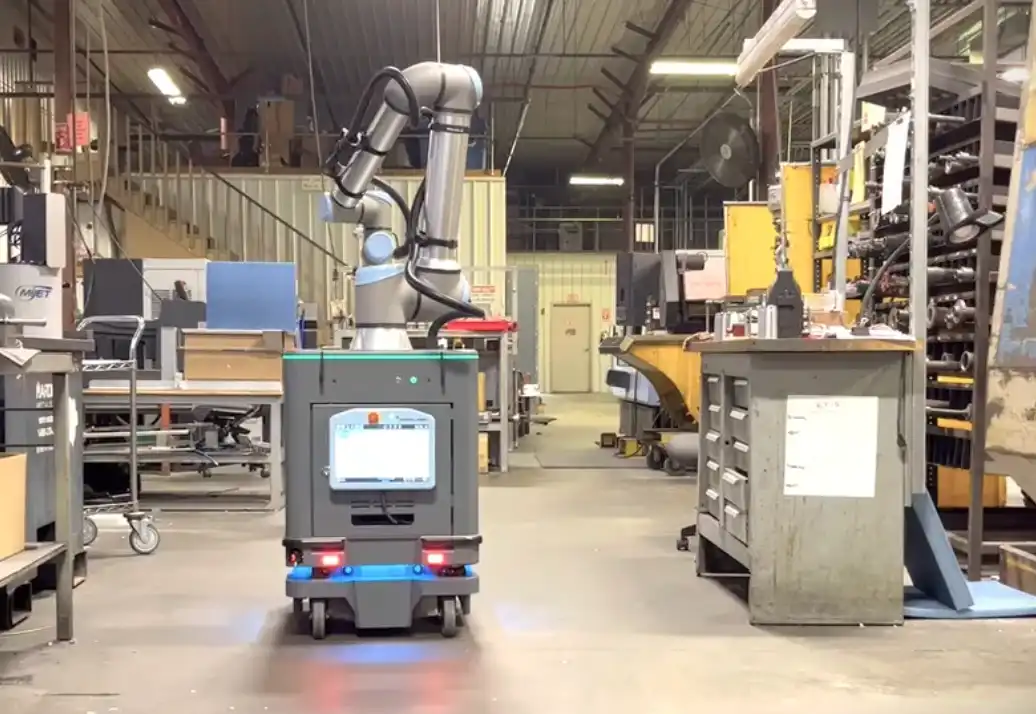
Cobot vs AMR integration comparison showing collaborative robot arm at workstation and autonomous mobile robot navigating warehouse
Why Integration Complexity Matters More Than Robot Capability
Spec sheets lie — or at least they mislead. A cobot with 12 kg payload capacity and ±0.03 mm repeatability sounds impressive until you realize it takes 14 weeks and $80,000 in systems engineering to connect it to your legacy MES. An AMR that navigates autonomously at 2 m/s means nothing if your Wi-Fi infrastructure can’t support fleet communication across a 50,000 sq ft warehouse.
The real question behind cobot vs AMR integration isn’t “which robot is more capable?” It’s “which robot fits into what I already have — and how much do I need to change to make it work?”
According to a 2023 survey by MHI and Deloitte, 74% of supply chain leaders cited integration with existing systems as their top barrier to robotics adoption — ranking it above cost, above ROI uncertainty, above workforce resistance.
That finding should reshape how you evaluate automation. Throughout this comparison, we assess cobot and AMR integration across four criteria that actually predict deployment success:
- Time to deploy — from purchase order to productive operation, measured in weeks
- Infrastructure changes — physical modifications (floor markings, charging stations, safety fencing) and network upgrades required
- Software integration — compatibility with your WMS, ERP, MES, PLC ecosystem, and the middleware or APIs needed to bridge gaps
- Workforce adaptation — training hours, new roles created, and the cultural shift required on the floor
These four dimensions interact. A fast-deploying AMR that demands six months of workforce adaptation isn’t actually fast. A cobot that plugs into your PLC in days but requires $30,000 in safety infrastructure isn’t actually cheap. Evaluating cobot vs AMR integration through this lens prevents the most expensive mistake in automation: buying the right robot and deploying it wrong.

Cobot vs AMR integration evaluation criteria including deployment time, infrastructure changes, software compatibility, and workforce adaptation
Cobot Integration Requirements — Hardware, Software, and Safety
Buying the cobot is the easy part. The real work — and the real budget — lives in everything surrounding it: the cell design, the tooling, the safety validation, and the software handshake with your existing control architecture. Teams that budget only for the robot arm itself typically underestimate total integration cost by 40–60%, according to estimates from the Robotic Industries Association (now part of the Association for Advancing Automation, or A3).
Hardware: More Than Just Bolting Down an Arm
Mounting a cobot requires a rigid base — aluminum extrusion tables, steel pedestals, or machine-integrated brackets — rated for the arm’s maximum dynamic load, not just its static weight. Then comes end-of-arm tooling (EOAT): grippers, vacuum cups, torque drivers, or vision-guided systems. Off-the-shelf EOAT from suppliers like Robotiq or Schunk can cost $2,000–$15,000 per tool, and custom fixtures for part presentation often double that figure.
Don’t overlook fixture design. Your cobot needs parts delivered to a repeatable position within ±0.5 mm. That means custom jigs, nests, or tray systems — each one a mini engineering project with its own lead time.
Software and Controls
- Teach-pendant programming: Most cobots from Universal Robots, FANUC, or ABB use proprietary interfaces. Simple pick-and-place routines take hours; multi-step assembly sequences can take weeks of tuning.
- PLC integration: Connecting the cobot to your line’s Siemens, Allen-Bradley, or Mitsubishi PLC via digital I/O, EtherNet/IP, or PROFINET adds communication mapping and handshake logic.
- Cycle-time validation: Achieving target throughput often requires iterative path optimization — a hidden time sink many teams discover only after deployment.
Safety Under ISO/TS 15066
A proper risk assessment is non-negotiable. ISO/TS 15066 defines permissible force and pressure limits for human-robot contact at specific body regions. You’ll need to measure actual forces using a calibrated device, document every hazard scenario, and potentially add safety-rated sensors, light curtains, or area scanners — even for a “fenceless” cobot cell.
When comparing cobot vs AMR integration, the cobot side demands deeper mechanical and controls engineering. AMR integration leans heavier on IT infrastructure — a distinction covered in the next section.
Budget realistically: for a single cobot cell handling a moderately complex task, expect $75,000–$200,000 all-in, with 8–16 weeks from kickoff to validated production. The arm itself may represent only 30–40% of that total.
AMR Integration Requirements — Fleet Management, Navigation, and IT Infrastructure
Where cobot integration is fundamentally a mechanical and safety engineering challenge, AMR deployment is an IT project wearing a robotics costume. The robot itself — the physical vehicle — represents maybe 40% of the total integration effort. The remaining 60%? Software, networking, and digital infrastructure that most operations teams underestimate badly.
Facility Mapping and Navigation Setup
Before a single AMR moves autonomously, your facility needs a detailed digital map. Most AMR platforms from vendors like MiR, Locus Robotics, or OTTO Motors use simultaneous localization and mapping (SLAM) technology, which requires an initial walkthrough to build a 2D or 3D representation of the environment. Reflective surfaces, narrow aisles under 1.5 meters, and frequently rearranged inventory zones all create mapping headaches that demand ongoing recalibration.
Fleet Management Software and Enterprise Connectivity
A single AMR is simple. Five or more? You need fleet management software orchestrating task assignments, traffic control, and dynamic path planning to prevent bottlenecks. This layer must integrate with your WMS or ERP system — typically through REST APIs or middleware — so the robots respond to real order data, not pre-programmed routes.
The real gap in cobot vs AMR integration complexity shows up here: cobots need a PLC connection and safety configuration, while AMRs demand enterprise-grade Wi-Fi (802.11ac minimum), dedicated VLANs, and often a cloud or on-premise server for the fleet orchestration layer.
Charging Infrastructure and Uptime Planning
- Auto-docking chargers: Plan one charger per 3–5 AMRs, positioned to minimize deadhead travel
- Battery runtime: Most lithium-ion AMRs deliver 8–12 hours per charge, but payload weight and travel distance cut that fast
- Network uptime: A 30-second Wi-Fi dropout can strand an entire fleet mid-route — redundant access points aren’t optional
Budget-wise, the IT infrastructure alone — Wi-Fi upgrades, server hardware, API development, and fleet software licensing — can add $50,000–$150,000 on top of the per-robot cost, according to deployment data published by MHI (Material Handling Institute). That figure surprises teams who priced out only the hardware.
Side-by-Side Comparison of Integration Effort, Cost, and Timeline
Numbers cut through marketing noise. The table below distills the cobot vs AMR integration comparison into the metrics that actually determine project success — or failure.
| Factor | Cobot | AMR |
|---|---|---|
| Typical Deployment Timeline | 2–8 weeks (single cell) | 6–16 weeks (fleet of 5–10 units) |
| Upfront Hardware Cost | $25K–$60K per arm + end-effectors | $30K–$80K per vehicle + charging infrastructure |
| Hidden Cost Drivers | Custom fixturing, safety fencing, risk assessments | Wi-Fi upgrades, WMS/ERP middleware, map maintenance |
| Primary Internal Expertise | Mechanical + controls engineering | IT networking + software integration |
| Safety Certification Effort | High — ISO/TS 15066 risk assessment per application | Moderate — CE/ANSI B56.5 compliance, mostly vendor-handled |
| Scalability | Linear: each new cell requires its own setup | Sublinear: fleet software scales; marginal cost per unit drops ~20–30% |
| Ongoing Maintenance Burden | Low — joint calibration, gripper wear | Medium — LIDAR cleaning, wheel replacement, software updates |
One pattern jumps out: cobots are faster to deploy in isolation, but AMRs become more cost-effective as fleet size grows. A single AMR pilot can feel expensive and slow; a 15-unit rollout amortizes the IT infrastructure investment dramatically.
The expertise gap matters just as much as the dollar figures. If your facility has strong mechanical engineers but a lean IT team, cobot integration will feel natural. Flip that profile — a tech-forward 3PL warehouse with robust Wi-Fi and a WMS already in place — and AMRs slot in with far less friction. According to a 2023 market analysis by Interact Analysis, roughly 60% of AMR deployment delays trace back to IT readiness, not the robots themselves.
Bottom line: neither technology is universally “easier.” The honest answer to the cobot vs AMR integration question depends on your existing infrastructure, your team’s skill set, and whether you’re deploying one unit or fifty.
When a Cobot Is the Right Choice for Your Operation
Cobots shine brightest where tasks demand dexterity, repeatability, and close human collaboration — not raw speed or autonomous mobility. If your operation runs high-mix, low-volume production, a cobot delivers the fastest ROI because reprogramming it for a new part takes hours, not weeks. Contract manufacturers and job shops with batch sizes under 500 units see payback periods as short as 8–14 months, according to data published by Universal Robots.
Scenarios Where Cobots Win Decisively
- Machine tending: Loading and unloading CNC mills, injection molders, or press brakes. A cobot with 5–10 kg payload and 850 mm reach handles 80% of common tending tasks without cell redesign.
- Quality inspection: Mounting a vision camera on a cobot end-effector lets you inspect parts at consistent angles and distances — eliminating the 15–25% variance typical of manual visual checks.
- Assembly and screw driving: Torque-controlled cobots from brands like FANUC CRX or Universal Robots UR5e excel at repetitive fastening where operator fatigue causes defects after the first two hours of a shift.
- Palletizing small cartons: For lines running under 12 cycles per minute, a cobot palletizer costs roughly $45,000–$80,000 installed — a fraction of a traditional robotic cell.
Decision Criteria to Validate the Fit
Don’t just match the application — match the constraints. Evaluate these five factors before committing:
- Payload: Most cobots top out at 16–25 kg. If your parts exceed that, you need an industrial robot or a different approach entirely.
- Reach: Measure the actual working envelope, not the brochure number. A 1,300 mm reach cobot loses 10–15% of usable range once safety-rated soft limits are configured.
- Cycle time: Cobots operate at reduced speeds (up to 1,500 mm/s) when humans are nearby. If your takt time is under 3 seconds, a cobot probably can’t keep up.
- Operator proximity: Power and force limiting (ISO/TS 15066) allows fenceless deployment, but only if contact forces stay below injury thresholds — typically 150 N for transient contact on the chest.
- Floor space: A cobot cell can fit in under 4 m², making it ideal for cramped brownfield facilities where an AMR fleet would struggle to navigate.
When weighing cobot vs AMR integration for a specific use case, ask one question first: does the value come from manipulating an object or moving it across distance? If the answer is manipulation, the cobot wins every time.
One common mistake is deploying a cobot where material transport is the actual bottleneck. A cobot bolted to a workstation won’t solve a logistics problem — that’s AMR territory. But for stationary tasks requiring sub-millimeter repeatability and safe human interaction, no other automation category matches the cobot’s integration simplicity and cost efficiency.
When an AMR Is the Better Fit
If your biggest bottleneck isn’t a task at a workstation but the dead time between workstations, an AMR solves what a cobot never will. Material transport across large facilities — warehouses over 50,000 sq ft, multi-building campuses, distribution centers with dozens of staging zones — is where autonomous mobile robots deliver outsized ROI.
Facility Characteristics That Favor AMR Deployment
- Large footprint with multiple zones: Facilities running intralogistics across receiving, kitting, assembly, QC, and shipping areas see the fastest payback. MiR and Locus Robotics both report sub-12-month ROI in warehouses exceeding 100,000 sq ft.
- High transport frequency: Operations moving materials more than 40 times per shift between fixed points are burning labor hours on walking — not working. AMRs reclaim that capacity immediately.
- Aging or inflexible conveyor infrastructure: Fixed conveyors cost $500–$1,500 per linear foot to install, and reconfiguring them for a new product line can take weeks. A fleet of AMRs reroutes in software within hours.
Use Cases Where AMRs Clearly Win
Hospital logistics teams at institutions like the Mayo Clinic use AMRs from Aethon (TUG robots) to move linens, medications, and lab samples across sprawling campuses — tasks that would be absurd to assign a robotic arm. Automotive tier-one suppliers use OTTO Motors AMRs to shuttle heavy sub-assemblies between welding cells and paint prep, eliminating forklift traffic and the safety incidents that come with it.
The cobot vs AMR integration decision becomes straightforward here: if the core problem is “things need to move between Point A and Point B reliably, repeatedly, and without a driver,” the AMR wins every time. Cobots manipulate; AMRs transport. Confusing the two wastes capital.
A useful rule of thumb from the Material Handling Institute: if more than 25% of your direct labor hours involve transporting rather than transforming product, AMR deployment should be your first automation investment — not your second.
When to Deploy Cobots and AMRs Together — And How to Make It Work
The most productive factories aren’t choosing one technology over the other — they’re combining both. A common pattern: AMRs deliver raw materials or kitted parts to cobot workcells, then carry finished assemblies to the next station. This eliminates the operator walking time that typically eats 20–35% of a shift while keeping the cobot’s cycle time fully utilized. BMW’s Spartanburg plant and several FANUC-integrated lines already run variations of this paired workflow.
An even more ambitious approach mounts a cobot directly onto an AMR chassis — creating a mobile manipulation platform. KUKA’s KMR iiwa and Omron’s LD + TM combination are real examples. These units can navigate to a location, pick or place a part, and move on — no fixed infrastructure at all. The tradeoff? You inherit every integration challenge from both technologies simultaneously.
The Extra Integration Layer You Can’t Skip
Running cobots and AMRs together demands an orchestration layer that neither system ships with out of the box. Specifically, you need:
- Inter-system communication: The AMR fleet manager and cobot controller must exchange real-time signals — “dock confirmed,” “part placed,” “cycle complete.” OPC UA or ROS 2 bridges handle this, but expect 2–4 weeks of middleware development.
- Unified scheduling: A MES or custom scheduler must coordinate AMR arrival times with cobot cycle times. A 10-second mismatch compounds into hours of idle time across a shift.
- Shared safety zones: When an AMR enters a cobot’s workspace, ISO 10218 and ISO 3691-4 both apply. Safety-rated monitored stop or speed-and-separation monitoring must trigger based on AMR proximity, not just human presence.
The cobot vs AMR integration debate often frames the two as competitors. In combined deployments, though, the real competitor is complexity — and the antidote is rigorous interface design before a single robot moves. Budget roughly 30–40% more integration time than a standalone deployment of either system, and assign a dedicated systems integrator who understands both platforms.
Practical tip: Start with a single cobot cell fed by one AMR. Validate the handshake protocol, measure actual vs. planned takt time, then scale. Trying to orchestrate a full fleet with multiple cobot stations on day one is the fastest path to a stalled project.
Real-World Integration Lessons from Manufacturing and Logistics Teams
Theory is clean. Deployment is messy. Facilities that have navigated cobot vs AMR integration consistently report the same handful of surprises — problems that never appeared in vendor demos or pilot simulations.
Wi-Fi Is the Silent AMR Killer
A Tier 1 automotive parts distributor deployed six MiR250 AMRs across a 180,000 sq ft warehouse only to discover that their existing Wi-Fi infrastructure created dead zones near metal racking. Robots would lose fleet-manager connectivity mid-route, stall, and block aisles. The fix — adding enterprise-grade access points with seamless roaming (802.11r) — cost an unplanned $35,000 and delayed full go-live by five weeks. Lesson: conduct a professional RF site survey before ordering a single AMR.
Risk Assessments Take Longer Than You Think
Cobot deployments at food-packaging facilities frequently stall during the ISO 14119 / ISO 10218-2 risk assessment phase. One mid-size bakery integrator reported that the assessment alone consumed 6–8 weeks because every gripper change and product SKU required a separate force-limiting validation. Skipping this step isn’t an option — it’s a regulatory and liability requirement.
Operators Make or Break Adoption
“The biggest ROI accelerator wasn’t the technology — it was involving line operators in week one of planning.” — Operations lead quoted in a 2023 MHI Annual Industry Report
Teams that excluded frontline workers from early planning saw 30–40% longer ramp-up periods, according to patterns documented by MHI and Deloitte’s warehouse automation surveys. Operators who feel ownership over the deployment report issues faster, suggest better waypoint placements for AMRs, and adapt cobot programs to real production variability.
Quick-Hit Takeaways
- Budget a 15–20% integration contingency — unexpected infrastructure gaps are the norm, not the exception.
- Run a two-week shadow deployment for AMRs before going live; map actual traffic patterns against planned routes.
- Assign a single integration owner who bridges IT, maintenance, and operations — siloed ownership is the top predictor of delays in combined cobot and AMR rollouts.
Frequently Asked Questions About Cobot and AMR Integration
Can a cobot be mounted on an AMR?
Yes — and this combination is gaining traction fast. Companies like KUKA, Omron, and Mobile Industrial Robots (MiR) offer platforms where a lightweight cobot arm rides on an AMR chassis, creating a mobile manipulation unit. The catch: payload drops significantly (often to 5–7 kg) because the AMR must support the arm’s weight, and safety validation becomes substantially more complex since you’re certifying two systems as one. Expect 30–50% longer integration timelines compared to deploying either technology standalone.
Which has a faster payback period?
Cobots typically reach ROI in 12–18 months for single-station tasks like machine tending or palletizing. AMR payback depends heavily on fleet size and facility layout — a three-unit fleet handling intralogistics in a 50,000 sq ft warehouse often pays back in 10–14 months by eliminating manual transport labor. The real variable isn’t the robot; it’s how many labor hours you’re displacing per shift.
Do I need a systems integrator for either technology?
For cobots, almost always — unless your application is a textbook pick-and-place with no custom tooling. End-of-arm tooling design, safety risk assessments, and PLC communication rarely fall within a plant engineer’s existing skill set. AMR deployments can sometimes skip a third-party integrator if the vendor provides turnkey fleet management software, but any project requiring WMS or ERP connectivity benefits from professional integration support.
How do safety standards differ between cobots and AMRs?
Cobots fall under ISO 10218-2 and ISO/TS 15066, which govern force and pressure limits during human contact. AMRs are primarily covered by ISO 3691-4 for industrial trucks and ANSI/RIA R15.08 for mobile robot safety. The key difference in a cobot vs AMR integration context: cobot safety is about contact thresholds at a fixed point, while AMR safety centers on dynamic path planning, obstacle detection, and fleet-level collision avoidance across an entire facility.
Making Your Integration Decision — A Practical Action Plan
You’ve seen the specs, the cost breakdowns, and the real-world lessons. Now distill all of it into action. The cobot vs AMR integration decision doesn’t need to be agonizing — it needs to be systematic.
The Three-Question Filter
Before requesting a single vendor quote, answer these honestly:
- Where is time actually lost? If it’s at the workstation (assembly, inspection, palletizing), lean toward a cobot. If it’s between workstations (transport, staging, delivery), an AMR wins.
- What does your IT infrastructure look like today? A facility without Wi-Fi coverage or a WMS/MES system isn’t ready for fleet-managed AMRs. A cobot can plug into a single PLC and run.
- What’s your 18-month headcount forecast? Struggling to fill repetitive manual roles? Cobots. Burning labor hours on pushing carts? AMRs. Both? Deploy both — but stagger the rollouts by at least 8 weeks.
Your 30-Day Readiness Checklist
- Week 1: Map every material handoff and manual task in your highest-volume value stream. Time each one.
- Week 2: Score your facility on floor condition, network coverage, and safety-zone feasibility.
- Week 3: Request integration-specific quotes — not just hardware pricing — from at least two vendors per technology.
- Week 4: Build a 12-month ROI model using the total integration costs outlined earlier in this guide, not just sticker prices.
Skip the pilot that tries to prove everything at once. Pick one cell or one route, validate ROI there, then scale.
Your next step is concrete: walk your production floor this week with a stopwatch and a notepad. Document where people wait, carry, or repeat. That data — not a brochure — will tell you exactly where cobot and AMR integration delivers the fastest payback.
See also
How to Avoid Common Mistakes with Airplane Paint Remover
How to combine laser cleaning machine with industrial robots
Fiber Laser Cutters and the Materials They Handle Best
Laser Cleaning HAZ & Metallography — Why No Heat-Affected Zone
What you should know about CNC machine tools and laser cutting