Roughly 78% of premature weld failures trace back to poor post-weld surface treatment—corrosion, contamination, or residual heat tint left unchecked. Weld cleaning applications span virtually every sector that joins metal, from food-grade stainless steel piping held to Ra 0.8 µm surface finishes, to aerospace titanium assemblies requiring zero oxide contamination. This guide breaks down exactly how each major industry uses weld cleaning, which methods fit which materials, and what standards govern the results.
What Weld Cleaning Involves and Why It Matters Across Industries
Every weld leaves a mark. The intense heat of the welding arc creates oxide layers, heat tint (that rainbow discoloration around the weld zone), and surface contamination that compromise both the appearance and performance of the finished joint. Weld cleaning is the process of removing these byproducts to restore the base metal’s protective properties — particularly the chromium oxide passive layer on stainless steel that prevents corrosion.
What exactly gets removed? Heat tint is the most visible culprit: those blue, gold, and purple bands that signal a chromium-depleted zone beneath the surface. Beneath that discoloration sits a thickened oxide layer that acts as a weak point for pitting and crevice corrosion. Residual flux, spatter, and embedded iron particles also need to go. Left untreated, these contaminants can cause premature failure in as little as a few months in aggressive environments like saltwater or chemical processing.
The stakes are high. According to NACE International, corrosion costs the global economy an estimated $2.5 trillion annually — and improperly cleaned welds are a significant contributor. Industries from food processing to aerospace mandate post-weld cleaning not as a cosmetic afterthought but as a structural and regulatory requirement. FDA sanitary standards, ASME pressure vessel codes, and aerospace prime specifications all include explicit criteria for weld surface condition.
This is why weld cleaning applications span such a broad range of sectors. Any industry joining metal under heat — whether fabricating pharmaceutical tanks or ship hulls — faces the same underlying chemistry. The oxide must come off. The passive layer must be restored. The specific method and acceptance criteria vary, but the core need is universal: a clean weld is a weld that lasts.
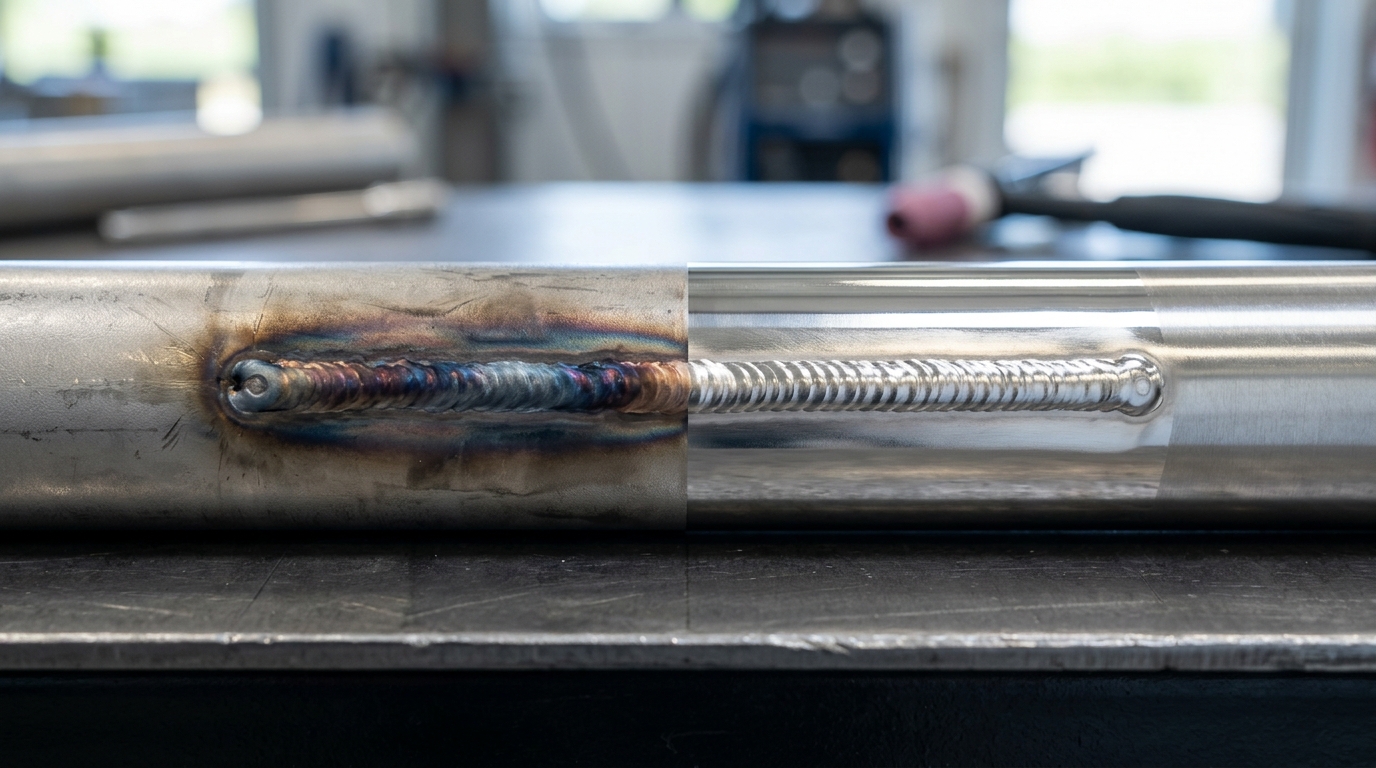
Before and after weld cleaning on stainless steel showing heat tint removal
How Different Weld Cleaning Methods Work
Three dominant approaches handle the bulk of weld cleaning applications across manufacturing: electrochemical cleaning, chemical pickling and passivation, and mechanical methods. Each operates on fundamentally different principles, and choosing wrong costs time, money, or worse — part integrity.
Electrochemical Cleaning
This method passes an electrical current through a phosphoric or citric acid solution via a carbon fiber brush or pad, dissolving heat tint and restoring the passive chromium oxide layer in a single step. It’s fast — a skilled operator can clean a 12-inch weld bead in under 30 seconds. Pharmaceutical, food processing, and architectural fabricators favor it because it delivers a clean, bright finish without altering surface geometry. The limitation? Equipment costs run $3,000–$8,000 for a quality unit, and it works best on stainless steel rather than carbon steel or aluminum.
Chemical Pickling and Passivation
Pickling uses a nitric-hydrofluoric acid mixture to strip oxide scale; passivation follows with nitric or citric acid to rebuild the protective layer. ASTM A967 governs passivation procedures for stainless steel components. Aerospace and defense contractors rely heavily on this two-step process because it treats complex geometries — pipe interiors, tight joints, weldments with limited access — uniformly. The downside: hazardous acid handling, mandatory neutralization, and wastewater disposal add regulatory burden and processing time measured in hours, not minutes.
Mechanical Methods
Grinding wheels, flap discs, wire brushes, and abrasive blasting physically remove weld discoloration and spatter. Shipbuilders and heavy industrial fabricators default to mechanical cleaning because it handles thick carbon steel scale that chemical methods struggle with. But grinding removes base material — sometimes 0.1–0.3 mm per pass — and can embed contaminants if operators use the wrong abrasive. Wire brushing stainless with a carbon steel brush, for instance, causes surface contamination that accelerates corrosion within weeks.
No single method dominates every scenario. The right choice depends on material type, surface finish requirements, production volume, and regulatory environment — factors explored in the industry-specific sections ahead.

Comparison of electrochemical, chemical pickling, and mechanical weld cleaning methods on stainless steel surfaces
Food and Beverage Industry Sanitary Weld Cleaning Requirements
A rough, discolored weld inside a dairy processing tank isn’t just ugly — it’s a potential breeding ground for Listeria, Salmonella, and other pathogens. Food-grade stainless steel (typically 304 or 316L) must maintain a smooth, fully passivated surface with an Ra value below 0.8 µm to prevent bacteria from lodging in microscopic crevices. This makes weld cleaning applications in food and beverage manufacturing some of the most demanding in any sector.
Two frameworks govern these requirements. The 3-A Sanitary Standards used across North America specify that product-contact surfaces must be free of pits, cracks, and heat tint that could harbor microorganisms. EHEDG guidelines in Europe go further, requiring documented evidence that surfaces can withstand CIP (clean-in-place) cycles without degradation. Both standards essentially demand the same outcome: welds that are as clean and corrosion-resistant as the parent material surrounding them.
The equipment list is long. Mixing vessels, heat exchangers, CIP piping systems, filler valves, conveyor frameworks — every welded joint on product-contact surfaces needs treatment. Pickling paste was the traditional go-to, but it introduces serious problems in hygienic environments. Residual acid can contaminate product batches. Rinse water disposal requires neutralization. And paste application near food zones creates chemical exposure risks that make safety officers nervous.
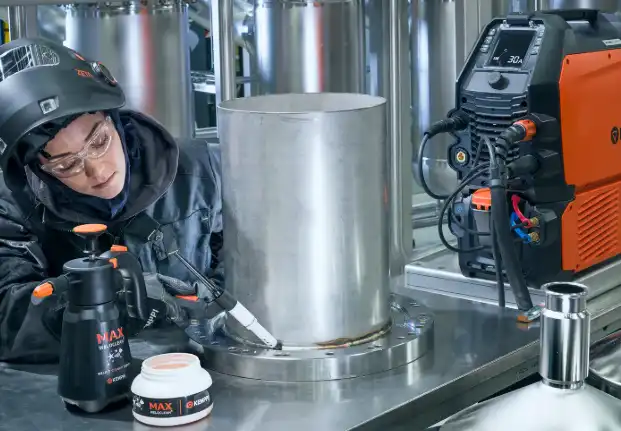
Electrochemical weld cleaning has largely replaced paste in modern food plants for exactly these reasons. The process uses a phosphoric acid–based electrolyte that’s far less hazardous than nitric-hydrofluoric pickling compounds, generates minimal waste, and simultaneously cleans and passivates in a single pass. Operators can treat welds on installed equipment without disassembly — a massive advantage when a production line shutdown costs thousands per hour.

Electrochemical weld cleaning on sanitary stainless steel pipe in food processing plant
Pharmaceutical and Medical Device Manufacturing Applications
Pharma doesn’t tolerate guesswork. The FDA’s Current Good Manufacturing Practice (CGMP) regulations demand that all product-contact surfaces be smooth, non-reactive, and free of crevices where bacteria or chemical residues could harbor. Welds on bioreactors, purified water systems, and sterile filling lines sit directly in the crosshairs of these requirements — and the consequences of failure range from costly batch rejections to patient harm.
The ASME BPE (Bioprocessing Equipment) standard sets the bar. For high-purity tubing welds, it specifies interior surface finishes as low as 15 µin (0.38 µm) Ra mechanically polished, then electropolished to 20 µin Ra or better. Heat tint beyond a pale straw color — anything past IQ Level 2 on the AWS D18.2 discoloration guide — triggers automatic rejection. That’s strict. A single dark blue oxide spot on an orbital TIG weld can scrap an entire spool of 316L tubing worth thousands of dollars.
Electrochemical weld cleaning applications in this sector focus on removing thin oxide layers without altering the carefully controlled surface geometry underneath. Mechanical methods like grinding are essentially banned on product-contact surfaces because they create directional scratches that trap microorganisms. Electropolishing, whether applied to individual welds or entire assemblies, simultaneously removes the heat-affected zone and generates a chromium-rich passive layer that resists rouge formation — the reddish iron oxide contamination that plagues WFI (Water for Injection) systems over time.
Medical device fabrication follows a parallel logic. Implantable components made from titanium or cobalt-chrome alloys require weld zones free of embedded particles down to sub-micron levels. Even 50 µm of residual contamination on a spinal fusion cage can trigger inflammatory responses in vivo. Passivation per ASTM A967 or A380 typically follows weld cleaning as a mandatory secondary step, creating a documented chain of surface preparation that auditors expect to see.

Electropolished pharmaceutical-grade stainless steel weld with mirror finish meeting ASME BPE surface requirements
Aerospace and Defense Weld Cleaning Standards
A single contaminated weld on a turbine engine bracket can ground an entire fleet. Aerospace weld cleaning applications operate under some of the tightest specifications in manufacturing, governed by documents like AMS 2700 (passivation of corrosion-resistant steels) and NASA-STD-5009 for fracture-critical hardware. The margin for error here isn’t small — it’s essentially zero.
Titanium alloys like Ti-6Al-4V demand particular caution. Titanium absorbs oxygen and nitrogen above roughly 500°F, forming a brittle alpha case layer that drastically reduces fatigue life. Post-weld cleaning must remove heat tint and oxide without introducing chloride contamination, which rules out many conventional pickling methods unless rinse protocols are meticulously controlled. Inconel 718 and other nickel superalloys present a different challenge: their chromium-depleted heat-affected zones are vulnerable to intergranular attack if residual flux or oxide isn’t fully removed.
Aluminum alloys — particularly 2024-T3 and 7075-T6 used in airframe structures — are prone to stress corrosion cracking when exposed to even trace chloride residues left by aggressive cleaning chemicals. Electrochemical weld cleaning has gained traction here because it avoids the chemical residue problem entirely, though operators must carefully control voltage to prevent pitting on these softer alloys.
Military procurement adds another layer. MIL-STD-2219 specifies fusion welding requirements for aerospace applications, and defense contractors typically mandate documented cleaning procedures with full traceability — including operator certification, solution batch numbers, and post-clean inspection records using dye penetrant or fluorescent methods. Skipping any step doesn’t just risk a failed audit. It risks catastrophic fatigue failure at 35,000 feet.
Marine and Shipbuilding Weld Cleaning for Corrosion Prevention
Saltwater is relentless. Chloride ions in seawater attack the passive chromium oxide layer on stainless steel at concentrations around 19,000 ppm — roughly 500 times higher than what most freshwater systems encounter. In marine environments, any weld left with residual heat tint, embedded iron particles, or incomplete oxide removal becomes a ticking clock for pitting corrosion, crevice corrosion, or stress corrosion cracking.
Hull fabrication on vessels using duplex and super duplex stainless steels (grades like 2205 and 2507) demands meticulous post-weld treatment. These alloys resist chloride attack far better than standard 316L, but only when their passive layer is fully intact. Electrochemical weld cleaning applications on hull sections and ballast tank welds restore that protective film without introducing mechanical contamination the way grinding would. Offshore platform construction raises the stakes further — splash zones where steel meets alternating wet-dry cycles see corrosion rates 3 to 5 times higher than fully submerged sections, according to NACE International research.
Desalination plants present another brutal scenario. Evaporator tubes and reverse osmosis system piping handle heated brine with chloride levels exceeding 70,000 ppm. Proper passivation after welding can extend component service life from under 5 years to well over 15 in these conditions. Subsea pipeline tie-ins, often welded in the field under less-than-ideal conditions, rely on portable electrochemical systems that clean and passivate simultaneously — critical when the joint will sit under 300 meters of seawater with zero access for maintenance.
Skipping thorough post-weld passivation in chloride-rich environments doesn’t just shorten lifespan. It invites catastrophic failure modes that show almost no visible warning before a pipe wall perforates or a structural weld cracks under load.
Architectural and Decorative Stainless Steel Weld Finishing
Architects specify stainless steel for its clean lines and longevity. But a beautifully designed handrail or building facade loses its appeal the moment a discolored, rough weld seam catches the eye. In architectural work, the weld finish is the product — there’s no paint or cladding to hide behind. Every heat tint, every grinding scratch, every uneven surface texture becomes a permanent visual defect on structures people touch, photograph, and scrutinize daily.
This is where electrochemical weld cleaning applications stand apart from traditional finishing methods. Mechanical grinding on a mirror-polished handrail, for instance, leaves directional scratch patterns that never quite match the surrounding grain, even after extensive blending. Pickling paste works chemically but creates unpredictable results on vertical surfaces — drip marks, uneven dwell times, and whitish residue that requires additional polishing. Electrochemical cleaning, by contrast, removes the heat-affected zone discoloration uniformly without altering the base metal’s surface profile. The result is a consistent tone across the entire weld line.
Public sculptures and interior design elements present an additional challenge: complex geometries. Think of a curved stainless steel reception desk or a freeform outdoor sculpture with dozens of intersecting weld joints. Reaching into tight radii with a grinding disc risks gouging. Electrochemical brushes conform to contours, treating the oxide layer precisely where it formed. Projects like the stainless steel cladding systems seen on modern commercial buildings demand this level of control — a single inconsistent panel weld can disrupt an entire facade’s visual rhythm.
Corrosion resistance still matters here, especially on exterior installations exposed to urban pollution and de-icing salts. But the aesthetic standard is what drives method selection. A 316-grade balustrade on a coastal hotel needs to resist pitting and look flawless under lobby lighting for decades. Electrochemical cleaning restores the passive chromium oxide layer while delivering the surface uniformity that architects and designers refuse to compromise on.
Automotive, Energy, and Heavy Industrial Weld Cleaning Uses
Volume changes everything. An automotive exhaust manifold plant welding 3,000 units per shift can’t afford the per-weld dwell time that aerospace demands. Here, speed and consistency outweigh mirror-finish aesthetics. Electrochemical cleaning systems integrated directly into robotic welding cells handle post-weld oxide removal on 409 and 439 stainless steel exhaust components in under 10 seconds per joint — fast enough to keep pace with automated MIG lines.
Power generation introduces a different pressure: operating temperature. Welds on superheater tubes in coal and gas-fired boilers face sustained temperatures above 540 °C, and any residual oxide scale accelerates creep failure. ASME Boiler and Pressure Vessel Code (BPVC) Section I mandates thorough post-weld treatment on these joints. Mechanical grinding followed by chemical passivation remains common for thick-walled chromium-molybdenum alloy piping, where material thickness of 25 mm or more makes electrochemical wand-based methods impractical for full penetration welds.
Petrochemical piping and pressure vessels sit at the intersection of corrosion risk and regulatory scrutiny. Weld cleaning applications on duplex stainless steel process piping — common in offshore oil and refinery service — must restore the chromium-to-iron ratio in the heat-affected zone without introducing chloride contamination. Pickling paste still dominates for large-diameter vessel circumferential seams, though disposal costs for spent acid are pushing some fabricators toward electrolytic alternatives.
Structural steel fabrication takes a more utilitarian approach. Carbon steel bridge girders and building frames typically need only wire brushing or light grinding before protective coatings are applied. The goal isn’t passivation — it’s paint adhesion. Removing weld spatter and slag ensures the primer bonds uniformly, which directly affects the coating’s 20- to 30-year service life.
How to Choose the Right Weld Cleaning Approach for Your Application
Picking the wrong method wastes money. Picking the right one saves hours per shift and keeps you compliant. The decision comes down to six variables, and weighting them correctly depends on your specific production context.
Material type narrows the field fast. Electrochemical cleaning excels on austenitic stainless steels (304, 316L) but requires careful parameter adjustment for duplex grades. Mechanical methods — grinding, wire brushing — work across carbon steel, aluminum, and exotic alloys, though they risk embedding contaminants if the abrasive media doesn’t match the base metal. Industry regulation is the next filter. If you’re operating under ASME BPE or FDA CGMP requirements, electrochemical systems with documented passivation verification are essentially mandatory.
Surface finish requirements separate decorative weld cleaning applications from purely functional ones. A mirror-polished handrail demands multi-step electrochemical treatment followed by buffing; a structural beam inside a warehouse just needs oxide removal. Production volume matters equally — high-throughput environments (500+ welds per day) justify automated or semi-automated electrochemical units, while a fabrication shop running 20 welds daily may find manual brushing systems more cost-effective.
Environmental and budget concerns round out the framework. Acid pickling generates hazardous waste requiring licensed disposal, which can add $2,000–$8,000 annually for a mid-size shop. Electrochemical systems use phosphoric acid-based fluids that are far easier to neutralize and dispose of legally.
| Decision Factor | Electrochemical | Mechanical (Grinding/Brushing) | Chemical (Pickling Paste) |
|---|---|---|---|
| Stainless steel (food/pharma grade) | ★ Best fit | Risk of contamination | Effective but slow |
| Carbon steel / mixed metals | Limited use | ★ Best fit | Suitable |
| High-volume production | ★ Best fit | Labor-intensive | Batch processing only |
| Strict regulatory compliance | ★ Best fit | Requires validation | Documented but hazardous |
| Decorative / visible surfaces | ★ Best fit | Acceptable with fine grits | Can cause streaking |
| Tight budget, low volume | Higher upfront cost | ★ Best fit | Low cost, high disposal cost |
| Environmental restrictions | Low waste | Dust/particulate management | Hazardous waste generated |
Start with your non-negotiables — regulation and material — then let volume and budget guide the final call. Most shops handling stainless steel across multiple sectors land on electrochemical cleaning as the default, adding mechanical prep only where weld geometry or alloy type demands it.
Frequently Asked Questions About Weld Cleaning Applications
What is the most effective weld cleaning method for stainless steel?
Electrochemical cleaning wins on nearly every metric. It removes heat tint, restores the passive chromium oxide layer, and leaves a finish comparable to the parent material — all in a single pass. For austenitic grades like 304 and 316, electrochemical systems operating at 20–40V AC consistently outperform pickling paste in speed and surface uniformity. Mechanical methods work for cosmetic finishing, but they don’t restore passivation the way electrochemical treatment does.
Is electrochemical weld cleaning safe for all metals?
No. It’s optimized for stainless steel and, with adjusted settings, nickel alloys. Carbon steel, aluminum, and titanium each react differently to the electrolyte solutions and current profiles involved. Using an electrochemical system on aluminum, for instance, can cause pitting or surface etching. Always verify the manufacturer’s material compatibility chart before switching alloys.
Can weld cleaning replace passivation?
Partially. Electrochemical weld cleaning applications restore the passive layer in the heat-affected zone, which is where corrosion risk concentrates. However, full-immersion passivation per ASTM A967 treats the entire component surface, catching scratches, tooling marks, and embedded iron that localized cleaning can’t reach. For critical pharma or food-grade assemblies, many specs still require both.
What industries require certified weld cleaning procedures?
Aerospace (AMS and NADCAP), pharmaceutical (FDA CGMP), food processing (3-A Sanitary Standards), nuclear energy (ASME NQA-1), and medical device manufacturing (ISO 13485) all mandate documented, validated cleaning protocols. Certification typically covers operator training, equipment calibration records, and traceability of electrolyte chemistry.
How does weld cleaning affect weld strength?
Properly executed cleaning doesn’t reduce weld strength. Electrochemical and chemical methods act only on the surface oxide layer — typically less than 5 microns deep — leaving the underlying weld metal and heat-affected zone metallurgy intact. Aggressive mechanical grinding, on the other hand, can thin the joint cross-section and introduce stress risers if operators remove too much material.
See also
Stainless Steel vs Aluminum Which Is Better for Sheet Metal Work
How to extend the service life of laser welding machine
The Complete Guide to Stainless Steel Welding Techniques