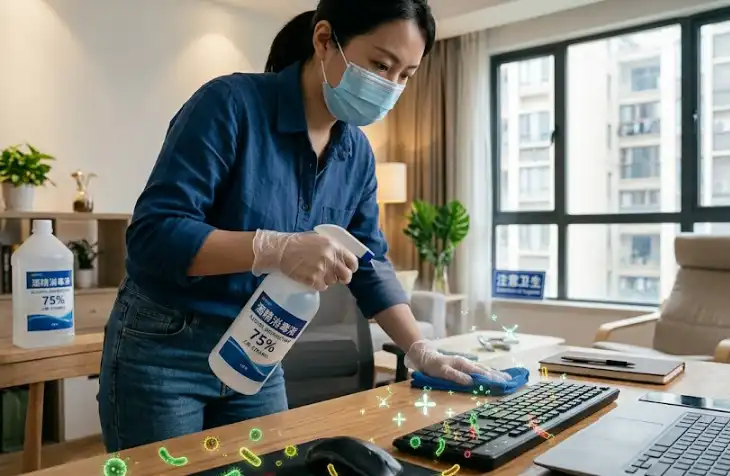
The EPA estimates that mold can begin colonizing a damp surface in as little as 24 to 48 hours — and once it takes hold, picking the wrong cleaning agent wastes time while spores keep spreading. So, does alcohol kill mold? Yes, rubbing alcohol (isopropyl alcohol) at 70% concentration can kill mold on hard, non-porous surfaces by denaturing the proteins and dissolving the lipid membranes of fungal cells, but it won’t penetrate porous materials like drywall or wood deeply enough to eliminate embedded roots called hyphae. This guide breaks down exactly when alcohol works, when it doesn’t, and which alternatives actually deliver results backed by science.
Does Rubbing Alcohol Actually Kill Mold — The Short Answer
Yes — isopropyl alcohol kills mold on contact. But that answer needs serious context before you grab a bottle and start spraying your bathroom walls.
Rubbing alcohol (typically 70% isopropyl) destroys mold cells by denaturing their proteins and dissolving their cell membranes. It works fast, usually within 10 to 15 minutes of direct contact. So if you’re asking does alcohol kill mold, the technical answer is clear. The practical answer? Much messier.
Here’s the critical distinction most people miss: killing mold and solving a mold problem are two completely different things. Alcohol can kill surface-level mold on hard, non-porous materials like glass, tile, or sealed countertops. It struggles on porous surfaces — drywall, wood, fabric, grout — because mold sends root-like structures called hyphae deep into the material. Alcohol evaporates too quickly to penetrate those depths.
Species matters too. Common household molds like Cladosporium and Penicillium are relatively easy to kill on contact. Stachybotrys chartarum (black mold) forms dense, protective biofilms that resist surface-level treatments. The EPA’s mold remediation guidelines don’t even recommend alcohol as a primary solution — they emphasize moisture control and physical removal instead.
Dead mold spores still trigger allergic reactions and respiratory symptoms. Killing them without removing them leaves behind allergens that remain biologically active. So even after alcohol does its job, the cleanup isn’t done. Think of alcohol as one tool in a larger process, not a standalone fix.
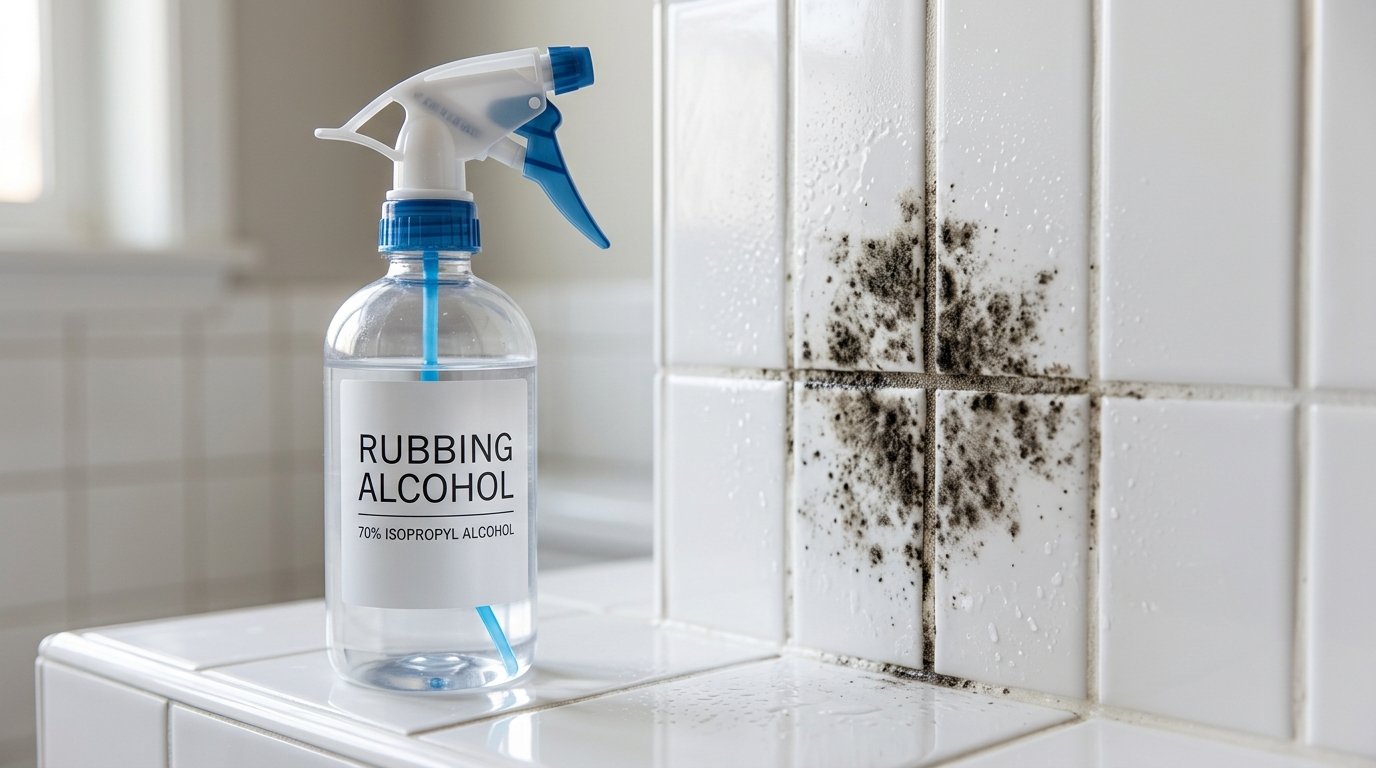
Rubbing alcohol spray bottle next to mold on bathroom tile surface
Why Alcohol Kills Mold — The Science Behind It
Alcohol attacks mold through three simultaneous mechanisms, and understanding them explains both why it works and why it has clear limits. The primary weapon is protein denaturation. Isopropyl alcohol disrupts the hydrogen bonds holding proteins in their functional three-dimensional shapes. Once those proteins unfold, the enzymes mold relies on for metabolism and reproduction stop working entirely. The cell essentially loses its operating system.
The second mechanism targets the cell membrane. Mold cells are surrounded by a lipid bilayer — a thin fatty barrier that controls what enters and exits. Alcohol is an excellent lipid solvent. It dissolves this membrane, causing the cell’s contents to leak out. Think of it like puncturing a water balloon from every direction at once. The third mechanism is dehydration: alcohol pulls water out of the fungal cells through osmotic stress, collapsing them from the inside.
So does alcohol kill mold effectively at the cellular level? Absolutely. Research published through the National Library of Medicine confirms that 60–80% isopropyl alcohol solutions are broadly effective as antimicrobial agents against fungi, bacteria, and many viruses. The concentration matters because pure alcohol evaporates too fast — the water in a 70% solution slows evaporation just enough to let the alcohol penetrate cell walls before disappearing.
That evaporation speed is a double-edged sword. On one hand, alcohol leaves zero residue. No sticky film, no discoloration, no chemical smell lingering for hours. On the other hand, once it evaporates — typically within 30 to 60 seconds on open surfaces — all antimicrobial activity stops. There is no residual protection. New mold spores landing on that same surface five minutes later face no resistance whatsoever. This is the fundamental gap between killing mold on contact and actually preventing regrowth.
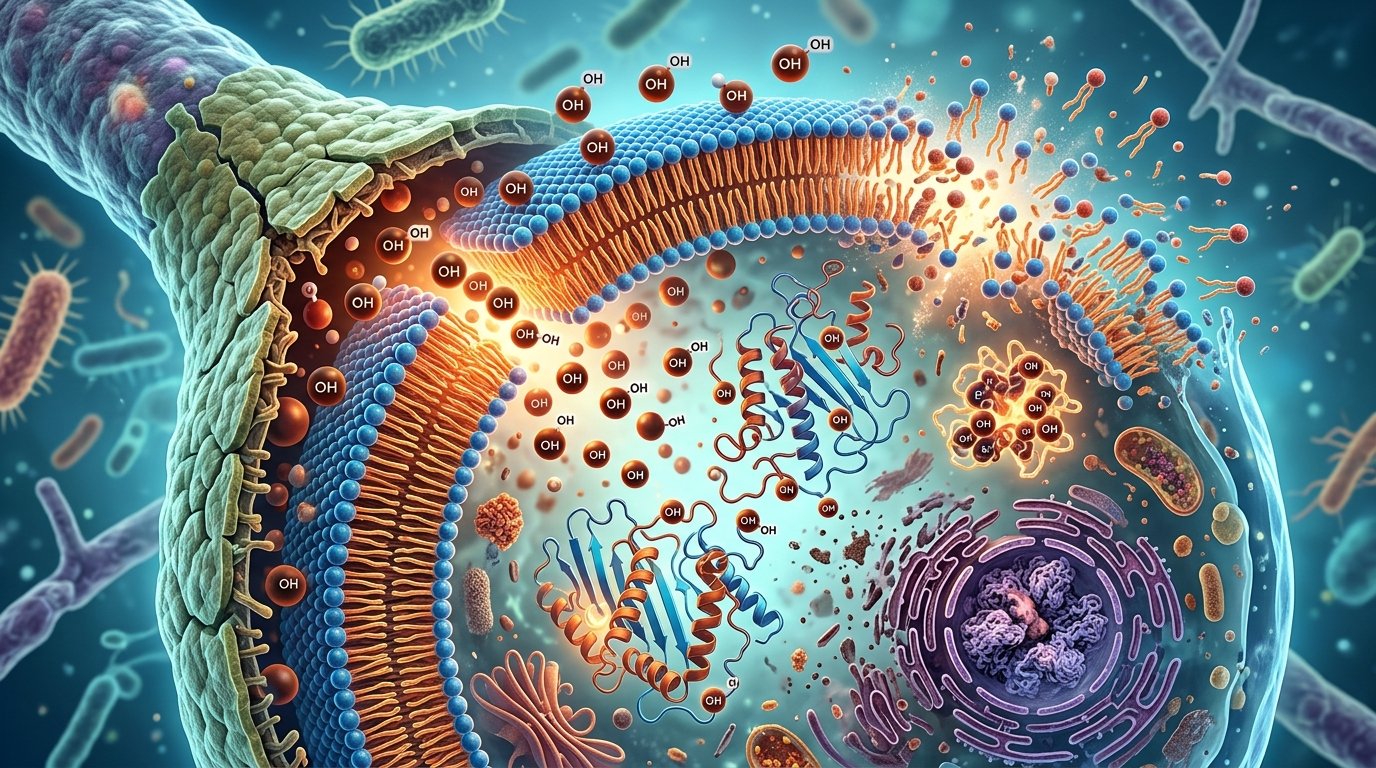
Scientific diagram of how alcohol destroys mold cell membranes and denatures proteins at the molecular level
What Type and Concentration of Alcohol Works Best on Mold
Here’s where most people get it wrong. They grab the highest concentration bottle on the shelf — 91% or 99% isopropyl — assuming stronger means better. It doesn’t. When asking does alcohol kill mold effectively, the answer depends almost entirely on what’s mixed with the alcohol.
Why 70% Beats 91% and 99%
A 70% isopropyl alcohol solution outperforms higher concentrations because of its water content. That 30% water serves a critical purpose: it slows evaporation, giving the alcohol more contact time with mold cells. Water also helps the solution penetrate cell walls rather than just skimming across them. High-concentration alcohol (91%+) evaporates so fast it can actually coagulate proteins on the outer surface of the cell, forming a protective barrier that shields the organism’s interior — the exact opposite of what you want. The CDC’s guidelines on chemical disinfectants confirm that 60–90% alcohol solutions are optimal for antimicrobial activity, with 70% being the most commonly recommended.
Isopropyl vs. Ethanol
Both work. Isopropyl alcohol (rubbing alcohol) and ethanol disrupt mold cell membranes through nearly identical mechanisms. The practical difference? Availability and cost. Isopropyl is cheaper, sold everywhere, and comes in clearly labeled concentrations. Ethanol-based options require a bit more caution — denatured alcohol contains toxic additives like methanol, making it unsuitable for any surface that contacts food or skin.
What About Vodka?
Standard vodka sits at 40% alcohol — well below the effective threshold. Some people swear by it for light cleaning, but at that concentration, you’re not reliably killing mold. You’re dampening it. Skip the cocktail-grade stuff and spend $3 on a bottle of 70% isopropyl instead.
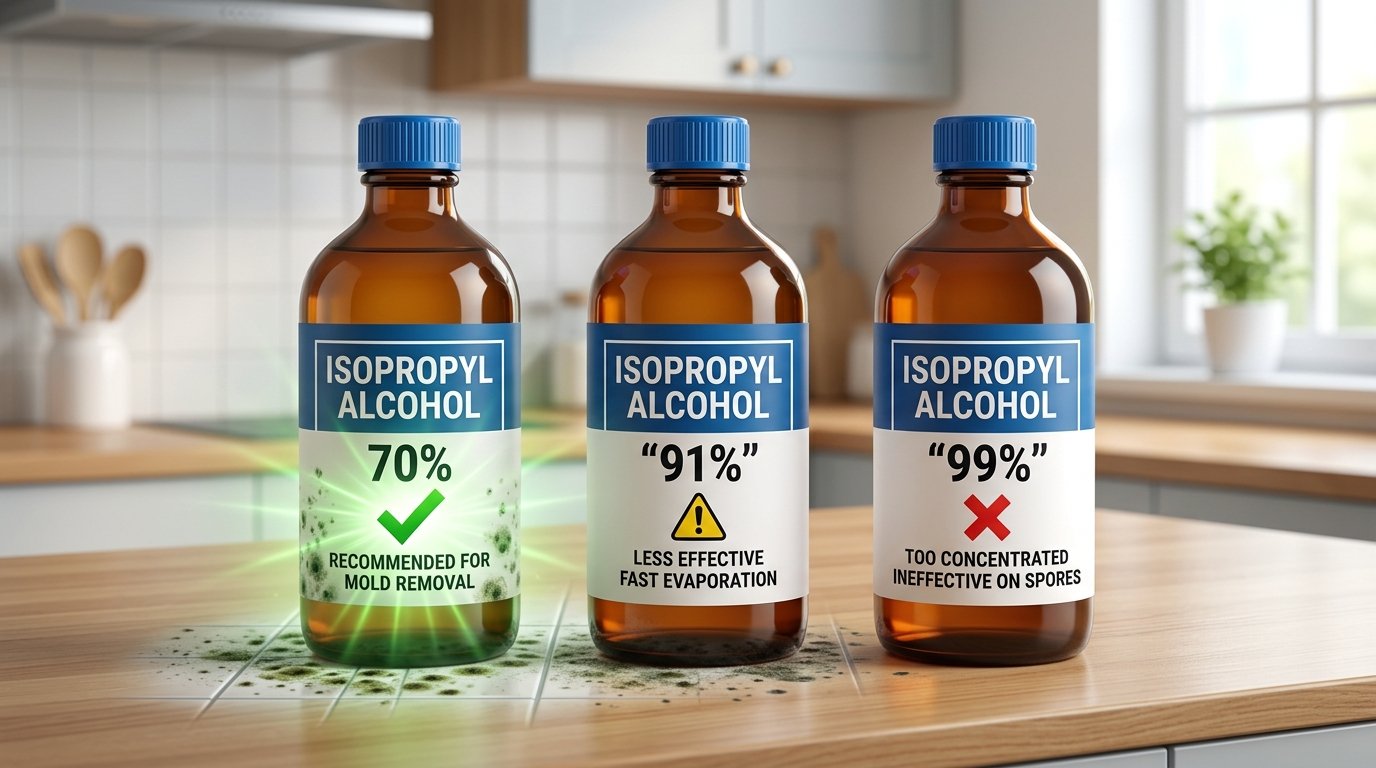
Comparison of 70%, 91%, and 99% isopropyl alcohol concentrations for mold killing effectiveness
How to Use Alcohol to Remove Mold Step by Step
Knowing that alcohol kills mold is one thing. Using it correctly — and safely — is another. Isopropyl alcohol is flammable at concentrations above 20%, so skipping safety steps isn’t an option. Here’s the exact process that works.
Before You Start
Open windows. Turn on exhaust fans. You need cross-ventilation, not just a cracked door. Put on nitrile gloves and a basic N95 respirator — the gloves protect your skin from both the alcohol and mold spores, while the mask keeps you from inhaling either one. Keep all ignition sources away: no candles, no pilot lights, no space heaters within the room.
Application Method
Fill a spray bottle with 70% isopropyl alcohol. Don’t dilute it further. Spray the moldy area until it’s visibly saturated — you want the surface wet, not damp. For tight corners or textured surfaces where a spray bottle can’t reach effectively, soak a microfiber cloth and press it directly against the mold. The key question of does alcohol kill mold on contact depends entirely on this saturation step. Partial coverage means partial results.
Contact Time and Scrubbing
Let the alcohol sit for a minimum of 10 minutes. This gives it time to fully denature the proteins inside mold cells. After that, scrub with a stiff-bristled brush using short, firm strokes. Work from the outside edges inward to avoid spreading spores to clean areas. Wipe the residue with a fresh damp cloth.
Disposal
Bag every contaminated cloth, brush, and paper towel in a sealed plastic bag immediately. Don’t toss them in an open trash can — the EPA recommends containing all mold-contaminated materials to prevent spore dispersal. If the mold patch was larger than roughly 3 square feet, double-bag everything before it leaves the room.
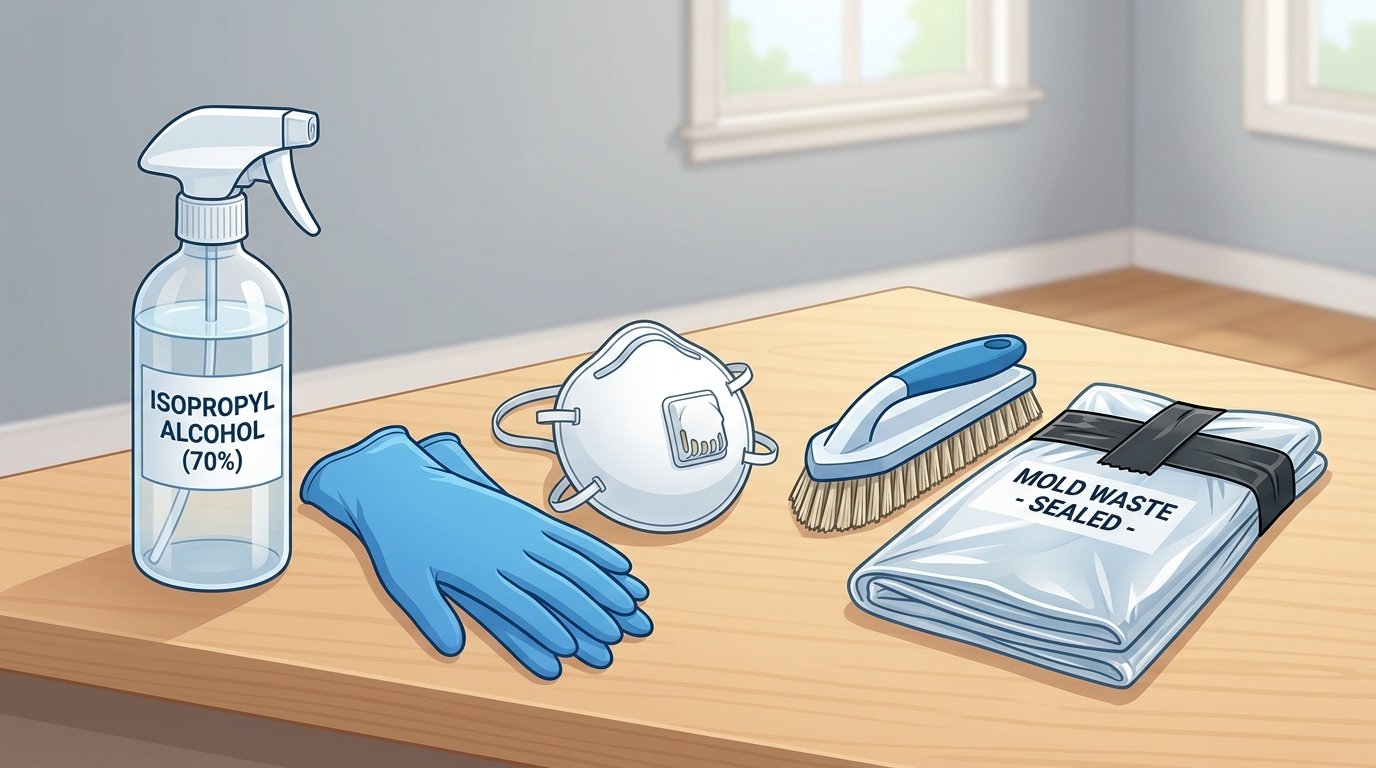
Supplies needed for alcohol mold removal including spray bottle, gloves, respirator, brush, and disposal bag
Surfaces Where Alcohol Is Safe to Use on Mold and Where It Isn’t
Surface type determines everything. Alcohol excels on non-porous materials — glass, ceramic tile, stainless steel, sealed granite, and laminate countertops. On these surfaces, mold sits on top with nowhere to hide. A 70% isopropyl solution can reach every fungal cell, denature its proteins, and leave the surface clean within minutes.
Porosity is the deal-breaker. When people ask does alcohol kill mold on drywall or unfinished wood, the honest answer is: only what you can see. Mold grows thread-like structures called hyphae that burrow deep into porous substrates — sometimes penetrating 3/16 of an inch or more into drywall paper facing. Alcohol evaporates far too quickly to chase hyphae into those tiny channels. You wipe the surface clean, but the root network stays alive and regrows within days.
Safe Surfaces
- Glass and mirrors
- Glazed ceramic and porcelain tile
- Sealed stone countertops (granite, quartz)
- Stainless steel and chrome fixtures
- Hard plastic and acrylic
Surfaces to Avoid
- Drywall and plaster — hyphae penetrate the paper layer; alcohol can’t follow
- Unfinished or unsealed wood — grain absorbs moisture and shelters deep growth
- Carpet and carpet padding — fibers trap spores at the base where alcohol never reaches
- Leather and suede — alcohol strips natural oils, causing cracking and discoloration
- Painted walls with flat/matte finish — alcohol may dissolve the paint binder while mold persists underneath
There’s also a damage risk separate from effectiveness. Alcohol can cloud certain lacquered wood finishes, strip wax coatings, and dull shellac. The EPA’s mold cleanup guide recommends that porous materials with significant mold growth — especially drywall and ceiling tiles — be removed and replaced rather than treated with any surface disinfectant. If the question is does alcohol kill mold on your bathroom tile grout, yes. On your basement drywall? Not meaningfully.
Alcohol vs Bleach vs Vinegar vs Hydrogen Peroxide for Mold Removal
So does alcohol kill mold better than the other options sitting under your sink? That depends entirely on the surface, the mold species, and your tolerance for fumes. No single agent wins every scenario. Here’s an honest breakdown.
| Agent | Kills Mold on Non-Porous | Kills Mold on Porous | Toxic Fumes | Leaves Residue | Approximate Cost |
|---|---|---|---|---|---|
| 70% Isopropyl Alcohol | Yes — fast | Surface only | Low | None | ~$3–5/bottle |
| Chlorine Bleach | Yes | No — can’t penetrate | High | Yes | ~$4–6/gallon |
| White Vinegar (5%) | Yes — slower | Partial penetration | Minimal | Slight odor | ~$3/gallon |
| 3% Hydrogen Peroxide | Yes | Moderate penetration | None | None | ~$1–2/bottle |
Bleach is the most overhyped option. It destroys mold pigment on tile and glass, making surfaces look clean. But on drywall, wood, or grout? The water in bleach soaks into porous material while the sodium hypochlorite stays on the surface. The EPA’s mold cleanup guide doesn’t even recommend bleach for routine mold removal — a detail most people miss entirely.
Vinegar edges out alcohol on porous surfaces because acetic acid penetrates deeper and disrupts mold at the root level. It kills roughly 82% of mold species according to commonly cited lab testing. Hydrogen peroxide offers a middle ground: no fumes, no residue, and mild penetration into semi-porous materials like grout. Alcohol wins when you need zero residue and fast evaporation — electronics, leather, sealed countertops.
The real answer? Use them strategically. Alcohol for quick, residue-free surface kills. Vinegar for bathroom grout and wood. Peroxide for fabrics and light-colored porous surfaces where bleaching is acceptable. Skip chlorine bleach on anything porous — it’s cosmetic, not curative.
Common Mistakes That Make Alcohol Ineffective Against Mold
Alcohol can work. But people sabotage themselves constantly. Even when someone correctly asks “does alcohol kill mold” and gets a yes, the execution falls apart in predictable ways.
Wrong Concentration — The Most Common Blunder
Grabbing 99% isopropyl feels logical. Stronger must be better, right? It’s not. Pure alcohol evaporates in seconds, barely penetrating the mold cell before it’s gone. The sweet spot — 70% isopropyl — needs adequate contact time too, which brings us to the next mistake.
Wiping Too Fast
Spray, immediate wipe, done. That’s what most people do. The problem is that alcohol requires at least 30 to 60 seconds of wet contact to denature mold proteins effectively. A quick wipe just smears spores around the surface. Let it sit. Walk away for a minute. Then scrub.
Ignoring the Moisture Source
This one kills every DIY mold treatment, not just alcohol. You scrub the bathroom ceiling spotless, but the exhaust fan hasn’t worked properly in six months. Mold returns within weeks. The EPA’s mold remediation guidance is blunt: fix the water problem first, or cleanup is temporary theater.
Mixing Alcohol with Other Chemicals
Some people combine alcohol with bleach, thinking they’ll create a super-cleaner. They create chloroform and hydrochloric acid fumes instead. Mixing alcohol with hydrogen peroxide can produce peracetic acid — corrosive and dangerous in enclosed spaces like bathrooms. Use one product at a time. Period.
Assuming Surface Treatment Handles Hidden Growth
A visible patch of mold on drywall often means extensive colonization behind it. Alcohol cannot reach mold growing inside wall cavities, beneath flooring, or within HVAC ductwork. Spraying the surface is like trimming a weed without pulling the root. If mold covers more than about 10 square feet, or you smell mustiness without seeing anything, the problem has likely spread beyond what any topical treatment can address.
When to Call a Professional Instead of DIY Mold Removal
Alcohol, vinegar, bleach — none of it matters once a mold problem crosses certain thresholds. Knowing when to stop Googling “does alcohol kill mold” and pick up the phone instead can protect both your health and your home’s structural integrity. Here are the hard lines.
The EPA’s 10-Square-Foot Rule
The EPA recommends professional remediation when mold covers more than roughly 10 square feet — about a 3×3-foot patch. That’s not an arbitrary number. Beyond that size, disturbing the colony during DIY cleanup releases enough spores to contaminate other rooms through normal air circulation. A spray bottle of isopropyl alcohol won’t contain that kind of spread.
Other Red Flags That Demand Professional Help
- Mold inside HVAC systems. Your ductwork distributes spores to every room. Cleaning visible mold on a vent cover accomplishes nothing if colonies live deeper inside.
- Persistent musty smell with no visible growth. This usually means mold is behind walls, under flooring, or in ceiling cavities — places you can’t reach without demolition.
- Health symptoms. Chronic coughing, headaches, or worsening asthma among household members signals significant exposure. Stop cleaning and get tested.
- Sewage or floodwater was involved. Category 3 water contamination introduces bacteria and pathogens far beyond what any household disinfectant handles safely.
What Professional Remediation Actually Costs
Expect to pay between $1,500 and $5,000 for a typical residential job. Small contained areas might run $500–$1,500. Full-house remediation after flooding? That can hit $10,000–$30,000. Professionals use HEPA-filtered negative air machines, antimicrobial treatments, and physical containment barriers — equipment that simply doesn’t have a DIY equivalent. Most importantly, they identify and fix the moisture source, which is the step homeowners skip most often.
Does alcohol kill mold on a bathroom tile? Absolutely. But alcohol can’t fix a leaking pipe behind drywall or decontaminate a flooded crawl space. Recognizing that boundary saves money in the long run, because untreated mold doubles its coverage area in as little as 24–72 hours under ideal conditions.
Frequently Asked Questions About Using Alcohol on Mold
Can you use vodka to kill mold?
Technically, yes — but it’s a poor choice. Most vodka sits at 40% alcohol (80 proof), which falls well below the 60–70% sweet spot for killing mold effectively. You’d need to apply it multiple times, and even then, results are inconsistent. Cheap 70% isopropyl alcohol costs a fraction of what vodka does and works significantly better.
Does alcohol kill black mold specifically?
Alcohol kills surface-level Stachybotrys chartarum (black mold) the same way it kills other species — by denaturing proteins and dissolving cell membranes. The real problem? Black mold typically indicates prolonged moisture exposure and deep colonization behind walls or under flooring. Alcohol won’t reach those embedded roots. If you’re dealing with visible black mold larger than a few square inches, the EPA recommends professional assessment.
Is rubbing alcohol safe around pets and children?
Safer than bleach, but not harmless. Ventilate the room, keep kids and animals out until the surface dries completely, and never let pets lick treated areas while still wet. Isopropyl alcohol is toxic if ingested — even small amounts can harm a cat or small dog.
Does alcohol prevent mold from coming back?
No. It evaporates within minutes and leaves zero residual protection. If the moisture source remains, mold returns — sometimes within days. Anyone asking does alcohol kill mold should also be asking what’s causing the dampness in the first place.
Can you mix alcohol and vinegar for mold?
You can, but don’t combine them in one bottle. Use them sequentially — spray vinegar first, let it sit 10 minutes, wipe, then follow with alcohol. This two-step approach targets a broader range of mold species since each solution works through different mechanisms.
Will alcohol kill mold in a washing machine?
Not effectively. The drum dilutes alcohol concentration instantly. For washing machine mold, run an empty hot cycle with 2 cups of white vinegar or a commercial washing machine cleaner, then wipe rubber gaskets with alcohol-soaked cloths separately.
The Bottom Line — What Actually Works for Mold and What Doesn’t
So, does alcohol kill mold? Yes — on hard, non-porous surfaces when you use 70% isopropyl alcohol correctly. That’s the honest, evidence-backed answer. But it’s a targeted tool, not a universal fix.
Use alcohol when:
- Mold covers less than 10 square feet of non-porous surface (glass, tile, metal, sealed countertops)
- You need fast evaporation with no residue — electronics, bathroom fixtures, window frames
- You’re dealing with surface-level growth, not deep contamination behind walls
Skip alcohol and choose alternatives when:
- Mold has penetrated porous materials like drywall, carpet, or unsealed wood — white vinegar or hydrogen peroxide reach deeper
- The affected area exceeds 10 square feet — call a certified remediation professional
- You see mold returning within weeks, which signals a hidden moisture source no cleaning agent can solve
Here’s the part most articles skip. Killing mold is the easy half. Preventing it from coming back is the real job. Every mold colony traces back to one thing: moisture. A small bathroom patch you wiped away with alcohol will reappear in 2-3 weeks if the exhaust fan doesn’t work or a pipe leaks behind the wall. The EPA’s mold cleanup guide puts it bluntly — fix the water problem first, or cleanup is pointless.
Measure humidity. Repair leaks immediately. Run ventilation after showers. These unglamorous steps matter more than which bottle you grab from under the sink. Alcohol is a legitimate weapon in your mold-fighting toolkit — just not the only one you’ll need.
See also
How to Tell Aluminum from Stainless Steel: Shop Guide
Weld Cleaning or Grinding? A Visual Comparison of Surface Quality
Injection Mold Cleaning Best Practices to Extend Tool Life
The necessity of using pure water in laser welding water coolers