A single contaminated weld seam — rough, discolored, harboring biofilm — can trigger a bacterial colony count exceeding 10⁶ CFU/cm² within 48 hours of production startup. That’s not a hypothetical; it’s a documented failure mode that has caused product recalls, facility shutdowns, and millions in lost revenue across dairy, brewing, and ready-to-eat processing lines. Weld cleaning for food and beverage equipment is the critical process of removing heat tint, oxide scale, and surface irregularities from welded stainless steel joints so they meet sanitary standards, resist corrosion, and leave microorganisms nowhere to hide. This guide breaks down the regulatory requirements, cleaning methods, surface finish targets, and practical steps you need to get every weld audit-ready.
Why Weld Cleaning Matters in Food and Beverage Manufacturing
A weld bead fresh off the torch looks rough. That discolored, oxidized surface — the heat tint zone — isn’t just cosmetic damage. It’s a structural vulnerability. When stainless steel is welded, temperatures above 400°C destroy the thin chromium oxide layer that gives the metal its corrosion resistance. What’s left behind is a porous, iron-rich surface that bacteria exploit within hours.
The geometry of an uncleaned weld creates what food safety engineers call “harborage points.” These are microscopic crevices where Listeria monocytogenes, Salmonella, and biofilm-forming organisms lodge themselves beyond the reach of standard CIP (clean-in-place) cycles. Research published by the Journal of Dairy Science has demonstrated that surface roughness above 0.8 µm Ra dramatically increases microbial adhesion on stainless steel food-contact surfaces. An uncleaned TIG weld on 304L stainless can easily measure 3.0 µm Ra or higher — nearly four times that threshold.
Corrosion follows contamination. Chloride-rich cleaning chemicals, acidic fruit juices, brine solutions — all of these attack compromised weld zones aggressively. Pitting starts. Then crevice corrosion. Eventually, product contamination or equipment failure forces an unplanned shutdown that costs tens of thousands of dollars per hour in large dairy or beverage plants.
This is exactly why weld cleaning for food and beverage equipment demands a specialized approach that goes well beyond what’s acceptable in structural or architectural fabrication. The stakes aren’t aesthetic — they’re biological. A single poorly finished weld joint inside a mixing vessel or transfer pipe can become the origin point of a product recall affecting millions of units. Getting the cleaning method, surface finish, and passivation sequence right isn’t optional; it’s the difference between a compliant facility and a liability.
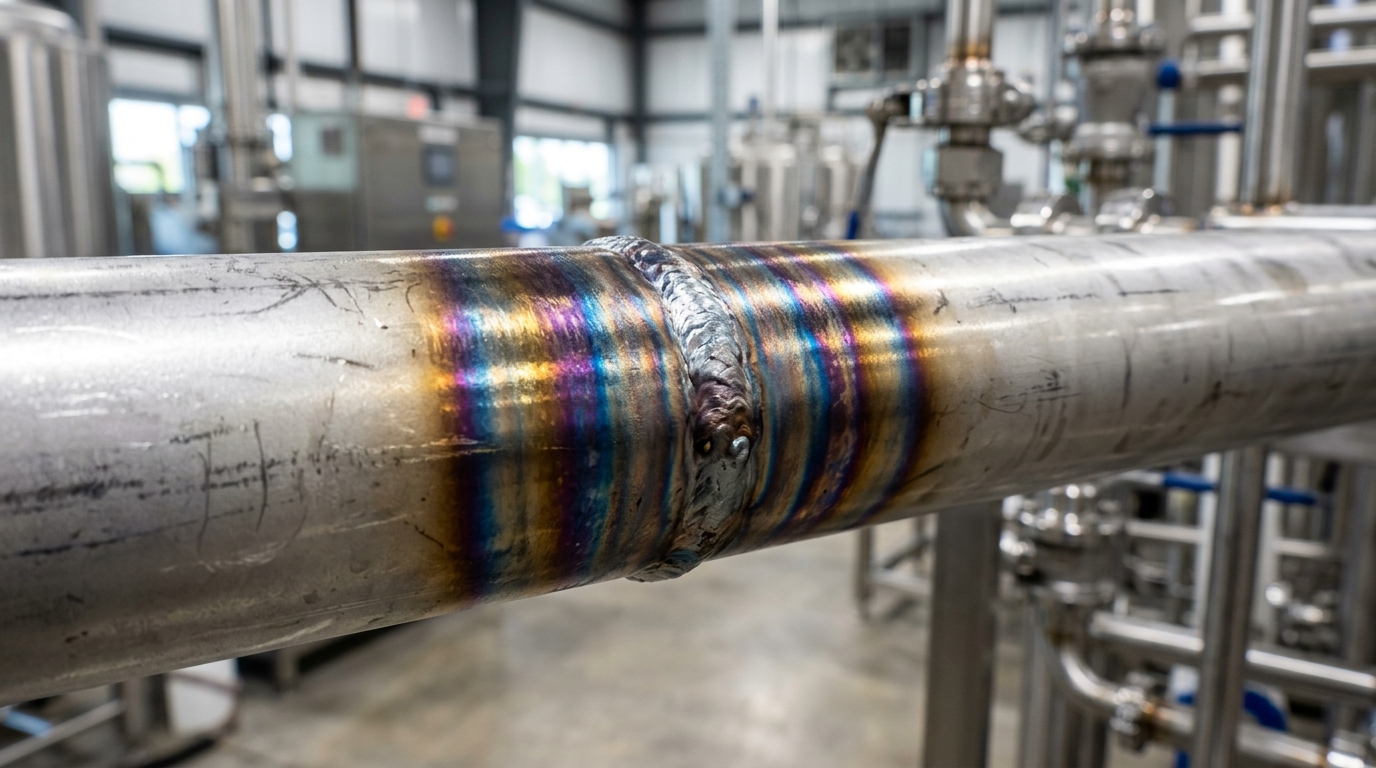
Uncleaned stainless steel weld on food-grade pipe showing heat tint discoloration and oxidation that compromises sanitary standards
Regulatory Standards and Codes Governing Sanitary Welds
Multiple overlapping standards dictate how welds on food-contact surfaces must be finished. Knowing which ones apply to your facility isn’t optional — it determines whether your equipment passes an audit or gets red-tagged.
3-A Sanitary Standards
The 3-A Sanitary Standards Inc. publishes criteria widely adopted across U.S. dairy, beverage, and processed food plants. Standard 01-07 specifically addresses accepted practices for polished metal surfaces. It requires food-contact welds to be continuous, free of pits, crevices, and cracks, and ground flush where necessary to achieve a surface finish of 32 Ra µin (0.8 µm) or better. Weld cleaning for food and beverage equipment starts here — if the finished weld can’t meet that roughness threshold, no amount of sanitizer will compensate.
FDA Regulations
Under 21 CFR Parts 110 and 117, the FDA mandates that equipment surfaces contacting food be corrosion-resistant, non-toxic, and cleanable. The language is broad on purpose. FDA inspectors don’t measure Ra values with a profilometer during a walkthrough, but they will cite you for visible oxidation, rough weld seams, or evidence of product buildup around joints. The practical takeaway: your welds need to be smooth enough that CIP (clean-in-place) cycles actually work.
EHEDG and ASME BPE
European operations typically follow EHEDG guidelines, which push surface finish expectations even tighter — often below 0.8 µm Ra for high-hygiene zones. ASME BPE (Bioprocessing Equipment) targets pharmaceutical and biotech but increasingly influences premium food and beverage fabrication. BPE calls for full-penetration autogenous welds with internal purging, inspected via borescope, and finished to SF4 (≤ 0.5 µm Ra) in critical applications. That’s a demanding bar, yet more food manufacturers are voluntarily adopting it to future-proof their facilities against tightening regulations.
Each of these frameworks approaches weld quality from a slightly different angle, but they converge on one point: the weld must be as cleanable as the parent material surrounding it.

Regulatory compliance inspection of sanitary weld surface finish on food-grade stainless steel equipment
How 3-A SSI, FDA, and EHEDG Requirements Differ
These three bodies all aim at the same goal — keeping food-contact surfaces safe — but they approach weld quality from different angles, with different enforcement mechanisms. Fabricators shipping equipment across borders need to know where the standards overlap and where they diverge sharply.
3-A Sanitary Standards Inc. (3-A SSI)
3-A SSI is a North American voluntary certification program. Its standards specify that welds on product-contact surfaces must be “continuous, smooth, and free of pits, folds, and crevices.” The organization publishes criteria for specific equipment categories — tanks, fittings, pumps — each with its own accepted practice number. A key detail: 3-A requires a surface finish of 32 µin (0.8 µm) Ra or better on product-contact welds unless the equipment category states otherwise. Third-party inspectors from 3-A SSI conduct on-site audits, so compliance isn’t just paperwork.
FDA 21 CFR Part 110 and 117
The FDA doesn’t prescribe a specific Ra value. Instead, it mandates that food-contact surfaces be “smooth, free of cracks, crevices, and inclusions” and “easily cleanable.” This performance-based language gives manufacturers flexibility but also ambiguity. In practice, FDA inspectors evaluate weld cleaning for food and beverage equipment by visual assessment and swab testing rather than profilometer readings. If a surface harbors bacteria, it fails — regardless of how it measures on paper.
EHEDG (European Hygienic Engineering & Design Group)
EHEDG takes the most prescriptive approach. Its guidelines require welds to pass cleanability testing using standardized soil and CIP protocols. EHEDG certification demands Ra ≤ 0.8 µm on welds, similar to 3-A, but adds a biological validation step that neither 3-A nor FDA explicitly requires. Equipment must demonstrate that no microbial residue survives a defined cleaning cycle. For fabricators targeting EU dairy or pharmaceutical-adjacent food markets, EHEDG certification often carries more weight than CE marking alone.
| Criteria | 3-A SSI | FDA | EHEDG |
|---|---|---|---|
| Geographic focus | North America | United States | Europe / global |
| Surface finish spec | ≤ 0.8 µm Ra (32 µin) | No fixed Ra value | ≤ 0.8 µm Ra |
| Biological validation | Not required | Not required | Required for certification |
| Enforcement | Voluntary third-party audit | Regulatory inspection | Voluntary lab testing + audit |
| Weld language | Continuous, smooth, crevice-free | Easily cleanable | Cleanability-tested |
The practical takeaway? If you’re fabricating for a U.S. dairy plant, 3-A SSI is likely your baseline. Exporting to Germany or the Netherlands pushes you toward EHEDG. And FDA compliance is non-negotiable for anything sold into the American market, even if you also hold 3-A certification. Proper weld cleaning for food and beverage equipment is the common thread — but the documentation, testing, and finish thresholds differ enough to trip up shops that treat these standards as interchangeable.

Side-by-side comparison of 3-A SSI, FDA, and EHEDG hygienic weld standards for food equipment
Surface Finish Requirements and How to Measure Ra Values
Surface roughness isn’t cosmetic. It’s a food safety parameter. The Ra value — arithmetic average roughness — quantifies the microscopic peaks and valleys on a metal surface, and bacteria exploit every one of them. Listeria monocytogenes cells measure roughly 0.5–2 µm in length, which means a surface with deep scratches or porous weld zones becomes a harbor where cleaning-in-place (CIP) cycles simply cannot reach.
The benchmark most processors work toward is Ra ≤ 0.8 µm (32 microinches) for food-contact surfaces. This figure appears across 3-A SSI standards and EHEDG guidelines, though some dairy and pharmaceutical applications push tighter — Ra ≤ 0.4 µm. Achieving these numbers after welding is the real challenge. An unfinished TIG weld on 316L stainless steel typically lands somewhere between Ra 1.5 µm and 3.2 µm, depending on filler metal, shielding gas coverage, and operator technique. Effective weld cleaning for food and beverage equipment must bring that number down without introducing new contamination or embedded particles.
How Ra Is Actually Measured
Contact profilometers remain the gold standard. A diamond-tipped stylus drags across the surface at a controlled speed, recording vertical displacement to produce a roughness profile. Portable units like the Mitutoyo SJ-210 or Mahr MarSurf PS 10 can take readings directly on installed piping — useful during commissioning audits. The key setting to get right is the evaluation length: ISO 4287 specifies a cutoff wavelength (λc) of 0.8 mm for surfaces in this Ra range, and using the wrong cutoff will skew results significantly.
Comparator gauges offer a faster, cheaper alternative. These are small reference plates with known Ra finishes that you press against the workpiece and judge by sight and touch. They work for quick pass/fail screening on the shop floor but lack the precision auditors expect in a validation package. For final documentation, always back up comparator checks with a profilometer trace.
How Weld Cleaning Methods Affect Final Ra
Electrochemical cleaning removes the heat tint oxide layer without mechanically altering the surface profile, so the underlying Ra stays close to the parent material’s original finish. Mechanical grinding, by contrast, can achieve very low Ra values — but only if the grit sequence is followed correctly. Jumping from 80-grit to a buffing wheel leaves subsurface scratches hidden under a polished-looking top layer. Pickling paste dissolves oxide chemically and can slightly etch grain boundaries, sometimes raising Ra by 0.1–0.2 µm on finer finishes. The method you choose during weld cleaning for food and beverage equipment directly determines whether you hit that 0.8 µm target or spend hours reworking.

Portable profilometer measuring Ra surface roughness on a stainless steel food-grade weld
Electrochemical Weld Cleaning vs. Pickling Paste vs. Mechanical Polishing
Three methods dominate the field, and none of them is universally superior. Each carries trade-offs that matter differently depending on the alloy, joint geometry, production schedule, and regulatory framework you’re working under. Picking the wrong one doesn’t just waste money — it can leave behind a surface that fails audit or harbors bacteria within weeks.
Electrochemical Weld Cleaning
This method uses a carbon fiber brush soaked in electrolyte solution, paired with low-voltage current, to strip heat tint and simultaneously passivate the surface. It’s fast — a typical 12-inch TIG weld on 304L stainless takes under 90 seconds. No hazardous fumes. No rinse water contamination. The operator can work in-place on installed piping without disassembly, which makes it especially practical for weld cleaning for food and beverage equipment already on the production floor. The downside? Equipment cost runs $3,000–$8,000 for a professional-grade unit, and heavily oxidized welds from poor shielding gas coverage may still need a preliminary mechanical pass.
Pickling Paste
Pickling paste — typically a mixture of nitric and hydrofluoric acid — is brutally effective at dissolving oxide scale. It’s cheap per application, often under $0.50 per weld. But hydrofluoric acid is extraordinarily dangerous; skin contact can cause deep tissue burns and systemic fluoride poisoning that doesn’t present symptoms for hours. The OSHA hydrofluoric acid safety guidelines classify it among the most hazardous industrial chemicals. Paste also demands careful neutralization and disposal, and dwell time runs 30–60 minutes per weld. For high-volume sanitary fabrication, that wait adds up quickly.
Mechanical Polishing
Grinding, flap discs, and belt finishing physically remove material to achieve target Ra values. This is the only method that reshapes weld profile — critical when a convex bead needs blending flush for cleanability. The catch: it generates dust, embeds abrasive particles if the wrong media is used, and removes the passive layer entirely. Every mechanically polished weld on food-contact stainless requires a separate passivation step afterward. Skilled operators can hit Ra 0.4 µm consistently, but inexperienced hands often over-grind and thin the parent material below minimum wall thickness.
Side-by-Side Comparison
| Factor | Electrochemical | Pickling Paste | Mechanical |
|---|---|---|---|
| Speed per weld | 1–3 min | 30–60 min | 5–15 min |
| Operator safety risk | Low | High (HF acid) | Moderate (dust, sparks) |
| Passivation included | Yes | Partial | No |
| Profile correction | No | No | Yes |
| Upfront cost | $3,000–$8,000 | Under $100 | $200–$1,500 |
| Environmental waste | Minimal | Acid neutralization required | Metal dust disposal |
The honest answer for weld cleaning for food and beverage equipment is that most professional shops use a combination. Mechanical polishing handles profile defects, electrochemical cleaning tackles heat tint on accessible welds, and pickling paste still earns its place on large vessels where brush access is limited — provided the safety protocols are airtight.
Choosing the Right Method Based on Equipment Type and Weld Location
The best weld cleaning method on paper often fails in practice because of one overlooked variable: access. A circumferential weld inside a 2-inch sanitary spool piece demands a completely different approach than a longitudinal seam running down the interior of a 5,000-gallon mixing vessel. When selecting a method for weld cleaning for food and beverage equipment, the decision tree starts with geometry, not chemistry.
Pipe Diameter and Internal Access
For tubing under 3 inches OD, electrochemical cleaning with a flexible brush head is typically the only viable option — pickling paste is nearly impossible to apply and rinse uniformly inside tight-radius bends, and mechanical polishing tools simply won’t fit. Once you move above 6-inch diameters, all three methods become feasible, but pickling paste gains an edge on long straight runs where dwell time can be controlled consistently. Tank interiors with manway access open up mechanical polishing as a realistic choice, especially when you need to hit Ra ≤ 0.5 µm on large flat weld zones near baffles or agitator mounts.
Material Grade Matters
316L tolerates aggressive pickling formulations better than 304 due to its higher molybdenum content, which resists pitting during acid exposure. On 304 stainless, shorter dwell times or lower-concentration pastes are essential — over-pickling can actually create micro-pits that trap bacteria, defeating the entire purpose. Electrochemical methods sidestep this risk because the operator controls current density in real time.
Downtime Constraints
Production schedules dictate more decisions than engineers like to admit. Electrochemical weld cleaning takes roughly 3–5 minutes per linear foot and requires minimal post-treatment rinse time. Pickling paste needs 20–60 minutes of dwell plus thorough neutralization. If a dairy plant has a 4-hour maintenance window between CIP cycles, that time difference determines the method before any technical spec does. The International Molybdenum Association provides useful guidance on matching stainless grades to cleaning chemistry — a resource worth bookmarking when spec’ing jobs across mixed-alloy facilities.
Step-by-Step Weld Cleaning Process for Stainless Steel Food Equipment
Knowing which method to use is only half the job. Execution determines whether the finished weld actually passes inspection. Here’s a practitioner-level walkthrough of the complete weld cleaning workflow for food-grade stainless steel, broken into discrete phases that each serve a specific purpose.
Pre-Cleaning Inspection
Before any cleaning agent or electrode touches the weld, examine the joint visually and by touch. You’re looking for cracks, incomplete fusion, undercut, and excessive spatter — defects that no amount of surface cleaning can fix. Run a gloved finger along the weld profile to detect sharp edges or raised spots that would trap product. If the weld itself is structurally deficient, stop here and repair it. Cleaning a bad weld is wasted effort.
Surface Preparation
Remove loose spatter with a stainless-steel wire brush dedicated exclusively to stainless work. Cross-contamination from carbon steel brushes introduces free iron particles that corrode within days. Degrease the weld zone and surrounding parent material with an acetone or isopropyl alcohol wipe — residual oils from handling interfere with both electrochemical cleaning and pickling chemistry. Allow the solvent to fully evaporate before proceeding.
Cleaning Execution
Apply your chosen method — electrochemical, chemical paste, or mechanical — following the parameters established for the specific alloy and wall thickness. For electrochemical weld cleaning for food and beverage equipment, maintain consistent pad contact speed (roughly 10–15 mm per second on typical 304L or 316L butt welds) and keep the electrolyte flow steady. Rushing this step leaves heat tint behind. Going too slow risks etching the surface below the target Ra value. Monitor amperage; a sudden drop signals a dry pad that needs re-wetting.
Rinsing Protocol
Neutralize and rinse immediately after cleaning. For electrochemical methods, a dedicated neutralizing fluid followed by deionized water works best. Tap water introduces chlorides — a serious concern on 316L surfaces. The ASTM A380 standard provides detailed guidance on acceptable rinse water quality for stainless steel. Wipe dry with lint-free cloths rather than air-drying, which can leave water spots that mask surface defects during final inspection.
Final Verification
Confirm the result with at least two checks. First, a visual inspection under strong white light at a 45-degree angle reveals residual discoloration that overhead shop lighting misses. Second, take a profilometer reading to verify the Ra value falls within spec — typically ≤ 0.8 µm for most dairy and beverage applications. For critical process zones, a copper sulfate test per ASTM A380 confirms that free iron has been eliminated. Document every measurement. Auditors want records, not assurances.
Passivation After Weld Cleaning and Why It Is Essential
Welding destroys the chromium oxide layer that makes stainless steel “stainless.” Heat from the arc depletes chromium in a narrow zone around the weld, leaving bare iron exposed at the surface. Weld cleaning removes discoloration and scale, but it does not fully rebuild that protective barrier. Passivation does.
The chemistry is straightforward. An acid bath — citric or nitric — dissolves free iron and iron compounds from the surface while leaving chromium and nickel intact. Once rinsed and exposed to air, the chromium-rich surface reacts with oxygen to form a dense, self-healing oxide film roughly 1–5 nm thick. This film is what prevents corrosion, pitting, and bacterial harbor points on food-contact surfaces.
Citric Acid vs. Nitric Acid Passivation
ASTM A967 recognizes both chemistries. Nitric acid passivation — typically 20–50% concentration at 50–60 °C for 30 minutes — has been the industry default for decades. It works. But it generates hazardous fumes, requires strict waste neutralization, and poses real handling risks. Citric acid passivation (4–10% concentration, similar temperatures and dwell times) achieves equivalent or superior results on 304 and 316L alloys with far less environmental and safety burden. Many fabricators performing weld cleaning for food and beverage equipment have shifted to citric acid for exactly these reasons.
The Cost of Skipping Passivation
Skip this step and the consequences compound fast. Rouge — that reddish-brown iron oxide staining — can appear within weeks on cleaned but unpassivated welds, especially in CIP environments where chloride-bearing sanitizers cycle daily. Rouging isn’t just cosmetic; it signals active corrosion and creates micro-crevices where Listeria and Salmonella biofilms anchor. Rework on an installed tank or piping system can cost 5–10× what passivation would have cost during fabrication. For any weld cleaning for food and beverage equipment project, passivation is not optional — it is the final step that validates every step before it.
Common Weld Cleaning Mistakes That Compromise Food Safety
Even experienced fabricators slip up. The consequences range from a failed audit to a full product recall, so understanding the most frequent errors in weld cleaning for food and beverage equipment is worth the five minutes it takes to read this section.
Leaving Heat Tint Behind
A faint straw-colored tint looks harmless. It isn’t. That thin oxide layer, even at the lightest temper colors (around 300 °C exposure), depletes the chromium available to reform a protective passive film. Bacteria colonize these chromium-depleted zones far more readily than a properly cleaned surface. The fix: treat every visible discoloration — not just the dark blues and purples — as incomplete cleaning.
Using Carbon Steel Tools on Stainless
Wire brushes, grinding discs, and flap wheels that previously touched carbon steel deposit iron particles into the stainless surface. Those embedded particles rust within days in a wet processing environment, creating pits that harbor Listeria and Salmonella. Dedicate tools exclusively to stainless steel and label them clearly. Cross-contamination from a single shared brush can undo hours of careful work.
Skipping Electrolyte Rinse After Electrochemical Cleaning
Phosphoric acid electrolyte left on the surface corrodes the weld zone over time and can leach into product. A thorough rinse with deionized or potable water — followed by a pH check confirming neutrality — eliminates this risk entirely. According to ASTM A380, residual chemical removal is a mandatory step in any cleaning and passivation sequence.
No Post-Clean Verification
Assuming the weld looks clean enough is a gamble. A copper sulfate test per ASTM A967 or a ferroxyl test takes under two minutes per weld and provides documented proof of a passive, iron-free surface. Skipping this step means you have zero defensible evidence during a regulatory inspection.
Abrasives That Embed Contaminants
Aluminum oxide and silicon carbide discs can fracture and lodge particles in the metal. For food-contact surfaces, non-woven abrasives or ceramic-grain discs rated for stainless steel are the safer choice — they cut without embedding debris that later becomes a corrosion initiation site.
Frequently Asked Questions About Weld Cleaning for Food and Beverage Equipment
Does electrochemical cleaning replace passivation?
Not exactly. Electrochemical weld cleaning removes heat tint and surface contamination, and some systems do promote a thin chromium oxide layer during the process. But that layer is typically thinner and less uniform than what a dedicated citric acid or nitric acid passivation bath produces. For equipment subject to 3-A SSI or ASME BPE audits, most inspectors still expect a separate passivation step with documented verification — usually via ASTM A967 testing. Think of electrochemical cleaning as surface prep, not a passivation substitute.
How often do welds need re-cleaning during an equipment’s service life?
If the initial weld cleaning for food and beverage equipment was done correctly and passivation is intact, re-cleaning welds specifically shouldn’t be necessary under normal CIP cycles. The exception: mechanical damage. A scratched or gouged weld zone exposes fresh iron, and that spot needs localized re-passivation. Facilities running aggressive CIP chemicals — particularly chloride-based sanitizers above 200 ppm — should inspect weld zones annually for pitting or rouge formation. Catching degradation early avoids full re-fabrication.
What inspection methods verify a sanitary weld?
Visual inspection under strong light catches obvious defects — undercut, porosity, discoloration. A borescope handles internal seams you can’t reach directly. For surface finish, a portable profilometer confirms Ra values on-site. Ferroxyl testing (per ASTM A380) detects free iron contamination invisible to the naked eye. Dye penetrant testing reveals subsurface cracks. No single method covers everything — a proper QA protocol stacks at least three of these together.
Can TIG welding alone meet food-grade requirements without post-weld cleaning?
TIG (GTAW) with proper argon back-purging produces the cleanest welds of any arc process. A perfectly purged TIG weld on 316L can come off the torch with minimal oxidation. But “minimal” isn’t “zero.” Even light straw-colored tint indicates some chromium depletion. Auditors and microbiologists don’t care how clean it looks — they care whether free iron is absent and the passive layer is continuous. Post-weld cleaning remains the standard expectation across every major food safety framework.
Actionable Summary and Next Steps for Compliant Weld Cleaning
Everything covered in this guide distills into a single principle: clean welds are verifiable welds. If you can’t measure it, document it, and repeat it, you don’t have a process — you have a gamble. Below is a practical checklist to turn that principle into daily operations.
Build Your Weld Cleaning SOP
Start by mapping every weld joint type in your facility to a specific cleaning method, acceptance criteria (Ra value, visual grade, passivation verification), and responsible role. Your SOP should specify electrolyte concentration ranges, dwell times, amperage settings for electrochemical units, or grit sequences for mechanical polishing — not just “clean per best practice.” Include hold points where QC must sign off before the next fabrication step proceeds. A well-structured SOP for weld cleaning for food and beverage equipment typically runs 8–12 pages, with photo references for accept/reject decisions at each stage.
Select Qualified Vendors and Validate Their Work
If you outsource fabrication or polishing, require vendors to submit procedure qualification records that reference your SOP, not just their own. Ask for Ra measurement reports with instrument calibration certificates dated within the last 12 months. Cross-check their passivation method against ASTM A967 — vendors who can’t name which test method they use (citric vs. nitric, concentration, temperature, dwell time) are a red flag.
Maintain Audit-Ready Documentation
Keep a weld log per asset that ties each weld number to its cleaning record, Ra reading, passivation verification result, and operator ID. Digital systems beat paper binders — they’re searchable, timestamped, and harder to backdate. When an auditor or customer asks how you ensure compliant weld cleaning for food and beverage equipment, handing over a structured dataset answers the question faster than any verbal explanation.
- Review and update your SOP at least annually or after any process change.
- Conduct internal audits quarterly, focusing on the three most common failure modes: skipped passivation, undocumented Ra readings, and expired consumables.
- Train every welder and finisher on the SOP — not just once, but with annual refreshers that include hands-on reject-sample exercises.
Compliance isn’t a destination. It’s a maintenance task. Treat it like one, and audits become confirmations rather than surprises.
1
See also