Coating failures cost the global infrastructure sector an estimated $2.5 trillion annually, according to NACE International’s IMPACT study — and roughly 80% of those failures trace back to inadequate surface preparation, not the coating itself. The rust removal and surface preparation standards SSPC provide the definitive framework that specifiers, inspectors, and contractors rely on to define exactly how clean a steel surface must be before any protective coating is applied. This guide breaks down every major SSPC standard — from hand tool cleaning (SP 2) through white metal blast (SP 5) — explains how they map to NACE and ISO equivalents, and helps you choose the right cleanliness grade for your specific coating system and service environment.
What Are SSPC Standards for Rust Removal and Surface Preparation
SSPC stands for the Society for Protective Coatings — formerly the Steel Structures Painting Council. This organization publishes a series of standards that define exactly how clean a steel surface must be before you apply a protective coating. Think of them as a shared language. A specifier in Houston and a blaster in Rotterdam can reference the same SSPC designation and agree on precisely what the finished surface should look like.
The rust removal and surface preparation standards SSPC maintains cover a spectrum of methods: hand tool cleaning, power tool cleaning, various grades of abrasive blasting, and even waterjetting. Each standard assigns a specific cleanliness level — from a light brush-off (SP 7) all the way to a white metal blast (SP 5) where virtually every trace of mill scale, rust, and old coating is gone. The designation numbers aren’t ranked sequentially by aggressiveness, which trips up newcomers, but each one maps to a precise visual and performance benchmark.
Why do these standards matter? Coating failures are expensive. According to AMPP (Association for Materials Protection and Performance), the global cost of corrosion exceeds $2.5 trillion annually, and improper surface preparation is the single largest contributor to premature coating breakdown — responsible for an estimated 60–80% of all failures. SSPC standards exist to eliminate guesswork and reduce that failure rate by giving contractors, inspectors, and engineers a measurable target.
Each standard pairs with visual reference photographs (typically the SSPC-VIS series) so inspectors can compare a prepared surface against a known benchmark in the field. This combination of written specification and visual comparator is what makes the system practical on real job sites, not just in specification documents sitting in a filing cabinet.

Inspector comparing a blast-cleaned steel surface to an SSPC-VIS reference standard for rust removal and surface preparation
Understanding the SSPC Standard Classification System
SSPC organizes its surface preparation standards under a simple “SP” designation system. Each SP number maps to a specific cleaning method and a defined cleanliness level — two variables packed into one reference code. That dual function is what makes the system so practical on job sites and in coating specifications alike.
The numbering isn’t random, but it also isn’t a linear scale of aggressiveness. SP 1 covers solvent cleaning — the most basic step, focused on removing oil, grease, and other contaminants before any mechanical work begins. SP 2 addresses hand tool cleaning (wire brushes, scrapers, chipping hammers), while SP 3 steps up to power tool cleaning with grinders, sanders, and rotary wire brushes. These three sit at the low end of surface cleanliness expectations.
Blast cleaning grades occupy the higher SP numbers and define progressively stricter cleanliness thresholds. SP 7 (Brush-Off Blast) requires only that tightly adhering residues remain. SP 6 (Commercial Blast) demands removal of at least two-thirds of all visible surface contamination. SP 10 (Near-White Blast) pushes that to roughly 95% cleanliness, and SP 5 (White Metal Blast) calls for a fully clean, uniform metallic surface — no staining, no residue. The jump between SP 6 and SP 10 is where most specification disputes happen, because the visual difference can be subtle under poor lighting.
Understanding how rust removal and surface preparation standards SSPC are classified helps you read a coating spec sheet without guessing. Each SP designation is supported by a written standard document from SSPC’s official standards library, which includes scope, definitions, procedures, and acceptance criteria. Knowing the category tells you both the “how” and the “how clean.”
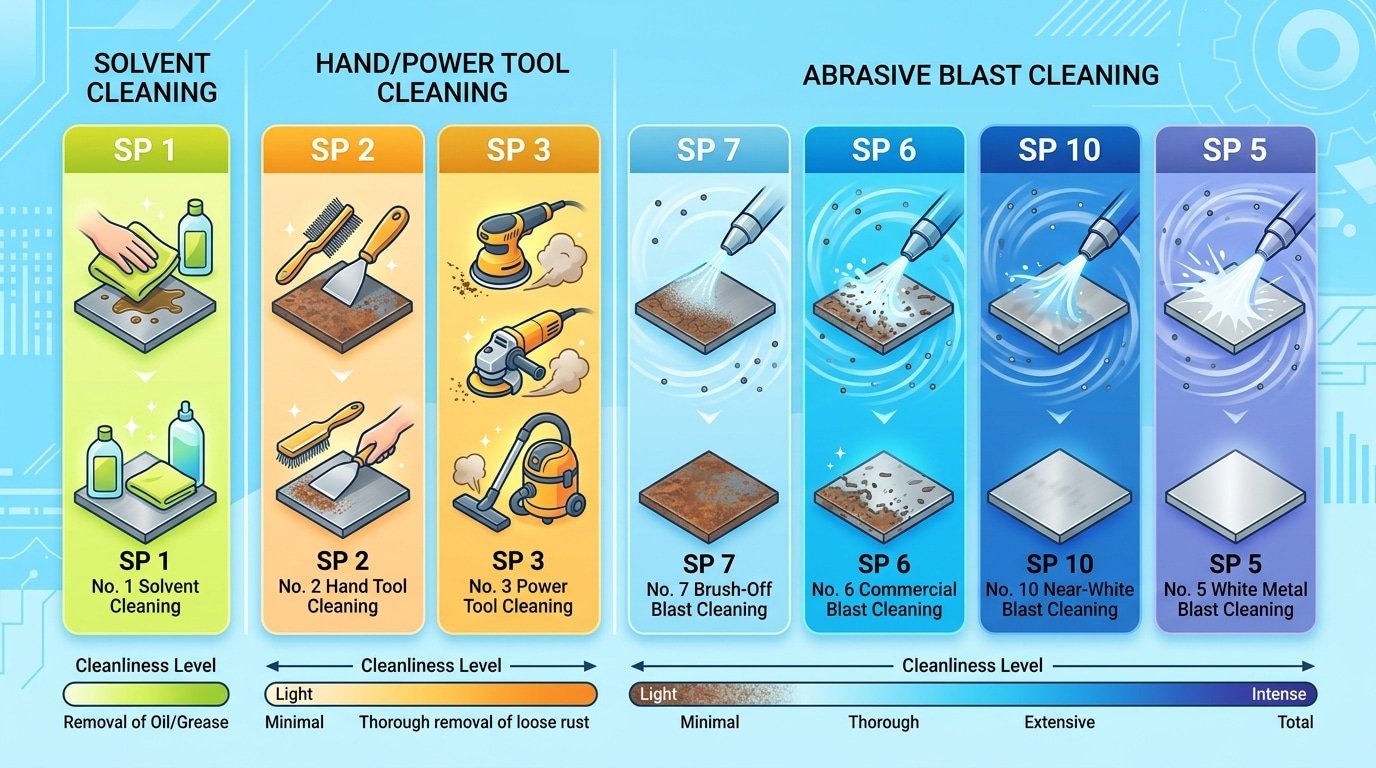
SSPC SP standard classification chart showing cleaning methods and cleanliness levels from SP 1 to SP 10
SSPC-SP 1 Through SP 3 — Manual and Mechanical Cleaning Methods
These three standards form the baseline of rust removal and surface preparation standards SSPC defines for non-blast methods. They’re the most accessible, least capital-intensive approaches — and also the most limited in what they can achieve. Understanding their boundaries matters as much as knowing their applications.
SP 1: Solvent Cleaning
SP 1 isn’t really about removing rust. It targets oil, grease, dirt, and other contaminants that would undermine any subsequent cleaning step or coating bond. Methods include wiping with solvent-soaked rags, vapor degreasing, steam cleaning, and alkaline washes. The critical detail most people miss: SP 1 is almost always a prerequisite before SP 2, SP 3, or any blast cleaning. Skip it, and you risk driving contaminants deeper into the steel surface during mechanical cleaning.
SP 2: Hand Tool Cleaning
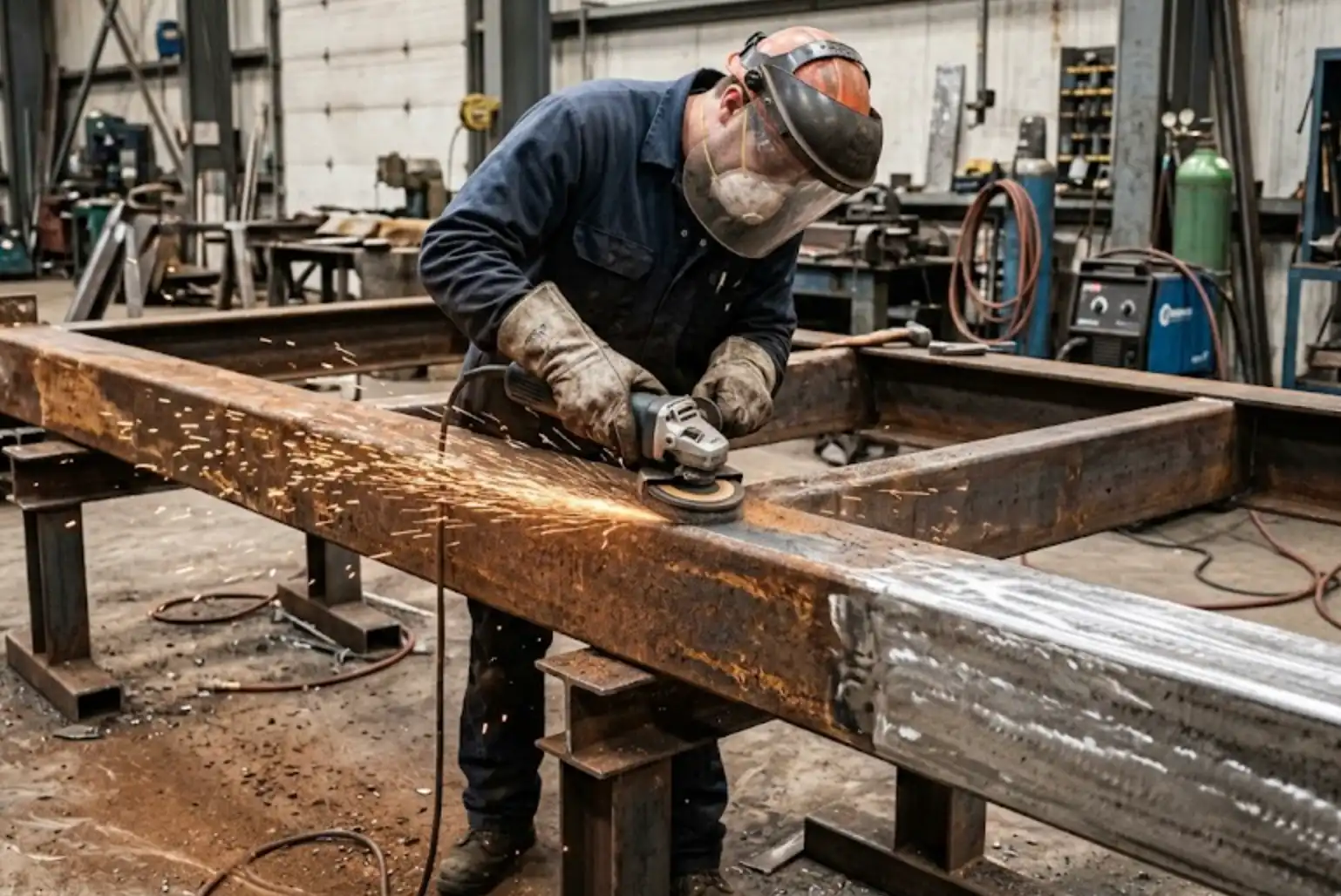
Wire brushing, scraping, chipping, sanding by hand. SP 2 removes loose mill scale, loose rust, and loose paint — but only what’s already failing. Tightly adherent rust stays put. That’s the standard’s biggest limitation: it won’t produce bare metal, and it generates zero measurable surface profile. Typical use cases include minor maintenance touch-ups and low-criticality environments where coating performance expectations are modest.
SP 3: Power Tool Cleaning
Power wire brushes, grinders, needle guns, and rotary sanders step things up from SP 2. The result is faster work and slightly more aggressive removal, yet the same fundamental rule applies — only loose material comes off. According to SSPC’s published guidelines, tightly adherent coatings and rust are permitted to remain under SP 3. Expect a marginal profile of roughly 0.5–1.0 mils at best, depending on the tool and operator technique. For projects demanding bare metal via power tools, you’d need SP 11 instead — covered later in this guide.

Steel surface comparison showing SP 2 hand tool cleaning versus SP 3 power tool cleaning results with visible adherent rust
Abrasive Blast Cleaning Standards from SP 5 to SP 10
Abrasive blast cleaning is where SSPC rust removal and surface preparation standards get serious. Four grades — SP 5, SP 6, SP 7, and SP 10 — define escalating levels of cleanliness achieved through pressurized abrasive media striking the steel surface. Each grade specifies exactly how much mill scale, rust, old coating, and foreign matter can remain.
SP 5 — White Metal Blast Cleaning
This is the gold standard. SP 5 requires removal of all visible rust, mill scale, paint, and contaminants. The surface must appear uniformly white or light gray with a metallic sheen. Zero staining allowed. It’s expensive, time-consuming, and typically reserved for immersion service or highly corrosive environments where coating failure carries severe consequences.
SP 10 — Near-White Metal Blast Cleaning
SP 10 permits staining on no more than 5% of each unit area (roughly 9 square inches). That 5% tolerance makes it dramatically more cost-effective than SP 5 while still delivering excellent coating adhesion. Most high-performance coating systems in chemical plants and marine structures specify SP 10 as the minimum requirement, according to guidance from SSPC’s official standards library.
SP 6 — Commercial Blast Cleaning
Here the threshold loosens to 33% allowable staining per unit area. Shadows, streaks, and discoloration from rust or mill scale can remain in the recesses of pitted steel. SP 6 works well for atmospheric exposures where moderate-duty coatings are specified — think structural steel in mild industrial settings.
SP 7 — Brush-Off Blast Cleaning
SP 7 is the lightest blast grade. The goal isn’t deep cleaning — it’s removing loose material and roughening the surface enough for mechanical adhesion. Tightly adherent mill scale and rust can stay. Think of it as a quick pass: fast, cheap, and suitable only for mild environments or recoating situations where the existing coating is still well-bonded.
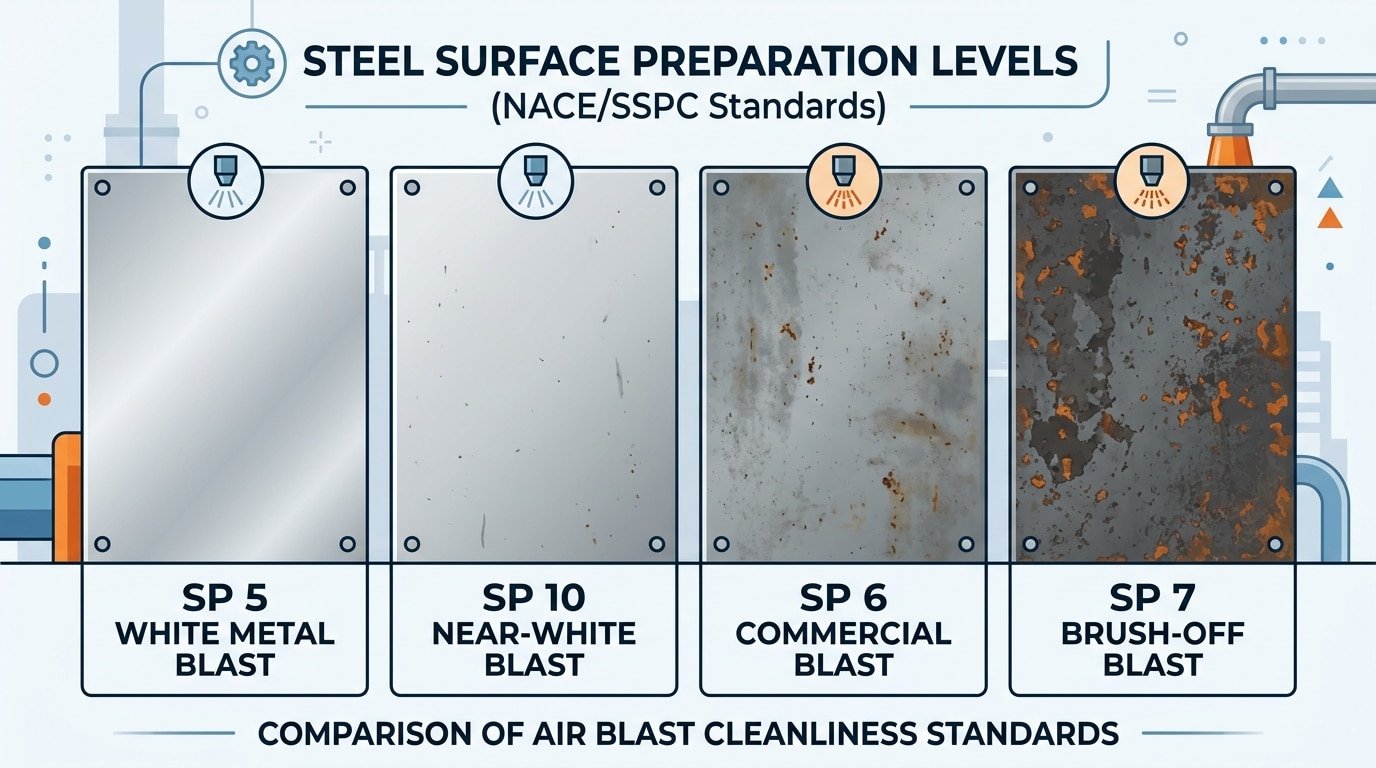
Visual comparison of SSPC blast cleaning grades SP 5 SP 6 SP 7 and SP 10 on steel surfaces
SSPC-SP 11 and SP 15 — Power Tool Cleaning to Bare Metal and Commercial Grade
Not every job site allows abrasive blasting. Confined spaces, occupied buildings, environmental restrictions — these constraints are real and common. That’s exactly where SP 11 and SP 15 step in, delivering blast-quality results using rotary impact tools, needle scalers, and bristle blasters instead of compressed air and abrasive media.
SP 11 — Power Tool Cleaning to Bare Metal
SP 11 demands what SP 3 never could: bare metal exposure across the entire surface. All mill scale, rust, old coatings, and corrosion products must be completely removed. But the real differentiator is the surface profile requirement — a minimum 1 mil (25 µm) anchor pattern, verified by replica tape or a surface profile gauge. This profile gives coatings something to grip, which is why SP 11 results are often considered equivalent to SSPC-SP 6 (commercial blast cleaning) in terms of coating performance.
The tools used here aren’t your standard wire brushes. Rotary flap wheels, needle guns, and rotary impact descalers do the heavy lifting. These generate enough energy to expose fresh steel and create measurable profile depth simultaneously.
SP 15 — Commercial Grade Power Tool Cleaning
SP 15 fills a practical gap within SSPC’s rust removal and surface preparation standards. It permits light staining — up to 33% of each unit area can retain shadows, slight streaks, or discoloration from rust and old coating. Think of it as the power tool equivalent of SP 6 blast cleaning. SP 15 still requires a minimum 1 mil profile, which separates it sharply from SP 3’s looser criteria. For maintenance repainting in moderate environments, SP 15 offers a cost-effective middle ground without sacrificing coating adhesion.
One honest caveat: achieving consistent SP 11 or SP 15 results depends heavily on operator skill. Uneven tool pressure creates inconsistent profiles, and inspectors should verify multiple spots across the prepared area rather than trusting a single reading.
How SSPC Standards Compare to NACE and ISO 8501 Equivalents
Specifications on international projects rarely reference just one system. You’ll see SSPC designations on a U.S.-originated spec, NACE numbers on a pipeline project in the Middle East, and ISO 8501-1 grades on a European offshore platform — sometimes all three on the same drawing. Understanding the cross-references between these systems isn’t optional; it’s how you avoid costly rework when an inspector pulls out a different comparator booklet than you expected.
SSPC and NACE International (now part of AMPP) jointly published their blast cleaning standards years ago, so the mappings are exact — not approximate. SSPC-SP 5 is identical to NACE No. 1 (White Metal Blast). SSPC-SP 10 equals NACE No. 2 (Near-White Blast). SSPC-SP 6 maps to NACE No. 3 (Commercial Blast), and SSPC-SP 7 corresponds to NACE No. 4 (Brush-Off Blast). Same requirements, same acceptance criteria, different label.
ISO 8501-1 uses a “Sa” grading scale tied to visual reference photographs. The equivalences look like this:
| SSPC | NACE | ISO 8501-1 | Cleanliness Level |
|---|---|---|---|
| SP 5 | No. 1 | Sa 3 | White Metal |
| SP 10 | No. 2 | Sa 2½ | Near-White Metal |
| SP 6 | No. 3 | Sa 2 | Commercial |
| SP 7 | No. 4 | Sa 1 | Brush-Off |
One critical nuance: ISO 8501-1 defines four initial rust grades (A through D) that describe the steel’s condition before cleaning. SSPC and NACE standards don’t formally classify initial condition the same way. When a spec calls for Sa 2½ on Grade C steel, you need to know both systems. For professionals working across borders, fluency in rust removal and surface preparation standards SSPC alongside ISO equivalents eliminates ambiguity and keeps inspection disputes off the punch list.
Selecting the Right SSPC Standard Based on Coating System and Environment
Picking a surface preparation level isn’t guesswork — it’s driven by three variables: what coating you’re applying, what environment the structure faces, and what condition the substrate is already in. Get this wrong in either direction and you pay for it. Over-specifying means blasting steel to SP 5 (White Metal) when SP 6 would perform identically under a simple alkyd system, burning budget on labor and abrasive. Under-specifying is worse. A high-performance epoxy in an immersion environment will delaminate within months over an SP 6 surface that should have been SP 5.
Matching Coating Type to Preparation Level
Thin-film alkyd and acrylic coatings are forgiving. They bond adequately to SP 2 or SP 3 surfaces in mild atmospheric exposures. Zinc-rich primers — both organic and inorganic — are a different animal entirely. Inorganic zinc silicates require SP 5 or SP 10 with a tightly controlled angular anchor profile of 1.5–3.0 mils because the coating cures through a chemical reaction with bare steel. Apply that same primer over an SP 6 surface with residual mill scale shadows, and adhesion drops below the 600 psi pull-off threshold most specs demand.
Environment Dictates the Floor, Not the Ceiling
Service environment sets the minimum acceptable standard. Immersion service — tanks, pipelines, marine substructure — almost always calls for SP 5 or SP 10 per SSPC’s published guidance. Atmospheric exposure in a C3 (medium) corrosivity category can often be served by SP 6. High-temperature applications above 400°F typically need SP 5 because thermal cycling amplifies any adhesion weakness at the coating-substrate interface.
Substrate condition matters too. Heavily pitted steel that’s been in service for decades may not achieve a true SP 5 finish regardless of effort — residual corrosion sits deep inside pits. In those cases, specifiers sometimes accept SP 10 with supplemental spot treatment rather than chasing an impossible white metal across the entire surface. Choosing the right rust removal and surface preparation standards SSPC level is ultimately a cost-performance optimization, not a race to the highest number on the chart.
Common Mistakes and Inspection Pitfalls in SSPC Surface Preparation
Getting the standard right on paper means nothing if the fieldwork falls apart. A surprising number of coating failures trace back not to the wrong SSPC specification, but to sloppy execution and missed inspection steps during preparation.
Skipping Contaminant Assessment Before Blasting
The single most repeated mistake: jumping straight to abrasive blasting without performing solvent cleaning per SP 1 first. Grease, oil, and chloride salts don’t disappear under blast pressure — they get driven deeper into the surface profile. Inspectors who skip chloride testing with Bresle patches often discover the problem only after blistering shows up under the coating weeks later. According to SSPC’s own technical guidance, solvent cleaning must always precede any mechanical or blast method.
Misreading Visual Comparators
Visual standards like SSPC-VIS 1 are meant to be used at the job site, under actual lighting conditions, held within 6 inches of the prepared surface. Too often, inspectors compare from memory. That’s how an SP 6 commercial blast gets signed off when staining clearly exceeds the allowable 33% threshold. Lighting matters enormously — a surface that looks clean under a 500-lux shop light can reveal residual mill scale under 1,000-lux inspection lamps.
Ignoring Surface Profile and Environmental Conditions
Failing to measure anchor profile with replica tape or a digital gauge is another gap. A coating spec calling for 2–3 mil profile won’t perform at 1.2 mils, regardless of how clean the steel looks. Equally damaging: blasting when the steel temperature sits within 5°F of the dew point. Condensation forms invisibly, creating a moisture film that causes flash rust before primer application. Rust removal and surface preparation standards SSPC explicitly require monitoring relative humidity (below 85%) and steel temperature throughout the work window — not just at the start of the shift.
Frequently Asked Questions About SSPC Rust Removal Standards
What’s the actual difference between SP 6 and SP 10?
SP 6 (Commercial Blast Cleaning) allows up to 33% of each square inch to retain staining from mill scale, rust, or old coatings. SP 10 (Near-White Blast Cleaning) tightens that to just 5%. In practice, an SP 10 surface looks almost uniformly metallic gray with only faint shadows of discoloration. SP 6 can show noticeable streaking. That gap matters enormously for high-performance epoxies and zinc-rich primers, which bond poorly over residual contamination.
Are SSPC standards legally required?
Not by default. SSPC standards are voluntary industry consensus documents. However, they become legally binding the moment a contract, specification, or government regulation references them. Federal agencies like the Department of Transportation and the Army Corps of Engineers routinely incorporate SSPC rust removal and surface preparation standards into project specs, effectively giving them the force of law on those jobs. Municipal bridge and water tank contracts do the same.
How do I verify compliance on a job site?
Three tools handle most field verification. A visual comparator — typically the SSPC-VIS 1 reference photographs — lets inspectors match the blasted surface against standardized images. A surface profile gauge (either replica tape or a digital probe) confirms anchor pattern depth, usually 1.5–4.0 mils for most coating systems. And a surface cleanliness test like the tape pull or soluble salt test catches invisible contaminants that visual checks miss.
Does surface preparation affect coating warranties?
Absolutely — and this is where shortcuts get expensive. Most coating manufacturers tie their warranty terms directly to a specified SSPC preparation level. Apply a polyurethane topcoat system over an SP 6 surface when the technical data sheet calls for SP 10, and the manufacturer can void the warranty entirely. Premature failure claims get denied every day for exactly this reason. The coating didn’t fail. The prep did.
Key Takeaways for Specifying and Applying SSPC Surface Preparation Standards
Every coating failure traces back to a surface preparation decision — right or wrong. The rust removal and surface preparation standards SSPC publishes exist to eliminate ambiguity from that decision. Here’s what matters most when you’re the one making the call.
Quick-Reference Decision Guide
- Mild interior exposure, alkyd or latex topcoat: SP 2 or SP 3 is usually sufficient. Don’t over-specify and inflate costs.
- Moderate industrial or exterior exposure: SP 6 (Commercial Blast) or SP 14 (Industrial Blast) hits the sweet spot between performance and budget.
- Immersion service, chemical tanks, or C5 environments: SP 5 (White Metal Blast) or SP 10 (Near-White Blast) — no shortcuts.
- Confined spaces or blast-restricted zones: SP 11 (Power Tool to Bare Metal) delivers near-blast results without airborne abrasive.
- Every single project, regardless of scope: SP 1 (Solvent Cleaning) comes first. Always.
Three Rules That Prevent Most Failures
Match the standard to the coating manufacturer’s data sheet — not habit, not budget pressure, not what worked on the last job. Verify the surface profile falls within the specified range using replica tape or a digital gauge. Document everything with photos at each hold point; inspectors can’t defend what they can’t prove.
Access Official Resources
Specifications are only as good as the edition you’re referencing. Outdated copies circulate on job sites more often than anyone admits. Download current SSPC standards, visual guides, and certification program details directly from SSPC’s official website. Their Coating Inspector Program (CIP) remains the industry’s most recognized credential for field verification — worth pursuing if inspection is part of your role.
Get the standard right. Confirm it in the field. Coat with confidence.
See also
Why Laser Cleaning Is the Greener Choice for Industrial Rust Removal
Ultimate Guide: Laser Rust Removal vs Sandblasting
Pulsed Laser Cleaning — Ultimate Guide to Oxide Removal