Corrosion costs the global maritime industry an estimated $80 billion annually, and a significant portion of that damage traces back to improperly cleaned welds on hull plates, ballast tanks, and piping systems. Weld cleaning for shipbuilding is the process of removing heat tint, oxide scale, and surface contaminants from welded joints on marine-grade metals—restoring corrosion resistance and ensuring compliance with classification society standards from Lloyd’s Register, DNV, and Bureau Veritas. The method you choose (electrochemical, mechanical, or chemical) directly affects a vessel’s service life, inspection pass rates, and long-term maintenance costs.
Why Weld Cleaning Is Critical in Shipbuilding and Marine Fabrication
Weld cleaning for shipbuilding is the process of removing heat tint, oxide scale, slag, and surface contaminants from welded joints on marine structures to restore corrosion resistance and ensure compliance with classification society standards. Skip this step, and you’re essentially handing the ocean a head start in destroying your vessel.
Saltwater is ruthless. A seawater chloride concentration of roughly 19,400 mg/L attacks unprotected weld zones through pitting corrosion, crevice corrosion, and stress corrosion cracking — often simultaneously. The heat-affected zone (HAZ) surrounding every weld loses its protective chromium oxide layer during fabrication, leaving bare metal exposed to one of the most aggressive natural electrolytes on Earth. Without proper post-weld cleaning, that compromised surface can begin corroding within weeks of a vessel’s launch.
Cyclic loading compounds the problem. Hull flexion from wave action generates fatigue stresses that concentrate at weld toes — precisely where residual oxides and micro-contamination weaken the metal’s surface. According to the International Association of Classification Societies (IACS), surface preparation quality directly influences a weld’s fatigue life classification. A poorly cleaned weld can drop two full fatigue categories, cutting expected service life by 40–60%.
Regulatory bodies like Lloyd’s Register, DNV, and ABS mandate specific surface finish criteria for structural and piping welds. Failing inspection means rework — and in a shipyard running 3-shift schedules against a delivery deadline, rework costs 5–8× more than doing it right the first time. Effective weld cleaning for shipbuilding isn’t a finishing touch. It’s a structural necessity that protects crews, cargo, and the massive capital investment a vessel represents.

Heat tint and oxide scale on an uncleaned stainless steel ship hull weld joint
Electrochemical vs Mechanical vs Chemical Weld Cleaning Methods Compared
Shipyards typically rely on three approaches: electrochemical cleaning, mechanical abrasion, and chemical pickling. Each method handles oxide removal differently, and the right choice depends on the alloy, joint location, and production throughput you need.
Electrochemical cleaning uses a low-voltage current passed through an electrolyte-soaked pad to dissolve heat tint in a single pass. It’s fast—roughly 1–2 minutes per linear meter on stainless steel—and leaves a passivated surface behind. Cost per meter runs between €0.80 and €1.50 when you factor in consumable pads and electrolyte. The downside? Limited penetration on heavy carbon steel scale.
Mechanical methods—grinding, flap discs, wire brushing—are the workhorse of carbon steel hull fabrication. A 125 mm grinder clears slag at about 3–5 meters per hour, and consumable costs sit around €0.30–€0.60 per meter. But grinding removes base metal, creates airborne particulates, and can embed contaminants that accelerate corrosion in seawater exposure zones. For tight structural joints inside double-bottom tanks, access is a real problem.
Chemical pickling with nitric-hydrofluoric acid mixtures delivers the most uniform oxide removal across complex geometries. According to ASTM A380, acid pickling remains the benchmark for restoring chromium oxide layers on austenitic stainless grades. However, acid handling in confined shipyard spaces introduces serious safety and waste-disposal burdens. Weld cleaning for shipbuilding demands balancing these trade-offs against classification society requirements and the specific hull section being treated.
| Factor | Electrochemical | Mechanical | Chemical Pickling |
|---|---|---|---|
| Best alloy fit | Stainless steel | Carbon steel | Both |
| Speed (linear m/hr) | 30–60 | 3–5 | 10–20 (dwell time) |
| Cost per meter | €0.80–€1.50 | €0.30–€0.60 | €1.00–€2.50 |
| Confined-space safe | Yes | Moderate | No (fume risk) |

Comparison of electrochemical, mechanical, and chemical weld cleaning methods on marine stainless steel plate
Electrochemical Weld Cleaning and Its Advantages for Marine-Grade Stainless Steel
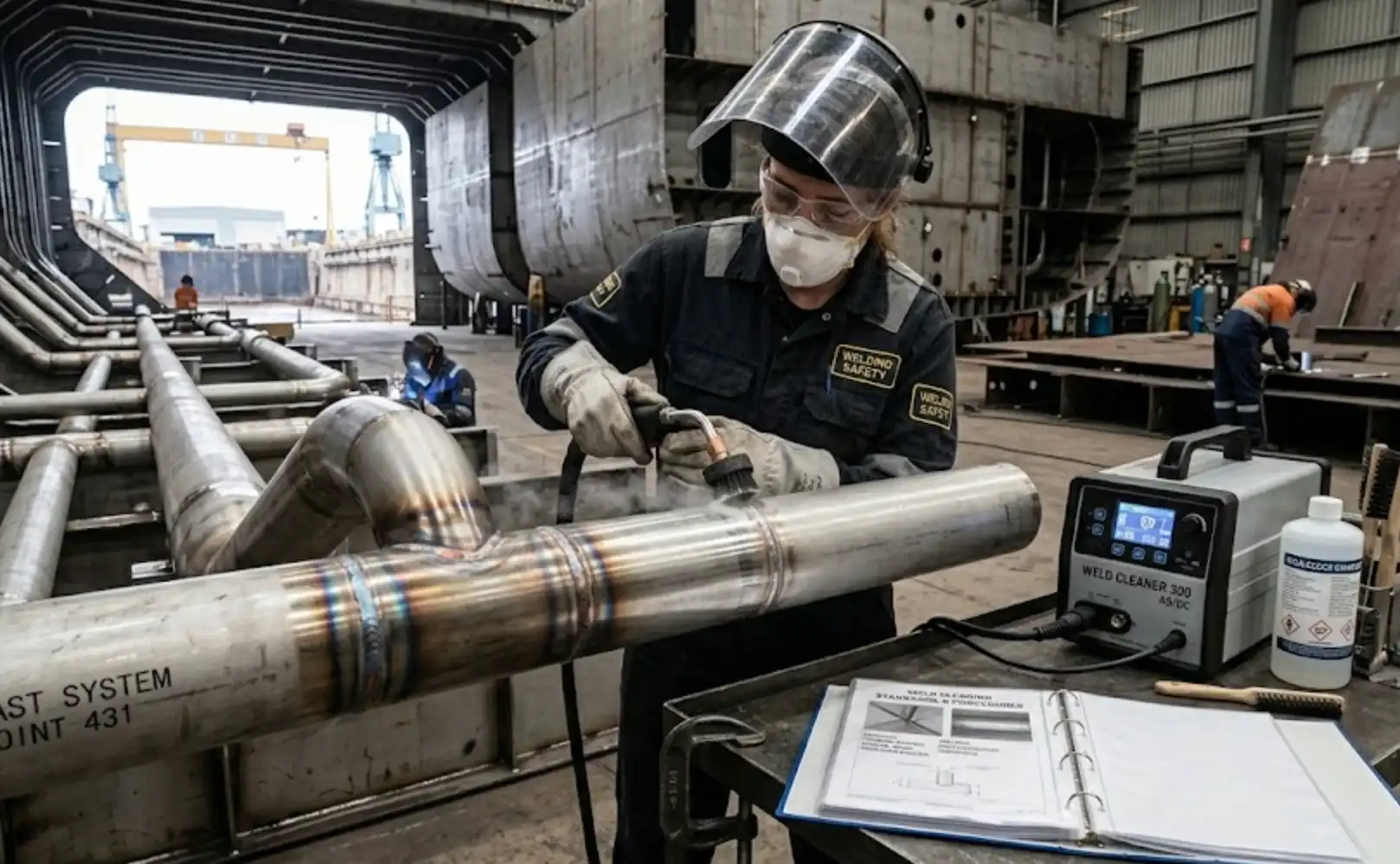
Electrochemical weld cleaning works through a deceptively simple mechanism. A carbon fiber brush soaked in a phosphoric acid-based electrolyte is passed over the weld surface while a low-voltage DC current—typically between 12V and 48V—flows through the workpiece. This current drives an electrochemical reaction that dissolves heat tint and oxide scale at the molecular level, then immediately triggers the reformation of a stable chromium oxide passive layer. The entire cycle takes seconds per inch of weld.
For marine-grade alloys like 316L and duplex 2205, that passive layer is everything. It’s the 2–3 nanometer chromium oxide film that stands between clean stainless steel and aggressive chloride-induced pitting. According to research published by the British Stainless Steel Association, electrochemical cleaning can restore passivation to levels comparable to or exceeding the base metal’s original corrosion resistance—something mechanical grinding alone cannot achieve.
Shipyard applications where this method excels include sanitary piping systems, ballast tank fittings, and exposed deck hardware. These components face constant saltwater exposure, so incomplete passivation is a fast track to crevice corrosion. Electrochemical weld cleaning for shipbuilding also eliminates the embedded iron contamination that wire brushes leave behind, a subtle but critical advantage when long-term corrosion resistance matters more than speed.
One practical limitation: the electrolyte must be matched to the alloy. Using a solution formulated for austenitic stainless on a super duplex joint can produce uneven results or surface etching. Operators need alloy-specific fluid kits and proper training—shortcuts here undermine the method’s core benefit.
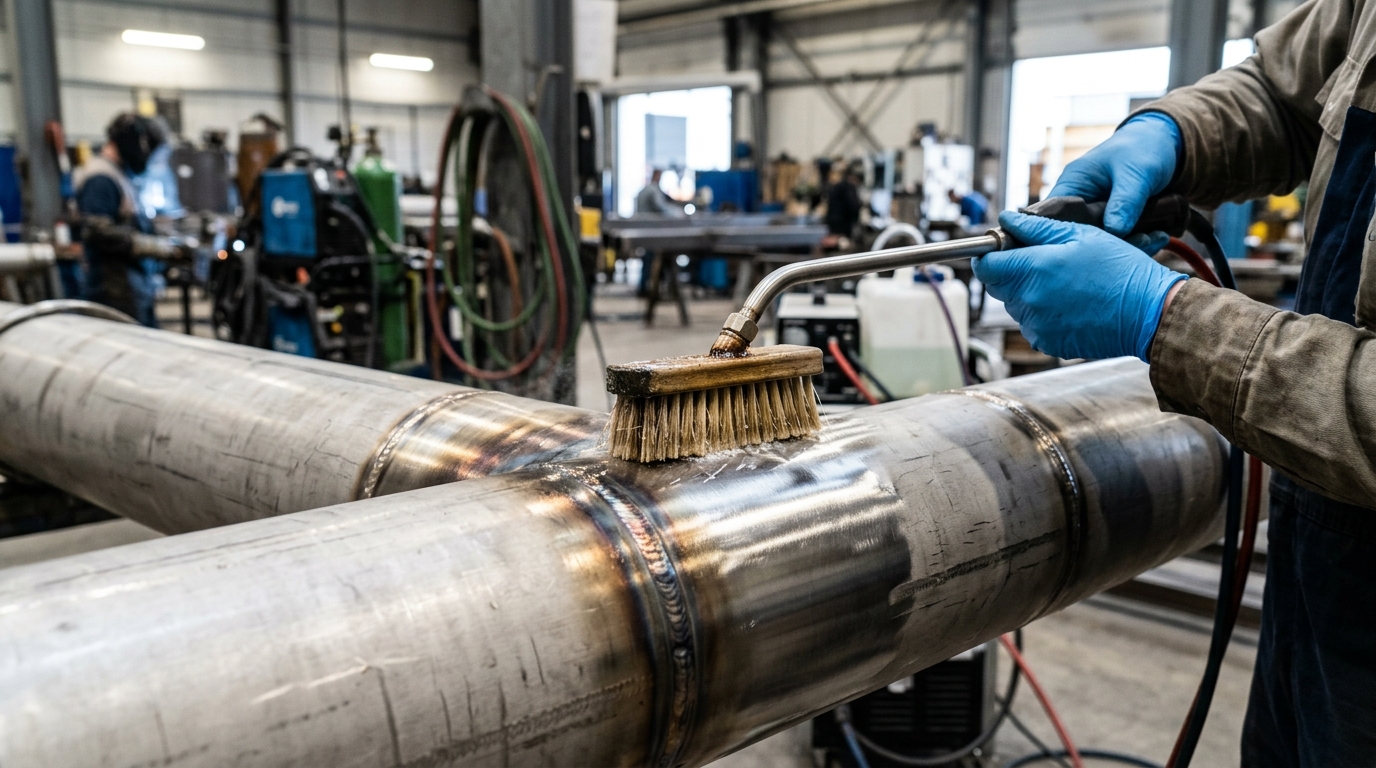
Electrochemical weld cleaning brush passivating a 316L stainless steel pipe weld for shipbuilding
Mechanical Cleaning Methods Including Grinding, Wire Brushing, and Blasting
Mechanical methods remain the workhorse of weld cleaning for shipbuilding on carbon steel structures. The logic is straightforward: hull plates, bulkheads, and heavy structural members don’t demand the polished finish that stainless steel piping does. They’re getting coated with primer and anti-fouling paint anyway. What matters is removing slag, spatter, and oxide scale so coatings adhere properly — and mechanical tools do that fast.
Angle grinders fitted with 36- or 40-grit flap discs handle most post-weld dressing on fillet and butt joints. For deeper slag pockets in multi-pass welds, needle scalers punch through where flap discs can’t reach. Wire brushing — typically with carbon steel cup brushes at 8,000–12,000 RPM — follows grinding to remove residual particles and prep the surface profile to the 50–75 µm range that epoxy primers need for adhesion.
Abrasive blasting scales up the process. Shipyards commonly use garnet or steel grit at nozzle pressures between 90–100 psi, achieving SA 2.5 (near-white metal) cleanliness per ISO 8501-1. This standard is what most classification societies reference for coating preparation on hull steel. Blasting is ideal for large weld seams running dozens of meters along keel sections, where hand grinding would be painfully slow.
The tradeoff? Noise levels regularly exceed 100 dB, dust generation is substantial, and material removal is hard to control precisely. Over-grinding a weld cap by even 0.5 mm can push the joint below minimum throat thickness, creating a defect that requires costly rework. Operators need training and gauges — not just muscle.

Mechanical weld cleaning with angle grinder on carbon steel ship hull plate
Chemical Pickling and Passivation for Ship Hull and Tank Welds
Pickling uses a nitric-hydrofluoric acid mixture—typically 8–20% nitric acid and 0.5–5% hydrofluoric acid by volume—to dissolve oxide scale and chromium-depleted layers from stainless steel welds. The acid eats away contaminated metal, exposing a fresh surface ready for passivation. Dwell times range from 5 to 30 minutes depending on steel grade, ambient temperature, and oxide thickness. Go too short and the heat tint stays; go too long and you risk intergranular attack, especially on sensitized 304L or 316L.
Passivation follows immediately. A nitric acid bath (20–50% concentration per ASTM A967) rebuilds the chromium oxide layer that gives stainless steel its corrosion resistance. After passivation, thorough rinsing with deionized or potable water is mandatory—residual acid left on a ship hull weld will cause the exact pitting it was meant to prevent.
Enclosed drydock and tank environments make this form of weld cleaning for shipbuilding genuinely hazardous. Hydrofluoric acid vapor is lethal at low concentrations. Forced ventilation, continuous air monitoring, and calcium gluconate gel on standby are non-negotiable. Spent acid must be neutralized to a pH between 6 and 9 before discharge, and fluoride levels in wastewater typically need to fall below 10 mg/L to meet port authority limits. Many yards now use gel-based pickling pastes instead of immersion baths—they reduce acid volume by roughly 70% and confine the reaction zone to the weld itself.
Marine Classification Standards for Weld Surface Quality
Classification societies don’t suggest—they mandate. Every weld on a classed vessel must meet surface quality criteria before that ship earns its certification, and failing an inspection can halt production for days. The four major societies—DNV, ABS, Lloyd’s Register, and Bureau Veritas—each publish detailed rules governing weld cleaning for shipbuilding, though their core acceptance criteria overlap significantly.
DNV’s rules for classification (Part 2, Chapter 4) specify that weld surfaces must be free of slag, spatter, and oxide discoloration beyond light straw tones on stainless steel. ABS mirrors this through its Guide for Nondestructive Inspection, requiring a surface roughness no greater than Ra 12.5 µm on critical structural joints. Lloyd’s Register focuses heavily on visual inspection per ISO 5817 quality level B for primary hull members, while Bureau Veritas references EN 1090-2 execution class EXC3 for marine structural steelwork.
Inspection protocols typically follow a three-tier approach. First, 100% visual examination of all welds. Then, NDT sampling—usually magnetic particle or dye penetrant testing on 10–25% of butt welds depending on joint criticality. Surface cleanliness gets assessed against ISO 8501-1 standards, with Sa 2½ being the minimum blast-clean grade for coated surfaces. Surveyors carry calibrated comparators to verify roughness on-site.
One detail shipbuilders often underestimate: classification rules apply not just to the weld itself but to the heat-affected zone extending 25–50 mm on either side. Residual oxide in that band can trigger a rejection just as quickly as a crater crack in the weld bead.
Choosing the Right Weld Cleaning Equipment for Shipyard Environments
Shipyards punish equipment. Salt air corrodes housings, scaffolding limits what you can carry, and confined ballast tanks leave almost no room to maneuver a bulky machine. Selecting weld cleaning equipment for these conditions means weighing portability, power source, duty cycle, and alloy compatibility—not just price per unit.
Weight matters more than spec sheets suggest. An electrochemical unit above 10 kg becomes a liability when technicians haul it up three levels of staging inside a double-hull section. Look for systems under 8 kg with shoulder straps and compact fluid reservoirs. For confined-space work in void tanks or cofferdams, battery-powered units rated at 30V DC or below eliminate trailing cables and reduce electrical hazard risk—a genuine concern when operators are surrounded by conductive steel surfaces.
Duty cycle separates shipyard-grade machines from shop tools. A unit rated at 60% duty cycle at full amperage will overheat during a 10-hour shift cleaning long seam welds on deck plating. For sustained weld cleaning for shipbuilding operations, target machines offering 80–100% duty cycle at their working amperage range. Brush tip and electrolyte compatibility also deserve attention: duplex stainless steels like 2205—common in chemical tanker cargo systems—require specific electrolyte formulations to avoid selective phase attack. Always confirm that the manufacturer’s consumables are validated for the exact marine-grade alloys in your build specification, per guidance from organizations like TWI.
Power supply availability varies wildly across a shipyard. Dry docks may offer 110V or 220V shore power at regular intervals, while outfitting quays might have only 440V three-phase connections requiring step-down transformers. Dual-voltage machines (110/220V auto-switching) reduce setup time and eliminate transformer weight from the toolkit.
Common Weld Cleaning Defects in Shipbuilding and How to Prevent Them
Heat tint residue tops the list. That straw-yellow to dark blue discoloration signals a chromium-depleted zone beneath the surface, and if it survives the cleaning process, pitting corrosion follows within months in seawater exposure. The root cause is almost always insufficient dwell time during electrochemical cleaning or using a pickling paste that’s been left on too briefly—under 20 minutes in cold conditions.
Incomplete passivation is subtler and more dangerous. A weld zone can look clean yet fail a ferroxyl test, revealing that the passive chromium oxide layer never fully reformed. This happens when operators rinse acid too aggressively before the passivation chemistry finishes reacting, or when contaminated rinse water redeposits chlorides onto the surface. According to ASTM A967, passivation verification through copper sulfate or ferroxyl testing isn’t optional—it’s the only way to confirm the layer exists.
Embedded iron contamination from carbon steel brushes or grinding discs is a persistent problem in weld cleaning for shipbuilding. One careless tool swap introduces free iron particles that rust within 24 hours in humid marine air. Prevention is straightforward: dedicated stainless-only tools, color-coded and stored separately.
Hydrogen embrittlement risk emerges during aggressive acid pickling of high-strength duplex welds. Excessive acid concentration or prolonged immersion drives atomic hydrogen into the microstructure, creating delayed cracking under tensile load. Limiting pickling bath temperatures below 50°C and strictly controlling immersion times to manufacturer specifications eliminates most incidents.
Health, Safety, and Environmental Compliance in Shipyard Weld Cleaning
Hexavalent chromium is the silent threat. When grinding or pickling stainless steel welds, Cr(VI) dust and fumes can reach airborne concentrations that exceed OSHA’s permissible exposure limit of 5 µg/m³ within minutes. Prolonged inhalation causes lung cancer—that’s not a theoretical risk but a well-documented occupational hazard confirmed by OSHA’s hexavalent chromium standards. Shipyard workers performing weld cleaning for shipbuilding face compounded exposure because confined hull sections trap fumes that open-air fabrication shops would naturally disperse.
Acid fumes from pickling baths present another acute danger. Nitric-hydrofluoric acid mixtures release hydrogen fluoride gas, which can cause pulmonary edema at concentrations as low as 30 ppm. Mandatory controls include local exhaust ventilation rated at minimum 100 feet per minute capture velocity, supplied-air respirators in enclosed tanks, and continuous atmospheric monitoring. Noise from mechanical grinding—often exceeding 95 dB(A)—adds cumulative hearing damage to the risk profile.
On the environmental side, IMO’s MARPOL Annex IV and local port authority regulations strictly govern how shipyards dispose of spent pickling acid, rinse water, and chromium-laden sludge. Most coastal facilities must treat effluent to below 0.5 mg/L total chromium before discharge. Electrochemical weld cleaning for shipbuilding significantly reduces this burden—its electrolyte waste volume is roughly 90% less than traditional pickling, and it generates no acid fumes. Shipyards operating near protected waterways face additional scrutiny, with some jurisdictions requiring zero-liquid-discharge systems for all chemical cleaning operations.
Step-by-Step Best Practices for Weld Cleaning in Ship Construction
A repeatable workflow eliminates guesswork. Here’s the sequence that keeps weld cleaning for shipbuilding on track from start to finish.
Pre-Cleaning Inspection
Before touching any equipment, inspect the weld visually under adequate lighting—500 lux minimum per ISO 3059 recommendations. Check for spatter, incomplete fusion, and surface cracks. Flag anything that cleaning alone can’t fix. Grinding over a crack just hides it.
Method Selection and Parameter Setup
Match the method to the material and location. Electrochemical cleaning handles 316L stainless in ballast tanks efficiently; mechanical grinding suits carbon steel hull seams where passivation isn’t required. Set amperage, brush speed, or acid concentration before starting—not mid-process. Document these parameters on the weld map.
Execution
Work in consistent, overlapping passes. For electrochemical units, maintain 2–3 seconds of contact per centimeter of weld length. Keep the carbon fiber brush saturated with electrolyte. Rinse immediately with deionized water to prevent electrolyte residue from initiating its own corrosion cycle.
Post-Cleaning Verification
Run a ferroxyl test on every stainless steel weld. Apply the solution, wait 15 seconds. Blue spots mean free iron contamination—go back and re-clean those areas. No shortcuts here; classification surveyors will repeat this exact test during audit.
Documentation for Classification Audits
Record the weld ID, cleaning method used, operator name, ferroxyl test result, and date. Attach photos showing before-and-after condition. This traceability package is what DNV, Lloyd’s, or Bureau Veritas inspectors expect to see on their desk—missing a single entry can stall sign-off on an entire block.
Frequently Asked Questions About Weld Cleaning for Shipbuilding
Can electrochemical cleaning fully replace acid pickling?
For most structural stainless steel welds, yes. Electrochemical systems remove heat tint and restore the passive layer in a single pass, matching the corrosion resistance that pickling achieves. The exception is deep oxide scale on heavy multi-pass welds exceeding 25 mm thickness—those sometimes still need a pickling step first. DNV accepts electrochemical cleaning as equivalent to pickling when documented chromium oxide restoration meets specified thresholds.
How should welds inside ballast tanks be cleaned?
Ballast tanks demand aggressive preparation because they cycle between seawater immersion and empty-tank condensation. Grind flush, then apply electrochemical or chemical passivation to every weld seam. Ventilation is critical—confined space protocols apply, and acid fume buildup can reach dangerous concentrations within minutes. Coat cleaned welds with an approved epoxy system within 4 hours to prevent flash rust.
What surface finish does DNV require for structural welds?
DNV rules reference ISO 8501-3 for weld seam preparation and typically require a minimum P3 grade—meaning no visible slag, spatter, or oxide discoloration. For corrosion-critical zones like tank internals, the acceptance criteria tighten further, often specifying a surface roughness below Ra 6.3 µm before coating application.
How often should weld cleaning equipment be maintained?
Carbon fiber brushes on electrochemical units last roughly 80–120 operating hours before fiber degradation reduces contact consistency. Electrolyte flow rates should be checked weekly. Mechanical grinders need abrasive disc replacement after approximately 40–60 welds, depending on alloy hardness. Skipping maintenance is the fastest way to introduce the very defects that weld cleaning for shipbuilding is meant to eliminate.
Achieving Consistent Weld Quality Across Every Ship Build
Every vessel that leaves a shipyard carries the permanent record of its weld cleaning quality beneath the paint. Corrosion doesn’t wait for a convenient time—it exploits the first oxide layer or embedded contaminant that slipped past inspection. The methods, standards, and equipment discussed throughout this guide aren’t theoretical; they’re the operational baseline that separates a 25-year service life from premature dry-dock repairs costing hundreds of thousands of dollars.
Consistency comes from systems, not individual skill. Documented procedures tied to IACS classification requirements, calibrated equipment checked at shift start, and trained operators who understand why 316L demands different parameters than duplex—these elements lock in repeatable results across hull sections, ballast tanks, and piping runs. Weld cleaning for shipbuilding fails most often when yards treat it as a final cosmetic step rather than an integral quality gate.
Audit your current process against three checkpoints: Are your cleaning methods matched to each material grade and joint location? Do your operators hold documented qualification for the techniques they perform? Can you trace every cleaned weld back to a specific procedure, operator, and inspection record? If any answer is no, the gap between your current practice and classification-compliant weld cleaning is measurable—and closeable. Pull your procedures, compare them against the standards and methods outlined here, and close those gaps before the next keel is laid.
1
See also
The Complete Guide to Stainless Steel Welding Techniques
How to Clean a Stainless Steel Sink Easily and Naturally
Laser Welding of 304 vs 316 Stainless Steel