
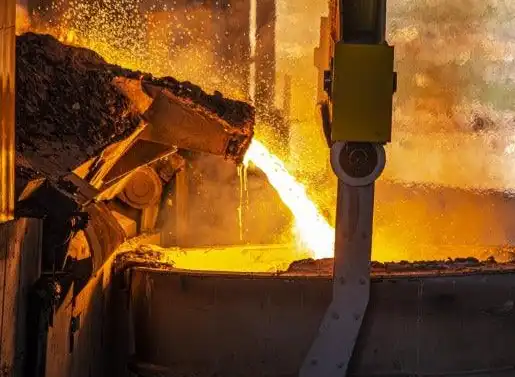
Global crude steel production hit 1.888 billion tonnes in 2023, according to the World Steel Association — yet most people couldn’t name the two elements that make up over 99% of every beam, blade, and bolt. So what is steel made of? At its core, steel is an alloy of iron and carbon, where iron typically accounts for at least 97–99% of the composition and carbon ranges from roughly 0.02% to 2.14% by weight. Different alloying elements — manganese, chromium, nickel, vanadium, and others — are added in precise amounts to create the hundreds of steel grades used across construction, automotive, aerospace, and energy industries.
What Steel Is Made Of — The Short Answer
Steel is an alloy of iron and carbon. That’s the core answer. By weight, carbon makes up between 0.02% and 2.14% of the mix, with iron accounting for the overwhelming majority — typically 98% or more. Push the carbon content above that 2.14% threshold and you no longer have steel; you have cast iron, a fundamentally different material.
Featured definition: Steel = iron + a small, precisely controlled amount of carbon. The carbon atoms wedge into the iron crystal lattice, dramatically increasing hardness and tensile strength while keeping the metal formable enough to shape.
So what is steel made of beyond those two elements? Most commercial steels also contain trace amounts of manganese, silicon, phosphorus, and sulfur — residuals from the raw materials and refining process. Specialty grades go further, deliberately adding chromium, nickel, molybdenum, vanadium, or tungsten to unlock specific performance characteristics like corrosion resistance or heat tolerance.
A useful way to think about it: iron provides the structural backbone, carbon provides strength, and every other alloying element fine-tunes the final behavior. The sections below break down each ingredient, explain how carbon percentage reshapes mechanical properties, and map out the major steel families — from mild carbon steel at 0.05% C all the way to tool steels exceeding 1.5% C.
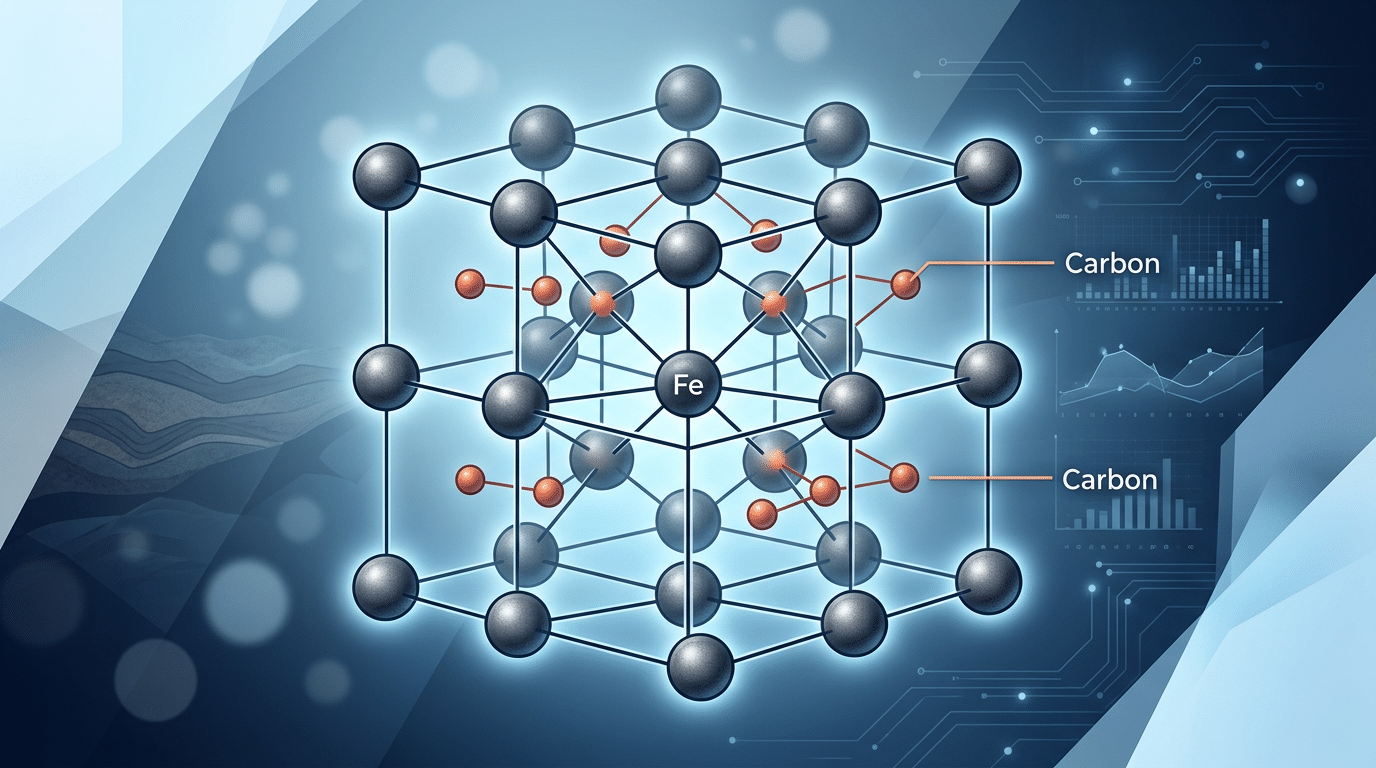
What steel is made of — iron and carbon atomic structure in a steel alloy
Iron and Carbon — The Two Primary Ingredients of Steel
Strip away every alloying element, every trade name, every grade specification, and what is steel made of at its most elemental level? Iron atoms locked in a crystalline lattice, with carbon atoms wedged into the gaps. That relationship — base metal plus interstitial hardener — is what separates steel from every other engineering material on Earth.
From Iron Ore to Pig Iron
Iron doesn’t exist in pure form in nature. It arrives as ore — primarily hematite (Fe₂O₃) or magnetite (Fe₃O₄) — bound to oxygen and silica. Inside a blast furnace operating above 1,500 °C, coke (a carbon-rich fuel derived from coal) reacts with that oxygen, reducing the ore into molten pig iron. This intermediate product contains roughly 3.5–4.5% carbon by weight, along with impurities like silicon, manganese, and sulfur. Pig iron is brittle and nearly useless for structural applications.
Why Carbon Changes Everything
Pure iron is surprisingly soft — about 80 HB on the Brinell hardness scale. Carbon atoms, roughly 60% smaller than iron atoms, slip into interstitial sites within iron’s body-centered cubic crystal structure. Even a tiny addition — say 0.2% carbon — can boost tensile strength from around 250 MPa to over 400 MPa. That’s a 60% gain from a fraction of a percent.
The magic of steel lies in proportion: too little carbon and you have wrought iron; too much and you have cast iron. The sweet spot — 0.02% to 2.0% — delivers the balance of hardness, ductility, and toughness that defines steel.
Carbon achieves this by impeding dislocation movement — the mechanism by which metals deform. More carbon means more resistance to deformation, which translates directly into higher hardness and yield strength. The trade-off? Ductility drops. A 0.1% carbon steel can elongate roughly 30% before fracture, while a 0.8% carbon steel may only stretch 10%. Engineers select carbon content based on exactly this tension between strength and formability, guided by standards from organizations like ASTM International and the American Iron and Steel Institute (AISI).

Blast furnace diagram showing how iron ore is refined into pig iron used to make steel
How Carbon Content Changes Steel Properties
Carbon is the single most influential element in determining what steel is made of — and how it behaves. Even tiny shifts in carbon percentage dramatically alter hardness, tensile strength, ductility, and weldability. The relationship isn’t subtle: double the carbon, and you can transform a soft, formable sheet into a blade that holds an edge.
Low-Carbon (Mild) Steel: Under 0.3%
Mild steel is highly ductile and easy to weld, making it the default choice for automotive body panels, structural beams, and wire products. Most mild steel sits around 0.05%–0.25% carbon. It won’t harden much through heat treatment, but that’s precisely the point — manufacturers need it to bend without cracking.
Medium-Carbon Steel: 0.3%–0.6%
Bump carbon into this range and strength climbs noticeably. Railroad tracks, axles, gears, and crankshafts typically use medium-carbon grades like AISI 1045. These steels respond well to quenching and tempering, achieving a balance between toughness and wear resistance that low-carbon grades simply can’t reach.
High-Carbon Steel: 0.6%–2.14%
This is where hardness peaks — and ductility drops sharply. Cutting tools, springs, and high-strength wire rely on carbon levels above 0.6%. A steel at 1.0% carbon can achieve Rockwell hardness above 60 HRC after proper heat treatment, according to ASM International data. The trade-off? Weldability becomes poor, and brittleness increases significantly.
| Carbon Range | Key Properties | Typical Products |
|---|---|---|
| < 0.3% | High ductility, excellent weldability | Car body panels, nails, pipes |
| 0.3%–0.6% | Higher strength, moderate ductility | Rail tracks, axles, gears |
| 0.6%–2.14% | Maximum hardness, low weldability | Knives, springs, drill bits |
Think of carbon content as a dial: turn it up for hardness and wear resistance, turn it down for formability and ease of fabrication. No single setting is “best” — the right carbon level depends entirely on what the finished part needs to survive.
Common Alloying Elements Beyond Carbon
Understanding what steel is made of goes far beyond iron and carbon. Steelmakers deliberately add specific elements — each with a precise job — to engineer performance characteristics that plain carbon steel simply cannot deliver.
| Element | Typical Range (%) | Primary Contribution |
|---|---|---|
| Chromium (Cr) | 0.5–30% | Corrosion resistance; forms a passive oxide layer. At 10.5%+ the steel qualifies as stainless. |
| Nickel (Ni) | 0.5–20% | Toughness retention at sub-zero temperatures; stabilizes austenite phase. |
| Manganese (Mn) | 0.3–13% | Deoxidation during melting; dramatically improves wear resistance at high concentrations (Hadfield steel uses ~12%). |
| Molybdenum (Mo) | 0.1–5% | High-temperature creep strength; resists pitting in chloride environments. |
| Vanadium (V) | 0.05–0.3% | Grain refinement via fine carbide precipitation; boosts both strength and toughness simultaneously. |
| Tungsten (W) | 1–18% | Heat hardness — critical in high-speed tool steels that must cut at red-hot temperatures. |
Notice the enormous range differences. Vanadium works its magic at fractions of a percent, while tungsten may constitute nearly a fifth of a high-speed steel like M2 tool steel. Small additions, big consequences — that’s the principle behind alloy design.
These elements rarely act alone. Chromium paired with molybdenum (as in 4140 steel) creates a combination tougher and more heat-resistant than either element achieves independently. When someone asks what is steel made of, the real answer is a carefully balanced recipe where every fraction of a percent matters.
The Four Main Types of Steel and Their Compositions
So what is steel made of when you move beyond generic descriptions? The answer depends entirely on which of the four major categories you’re working with. Each type has a distinct compositional fingerprint that dictates its performance.
| Steel Type | Key Composition | Primary Applications |
|---|---|---|
| Carbon Steel | Iron + 0.05–2.0% carbon; minimal other elements | Structural beams, automotive frames, pipelines |
| Alloy Steel | Iron + carbon + 1–50% elements like Cr, Mo, Ni, V | Gears, axles, pressure vessels |
| Stainless Steel | Iron + carbon + minimum 10.5% chromium | Medical instruments, food processing, architecture |
| Tool Steel | Iron + carbon (0.5–1.5%) + W, Mo, V, Co | Cutting tools, dies, molds |
Carbon steel accounts for roughly 90% of all steel production, according to the World Steel Association. Its simplicity — iron plus carbon with only trace amounts of manganese or silicon — keeps costs low while delivering reliable strength.
Alloy steel is where engineers get creative. Adding molybdenum and chromium in precise ratios (think AISI 4140 with ~1% Cr and 0.2% Mo) produces steel that resists fatigue under extreme mechanical loads. Heavy machinery and aerospace components rely on these grades.
Stainless steel’s defining trait is its chromium-oxide surface layer, which self-heals when scratched. Grade 304 — the most widely used stainless — contains 18% chromium and 8% nickel. Tool steel, by contrast, prioritizes hardness retention at high temperatures; grades like M2 high-speed steel pack tungsten (6%), molybdenum (5%), and vanadium (2%) into a tightly controlled matrix.
The boundaries between these categories aren’t always rigid. What truly separates them is the intent behind each composition — corrosion resistance, wear resistance, formability, or raw strength.
How the Steelmaking Process Shapes Composition
Knowing what steel is made of only tells half the story — how it’s made determines the precise chemical fingerprint of the final product. Two dominant production routes exist, and each one controls composition through fundamentally different mechanisms.
Blast Furnace / Basic Oxygen Furnace (BOF) Route
This integrated route starts with iron ore, coke, and limestone fed into a blast furnace to produce liquid pig iron containing roughly 4–4.5% carbon. That carbon-rich hot metal then moves to a basic oxygen furnace, where pure oxygen is blown at supersonic speed through the melt. The oxygen reacts with excess carbon, silicon, and manganese, burning them off as gases or slag. Steelmakers can reduce carbon content to as low as 0.02% within about 20 minutes — giving them precise control over the final composition.
Electric Arc Furnace (EAF) Route
EAF steelmaking skips the blast furnace entirely. Instead, recycled scrap steel is melted using electrodes that generate temperatures above 1,600°C. Because scrap composition varies batch to batch, EAF operators rely heavily on spectrometer analysis and targeted alloy additions to hit exact chemistry targets. According to the World Steel Association, EAF production now accounts for roughly 28% of global steel output, and that share is climbing as decarbonization pressures mount.
Refining and Ladle Metallurgy — The Final Tuning
Regardless of route, the real compositional precision happens during secondary refining. Techniques like ladle metallurgy stations (LMS), vacuum degassing, and argon stirring allow steelmakers to:
- Deoxidize the melt using aluminum or silicon, removing dissolved oxygen that would cause porosity
- Desulfurize to levels below 0.005%, critical for pipeline-grade and automotive steels
- Micro-alloy with precise additions of niobium, vanadium, or titanium measured in parts per million
The manufacturing method doesn’t just shape the steel — it defines what steel is made of at the atomic level. A BOF shop producing ultra-low-carbon interstitial-free steel for automotive panels and an EAF mini-mill rolling rebar may both call their product “steel,” but their compositions differ as dramatically as their processes.
Frequently Asked Questions About Steel Composition
Is steel a pure metal or an alloy?
Steel is always an alloy — never a pure metal. By definition, it combines iron with carbon (0.02%–2.0%) and often additional elements like manganese, chromium, or nickel. Pure iron is too soft for structural use, which is exactly why steelmakers add carbon and other elements.
What is the difference between steel and iron?
Iron is a chemical element (Fe). Steel is what you get when you control the amount of carbon dissolved in that iron. Cast iron contains more than 2% carbon and is brittle; steel stays below that threshold, giving it a balance of strength and ductility that pure iron lacks.
Can steel exist without carbon?
Not really. Even so-called “interstitial-free” steels contain trace carbon — typically around 0.003%. Remove carbon entirely and you simply have iron. Carbon is the defining ingredient when asking what is steel made of.
What makes stainless steel stainless?
A minimum of 10.5% chromium by weight. Chromium reacts with oxygen to form a self-healing passive oxide layer on the surface, blocking rust. Higher chromium content — 16% to 18% in common grades like 304 — provides even greater corrosion resistance.
Is steel stronger than pure iron, and why?
Yes, dramatically. Carbon atoms wedge into iron’s crystal lattice and block the movement of dislocations — the microscopic slip planes that allow metals to deform. This mechanism, called solid-solution strengthening, can make even low-carbon steel two to three times harder than pure iron. Add alloying elements and heat treatment, and strength climbs further still.
Understanding Steel Composition — Key Takeaways
So, what is steel made of? Iron and carbon — always. Everything else is a deliberate choice that shapes performance. Carbon content alone determines whether a steel is soft enough to stamp into car panels (low-carbon, under 0.25%) or hard enough to cut through rock (high-carbon, up to 2.0%).
Alloying elements like chromium, nickel, manganese, molybdenum, and vanadium each solve specific engineering problems. Chromium at 10.5%+ creates stainless steel’s passive oxide layer. Nickel improves toughness at sub-zero temperatures. Vanadium refines grain structure for stronger, lighter components. No single element does everything — steel design is always a tradeoff.
Remember the four main types: carbon steel (workhorse of construction), alloy steel (engineered for strength or wear resistance), stainless steel (corrosion-resistant), and tool steel (extreme hardness for cutting and forming). Picking the wrong category wastes money or risks failure.
Your next step: Match your application to a steel type first, then narrow down to a specific grade. Building a structural frame? Start with ASTM A36 carbon steel. Need surgical instruments? Look at 440C stainless. For deeper grade-by-grade comparisons, resources from ASM International and the World Steel Association offer reliable, peer-reviewed data worth bookmarking.
See also
How to determine whether steel has been galvanized
Classification of Carbon Metal Content, Steel, and Alloy Steel
Weld Cleaning Machine for Carbon Steel – How to Choose the Right One