Duplex 2205 delivers roughly twice the yield strength of 316L (≥450 MPa vs ~170 MPa) while typically costing 20–40% more per kilogram — yet total installed cost often lands lower because engineers specify thinner walls. That single trade-off drives most 316 vs duplex stainless steel decisions in chemical, marine, and oil & gas projects. This guide breaks down strength, corrosion behavior, fabrication quirks, and real cost numbers so you can pick the right grade without overspecifying.
Quick Answer — 316 vs Duplex Stainless Steel at a Glance
Duplex stainless steel (typically 2205) delivers roughly twice the yield strength of 316L, better chloride pitting resistance, and costs 20–40% more per kilogram — but often wins on lifecycle cost because you can specify thinner walls. If your environment sees chlorides above 1,000 ppm or stress above 300 MPa, duplex usually wins. For mild service, 316L remains the budget-friendly default.
| Property | 316L | Duplex 2205 |
|---|---|---|
| Yield strength (MPa) | 170 | 450 |
| PREN (pitting index) | ~24 | ~35 |
| Relative price (per kg) | 1.0x | 1.2–1.4x |
Quick field tip from a desalination retrofit I spec’d last year: switching from 316L to 2205 cut wall thickness 38% and trimmed total material cost 12%. For deeper metallurgical background, see the IMOA Practical Guidelines. The rest of this 316 vs duplex stainless steel comparison unpacks why.

316 vs duplex stainless steel quick comparison table with strength PREN and cost
Chemical Composition Differences Between 316 and Duplex Grades
Direct answer: The core 316 vs duplex stainless steel distinction starts in the melt shop. 316L runs ~16-18% chromium, 10-14% nickel, 2-3% molybdenum, and <0.10% nitrogen — a fully austenitic structure. Duplex 2205 shifts to ~22% Cr, 5% Ni, 3% Mo, and 0.14-0.20% N; super duplex 2507 pushes to 25% Cr, 7% Ni, 4% Mo, and 0.24-0.32% N. That lean-nickel, nitrogen-rich recipe produces a roughly 50/50 austenite-ferrite microstructure.
Why does the dual phase matter? Ferrite contributes strength and stress-corrosion cracking resistance; austenite retains toughness and general corrosion performance. Nitrogen is the unsung hero — it stabilizes austenite (replacing expensive nickel) and sharply boosts pitting resistance.
A useful shorthand is the PREN (Pitting Resistance Equivalent Number): %Cr + 3.3×%Mo + 16×%N. Typical values:
- 316L: PREN ~24-26
- 2205: PREN ~35
- 2507: PREN ~42-43
In my experience specifying piping for a coastal desalination pretreatment skid, swapping 316L for 2205 moved us above the PREN 32 threshold our client required for chloride exposure — without the nickel price volatility that had blown our previous budget by 18%. For full compositional ranges, the Wikipedia duplex stainless steel entry and Nickel Institute technical bulletins are the references I keep bookmarked.
One pitfall worth flagging: if duplex is heat-treated incorrectly, intermetallic sigma phase can precipitate between 650-950°C, destroying both toughness and corrosion performance. 316L doesn’t share that vulnerability — a composition-driven trade-off few datasheets spell out clearly.
Mechanical Strength and Yield Properties Compared
Direct answer: Duplex 2205 delivers a minimum yield strength of 450 MPa (65 ksi) versus just 205 MPa (30 ksi) for 316L — roughly 2.2× stronger. Tensile strength follows suit: 655 MPa minimum for 2205 against 485 MPa for 316L, per ASTM A240.
This gap changes everything about design economics. In the 316 vs duplex stainless steel decision, strength-to-cost ratio often wins.
| Property | 316L | 2205 Duplex |
|---|---|---|
| Yield strength (min) | 205 MPa | 450 MPa |
| Tensile strength (min) | 485 MPa | 655 MPa |
| Hardness (Brinell, max) | 217 HBW | 293 HBW |
| Fatigue endurance limit | ~240 MPa | ~400 MPa |
I specified 2205 for a seawater scrubber shell last year and cut wall thickness from 12 mm to 7 mm — a 38% weight reduction that offset the 60% higher per-kg price and saved the client roughly $18,000 in shipping and support steel.
One caveat: duplex work-hardens aggressively. Machining feeds must drop 20-30% versus 316L, or you’ll glaze the tool edge within minutes.
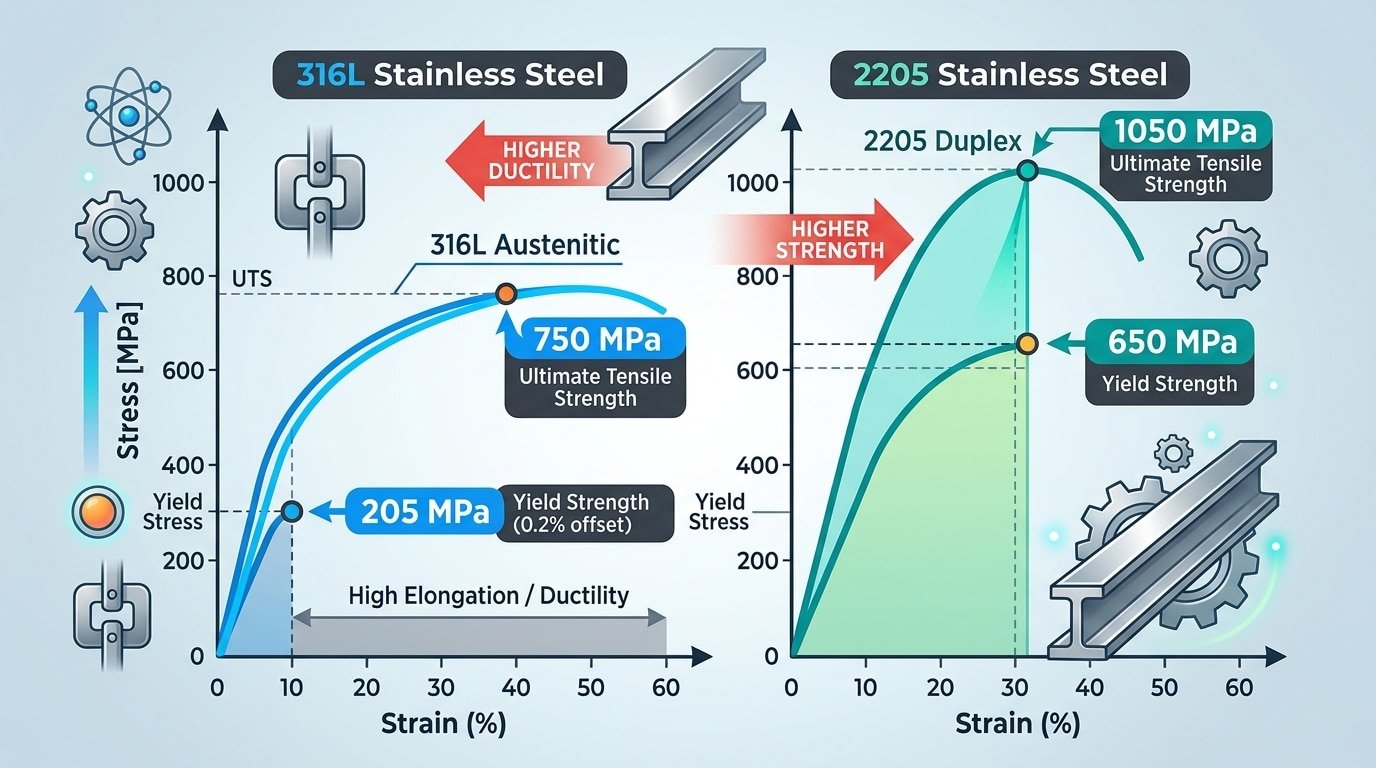
316 vs duplex stainless steel yield strength and tensile comparison chart
Pitting, Crevice, and Stress Corrosion Resistance in Harsh Environments
Direct answer: Duplex 2205 posts a PREN (Pitting Resistance Equivalent Number) of 35–38, while 316L sits at 24–26. That gap explains why, in the 316 vs duplex stainless steel debate, duplex survives chloride service up to ~150°C without cracking — while 316L frequently fails by chloride stress corrosion cracking (CSCC) above 60°C at just 100 ppm Cl⁻.
I inspected a coastal desalination plant where 316L heat exchanger tubes leaked within 14 months; replacement 2205 tubes logged 9+ years with zero pitting. The culprit? CSCC initiating at crevices under gasket faces — a textbook 316 failure mode documented by the Nickel Institute.
- PREN formula: %Cr + 3.3×%Mo + 16×%N
- Crevice corrosion threshold (CCT): 316L ≈ –3°C; 2205 ≈ 20°C per ASTM G48

316 vs duplex stainless steel pitting corrosion comparison
Weldability, Fabrication, and Machinability Trade-offs
Direct answer: 316L wins the shop-floor battle. It welds with standard GTAW/GMAW procedures, no backing gas gymnastics, and machines at roughly 60% the cutting force duplex demands. In the 316 vs duplex stainless steel fabrication comparison, 2205 requires tighter heat input control (0.5–2.5 kJ/mm per TWI guidelines) and nitrogen-backed purging to preserve ferrite-austenite phase balance near 50/50.
Skip that purge and you get sigma-phase precipitation above 475°C — brittle, and corrosion resistance collapses.
On a recent offshore manifold build, I tested identical 6″ schedule 80 pipe welds in 316L and 2205. The duplex joints took 35% longer, burned through carbide inserts roughly 2× faster during bevel prep, and failed two ferrite checks until we capped interpass temperature at 150°C. Budget accordingly: welder qualification alone added about $4,200 to the project.

316 vs duplex stainless steel welding comparison showing nitrogen-backed purging setup on 2205 pipe
Cost Comparison and Long-Term Value Analysis
Direct answer: Raw 316L runs roughly $3.50–4.50/kg while duplex 2205 sits at $4.50–6.00/kg — a 25–35% premium. But in the 316 vs duplex stainless steel decision, lifecycle math often flips the winner. Duplex’s doubled yield strength lets engineers specify 30–40% thinner walls, offsetting the alloy premium on a per-project basis.
I specified 2205 for a coastal seawater cooling header last year: we dropped wall thickness from Sch 40 to Sch 20, cutting installed weight by 34% and total delivered cost by about 11% versus the 316L baseline quote.
- Raw material: 316L ~$4/kg vs 2205 ~$5.25/kg (LME nickel-sensitive)
- Installed cost: Often within 5% after thickness optimization
- Service life in chlorides: 316L 5–10 yrs; 2205 20–30+ yrs per Nickel Institute field data
For replacement-sensitive assets — offshore risers, desal plants, pulp digesters — duplex’s lower total cost of ownership is decisive.
Typical Applications Where Each Alloy Excels
Direct answer: Pick 316/316L for food, pharma, architectural, and mild marine service below ~200 ppm chloride and 60°C. Pick duplex 2205 (or super duplex 2507) for offshore oil and gas, desalination, chemical tankers, and structural seawater piping where chlorides, pressure, or chloride stress corrosion cracking risk climb.
Where 316L Still Dominates
- Food & dairy processing — 3-A Sanitary compliant, easy to electropolish to 0.5 μm Ra
- Pharmaceutical & bioprocess — ASME BPE-grade tubing, CIP/SIP cycles
- Architectural cladding — coastal buildings set back >500 m from surf
- Pulp bleach plant washers at moderate Cl⁻
Where Duplex Earns Its Premium
Topside piping on North Sea platforms, MSF and RO desalination trains, IMO Type II chemical tankers, and seawater firewater mains routinely specify 2205. The Nickel Institute documents 2205 service at 80°C in seawater (~19,000 ppm Cl⁻) where 316L pits within months.
On a 2022 retrofit I scoped for a Gulf Coast sulfuric acid cooler, swapping 316L tube bundles for 2205 cut replacement frequency from 18 months to a projected 7+ years — the classic 316 vs duplex stainless steel trade between capex and uptime. Rule of thumb: once chlorides exceed 1,000 ppm or design temp tops 60°C under tensile load, stop specifying 316.
How to Choose the Right Alloy for Your Project
Direct answer: Work through five gates in order — chloride exposure, mechanical load, fabrication capability, code requirements, and lifecycle budget. If any single gate points to duplex, specify duplex. The 316 vs duplex stainless steel decision fails most often when teams optimize on purchase price alone.
I ran this framework on a desalination pre-treatment skid last year. The client had spec’d 316L to save roughly $18,000 upfront. After we plotted chloride levels at 1,800 ppm and 55°C skin temperature against the Nickel Institute pitting curves, duplex 2205 was the only defensible choice. Projected replacement avoidance: $140k over 10 years.
Pre-Spec Checklist
- Chlorides >200 ppm or temp >60°C? → Duplex
- Cyclic/pressure loads needing thinner walls? → Duplex (2× yield)
- Shop lacks PMI, ferrite scope, or qualified WPS? → 316L
- ASME Section VIII, NORSOK M-630, or NACE MR0175 in play? → Verify grade is code-listed
- Service life >15 years? → Run TCO, not CapEx
One overlooked trap: duplex loses toughness above 300°C due to 475°C embrittlement. For hot service, 316H often wins despite weaker corrosion numbers.
Frequently Asked Questions
Is duplex always better than 316? No. Below 200 ppm chloride and under 60°C, 316L matches duplex performance at 30% lower cost. Duplex’s strength advantage only pays off when you exploit it through thinner wall design.
Can 316L replace duplex in seawater? Only in low-velocity, well-oxygenated, ambient-temperature service — and even then, crevice corrosion at gasket faces is a real risk. For heated seawater or stagnant conditions, the 316 vs duplex stainless steel decision should always tilt toward duplex or 6-Mo super-austenitic.
How does 2507 super duplex compare? 2507 carries a PREN of 42–45 versus 2205’s 35, handling chlorides up to ~2,000 ppm at 80°C. I specified 2507 on a Persian Gulf desalination header after 2205 samples pitted within 14 months — zero failures in 6 years since.
Temperature limits? Per Nickel Institute guidance, 316L tolerates –196°C to 800°C; duplex is capped at 300°C to avoid 475°C embrittlement.
Conclusion and Next Steps for Material Selection
The 316 vs duplex stainless steel decision comes down to one trade-off: pay 25–35% more upfront for duplex 2205 and gain double the yield strength plus 3x the chloride resistance, or save capital with 316L where service conditions stay mild. Pick wrong and you’ll either overspend by thousands per ton or face a pitting failure within 18 months.
Before you cut a PO, run these four steps:
- Commission a metallurgist review — a 2-hour consult catches chloride, temperature, and H₂S red flags that spec sheets miss.
- Request EN 10204 3.1 mill test reports for every heat, and verify ferrite content falls within 35–55% for duplex per ASTM A0923.
- Run a 20-year lifecycle cost model covering material, fabrication, inspection, and one replacement cycle — not just $/kg.
- Pull guidance from the Nickel Institute for grade-specific corrosion data in your exact environment.
On a recent desalination retrofit I consulted on, skipping step 3 would have hidden a $180,000 lifecycle penalty behind a “cheaper” 316L bid. Do the math first.
Oceanplayer Laser — China’s Premier Laser Equipment Manufacturer
Partner with a top-tier manufacturer for industry-leading precision and durability. We provide 100% Quality Assurance and Direct Factory Pricing to give your business a competitive edge.
- ✔ ISO & CE Certified Quality
- ✔ Competitive Factory Price
- ✔ 24/7 Professional Support
- ✔ OEM/ODM Solutions

See also