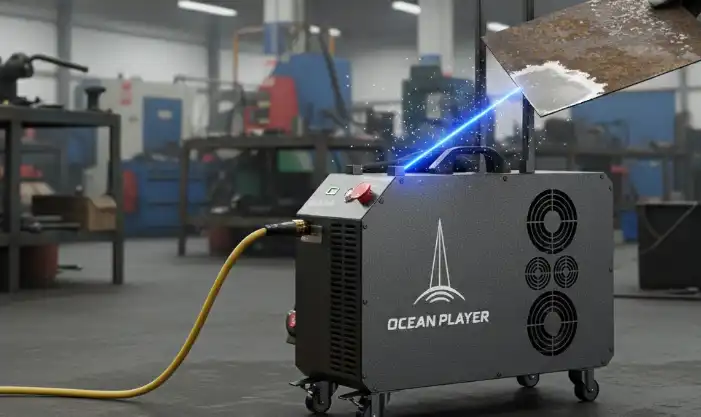
Choosing a portable laser cleaning machine isn’t just about raw power. If you run a small to mid-sized factory, day-to-day reality looks like tight aisles, quick changeovers, and one operator juggling multiple tasks. In mold maintenance—where you must remove oxide and residues without changing surface finish or geometry—portability and ease of use beat brute force. This guide shows you how to prioritize mobility, ergonomics, and control, then layer in power, safety, and total cost of ownership (TCO). We’ll use laser mold cleaning as the running example so every spec you compare has a practical anchor.
Key search intent covered here includes portable laser cleaning machine applications and pricing for SMEs, power class selection, pulsed vs continuous trade-offs, and safety/compliance basics for Class 4 handheld systems.
Key takeaways
- Start with portability: for molds, look for air‑cooled, sub‑40 kg base units, 3–8 m fiber length, and ≤2 kg handheld heads—optimized for single-operator use in constrained spaces.
- For mold finish preservation, pick pulsed fiber (MOPA/nanosecond) as your default; high‑power CW excels on heavy rust/large areas but demands tighter process control to avoid surface change.
- Power classes: 100–300 W portable pulsed units cover most mold upkeep; step to 300–500 W when you need faster coverage while staying reasonably mobile.
- Pricing signals: public listings suggest ~$6.5k+ for 100 W backpack-class and five-figure pricing for mid-power portable pulsed units; brand, source quality, and certifications drive variance.
- TCO is favorable: electricity is modest for portables and there are no blast media or chemical consumables—your main costs are CapEx, operator time, and fume extraction.
- Safety is non-negotiable: treat handhelds as Class 4 lasers; align controls with ANSI Z136/IEC 60825 principles, use wavelength-matched eyewear, and implement fume extraction.
Why portability matters first in laser mold cleaning
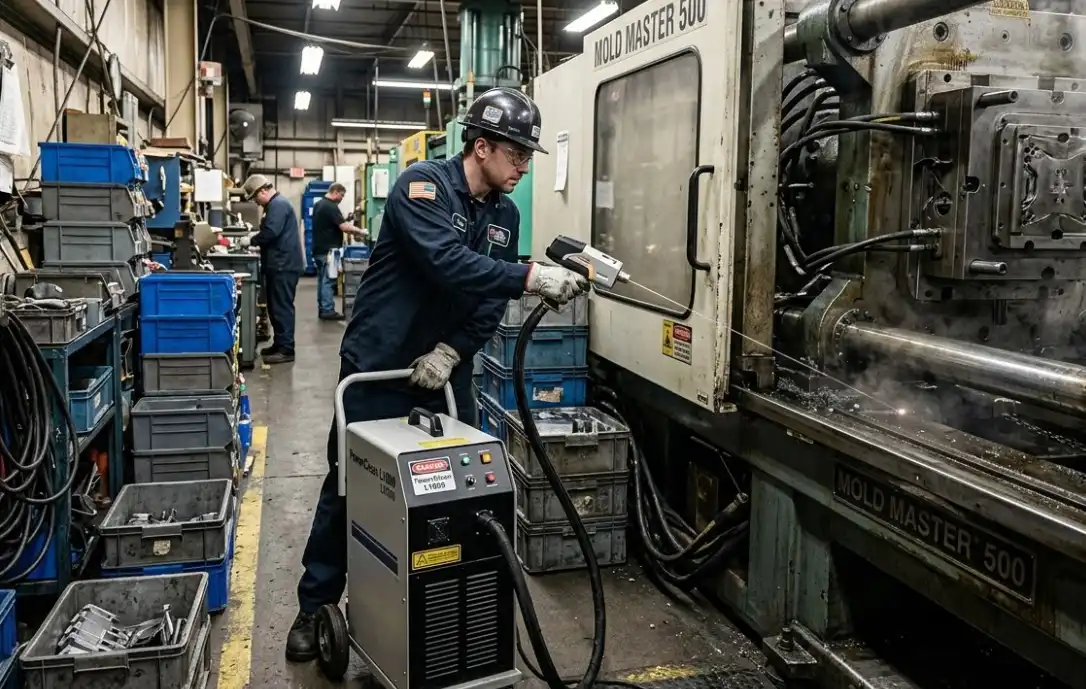
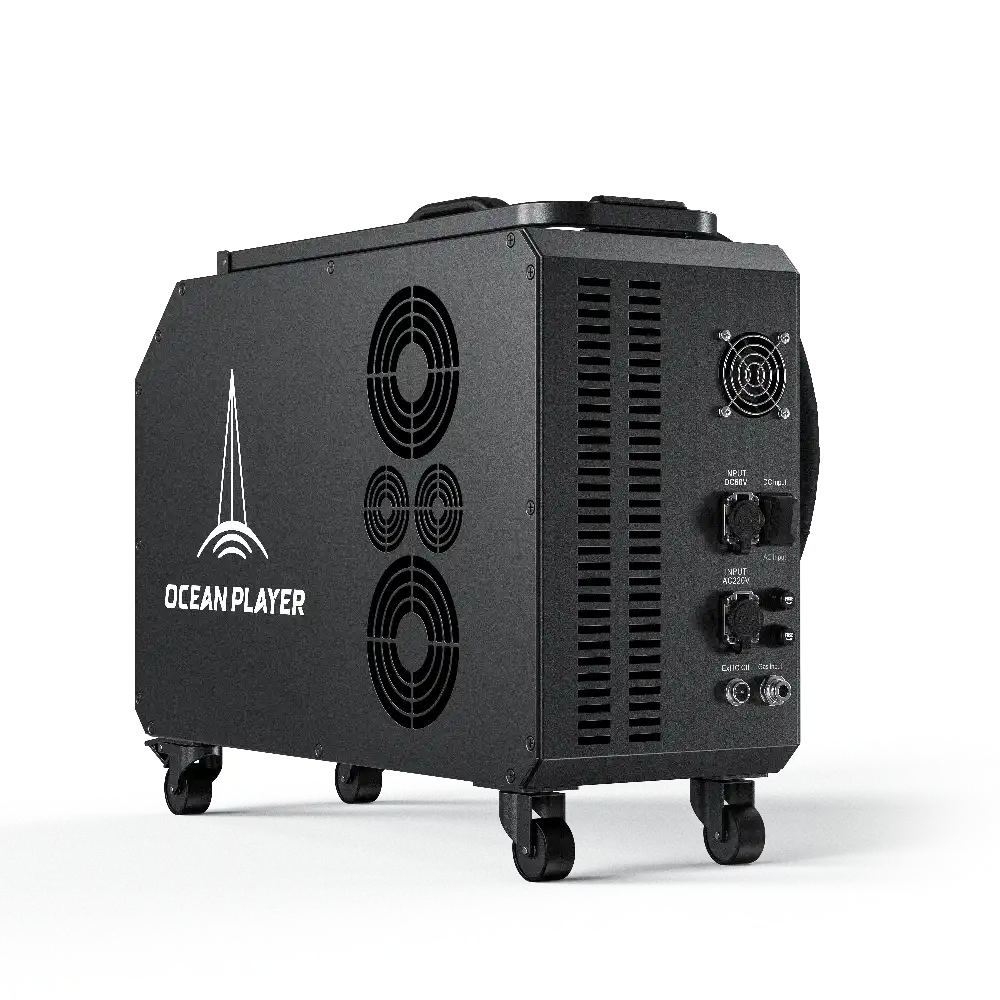
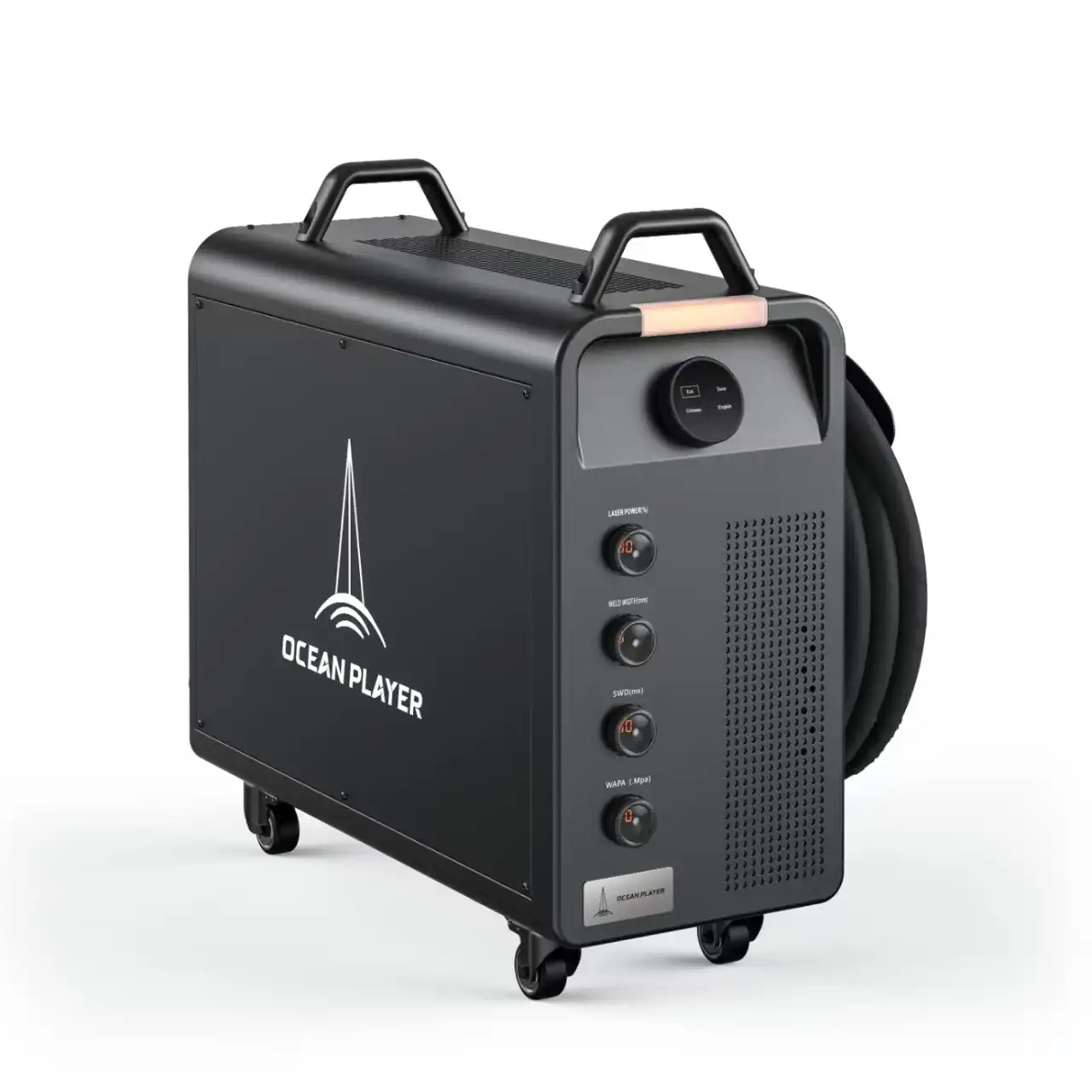
A portable laser cleaning machine you can maneuver to the tool is often worth more than a higher-power unit you can’t position. For mold work, “portable” should mean sub‑40 kg base mass you can wheel easily, air cooling (especially 100–300 W) to keep weight down and maintenance simple, a handheld head around 1–2.2 kg for steady control, and fiber length in the 3–8 m range to reach cavities without moving the base unit.
Representative vendor pages illustrate these parameters. For instance, cart‑class portable cleaners list compact footprints and air cooling in the 300–500 W range on product pages from established suppliers such as LaserStar (300 W/500 W pulsed cleaners). Handheld head weight examples around ~2.2 kg appear in specifications from manufacturers like Wattsan. These data points show what “portable” looks like in practice and help you benchmark quotes.
Evidence links for this section
- LaserStar’s 300 W portable pulsed cleaner product page describes portable form factors for mobility and industrial use: see the company’s “industrial laser cleaner 300 W” page (2024–2025). LaserStar 300 W pulsed cleaner
- A 2.2 kg handheld head weight example is published in a Wattsan cleaning machine specification for comparable handheld configurations. Wattsan handheld head spec example
Laser cleaning vs abrasive/chemical methods (quick comparison)
Laser cleaning avoids media impacts and chemical handling. Here’s a concise view for mold upkeep:
| Criterion | Portable laser cleaning machine (pulsed) | Abrasive blasting | Chemical stripping |
|---|---|---|---|
| Substrate risk on polished molds | Very low when pulsed/parameterized | Moderate to high (pitting/peening) | Moderate (etching/underfilm effects) |
| Consumables | None (filters for extraction) | Media + disposal | Chemicals + disposal |
| Setup/cleanup time | Low | Medium to high | Medium |
| Mobility around presses | High (portable form factor) | Medium (hoses/media) | Medium |
| Environmental exposure | Low (no media) | Dust and spent media | Chemical exposure |
| Skill/safety | Class 4 laser controls required | PPE; dust/explosion controls | PPE; chemical handling |
Note on energy costs: U.S. industrial electricity has averaged single‑digit cents per kWh in recent years; consult the Energy Information Administration’s current industrial price series (2024–2026). EIA industrial electricity prices
For broader context on throughput and applications, see an OEM’s educational overview on what laser cleaning is and how power/automation affect coverage rate. IPG Photonics “What Is Laser Cleaning?”
Portable laser cleaning machine classes and the buyer’s checklist
Most SME mold programs can shortlist two portable classes of pulsed fiber cleaners:
- 100–300 W: portable, air‑cooled units optimized for precision cleaning in tight areas; very low site power requirements; excellent control on delicate finishes.
- 300–500 W: still portable, with higher coverage rates; may be air or water cooled depending on duty cycle; better for larger molds or more frequent cleaning.
Use this compact matrix while speaking with vendors. Ask for written values—especially where brochures are vague.
| Buyer dimension | What to request from vendors | Why it matters for molds |
|---|---|---|
| Laser type | Pulsed fiber (MOPA/nanosecond) vs CW | Pulsed minimizes heat‑affected zones on polished cavities |
| Total weight | Base unit mass and footprint | Determines true portability in cramped bays |
| Handheld head | Mass, grip style, E‑stop, emission indicator | Operator steadiness and safety |
| Fiber length | 3–8 m typical | Reach into presses without moving the base |
| Cooling | Air vs water; duty cycle | Reliability and maintenance load |
| Optics | F‑theta lenses, field size, cleaning width | Matching spot size to cavity geometry |
| Controls/UI | Presets, pulse width/frequency range | Repeatability across shifts |
| Fume extraction | Compatibility, nozzle options, filter cost | Keeps residues out of the workspace |
| Power input | Single‑phase/plug type/inrush | Avoid surprise facility upgrades |
| Compliance docs | EN/IEC labeling, test reports, manuals | Speeds safety approval and training |
Pulsed vs continuous: what actually works for molds
In laser mold cleaning, you’re balancing energy density against the mold’s tolerance to heat. Pulsed fiber systems deposit energy in short bursts, enabling ablation of oxides and residues with minimal thermal diffusion into the base metal. That’s why surface‑prep specialists discuss pulsed laser ablation when the goal is selective removal and surface preservation. Pulsed laser surface preparation explainer
Mold‑focused technical collateral also describes cleaning in situ with repeatable results and minimal damage risk, aligning with pulsed operation for delicate finishes. Loop Technology mold cleaning PDF (2024) and Loop’s automated mold cleaning overview
- For mold fidelity: Choose pulsed by default. It gives you a wider process window for polished aluminum and tool steel molds.
- For heavy rust/large plates: CW ≥ 1 kW can win on sheer speed, but you must tighten controls to avoid finish change and often move toward semi‑automation.
Starting parameter ranges for mold trials (guidance, not specs)
Use these as conservative starting points, then tune via trials.
| Mold material/finish | Pulse width (ns) | Repetition rate (kHz) | Scan speed (mm/s) | Notes |
|---|---|---|---|---|
| Polished aluminum cavity | 100–200 | 20–60 | 400–1,000 | Start low fluence; inspect for haze or micro‑melting |
| Tool steel (polished) | 150–250 | 20–50 | 300–900 | Slightly longer pulses can help lift oxides; check Ra change |
| Chrome‑plated features | 100–180 | 20–40 | 300–700 | Avoid high overlap; monitor edge sharpness |
Uncertainty & sources — The parameter ranges above are conditional starting points, not guarantees. Actual safe/optimal windows depend strongly on material condition (oxidation, coatings), contamination type/thickness, spot diameter and raster overlap, and measurement method; changing any of these can shift recommended pulse width, repetition rate, or scan speed. Always verify with on‑site trials and Ra/dimensional checks. See practical guidance from Loop Technology’s mold cleaning guide (2024) and the Adapt Laser pulsed cleaning overview for caveats and tuning advice.
Parameter playbook for common mold scenarios
Think of parameters as dials you adjust to keep fluence just above the removal threshold for contamination but below the damage threshold for your substrate.
For aluminum molds with thin oxide, prefer shorter pulse widths and moderate repetition rates, and favor higher scan speeds to minimize cumulative heating. For tool steel molds with baked residues, slightly longer pulses and lower scan speeds can assist removal, but verify that surface roughness (Ra) remains within tolerance. For chrome‑plated features and logos, keep overlap conservative and inspect under magnification for edge rounding; when in doubt, reduce repetition rate and increase passes rather than spiking pulse energy. These practices align with mold‑oriented collateral from automation integrators and broader pulsed‑laser surface prep guidance.
Field‑test protocol you can run in a day
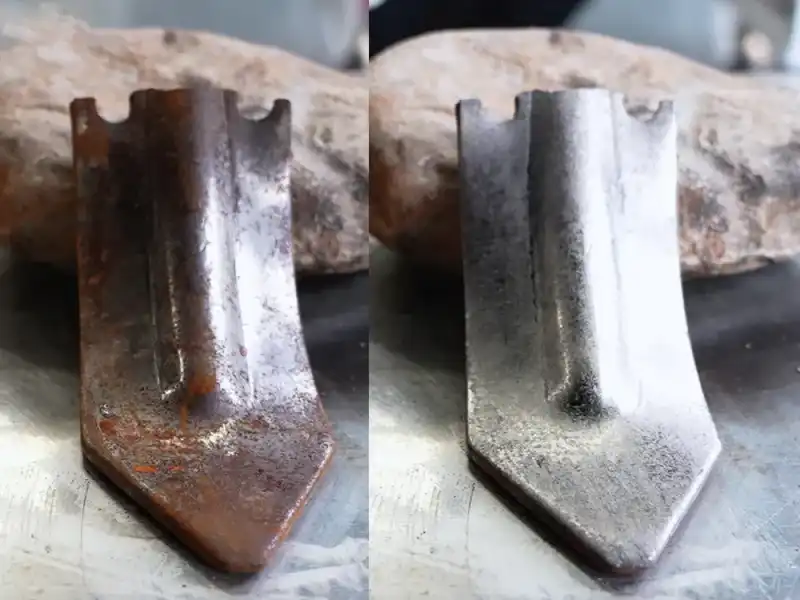
A good test tells you if a portable laser cleaning machine fits your line—without guesswork. Here’s a simple protocol that maintenance teams can execute.
- Select 3–5 representative contaminated areas or coupons per material/finish.
- Measure pre‑cleaning Ra (ISO 4287/25178), record photos under consistent lighting, and note any critical dimensions.
- Sweep parameters (pulse width, repetition rate, scan speed) from conservative to moderate settings, logging fluence and overlap.
- Record time per area or per cavity, operator comfort/steadiness, and fume capture effectiveness.
- Re‑measure Ra and critical dimensions; document any discoloration or edge effects.
- Define acceptance: for example, ≥95% residue removal, ΔRa ≤ 0.2 µm, and no measurable dimensional change.
Sample log (CSV-style)
panel_id,material,finish,pulse_width_ns,rep_rate_kHz,scan_speed_mm_s,passes,fluence_J_cm2,time_s,Ra_before_um,Ra_after_um,notes
A1,Aluminum,Polished,120,30,800,2,~1.2,75,0.08,0.09,No haze
A2,ToolSteel,Polished,180,25,600,2,~1.5,92,0.05,0.06,Slight residue in corner
Pricing signals and a simple 3‑year TCO example
Public prices vary widely by brand, source, and configuration, but they do provide anchors:
- Backpack‑class 100 W pulsed units have been publicly listed starting around $6,500 by established sellers. STYLECNC 100 W backpack listing
- A branded portable/hybrid 120 W cleaner/marker has been listed at $14,995. LaserStar Hybrid Backpack 120 W
Higher‑power CW category pages sometimes show low entry numbers (context‑specific and not mold‑focused). Treat all public figures as anchors, not guarantees. For instance, budget‑oriented supplier listings show 2–3 kW CW cleaners with entry prices on their category pages, which are not directly comparable to portable pulsed mold‑maintenance units. STYLECNC laser cleaning category anchors
Energy inputs and TCO
- Electricity: U.S. industrial prices have hovered in the single‑digit‑cents per kWh range in 2024–2026 per government statistics. EIA industrial price series A 100 W backpack unit specifying total consumption under 500 W implies roughly 0.5 kWh per operating hour; at $0.09/kWh, that’s about $0.045/h. STYLECNC backpack consumption spec
- For 300–500 W portables, request total input (kW) to refine $/h. Even at a few kW, operating cost remains modest compared with media/chemical consumables.
3‑year TCO sketch (illustrative)
- CapEx: $12,000–$35,000 for a quality portable pulsed cleaner, depending on power and certifications.
- Operating: Electricity (low), extraction filter media, occasional protective lenses.
- Savings vs blasting/chemicals: Eliminates consumables/media disposal, reduces tool damage risk and rework, and cuts cleaning time (labor/downtime).
Safety and compliance: treat handhelds as Class 4 systems
Portable or not, these are Class 4 lasers. Your program should reflect recognized controls.
- Assign a Laser Safety Officer (LSO) and define procedures for startup/shutdown, Nominal Hazard Zone (NHZ) control, and emergency stops.
- Engineering controls: emission indicators, key switch, remote interlock, appropriate barriers or curtains, and verified beam stops wherever feasible.
- Administrative controls: training, signage, and labeling per EN/IEC guidance; documented parameter limits for molds; eyewear matched to wavelength and optical density.
- Fume extraction: use nozzles and filters rated for the contaminants you’ll remove; verify capture close to the surface.
Public guidance referencing BS EN/IEC 60825‑1 is available from the UK government’s laser safety advice note, and the UK’s designated standards notice includes EN 60825‑1 in the standards family. UK government laser radiation safety advice UK designated standards notice including EN 60825‑1
In U.S. facilities, align with ANSI Z136.1/.3 programs and LIA guidance.
- For US/EHS technical compliance, reference ANSI Z136.1 (see Chapter 4 for hazard evaluation/Maximum Permissible Exposure and NHZ calculation, and Chapter 5 for engineering and administrative controls) and implement NHZ controls accordingly; for product labeling and interlocks follow IEC 60825‑1 (Clause 6 on protective measures and interlocks; Clause 7 on labeling/warnings). LBL laser safety overview referencing NHZ and Z136 practices and the UK gov EN/IEC 60825‑1 guidance are useful summaries.
- Eyewear example (1064 nm): for high‑power pulsed fiber cleaners, select protective eyewear with a nominal OD in the OD 5–OD 7 range at 1064 nm (higher OD for higher pulse peak power). Verify by measuring transmittance with a calibrated 1064 nm power meter: OD = −log10(transmittance); confirm measured OD meets the value required by your MPE/NHZ calculation before work inside the NHZ.
Practical example: configuring a portable 300 W pulsed unit for molds
Here’s how a typical SME config might look—use it to sanity‑check vendor quotes.
- Power and type: 300 W pulsed fiber (MOPA), air‑cooled, with presets for pulse width and frequency suited to oxide/residue removal.
- Portability: <40 kg base on a compact cart, 5–8 m fiber, handheld head around ~2 kg with an integrated E‑stop and emission indicator.
- Optics and width: F‑theta lens set enabling a practical field size for cavity work; cleaning width adjustable to match features.
- Controls: Shortcuts for conservative, standard, and aggressive presets (locked by admin) to improve repeatability.
- Extraction: Inline nozzle compatible with the head; filters sized to expected residue load.
In practice, a configuration like this from Oceanplayer or other reputable manufacturers helps a single operator move between presses, clean residues within acceptance limits, and keep downtime tight. If your molds are large or heavily fouled, consider stepping to 500 W or using a semi‑automated head for the big areas, then return to handheld pulsed settings around critical features.
Next steps for SMEs
Shortlist two or three portable laser cleaning machine options in the 100–500 W pulsed class and request written specs for weight, head mass, fiber length, cooling, and total kW input. Run the one‑day field test above; log fluence, time per cavity, ΔRa, and operator feedback. Verify safety readiness—LSO assigned, eyewear specified, barriers/signage planned, and fume extraction selected. Finally, ask vendors for service/warranty terms, spare optics pricing, and documentation aligned to EN/IEC and (if applicable) ANSI Z136.
If you’d like a neutral spec sheet to compare against, request a portable 300 W pulsed mold‑maintenance configuration and we’ll share a template to benchmark any vendor quote.
Appendix: quick formulas and definitions
- Fluence (energy density), J/cm² ≈ (Pulse energy, J) / (Spot area, cm²)
- Overlap (%) in raster scans ≈ 100 × [1 − (line spacing / spot diameter)]
- Ra: arithmetic average surface roughness per ISO 4287; measure before and after cleaning on the same area under the same conditions.