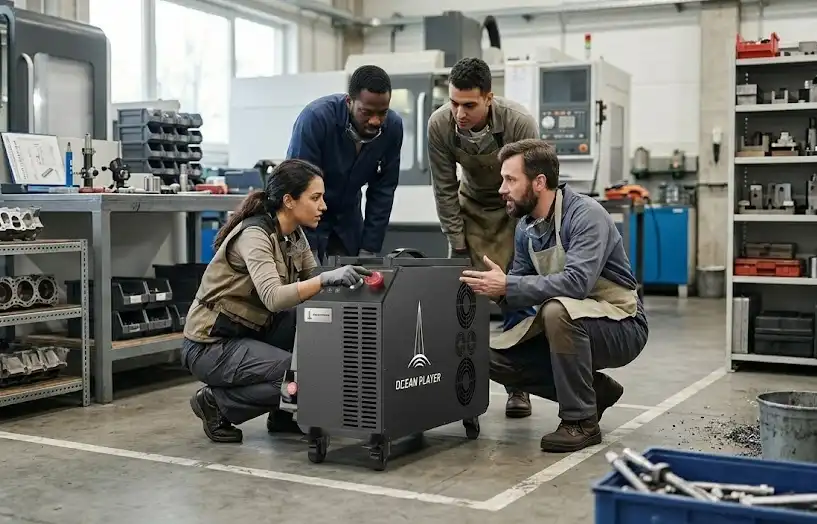
Laser cleaning has become a go-to method for removing heavy rust and paint from steel structures, molds, and large fabrications. But if you run multi-shift operations in dusty bays, your first question is simple: how long will a laser cleaning machine actually last—and what determines that life? In this guide, we define service life in practical terms, break it down by subsystem, and show how maintenance economics and depreciation interact so you can budget with confidence.
At a high level, a modern pulsed-fiber-based cleaning system can run for years. Yet “years” hides the reality that different parts age at very different rates. Protective optics and filters are consumables; scan heads and chillers have wear sensitivities; the fiber source can be extremely reliable if kept cool, clean, and within duty limits. We’ll tie these mechanisms to real maintenance levers and then model ROI and replacement timing.
Here’s the deal: public, laser-cleaning-specific MTBF datasets are sparse. Reliability math (MTBF/MTTF/B10) is widely documented for industrial equipment, but many laser OEMs don’t publish hard hour counts for cleaning use. Where data is limited, we present conservative ranges and link to authoritative references so you can verify details for your exact configuration and site conditions.
Key takeaways
- Expect multi-year service life for the full system; the pulsed fiber source often targets tens of thousands of hours under nominal conditions, while optics and filters are the shortest-lived items and drive most downtime risk.
- The top lifespan driver is contamination control: clean protective windows, strong fume extraction with differential pressure monitoring, and stable cooling extend life and protect expensive parts.
- Plan consumables: protective windows/cover glass, HEPA and carbon filters, pre-filters, coolant and strainers; these small costs prevent large failures (scan head optics, delivery fiber, source downtime).
- Model depreciation (e.g., 7-year MACRS in the US) alongside maintenance and downtime. Replace when annual downtime + maintenance outpaces the amortized cost of a new system at your utilization.
- Verify OEM data for your exact machine, especially environmental sealing/purge, optics part numbers and costs, and recommended service intervals.
- Discipline pays: plants with daily optics checks and ΔP-based filter swaps routinely report steadier uptime and longer effective life than those on fixed-interval or ad-hoc maintenance.
The quick answer: realistic laser cleaning machine service life ranges
When buyers ask, “What’s the laser cleaning machine service life?” the only honest answer is: it depends on subsystem wear, environment, and maintenance discipline. Under heavy-duty rust/paint removal with good extraction and optics protection, you can expect multi-year uptime with scheduled optics/filter replacements and periodic chiller service. Without those controls, practical life shrinks fast—especially for the optics and scan head.
Subsystem snapshot — indicative ranges for heavy-duty use
The figures below are indicative for multi-shift cleaning in dusty bays with effective fume extraction and proper optics protection. Treat them as planning ranges; verify with the chosen OEM’s datasheets and manuals.
| Subsystem | What tends to fail or drift | Indicative life/cadence in heavy-duty rust/paint | What extends life | Where to verify |
|---|---|---|---|---|
| Pulsed fiber laser source | Pump diode aging, thermal stress | Often specified qualitatively as “very long life”; marketing/spec pages imply tens of thousands of hours under nominal conditions; hard MTBF values for cleaning use are rarely public | Tight cooling control; clean power; ambient dust control | Confirm with the vendor’s datasheet and warranty terms; note that many do not publish numeric MTBF publicly (see the reliability note from a major OEM’s high-power fiber lasers page) |
| Scan head/galvanometers | Mirror contamination, thermal drift | Performance-limited; years with proper sealing/purge and clean optics; early failures if dust reaches mirrors | Positive-pressure enclosure or purge; thermal limits; regular verification | OEM application notes and scanning handbooks discuss environment and mirror durability |
| Protective window/cover glass; focus/F-theta | Contamination, micro-pitting, coating damage | Shortest-lived consumables in abrasive cleaning; daily to weekly cleaning; replacement from hundreds to a few thousand heavy-duty hours depending on contamination load | Air-knife/purge; standoff distance; disciplined cleaning SOP | Optics handling and maintenance guides; application notes |
| Delivery fiber/cable | Microbending, dirty endfaces, back-reflection | Long if treated correctly; failures spike with bend-radius violations and contamination | Respect MBR; inspect→clean→inspect workflow; strain relief | Fiber handling/cleaning manuals |
| Cooling (water chiller) | Coolant degradation, clogged filters, fouled condenser | Pumps/fans last years; coolant quality dominates; 3–6 month coolant changes typical in harsh duty; weekly filter/coil care | Monthly pH/conductivity checks; scheduled filter swaps; condenser cleaning | Chiller OEM manual and maintenance tables |
| Fume/dust extraction | Clogged filters, VOC saturation | Filter life varies with dust/paint load; manage by ΔP, not fixed time | Stage filtration; monitor ΔP rise (~5–7 PSI or vendor-specified mbar) | Extraction system manuals and filter guidance |
Why this spread? Heavy rust and paint ablation generates hot particulate and fumes that deposit on optics and into electronics if not captured. The more effectively you capture at the source—and the cleaner your purge/air-knife—the longer everything else lasts.
What actually wears out first in heavy-duty rust/paint removal
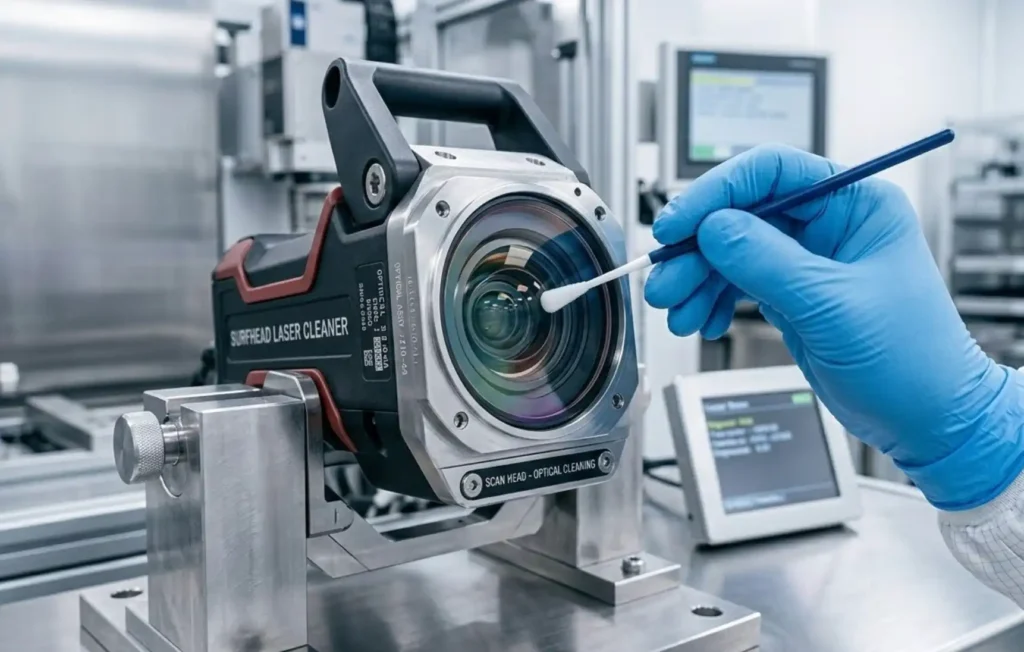
Ablation showers your protective window with hot debris, smoke, and resinous byproducts. That window shields the expensive focus lens and scan mirrors. If it gets dirty or pitted, transmission drops, local heating rises, and downstream optics start to suffer. Think of the protective window as your sacrificial anode: cheap to replace, expensive to neglect.
Optics and protective windows
The protection window and cover glass are the first line of defense. Frequent inspection and gentle, correct cleaning—lint-free wipes/swabs, high-purity solvents, inspect→clean→inspect—keep transmission high and prevent micro-pitting. Application notes and industrial maintenance tips emphasize that inadequate window care cascades into focus lens damage and downtime; several industry sources detail proper lens cleaning and handling techniques, including solvent purity, blow-off, and no-touch policies, consistent with guidance like the maintenance recommendations published by a major machine tool maker in 2024 and optics-care notes from laser integrators. For a background on proper handling and safety glass concepts, see the professional overviews on laser safety windows by a leading safety optics manufacturer.
Evidence to consult:
- Reliability fundamentals for interpreting MTBF/MTTF/B10 and their limits in harsh duty are summarized in the industry safety literature such as Eaton’s safety manual and Omron’s machine safety catalogue, which help buyers avoid overconfidence in a single MTBF figure.
Scan head and galvanometers
Galvo systems are robust but sensitive to dust on mirrors and thermal drift. Photonics scanning handbooks from established vendors discuss mirror/coating durability and environmental considerations for scanning systems. In dirty bays, put the scan head in a sealed or positive-pressure enclosure; maintain purge gas where supported; watch temperatures. Periodic calibration/verification keeps drift in check.
Delivery fiber and connectors
Most delivery fibers fail due to us, not age: violating minimum bend radius, yanking unrestrained cables, or mating dirty connectors. Fiber-handling references recommend generous bend radii (based on cladding diameter), strain relief, and a strict inspect→clean→inspect routine. Back-reflections from misalignment or poor endface care can also concentrate heat.
Cooling and electronics
Overheating shortens the life of diodes, power electronics, and even optics coatings. In heavy-duty cycles, coolant quality (pH/conductivity), clean strainers, and unfouled condensers are non-negotiable. Chiller service articles and OEM guidance commonly suggest frequent checks and more aggressive coolant-change intervals in hot or contaminated environments, while general chiller maintenance schedules highlight weekly to monthly coil/filter cleaning and periodic flushes. Keep enclosures filtered, blow out dust periodically, and protect against brownouts or surges.
Environment and engineering controls that extend life
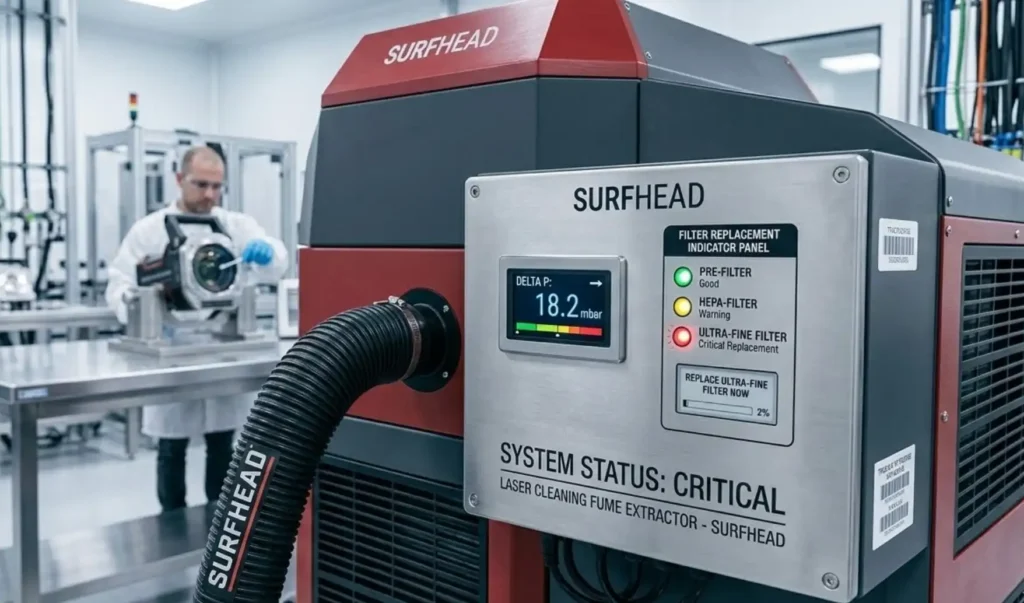
Great optics discipline can’t fully compensate for poor capture. Local exhaust ventilation (LEV) with staged filtration—pre-filter → HEPA → activated carbon—reduces particulate and VOCs from coating ablation, protecting people and machines. Occupational health guidance recommends engineering controls and air sampling to keep exposures below permissible limits. In practice, the same capture that satisfies safety also extends component life: fewer deposits on windows and mirrors, cleaner electronics bays, and cooler operation.
- For principles and methods on ventilation and exposure assessment, consult the OSHA Technical Manual sections on lasers and air contaminants and NIOSH’s NMAM for validated sampling methods. These references explain why source capture and verification matter, even if they don’t prescribe a single capture velocity for every laser ablation task.
- For filter change timing, industrial filtration experts recommend tracking differential pressure (ΔP) across filters and swapping when ΔP rises significantly from the clean baseline (often around 5–7 PSI or the vendor’s mbar threshold). Some laser extraction systems include flow control and filter-condition indicators to help maintain capture efficiency.
Put simply: better capture equals longer life. If dust pervades your bay, consider enclosing the scan head region and applying positive-pressure purge that flows outward across the protective window, plus an air-knife to deflect debris.
Maintenance program and cost levers
A disciplined, light-touch maintenance program prevents expensive failures. Below is a pragmatic schedule for multi-shift, heavy-duty cleaning. Adjust intervals to your contamination load and log results so you can stretch or tighten with data.
| Interval | Tasks | Why it matters | Typical notes |
|---|---|---|---|
| Daily (or each shift) | Inspect protective window; clean if any haze/spatter; verify extraction airflow/ΔP reading; quick walkaround for cable strain and bend radius compliance | Avoids micro-pitting and heat load; ensures capture; prevents fiber damage | Perform cleaning in a clean area with high-purity solvent; record ΔP and airflow |
| Weekly | Deep clean protective window as needed; clean chiller strainers; brush/air-clean condenser coils and electronics filters; verify purge/air-knife operation | Keeps thermal margins; protects electronics; maintains capture efficiency | Log temperatures, coolant level, and alarms |
| Monthly | Coolant pH/conductivity check; full optics inspection (window, focus glass, scan mirror window); verify power quality and grounding | Prevents corrosion/deposits; catches early optics wear | Replace pre-filters if ΔP rising; ensure connectors are clean |
| 3–6 months (harsh duty) | Coolant replacement and system flush if indicated; scheduled filter replacements (pre/HEPA/carbon) using ΔP trend; calibration/verification of scan head and beam path | Resets fouling; protects pumps/fans; maintains process quality | Short planned downtime beats unplanned failure |
| Annually | Chiller service; enclosure dust-out; full reliability review (consumables spend, downtime, optics replacement cadence) | Informs budget and replacement timing | Compare against OEM recommendations and plant data |
Consumables and spares to budget explicitly:
- Protective windows/cover glass (your cheapest insurance)
- Pre-filters, HEPA, and carbon filters for extraction
- Coolant and filter cartridges/strainers
- Occasional focus/F-theta optics, pump/fan wear items, and fiber repair/replace funds
Stock at least one full set of optics and filters on-site. The best ROI lever in harsh-duty cleaning is simply never running with a dirty protective window or clogged filters.
ROI, depreciation, and the replacement threshold
Decision-makers care less about theoretical life and more about cost per productive hour. Here’s a straightforward framework you can adapt.
Key definitions
- Annualized ownership cost = depreciation + financing (if any) + expected maintenance/consumables + expected downtime cost + energy + labor to run maintenance.
- Replacement threshold (rule-of-thumb): replace when annual maintenance + downtime begins to exceed the amortized annual cost of a new system at your utilization and risk profile.
Depreciation in the US
- Many plants classify industrial laser equipment under MACRS with a 7-year recovery period. Managerial books may also use straight-line for internal comparisons. For statutory guidance and examples, see the IRS resource on how to depreciate property; consult your tax advisor for Section 179 expensing and current bonus depreciation rules.
Worked example (illustrative)
- Capex (installed): $250,000
- Utilization: 16 hours/day, 300 days/year → 4,800 hours/year
- Maintenance + consumables (with strong discipline): $12,000/year in optics, filters, coolant, plus 60 hours/year of planned maintenance labor at $60/hour → $15,600/year
- Downtime risk: budget 20 unplanned hours/year at $1,500/hour (line stoppage, rework) → $30,000/year
- Energy: laser + chiller average 6 kW during ablation → 6 kW × 4,800 h × $0.12/kWh ≈ $3,456/year
- Depreciation (straight-line over 7 years for internal comparison): $250,000 / 7 ≈ $35,714/year (tax books may differ under MACRS)
Annualized ownership (illustrative)
- Depreciation: $35,714
- Maintenance/consumables: $15,600
- Downtime: $30,000
- Energy: $3,456
- Total: ≈ $84,770/year → ≈ $17.66/hour at 4,800 hours
Sensitivity to environment and discipline
- If extraction maintenance is weak and optics are neglected, downtime could triple (e.g., 60 hours unplanned) and optics spend could double, pushing annual cost well past $110,000 and cost/hour beyond $23. By contrast, tighter ΔP monitoring and daily optics checks can hold downtime near planned levels.
Replacement decision
- Suppose a new machine at today’s prices has a similar $17–$18/hour ownership cost. If your aging unit’s combined maintenance + downtime crosses that level and climbs each year, your breakeven to replace has arrived—especially if failures concentrate in long-lead parts (scan head, delivery fiber) that also jeopardize throughput.
Authoritative references to ground the model
- For depreciation methods and class lives, see the IRS’s primary guide in Publication 946, How to Depreciate Property.
- For reliability math used in repairable vs. non-repairable components (MTBF, MTTF, MTTFd/B10d), industry guides such as Eaton’s safety manual and Omron’s machine safety catalogue explain the concepts and limitations.
Procurement questions to lock in life and TCO
Use conversations—not guesses—to pin down life drivers. Ask vendors for documentation on environmental sealing or IP rating near the scan head and electronics bay, and whether positive-pressure purge is supported. Request optics part numbers and pricing for protective windows and focus optics, plus the recommended cleaning solvents and SOP. Confirm fume-extraction specifications, including staged filtration and whether the controller supports differential pressure monitoring and flow alarms. Capture chiller service intervals, coolant specifications, and any built-in diagnostics. Finally, clarify warranty terms, on-site response times, and spare-parts lead times, then reflect those numbers in your downtime budget.
Evidence, assumptions, and what to verify on-site
Two realities shape this guide. First, vendors often avoid publishing numeric MTBF for pulsed fiber laser sources in cleaning contexts, so we anchor reliability discussions in broadly accepted methods and in maintenance mechanisms that you can control. Second, capture and cooling practices differ dramatically by plant. Verify everything that matters on your floor: measure airflow, log ΔP, trend temperatures, and keep a photo log of optics before/after cleaning. These simple records will let you raise or lower maintenance frequency scientifically and defend your replacement timing in budget reviews.
To dig deeper or cite in your internal memo:
- Reliability and safety math overview: see the publisher-labelled manuals such as Eaton’s safety manual and Omron’s machine safety catalogue for MTBF/MTTF/MTTFd concepts and their safe-use context.
- Scanning environment considerations: consult an optical scanning handbook from a leading photonics group for mirror/coating and environment notes.
- Fiber connector care: standard references on cleaning fiber ends from respected photonics encyclopedias outline inspect→clean→inspect workflows.
- Extraction maintenance by ΔP: filtration experts recommend swapping filters based on differential pressure rise rather than calendar time, with staged filters to protect HEPA and carbon elements.
- Ventilation and exposure control: OSHA’s Technical Manual on lasers and air contaminants, and NIOSH’s NMAM methods, provide authoritative, primary guidance on engineering controls and sampling.
Selected authoritative sources (examples):
- According to the publisher’s guide in the OSHA Technical Manual, lasers and air contaminants are addressed with engineering controls and exposure assessment in dedicated chapters: see OSHA’s laser and air contaminants sections (latest revisions 2021–2026).
- For validated air sampling methods, consult NIOSH’s NMAM 5th Edition reference compendium (latest updates 2020–2023).
- For reliability terminology and safe application, see Eaton’s Safety Manual and Omron’s Machine Safety Catalogue Y207, which detail MTBF/MTTF/MTTFd and B10/B10d usage in machinery safety contexts.
- For scanning environment fundamentals, see a 2022 optical and polygonal laser scanning handbook published by a well-known photonics manufacturer.
- For fiber-end cleaning practice, see the encyclopedic guidance on cleaning of fiber ends from a widely cited photonics reference site.
- For ΔP-based filter maintenance principles, see a filtration engineering explainer from an industrial provider.
Closing: a practical rule for heavy-duty plants
If you remember one thing, make it this: protect optics, maintain extraction by ΔP, and keep cooling clean and stable. Do those three, and your effective service life stretches across years with predictable, low-cost consumables. When your annual maintenance plus downtime edges above the amortized cost/hour of a new system—and the failure pattern shifts to long-lead parts—plan the replacement. That’s how you turn uncertainty into a number you can defend.
References (descriptive anchors; open in a new tab):
- Reliability math and terminology: see the industry summaries in the Eaton Safety Manual and Omron Machine Safety Catalogue Y207; for a general primer, see Wikipedia’s overview of MTBF.
- Fiber source reliability statements (qualitative, without public MTBF numbers): see a major OEM’s High-Power Fiber Lasers page.
- Scanning environment and mirror durability: Optical and Polygonal Laser Scanning Handbook (2022).
- Fiber cleaning workflow: Cleaning of fiber ends, RP Photonics Encyclopedia.
- Extraction and ΔP change criteria: Filter maintenance demystified by BHF Technologies.
- Ventilation and exposure control: OSHA Technical Manual — Lasers and OSHA Technical Manual — Air Contaminants; sampling methods in NIOSH NMAM 5th Edition.
- Chiller maintenance practices (illustrative, cross-check with your OEM): Maximus Chillers — Chiller maintenance schedule and Adapt Laser — Troubleshooting your laser cooling system.
- Differential pressure and filter condition indicators in laser extraction systems: see the feature summaries in Videojet’s laser fume extraction systems.