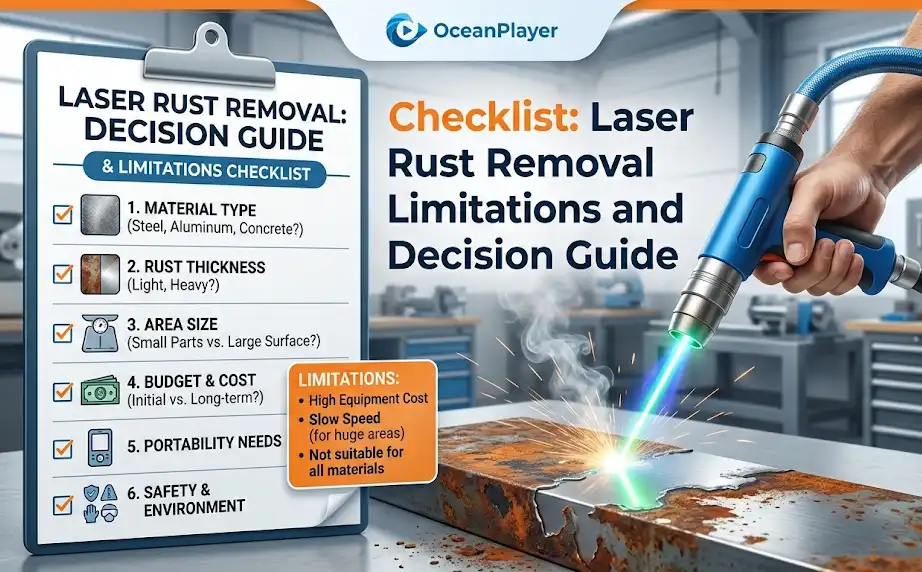
If you’re weighing laser rust removal for production or MRO work, you’re likely balancing safety, throughput, and total cost rather than chasing a single “best” method. Class 4 hazards, enclosure and ventilation needs, and uncertain area rates can turn a promising demo into an expensive, slow cell. This guide gives you a decision-first checklist—where laser cleaning is the wrong tool, what controls make it viable, and how to model the economics realistically.
Right after the quick read, you’ll find a deeper checklist, a compact TCO worksheet, and a site-readiness SOP set. Where standards matter, we cite them directly so your team can align with a Laser Safety Officer (LSO) and facilities.
Key takeaways
- Laser cleaning is typically a Class 4 operation unless fully enclosed to Class 1; plan for a Laser Controlled Area, interlocks, eyewear, and an LSO program. See OSHA’s overview of laser hazards and ANSI-aligned manuals for specifics in 2024–2025.
- The biggest practical “laser rust removal limitations” are economic: CapEx jumps with power class; OpEx includes electricity, optics/windows, filter media and disposal, training, and safety administration.
- Throughput on thick, tenacious, or pitted rust drops sharply; geometry remains line-of-sight. Always validate your own area rate on representative parts.
- Ventilation and filtration aren’t optional: design for source capture and verify capture velocity with smoke/tracer tests per LEV best practices.
- Surface profile after laser cleaning may be smoother than abrasive methods; if your coating spec needs a certain anchor profile, plan extra prep or pick another process.
- Walk away when you can’t meet enclosure/LEV requirements, the area is very large with deep pitting, or the schedule/budget can’t support validation and controls.
Quick decision checklist
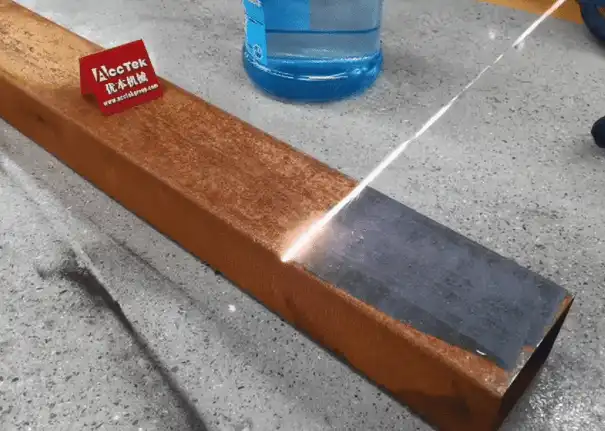
Below is a one-page view to triage projects before you sink time into procurement. Use it with your LSO and facilities.
| Decision band | Signals & thresholds to check |
|---|---|
| No-Go | • You cannot implement a Class 4–appropriate controlled area or Class 1 enclosure with interlocks and verified eyewear; signage/interlock program is not feasible. • You can’t achieve or commission effective local exhaust ventilation (LEV) with measurable capture at the source and space for filter housing and maintenance. • Geometry is non–line-of-sight (deep cavities, complex internals) or highly reflective curved surfaces in an uncontrolled environment. • Coating spec mandates a rough anchor profile that laser cleaning won’t deliver in time/budget. |
| Proceed with Caution | • Rust is thick/tenacious or pitted; mandate an on-part validation (e.g., 0.25 m² coupon) to measure area rate. • Need multi-pass parameter matrix; thermal monitoring to avoid heat-affected changes. • Reflection controls (beam dumps/baffles) and spare protective windows are planned. • Waste characterization plan (e.g., TCLP for chromium-bearing dust) is in scope. |
| Viable with Controls | • Small-to-moderate areas with light-to-moderate rust, clear line-of-sight, and fixturing access. • Class 1 enclosure or rigorously managed Laser Controlled Area with SOPs, trained users, eyewear, and documented checks. • LEV commissioned (capture verified) and filter maintenance logged. • Quality verified visually and, where critical, via profilometry/adhesion pull tests. |
Context for the safety and ventilation statements above comes from ANSI-aligned manuals and OSHA’s laser hazards index, and LEV commissioning guidance such as HSE HSG258.
Deep checklist: where laser rust removal is the wrong tool
Critical No-Go cases
- You cannot create a Laser Controlled Area or a Class 1 enclosure with interlocks, eyewear with correct OD/wavelength labeling, warning beacons/signage, and LSO oversight. See OSHA’s summary page and ANSI-aligned institutional manuals (2024–2025) for what that entails.
- You cannot provide effective LEV: no way to place hoods/hoses close to the ablation zone, no accommodation for HEPA (+ optional carbon) filtration, or no plan to verify capture via smoke/tracer and airflow measurements.
- The part geometry blocks line-of-sight or safe focal access; polished/curved surfaces in open areas create uncontrolled reflection risks.
- The downstream coating requires a specific anchor profile you can’t meet with laser alone, and time/budget won’t support secondary surface prep.
- Project scale: very large areas with deep pitting where scan width and multi-pass needs make cycle times noncompetitive for your deadline.
Proceed with Caution — controls you must budget and prove
- Run a validation test on a representative coupon (e.g., 0.25 m²): document parameters (power, frequency, fluence, scan speed, overlap), number of passes, and total time. Extrapolate, then derate by 20–40% for edges/fixturing/part handling.
- Commission LEV: target capture at the source; for low-momentum plumes, typical commissioning targets cluster around 0.5–1.0 m/s at the hood face and may need up to ~2 m/s for higher-momentum plumes; verify with smoke and anemometer readings logged to a worksheet.
- Stock protective windows/lenses and define an optics cleaning cadence. Record differential pressure across filters and set change triggers per OEM indicators.
- Plan waste handling: sample collected particulate and filters; when chromium is plausible, use EPA SW‑846 TCLP to determine hazardous status before disposal.
- Implement reflection controls (beam dumps/baffles) inside enclosures; map Nominal Hazard Zone (NHZ) and post boundaries per your LSO.
Viable with Controls — confirmations before greenlighting
- Operators trained and authorized; eyewear with correct OD/wavelength checked; SOPs approved by the LSO. Interlocks and emergency stops tested per shift.
- Enclosure achieves Class 1 at the operator position or Laser Controlled Area controls are enforced; warning lights/signage active.
- LEV capture verified on start-up; filter maintenance log in place; room make-up air/HVAC impact assessed.
- Quality acceptance defined: visual standard, optional profilometry/adhesion test where coating performance is critical.
Cost structure deep dive (laser cleaning TCO)
Laser’s headline attraction is low consumables, but the full cost picture includes power class–driven CapEx, ventilation/enclosure, and an ongoing safety program. Use the structure below to scope your RFQ and TCO.
- CapEx tiers and typical add-ons
- Entry/handheld (~50–200 W): laser and scanner head, eyewear, basic extraction. Some applications remain Class 4 without an enclosure.
- Portable/mid (~200–500 W): adds more robust extraction and often a chiller at the upper end; enclosure or guarded cell strongly advised.
- Industrial cell (≥500 W): water chiller, Class 1 enclosure with interlocks, beam dumps/baffles, LEV with HEPA (+ optional carbon), controls, signage, and integration engineering. Many vendors publish “call for quote” for these systems.
- OpEx drivers
- Electricity: pair duty cycle hours with fiber-laser wall-plug efficiency bounds (>40–50%) and include chiller and extractor motors.
- Optics/consumables: protective windows and scanner optics; cleaning supplies; periodic alignment/calibration.
- Filtration: prefilter + HEPA (+ optional carbon) changeouts; track differential pressure and set maintenance intervals.
- Safety program: LSO time, training refreshers, eyewear inventories/cert checks, interlock verification, signage upkeep.
- Waste: sampling/characterization (e.g., TCLP), disposal fees when hazardous.
- Facility add-ons
- Electrical capacity for laser + chiller + extractor; heat rejection and make-up air for negative-pressure enclosures; floor space for the cell and filter housings; lockout/interlock wiring.
Compact TCO worksheet (example scaffold)
| Line item | Data you need | How to estimate |
|---|---|---|
| CapEx amortization | Purchase price by power class + enclosure/LEV | Straight-line over 5–7 years; sensitivity at 1,000–3,000 hrs/yr |
| Energy | kW draw × hours | Laser input kW = optical power / efficiency; add chiller/extractor kW |
| Filters & optics | OEM SKUs + change intervals | Use DP logs and OEM indicators; price via RFQ |
| Safety & training | LSO/admin hours + courses/yr | Budget internal time + any external training |
| Waste & compliance | Sampling + disposal | TCLP + disposal vendor quotes; include documentation effort |
ROI sensitivity notes: Utilization dominates. Low hours/week rarely justify CapEx unless the process unlocks critical quality/safety wins elsewhere.
Safety, ventilation, and waste: the non-negotiables
- Class and controls: Unless fully enclosed to Class 1, treat as Class 4 with an LSO, SOPs, eyewear matched to wavelength/OD, interlocks, warning lights/signage, and NHZ evaluation. See the OSHA page that consolidates laser hazard standards and ANSI-aligned institutional manuals in 2024–2025.
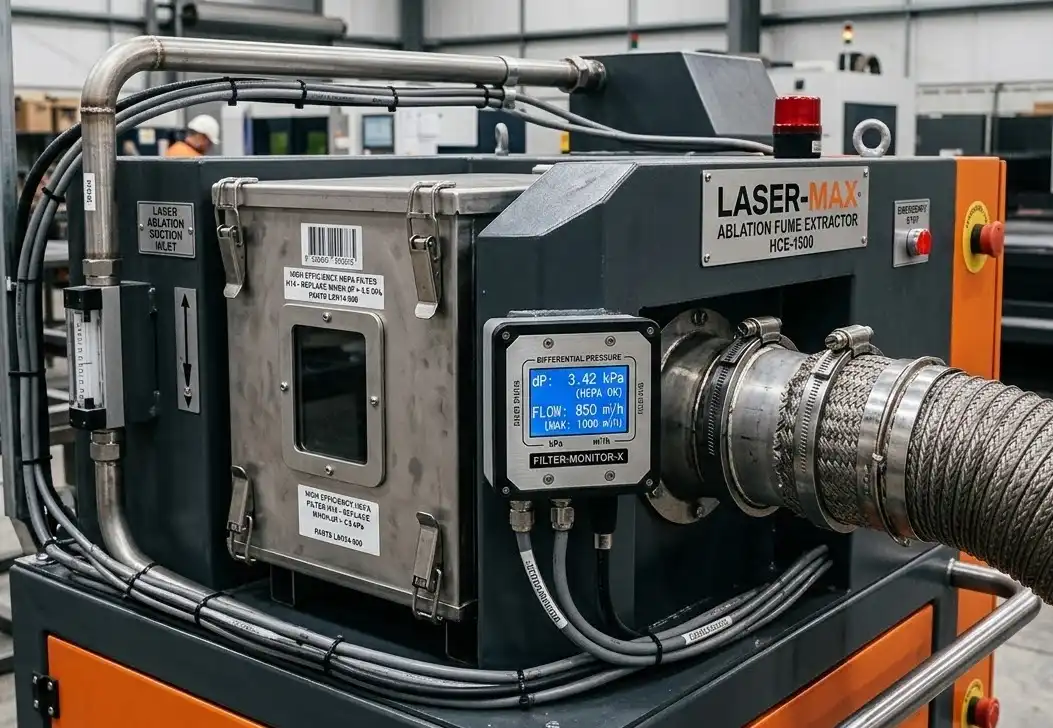
- Ventilation: Design for source capture and commission it. Practical commissioning targets for similar thermal plumes cluster around 0.5–1.0 m/s at the hood face, rising toward ~2 m/s where plume momentum is higher. Verify using smoke/tracer tests and airflow measurements; document results per LEV best practices.
- Filtration and maintenance: Typical trains use prefilter → HEPA (e.g., rated 99.995% at 0.3 μm) → optional gas phase when organics are present. Replace combined filters at least annually and others by condition indicators; maintain logs.
- Waste: Collected dust can contain metals. Determine hazardous status via the EPA’s SW‑846 framework; when chromium is possible, run TCLP (Method 1311) and document the generator determination before disposal.
Authoritative anchors for the bullets above include OSHA’s laser hazards index; ANSI-aligned university manuals; HSE HSG258 for LEV; and the EPA’s SW‑846/TCLP.
Throughput and laser rust removal limitations: technical constraints
Public, apples-to-apples area rates are rare because removal depends on oxide thickness/tenacity, overlap, and scan width. That’s one of the practical laser rust removal limitations. Instead of trusting brochure numbers, run an in-house protocol:
- Define a representative coupon (e.g., 0.25 m²) and acceptance criteria for cleanliness.
- Record parameters (power, frequency, fluence, scan speed, overlap) and number of passes; time the operation.
- Compute area rate (m²/hr) and derate by 20–40% for edges, fixtures, repositioning, and QA.
- Inspect for heat-affected color/temper changes and surface roughness. If your spec requires a profile, plan additional prep.
Geometry and access remain limiting: the beam is line-of-sight; tight cavities and complex internals are poor candidates without special fixturing. When you need a quick sanity check, remember that published “laser rust removal throughput” figures are context-specific—treat them as hypotheses to test.
Site readiness and pre-start SOPs
Here’s a concise “laser cleaning ventilation checklist” plus safety items you can copy into your SOP. Adapt with your LSO.
- Before procurement: confirm electrical capacity (laser + chiller + extractor), space for enclosure and filters, make-up air needs, and noise/light spill compatibility with neighbor processes.
- Enclosure & controls: choose Class 1 where feasible; otherwise, designate a Laser Controlled Area with interlocks, barriers, warning lights/signage, eyewear OD/wavelength labeling, and NHZ mapping.
- Ventilation: select source capture; design hoods/nozzles as close as practicable; plan for HEPA (+ optional carbon) and accessible filter change-out; commission with smoke and anemometer; log differential pressure.
- Pre-start each shift: test interlocks and emergency stops; verify warning beacons; check extractor airflow and filter DP; inspect protective window; confirm authorized operators and eyewear condition; stage spill/incident response.
- Documentation: maintain SOPs, training records, commissioning/maintenance logs, and waste determinations (e.g., TCLP results) with disposal manifests.
Decision flow and next steps
- Run the quick checklist. If any No-Go applies, don’t force it—choose another process or plan additional prep. This protects you from the most common laser rust removal limitations that derail projects late.
- If “Proceed with Caution,” schedule a pilot on representative parts: measure throughput, commission LEV, and complete a safety/waste plan. Update your TCO worksheet with real measurements.
- If “Viable with Controls,” greenlight with a Class 1 enclosure or rigorously managed Laser Controlled Area, a documented maintenance plan for filters/optics, and a QA protocol.
Further reading and evidence
- According to OSHA’s consolidated index, see Laser Hazards Standards and guidance: OSHA laser hazards standards index
- University manual aligned to ANSI Z136.1-2022: FIU Laser Safety Manual (2025)
- LEV design and commissioning: HSE HSG258 Local exhaust ventilation (3rd ed.)
- Hazardous waste determination and TCLP: EPA SW‑846 hazardous waste characteristics and TCLP
- Background reading on disadvantages: Cold Jet on disadvantages of laser cleaning (2025)
- Background overview of cleaning/texturing: The Fabricator overview article